2015 TATA SAFARI check oil
[x] Cancel search: check oilPage 112 of 161

112
Checking Oil Level in Front/Rear Axle Checking Oil Level in Front/Rear AxleChecking Oil Level in Front/Rear Axle Checking Oil Level in Front/Rear Axle
Checking Oil Level in Front/Rear Axle
1 . Clean the oil level plug and surrounding area.
2. Remove the oil level plug and check whether oil is dripping
out. Oil level must be below the required level. Add oil to bring
it to the level, when it starts dripping out.
3 . Tighten oil level plug to 2 to 3 mkg. torque.
Changing Oil in Front Axle/Rear Axle Changing Oil in Front Axle/Rear AxleChanging Oil in Front Axle/Rear Axle Changing Oil in Front Axle/Rear Axle
Changing Oil in Front Axle/Rear Axle
1 . Clean the oil level plug, drain plug and surrounding area.
2 . Place a container under Front/Rear axle to collect the oil.
3 . Remove the drain plug and let the oil drain out.
4 . Also remove the oil level plug.
5 . Tighten the oil drain plug and fill new recommended oil through
oil level plug till it begin to drip.
6 . Tighten oil drain and oil level plugs to 2 to 3 mkg. torque.
FRONT AXLE AND REAR AXLE OIL FRONT AXLE AND REAR AXLE OILFRONT AXLE AND REAR AXLE OIL FRONT AXLE AND REAR AXLE OIL
FRONT AXLE AND REAR AXLE OIL
1. Front Axle Oil Filler Plug / Level Plug
2. Front Axle Oil Drain Plug
1
2
M A I N T E N A N C E
ProCarManuals.com
Page 116 of 161

116
POWER STEERING POWER STEERINGPOWER STEERING POWER STEERING
POWER STEERING
Procedure for Oil Filling and Bleeding of Power Procedure for Oil Filling and Bleeding of PowerProcedure for Oil Filling and Bleeding of Power Procedure for Oil Filling and Bleeding of Power
Procedure for Oil Filling and Bleeding of Power
Steering SteeringSteering Steering
Steering (Ensure that Power Steering fluid reservoir is totally
clean before starting the work)
1 . Fill the reservoir nearly full. Crank the engine for 10
seconds without allowing it to start (if possible). If engine
does start, shut the engine immediately. Check & refill
the reservoir repeat atleast three times, each time
checking & refilling the reservoir.
2 . Check for leakage in the system and if noticed take
corrective action.
3 . Start the engine and steer the vehicle from full left to full
right turns 3-4 times.
4 . Add fluid if necessary to maintain the level upto filter top.
NOTICE NOTICENOTICE NOTICE
NOTICE
Do not force the wheel against lock position either
extreme left or right. The power steering pump may get
damaged. Hold it lightly.
5 . When the engine is at steady speed, check for bubble
or foaming in the oil. If present it indicates that air is
getting sucked into the systems. Check the suction
line/fittings and correct if necessary.
6 . Once the system is bled properly and free from foaming
there should not be any appreciable change in oil level
in the reservoir, when the engine is started or stopped
repeatedly.
7 . Now the system is ready for driving.
Final oil level should be at ‘H’ mark on dip stick.
NOTICE NOTICENOTICE NOTICE
NOTICE
* Do not allow fluid level to drop significantly or run out
of the reservoir during the above operation. This may
induce air to the system.
* Do not start the engine without oil in the power steering
system. This will result in serious damage to the
pump. In case of emergency disconnect the pump belt
and then start the engine.
* Always use recommended oil from closed containers.
Any dirty oil poured in the system will result in damage
to pump and gear box.
M A I N T E N A N C E
ProCarManuals.com
Page 125 of 161

125
R RR R
R
epair epairepair epair
epair
ing a ing a ing a ing a
ing a
T TT T
T
yr yryr yr
yr
e ee e
e
•Mark suitability the tyre position (if original colour dot mark is
not visible) with reference to valve stem hole to ensure that the
tyre is refitted in original location.
•Ensure that balancing weights are not disturbed during removal
of tyres.
•Check the balance weight prior to removal of tyre if found loose,
mark its location on rim & refit properly. Balance the wheel after
every dismantling and assembly of tyre on wheel rim.
•Tightening torque of wheel nut is 12-15 mkg.
•While fitting wheels on vehicle ensure that wheel bolts are free
from dust, scratches, dirt, dents, etc.
•Do not apply any oil on the wheel nut or bolt. Wipe off if present.
T TT T
T
YRES YRESYRES YRES
YRESM A I N T E N A N C E
ProCarManuals.com
Page 129 of 161

129
VEHICLE C VEHICLE CVEHICLE C VEHICLE C
VEHICLE C
ARE AREARE ARE
ARE
W WW W
W
A AA A
A
XING : XING :XING : XING :
XING :
Waxing and polishing is recommended to maintain the gloss
and wet-look appearance of your paint finish.
1. Use a good quality polish and wax for your vehicle.
2. Re-wax your vehicle when the water does not slip off the
surface and collects over the surface in patches.
Further tips for the care of your new vehicle finish : Further tips for the care of your new vehicle finish :Further tips for the care of your new vehicle finish : Further tips for the care of your new vehicle finish :
Further tips for the care of your new vehicle finish :
If your vehicle is washed in an automatic car wash, please
remember that the paint can be scratched by type of brushes,
unfiltered washing water or the washing process itself.
Scratching reduces paint durability and gloss, especially on
darker colours. It is suggested to wash the vehicle by hand with
cool and clean water using a soft cloth or sponge. Please do not
use soap but a car shampoo recommended by your dealer.
Please take the following precautions : Please take the following precautions :Please take the following precautions : Please take the following precautions :
Please take the following precautions :
1. Always wash your vehicle in shade, avoiding direct exposure
to sunlight during washing.
2. Dry wiping your vehicle may lead to the formation of
scratches and hence always use a soft cloth and clean water
while wiping your vehicle.
3. Always keep your vehicle parked in a well ventilated shade.
Exposure to heat with entrapped moisture promotes corrosion.4. Avoid driving on gravel roads, as the possibility of paint
chip off due to the impact of stones is high. If you are
driving on freshly tarred road, check immediately
afterwards for any stains & clean them.
5. External contamination in the form of sap or industrial
fall-out may mar or develop spots on a new finish. Hence
avoid parking your vehicle near trees, which are known
to drop sap, or near factories, which give out heavy smoke.
6. The acid content in bird droppings may damage the newly
painted finish and hence any bird dropping must be
immediately washed off.
7. The paint finish is susceptible to damage in case petrol,
brake fluid, liquid from car battery, oil, antifreeze,
transmission fluid or windshield solvent spills onto the
painted surface. In case of such a spillage immediately
rinse the affected area with water. Avoid wiping the area
far as possible, however if wiping is required, ensure that
you wipe the area gently with soft cotton cloth.
8. Avoid using sharp objects to scrap off tar or mud from a
painted surface as it may develop scratches or may peel
off the paint.
M A I N T E N A N C E
ProCarManuals.com
Page 133 of 161

133
TURBO CHARGER (IF FITTED) TURBO CHARGER (IF FITTED)TURBO CHARGER (IF FITTED) TURBO CHARGER (IF FITTED)
TURBO CHARGER (IF FITTED)
V VV V
V
ar arar ar
ar
iable iable iable iable
iable
T TT T
T
urbine urbine urbine urbine
urbine
T TT T
T
echnolo echnoloechnolo echnolo
echnolo
g gg g
g
y- y- y- y-
y-
VT VTVT VT
VT
T T T T
T
T TT T
T
urb urburb urb
urb
o oo o
o
char charchar char
char
ger : ger :ger : ger :
ger :
Your vehicle is fitted with a turbocharger having variable
turbine technology ( VTT ). Turbocharger is an efficient
supercharging device used in our engine. It makes optimal
use of thermal energy of engine exhaust gases to run a
turbine which in turn drives a compressor to force air under
pressure into the inlet manifold. This turbocharger is
optimized for higher power output flat torque across large
engine speed range and better fuel consumption.
L LL L
L
ubr ubrubr ubr
ubr
ic icic
ic
ic
a aa a
a
tion of tion of tion of tion of
tion of
T TT T
T
urb urburb urb
urb
o oo o
o
char charchar char
char
ger : ger :ger : ger :
ger :
The turbocharger rotor assembly is supported by two fully
floating bearing bushes in the bearing housing. These
bearing bushes are lubricated with finely filtered engine
oil from the lubrication system of the engine.
Idle the engine for a while (30 seconds) after starting the
engine and before stopping the engine to ensure adequate
lubricating oil supply to the turbocharger.
T TT T
T
urb urburb urb
urb
o oo o
o
char charchar char
char
ger C ger Cger C ger C
ger C
onnec onneconnec onnec
onnec
tions : tions :tions : tions :
tions :
All turbocharger connections must be leak-proof. Check air
inlet, air outlet, exhaust gas inlet and exhaust outlet
connections as well as oil inlet and outlet connections to
the turbocharger and tighten the connections where
required.Proper maintenance of air filter, oil filter as well as use of
correct grade of oil and adherence to oil change intervals is
essential for proper functioning of the turbocharger.
If you suspect any malfunctioning of the turbocharger, take
the vehicle to the nearest dealer. Do not remove the
turbocharger yourself.
M A I N T E N A N C E
Turbocharger ( VTT )
ProCarManuals.com
Page 134 of 161
134
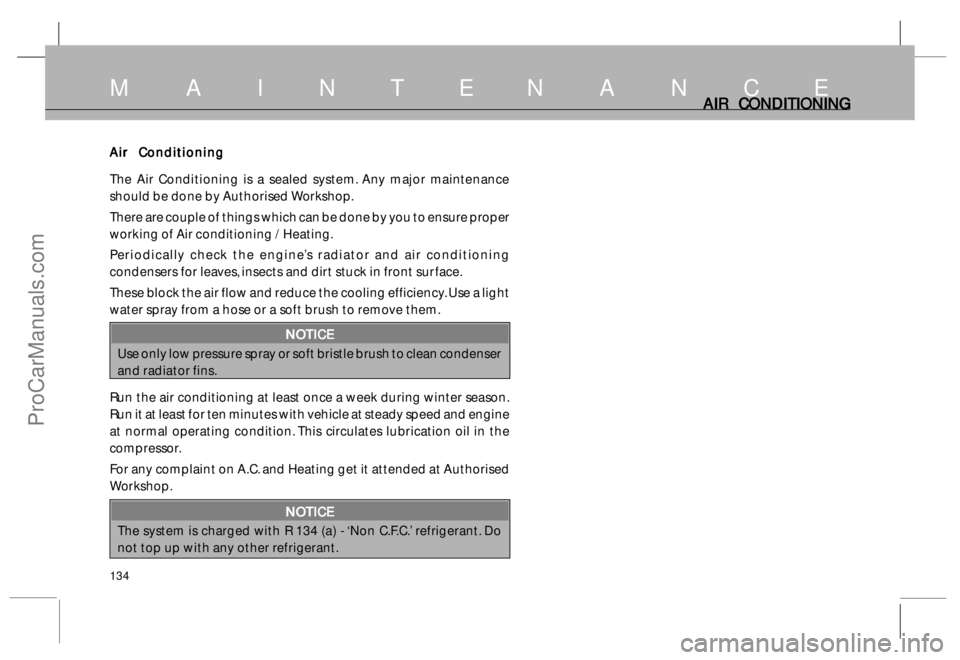
AIR CONDITIONING AIR CONDITIONING AIR CONDITIONING AIR CONDITIONING
AIR CONDITIONING
Air Conditioning Air ConditioningAir Conditioning Air Conditioning
Air Conditioning
The Air Conditioning is a sealed system. Any major maintenance
should be done by Authorised Workshop.
There are couple of things which can be done by you to ensure proper
working of Air conditioning / Heating.
Periodically check the engine’s radiator and air conditioning
condensers for leaves, insects and dirt stuck in front surface.
These block the air flow and reduce the cooling efficiency. Use a light
water spray from a hose or a soft brush to remove them.
NO NONO NO
NO
TICE TICETICE TICE
TICE
Use only low pressure spray or soft bristle brush to clean condenser
and radiator fins.
Run the air conditioning at least once a week during winter season.
Run it at least for ten minutes with vehicle at steady speed and engine
at normal operating condition. This circulates lubrication oil in the
compressor.
For any complaint on A.C. and Heating get it attended at Authorised
Workshop.
NO NONO NO
NO
TICE TICETICE TICE
TICE
The system is charged with R 134 (a) - ‘Non C.F.C.’ refrigerant. Do
not top up with any other refrigerant.
M A I N T E N A N C E
ProCarManuals.com
Page 136 of 161

136
( These tips are given for your guidance and preliminary jobs to be done in an emergency situation. In normal case, the problems
should be attended in an Authorised Workshop by following the repair procedures given in Workshop Manual)
SR. NO. SR. NO.SR. NO. SR. NO.
SR. NO.
PROBLEM OBSERVED PROBLEM OBSERVEDPROBLEM OBSERVED PROBLEM OBSERVED
PROBLEM OBSERVED
CAUSE CAUSECAUSE CAUSE
CAUSE
A AA A
A
CTION CTION CTION CTION
CTION
T TT T
T
O BE O BE O BE O BE
O BE
T TT T
T
AKEN AKENAKEN AKEN
AKEN
ENGINE ENGINEENGINE ENGINE
ENGINE
1 . Engine not cranking Dead battery loose or dirty
•Get battery checked&/or changed
battery connections
•Clean and tighten battery
connections
2 . Engine cranks but does not start Air in the fuel system
•Press pear pump for air removal
•Check leakages
Service lamp should glow
•Get defect rectified
EMS fuse blown
•Replace the fuse
3. Engine overheatsCoolant level low
•Top up coolant, check and
correct leakages
Hose collapse / torn
•Get the hose replaced
Low engine oil level
•Add oil
Radiator cap not sealing properly
•Fit the radiator cap correctly
A.C. condensers fans not working
•Get defect rectified
Brakes binding
•Get defect rectified
Electric fan not working
•Get defect rectified
High delivery pressure in A.C.
•Get defect rectified
refrigerant circuit
4 . Charging indicator continuouslyBattery not getting charged
•Get the belt tension adjusted
remains ‘ON’due to loose belt drive Replace if broken
PRELIMINARY TROUBLE SHOOTING
ProCarManuals.com
Page 138 of 161
138
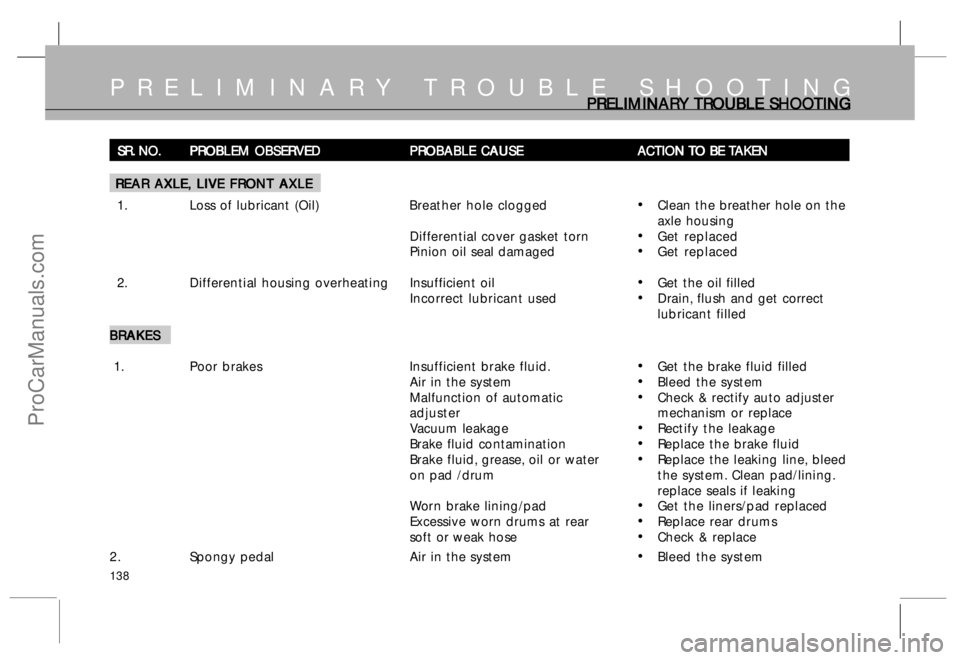
PRELIMINAR PRELIMINARPRELIMINAR PRELIMINAR
PRELIMINAR
Y Y Y Y
Y
TR TRTR TR
TR
OUBLE SHOO OUBLE SHOOOUBLE SHOO OUBLE SHOO
OUBLE SHOO
TING TINGTING TING
TING
SR. NO. SR. NO.SR. NO. SR. NO.
SR. NO.
PROBLEM OBSERVED PROBLEM OBSERVEDPROBLEM OBSERVED PROBLEM OBSERVED
PROBLEM OBSERVED
PROBABLE CAUSE PROBABLE CAUSEPROBABLE CAUSE PROBABLE CAUSE
PROBABLE CAUSE
A AA A
A
CTION CTION CTION CTION
CTION
T TT T
T
O BE O BE O BE O BE
O BE
T TT T
T
AKEN AKENAKEN AKEN
AKEN
REAR AXLE, LIVE FRONT AXLE REAR AXLE, LIVE FRONT AXLEREAR AXLE, LIVE FRONT AXLE REAR AXLE, LIVE FRONT AXLE
REAR AXLE, LIVE FRONT AXLE
1. Loss of lubricant (Oil) Breather hole clogged
•Clean the breather hole on the
axle housing
Differential cover gasket torn
•Get replaced
Pinion oil seal damaged
•Get replaced
2. Differential housing overheatingInsufficient oil
•Get the oil filled
Incorrect lubricant used
•Drain, flush and get correct
lubricant filled
BRAKES BRAKESBRAKES BRAKES
BRAKES
1. Poor brakes Insufficient brake fluid.
•Get the brake fluid filled
Air in the system
•Bleed the system
Malfunction of automatic
•Check & rectify auto adjuster
adjustermechanism or replace
Vacuum leakage
•Rectify the leakage
Brake fluid contamination
•Replace the brake fluid
Brake fluid, grease, oil or water
•Replace the leaking line, bleed
on pad /drum the system. Clean pad/lining.
replace seals if leaking
Worn brake lining/pad
•Get the liners/pad replaced
Excessive worn drums at rear
•Replace rear drums
soft or weak hose
•Check & replace
2. Spongy pedalAir in the system
•Bleed the system
PRELIMINARY TROUBLE SHOOTING
ProCarManuals.com