Page 300 of 492
300
4-3. Do-it-yourself maintenance
■Adding engine oilIf the oil level is below or near
the low level mark, add engine
oil of the same type as already in
the engine.
Make sure to check the oil type and prepare the items needed before
adding oil.
Remove the oil filler cap by turning it counterclockwise.
Add engine oil slowly, checking the dipstick.
Install the oil filler cap by turning it clockwise.
Engine oil selection →
P. 420
Oil quantity
(Low → Full) 1.1 qt. (1.0 L, 0.9 Imp. qt.)
Items
Clean funnel
■Engine oil consumption
Some engine oil will be consumed while driving. Under the following condi-
tions, oil consumption can be increased and thus require refilling between
maintenance intervals:
●When the engine is new and within the break-in period
●When the engine oil is of lower quality
●When the incorrect oil viscosity is used
●When engine braking is employed
STEP 1
STEP 2
STEP 3
Page 301 of 492

301
4-3. Do-it-yourself maintenance
4
Maintenance and care
●When the engine is operated at high engine speeds
●When the engine is operated under heavy loads
●When towing a trailer
●When the engine idles for long periods of time
●When the vehicle is operated in stop and go and/or heavy traffic situa- tions
●When the vehicle is used under severe thermal conditions
●When the vehicle accelerates and decelerates frequently
Under these or similar conditions, you should check your oil at least every
2nd fuel fill-up and change your engine oil more frequently. If your oil con-
sumption rate is greater than 1 quart ev ery 1,200 miles or 1 liter every 2,000
kilometers, contact your SUBARU dealer who may perform a test under con-
trolled conditions.
WARNING
■Used engine oil
●Used engine oil contains potentially harmful contaminants which may
cause skin disorders such as inflammation or skin cancer, so care should
be taken to avoid prolonged and repeated contact. To remove used engine
oil from your skin, wash thoroughly with soap and water.
●Dispose of used oil and filters only in a safe and acceptable manner. Do
not dispose of used oil and filters in household trash, in sewers or onto the
ground.
Call your SUBARU dealer, service station or auto parts store for informa-
tion concerning recycling or disposal.
●Do not leave used engine oil within the reach of children.
Page 302 of 492
302
4-3. Do-it-yourself maintenance
Engine coolantThe coolant level is satisfactory if it is between the “FULL” and “LOW”
lines on the reservoir when the engine is cold. Reservoir cap
“FULL”
“LOW”
If the level is on or below the
“LOW” line, add coolant up to the
“FULL” line.
CAUTION
■To prevent serious engine damage
Check the oil level on a regular basis.
■When replacing the engine oil
●Be careful not to spill engine oil on the vehicle components.
●Avoid overfilling, or the engine could be damaged.
●Check the oil level on the dipstick every time you fill the oil.
●Be sure the engine oil filler cap is properly tightened.
■If the coolant level drops within a short time after replenishing
Visually check the radiator, hoses, engine coolant filler cap, radiator cap,
drain cock and water pump.
If you cannot find a leak, have your SUBARU dealer pressure test the cap
and check for leaks in the cooling system.
Page 304 of 492
304
4-3. Do-it-yourself maintenance
Radiator and condenserCheck the radiator and condenser and clear any foreign objects.
If either of the above parts are extremely dirty or you are not sure of
their condition, have your vehicle checked by your SUBARU dealer.
Brake fluid
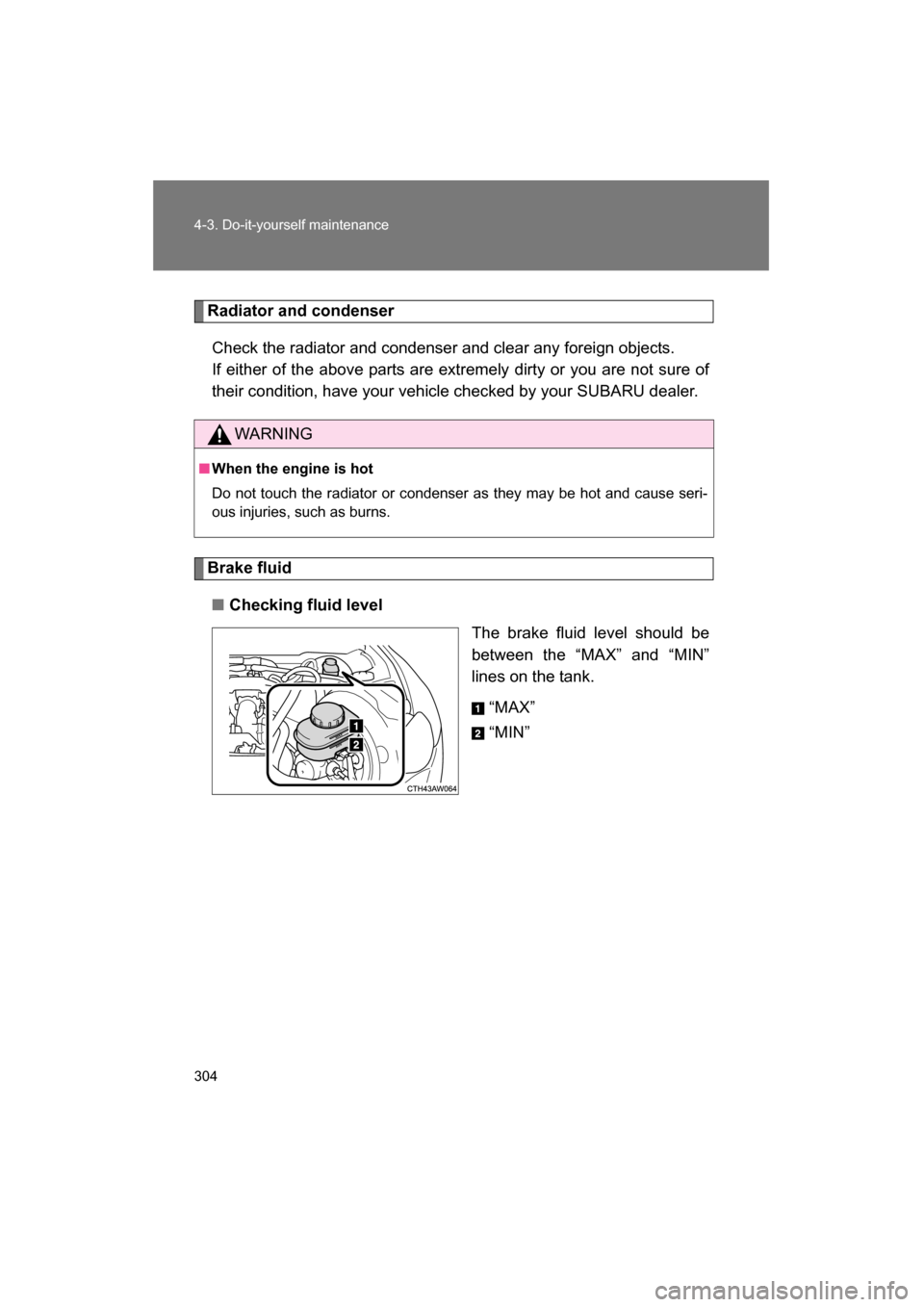
■Checking fluid level The brake fluid level should be
between the “MAX” and “MIN”
lines on the tank.
“MAX”
“MIN”
WARNING
■When the engine is hot
Do not touch the radiator or condenser as they may be hot and cause seri-
ous injuries, such as burns.
Page 310 of 492
310
4-3. Do-it-yourself maintenance
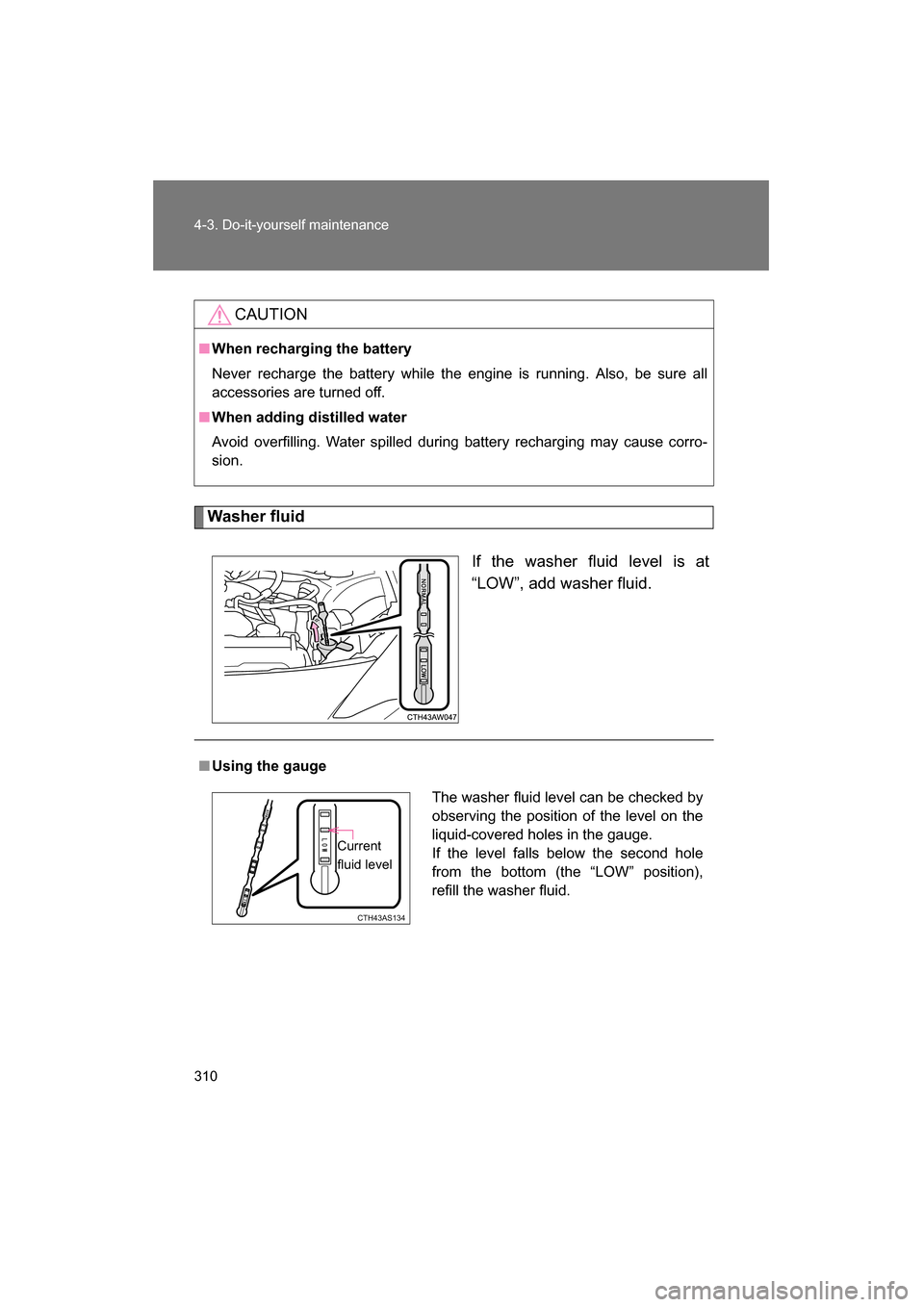
Washer fluidIf the washer fluid level is at
“LOW”, add washer fluid.
CAUTION
■When recharging the battery
Never recharge the battery while the engine is running. Also, be sure all
accessories are turned off.
■When adding distilled water
Avoid overfilling. Water spilled during battery recharging may cause corro-
sion.
■Using the gaugeThe washer fluid level can be checked by
observing the position of the level on the
liquid-covered holes in the gauge.
If the level falls below the second hole
from the bottom (the “LOW” position),
refill the washer fluid.
CTH43AS134
Current
fluid level
Page 335 of 492
335
4-3. Do-it-yourself maintenance
4
Maintenance and care
Checking and replacing fuses
If any of the electrical components do not operate, a fuse may have
blown. If this happens, check and replace the fuses as necessary.Vehicles without a keyless access with push button
start system
Turn the engine switch off.
Vehicles with a keyless access with push button start
system
Turn the push-button ignition switch off.
Open the fuse box cover.
Engine compartment Push the tabs in and lift the lid
off.
Instrument panel Remove the lid.
STEP 1
STEP 2
Page 377 of 492

5
When trouble arises
377
5-2. Steps to take in an emergency
■If the tire pressure warning light frequently comes on after blinking
for approximately one minute (if equipped)
If the tire pressure warning light frequently comes on after blinking for
approximately one minute when the push-button ignition switch is turned
to “ON” mode (vehicles with a keyless access with push button start sys-
tem) or the engine switch is turned to the “ON” position (vehicles without
a keyless access with push button start system), have it checked your
SUBARU dealer.
WARNING
■If the tire pressure warning light comes on (if equipped)
Be sure to observe the following precautions. Failure to do so could
cause loss of vehicle control and result in death or serious injury.
●Stop your vehicle in a safe place as soon as possible. Adjust the tire
inflation pressure immediately.
●If the tire pressure warning light comes on even after tire inflation pres-
sure adjustment, it is probable that you have a flat tire. Check the tires.
If the tire is flat, change to the spare tire and have the flat tire repaired
by the nearest SUBARU dealer.
●Avoid abrupt maneuvering and braking. If the vehicle tires deteriorate,
you could lose control of the steering wheel or the brakes.
■If a blowout or sudden air leakage should occur (vehicles with a tire
pressure monitoring system)
The tire pressure monitoring system may not activate immediately.
Page 391 of 492
5
When trouble arises
391
5-2. Steps to take in an emergency
WARNING
■Using the tire jack
Improper use of the tire jack may lead to death or serious injuries due to
the vehicle suddenly falling off the jack.
●Do not use the tire jack for any purpose other than replacing tires or
installing and removing tire chains.
●Only use the tire jack that comes with this vehicle for replacing a flat
tire.
Do not use it on other vehicles, and do not use other tire jacks for
replacing tires on this vehicle.
●Always check that the tire jack is securely set to the jack point.
●Do not put any part of your body under the vehicle supported by a jack.
●Do not start or run the engine while your vehicle is supported by the
jack.
●Do not raise the vehicle while someone is in it.
●When raising the vehicle, do not put an object on or under the jack.
●Do not raise the vehicle to a height greater than that required to
replace the tire.
●Use a jack stand if it is necessary to get under the vehicle.
Take particular care when lowering the vehicle to ensure that no one
working on or near the vehicle may be injured.