Page 298 of 492
298
4-3. Do-it-yourself maintenance
Engine compartment
Battery (→P. 306)
Engine oil level dipstick (→ P. 299)
Brake fluid reservoir (→ P. 304)
Engine oil filler cap (→ P. 300)Washer fluid tank
(→ P. 310)
Electric cooling fans
Condenser ( →P. 304)
Radiator ( →P. 304)
Engine coolant reservoir (→ P. 302)
Fuse box ( →P. 335)
Page 299 of 492
299
4-3. Do-it-yourself maintenance
4
Maintenance and care
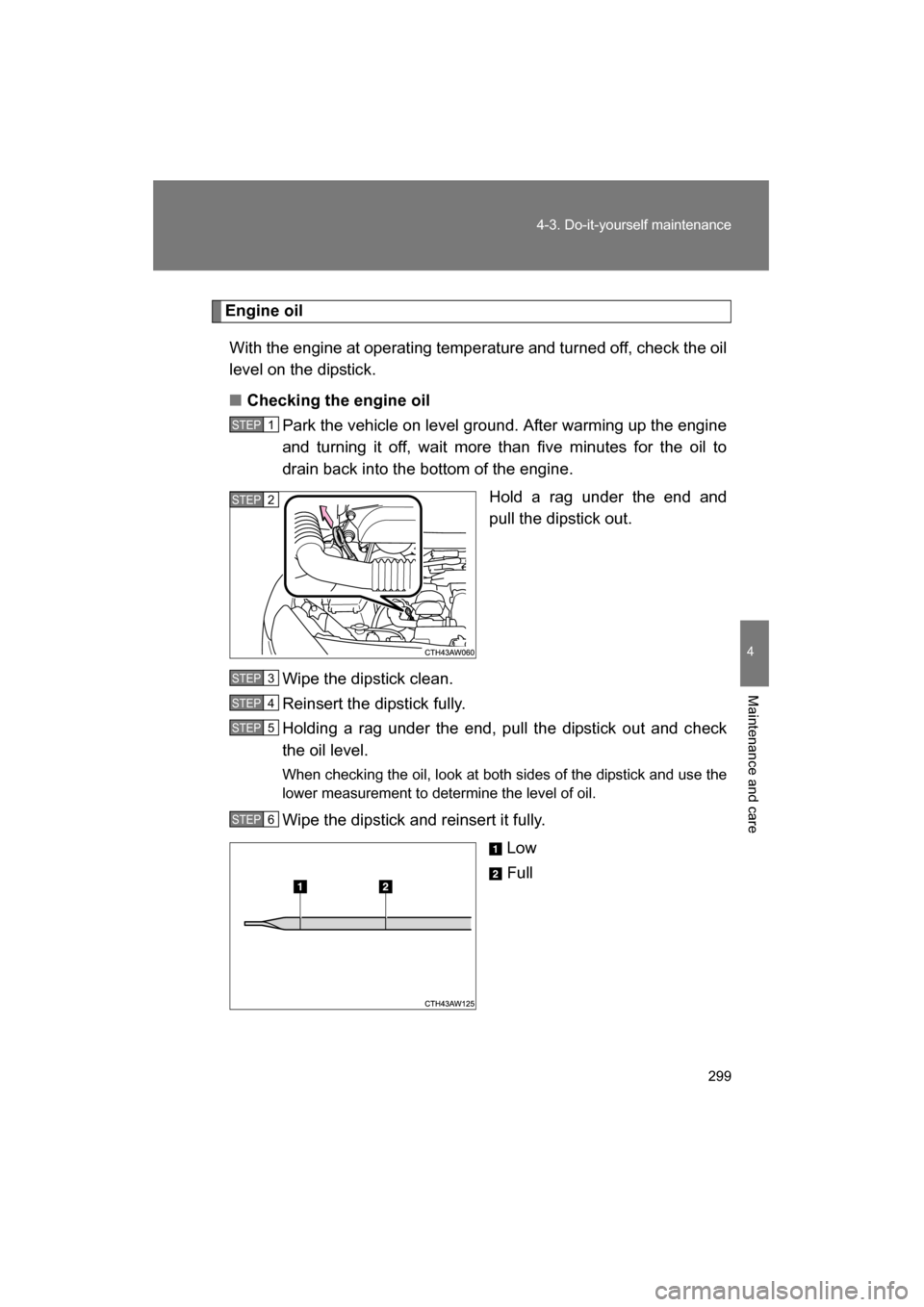
Engine oilWith the engine at operating temperature and turned off, check the oil
level on the dipstick.
■Checking the engine oil Park the vehicle on level ground. After warming up the engine
and turning it off, wait more than five minutes for the oil to
drain back into the bottom of the engine.
Hold a rag under the end and
pull the dipstick out.
Wipe the dipstick clean.
Reinsert the dipstick fully.
Holding a rag under the end, pull the dipstick out and check
the oil level.
When checking the oil, look at both sides of the dipstick and use the
lower measurement to determine the level of oil.
Wipe the dipstick and reinsert it fully.
Low
Full
STEP 1
STEP 2
STEP 3
STEP 4
STEP 5
STEP 6
Page 300 of 492
300
4-3. Do-it-yourself maintenance
■Adding engine oilIf the oil level is below or near
the low level mark, add engine
oil of the same type as already in
the engine.
Make sure to check the oil type and prepare the items needed before
adding oil.
Remove the oil filler cap by turning it counterclockwise.
Add engine oil slowly, checking the dipstick.
Install the oil filler cap by turning it clockwise.
Engine oil selection →
P. 420
Oil quantity
(Low → Full) 1.1 qt. (1.0 L, 0.9 Imp. qt.)
Items
Clean funnel
■Engine oil consumption
Some engine oil will be consumed while driving. Under the following condi-
tions, oil consumption can be increased and thus require refilling between
maintenance intervals:
●When the engine is new and within the break-in period
●When the engine oil is of lower quality
●When the incorrect oil viscosity is used
●When engine braking is employed
STEP 1
STEP 2
STEP 3
Page 301 of 492

301
4-3. Do-it-yourself maintenance
4
Maintenance and care
●When the engine is operated at high engine speeds
●When the engine is operated under heavy loads
●When towing a trailer
●When the engine idles for long periods of time
●When the vehicle is operated in stop and go and/or heavy traffic situa- tions
●When the vehicle is used under severe thermal conditions
●When the vehicle accelerates and decelerates frequently
Under these or similar conditions, you should check your oil at least every
2nd fuel fill-up and change your engine oil more frequently. If your oil con-
sumption rate is greater than 1 quart ev ery 1,200 miles or 1 liter every 2,000
kilometers, contact your SUBARU dealer who may perform a test under con-
trolled conditions.
WARNING
■Used engine oil
●Used engine oil contains potentially harmful contaminants which may
cause skin disorders such as inflammation or skin cancer, so care should
be taken to avoid prolonged and repeated contact. To remove used engine
oil from your skin, wash thoroughly with soap and water.
●Dispose of used oil and filters only in a safe and acceptable manner. Do
not dispose of used oil and filters in household trash, in sewers or onto the
ground.
Call your SUBARU dealer, service station or auto parts store for informa-
tion concerning recycling or disposal.
●Do not leave used engine oil within the reach of children.
Page 302 of 492
302
4-3. Do-it-yourself maintenance
Engine coolantThe coolant level is satisfactory if it is between the “FULL” and “LOW”
lines on the reservoir when the engine is cold. Reservoir cap
“FULL”
“LOW”
If the level is on or below the
“LOW” line, add coolant up to the
“FULL” line.
CAUTION
■To prevent serious engine damage
Check the oil level on a regular basis.
■When replacing the engine oil
●Be careful not to spill engine oil on the vehicle components.
●Avoid overfilling, or the engine could be damaged.
●Check the oil level on the dipstick every time you fill the oil.
●Be sure the engine oil filler cap is properly tightened.
■If the coolant level drops within a short time after replenishing
Visually check the radiator, hoses, engine coolant filler cap, radiator cap,
drain cock and water pump.
If you cannot find a leak, have your SUBARU dealer pressure test the cap
and check for leaks in the cooling system.
Page 325 of 492

325
4-3. Do-it-yourself maintenance
4
Maintenance and care
■When replacing wheels (vehicles with a tire pressure monitoring
system)
The wheels of your SUBARU are equipped with tire pressure warning
valves and transmitters that allow the tire pressure monitoring system to
provide advanced warning in the event of a loss in tire inflation pressure.
Whenever wheels are replaced, the tire pressure warning valves and
transmitters must be installed. (→P. 313)
WARNING
■When replacing wheels
●Do not use wheels that are a different size from those recommended in
the Owner’s Manual, as this may result in loss of handling control.
●Never use an inner tube in a leaking wheel which is designed for a
tubeless tire. Doing so may result in an accident, causing death or seri-
ous injury.
■When installing the wheel nuts
●Never use oil or grease on the wheel bolts or wheel nuts.
Oil and grease may cause the wheel nuts to be excessively tightened,
leading to bolt or disc wheel damage. In addition, the oil or grease can
cause the wheel nuts to loosen and the wheel may fall off, causing an
accident and resulting in death or serious injury. Remove any oil or
grease from the wheel bolts or wheel nuts.
●Be sure to install the wheel nuts with
the tapered ends facing inward.
Installing the nuts with the tapered
ends facing outward can cause the
wheel to break and eventually cause
the wheel to come off while driving,
which could lead to an accident
resulting in death or serious injury.
Tapered portion
Page 356 of 492

356
4-3. Do-it-yourself maintenance
■When replacing light bulbs
SUBARU recommends that you use genuine SUBARU products designed
for this vehicle.
Because certain bulbs are connected to circuits designed to prevent over-
load, non-genuine parts or parts not designed for this vehicle may be unus-
able.
■Removing and installing the luggage trim cover and trunk lid panel cover clip
WARNING
■Replacing light bulbs
●Turn off the lights. Do not attempt to replace the bulb immediately after
turning off the lights.
The bulbs become very hot and may cause burns.
●Do not touch the glass portion of the light bulb with bare hands. When it is
unavoidable to hold the glass portion, use and hold with a clean dry cloth
to avoid getting moisture and oils on the bulb.
Also, if the bulb is scratched or dropped, it may blow out or crack.
●Fully install light bulbs and any parts used to secure them. Failure to do so
may result in heat damage, fire, or water entering the headlight unit. This
may damage the headlights or cause condensation to build up on the lens.
■When changing the back-up lights
Stop the engine and wait until the exhaust pipe has cooled sufficiently. The
lights are located near the exhaust pipe and touching a hot exhaust pipe can
cause burns.
Removing
Installing
Page 415 of 492
Vehicle specifications6
415
6-1. SpecificationsMaintenance data (fuel, oil level, etc.) ......... 416
Fuel information ............... 428
Tire information ................ 432
6-2. Customization Customizable features .......................... 445