2015 SKODA YETI ECU
[x] Cancel search: ECUPage 85 of 232

›Press the lever in direction of arrow 1
» Fig. 75 and fold back the seat back-
rest in the direction of arrow 2.›
Check for yourself that the seat backrest is engaged by pulling on it.
›
Remove the tongue of the lock from the safety position.
WARNING■ After folding back the seat, the seat belts must be ready for use.■The seat backrests must be securely engaged so that objects from the
boot cannot slip into the passenger compartment on sudden braking – risk
of injury!■
When folding the seat backrest always make sure that it has safely
locked into position, this is confirmed by the position and a visible marking
on the cover of the lever.
Transporting and practical equipment
Useful equipment
Introduction
This chapter contains information on the following subjects:
Car park ticket holder
84
Storage compartment on the dash panel
84
stowage compartments in the doors
85
Storage compartment in the front centre console
85
Cup holders
85
Cigarette lighter
86
Ashtray
87
12-Volt power outlet
88
Waste container
88
Multimedia holder
89
Storage compartment under the front arm rest
90
storage net in the front centre console
90
Glasses compartment
90
Storage compartment on the front passenger side
91
Storage compartment under the passenger seat
91
Clothes hook
92
Storage pockets on the front seats
92
Storage compartment in the rear centre console
92
Folding table on front seat backrest
93
folding table at the centre backrest
93
Removable through-loading bag
93
AUX, USB and MDI inputs
94
83Transporting and practical equipment
Page 86 of 232

WARNING■Do not place anything on the dash panel. These objects might slide or fall
down when driving (when accelerating, cornering or following a bad ma-
noeuvre) and may distract you from concentrating on the traffic – there is a
risk of an accident!■
When driving, ensure that no objects from the centre console or from oth-
er storage compartments can get into the driver's footwell. You would not
be able to brake, operate the clutch pedal or accelerate - danger of causing
an accident!
■
No objects should be placed in the storage compartments nor in the
drinks holders; the vehicle occupants could be endangered if there is sud-
den braking or the vehicle collides with something.
■
Ash, cigarettes, cigars and the like. may only be placed in the ashtray!
Car park ticket holder
Fig. 76
Parking ticket holder
Read and observe on page 84 first.
The parking ticket holder » Fig. 76 is designed e.g. for securing car park tickets.
WARNINGThe ticket should always be removed before starting off so that the driver's
vision is not impaired.Storage compartment on the dash panelFig. 77
Opening the storage compart-
ment
Read and observe on page 84 first.
Opening
›
Press the button » Fig. 77.
The cover folds in the arrow direction.
Closing
›
Fold back the storage compartment lid in the opposite direction to that of
the arrow » Fig. 77 until it clicks.
Certain models do not have a storage compartment lid.
WARNING■ The storage compartment is not a substitute for the ashtray and must al-
so not be used for such purposes – risk of fire!■
The storage compartment must always be closed when driving for safety
reasons.
■
Do not put any highly inflammable objects or objects which are sensitive
to heat (e.g. lighters, sprays, spectacles, etc.) in the storage compartment.
84Using the system
Page 92 of 232

Storage compartment under the front arm restFig. 89
Open storage compartment / open air supply
Read and observe
on page 84 first.
Opening the storage compartment
›
Lift the armrest in the direction of arrow
A
» Fig. 89 .
Closing storage compartment
›
Open the armrest to the stop, only then can it be folded downwards and
against the direction of the arrow
A
» Fig. 89 .
Open the air supply
›
Pull the handle in the direction of the arrow
B
» Fig. 89 .
Close air supply
›
Push the shutter against the arrow
B
to the stop » Fig. 89.
When the air inlet is opened, the air flows into the storage compartment with
a temperature corresponding to the control dial settings on the A/C unit, de-
pending on the outer climate conditions.
The air inlet in the storage compartment is connected to position through
adjustment of the control dial for air distribution. This setting causes the maxi-
mum amount of air to flow into the storage compartment (depending on the
rotary regulator position for the fan).
Note
If not using the air feed in the storage compartment we recommend that you
leave the air supply closed.storage net in the front centre consoleFig. 90
Storage net
Read and observe on page 84 first.
The storage net » Fig. 90 can be used for storage of e.g. maps, magazines etc.
The maximum permissible load of the net is 0.5 kg.
WARNINGNever exceed the maximum permissible load of the net. If heavy objects
have not been suitably secured, there is a risk of injury!
CAUTION
Do not place any sharp objects into the net – risk of net damage.
Glasses compartment
Fig. 91
Opening the glasses storage box
Read and observe on page 84 first.
Opening
›
Press the button » Fig. 91.
The box folds in the direction of the arrow.
90Using the system
Page 95 of 232

WARNINGThe storage compartment is not a substitute for the ashtray and must also
not be used for such purposes – risk of fire!
CAUTION
Before folding forward, the rear centre seat storage compartment must be
closed - there is a risk of damage to the storage compartment.
Folding table on front seat backrest
Fig. 97
Fold down the folding table
Read and observe on page 84 first.
Folding up/folding down
›
Fold the table into the horizontal position by pulling in the direction of arrow
» Fig. 97 .
›
Pushing against the direction of the arrow folds the table back into the verti-
cal position.
The maximum permissible load for the table is 10 kg.
WARNING■ The table must not be in the horizontal position while driving - risk of in-
jury.■
Do not put any hot drinks in the cup holder in the folding table. If the ve-
hicle moves, they may spill – risk of scalding!
■
Do not use any cups or beakers which are made of brittle material (e.g.
glass, porcelain). This could lead to injuries in the event of an accident.
folding table at the centre backrestFig. 98
Middle seat backrest already fol-
ded forward
Read and observe on page 84 first.
The centre seat back can be used after folding forwards » page 81, Fold seat
backrest forwards and fold down seat completely as an armrest or table
» Fig. 98 with cup holders by folding it forwards » Fig. 80 on page 85 .
CAUTION
If the middle rear seat backrest should be folded forward for lengthy periods,
then make sure that the belt locks are not located below it - this can warp the
upholstery or fabric.
Removable through-loading bag
Fig. 99
Securing the removable through-
loading bag
Read and observe on page 84 first.
The removable through-loading bag (hereinafter referred to as a through-load-
ing bag) is used exclusively for transporting skis.
Stowing through-loading bag and skis
›
Open a rear side door of the vehicle.
›
Fold the middle seat backrest forward » page 80, Rear seats .
93Transporting and practical equipment
Page 96 of 232

›Place the empty through-loading bag in the gap between the front and rear
seats in such a way that the end of the bag with the zip lies in the boot.›
Open the boot lid.
›
Push the skis into the through-loading bag from the boot » .
›
Close the through-loading bag.
Securing through-loading bag and skis
›
Pull the securing belt with both lock tongues out of the pocket of the
through-loading bag.
›
Insert the lock tongues
A
» Fig. 99 in the belt locks of the rear middle seat
belt
C
, first on the one side and then on the other side.
›
Place the securing belt in the middle of the skis between the heel and the tip
of the bindings and pull the securing belt tight at the free end of the belt
B
.
WARNING■ After placing the skis into the through-loading bag, you must secure the
through-loading bag with the securing belt.■
The securing belt must hold the skis tight.
■
Ensure that the securing belt for skis grasps the middle between the tip
and the heel element of the binding (see also marking on the through-load-
ing bag).
■
The total weight of the skis which are transported must not exceed 10 kg.
CAUTION
■ Never fold and stow the through-loading bag wet - risk of damaging the
through-loading bag.■
The through-loading bag is designed for the transportation of a maximum of
two pairs of skis.
■
Place the skis and sticks in the through-loading bag with the tips facing to
the rear.
AUX, USB and MDI inputsFig. 100
AUX input under the armrest
Fig. 101
Installation locations of the AUX, USB and MDI inputs
Read and observe
on page 84 first.
Depending on the equipment, the vehicle may have AUX- USB- or MDI inputs
for connecting external sources.
The MDI input is above the storage compartment in the front centre console
» Fig. 101 -
and is identified with the labelling
and by the symbol
.
The MDI input is above the storage compartment in the front centre console
» Fig. 101 -
and is identified with the labelling
on the covering cap.
The AUX input is marked with the labelling
and depending on equipment is
at the locations listed below. ▶ Under the armrest » Fig. 100.
▶ Above the storage box of the front centre console » Fig. 101 –
.
Additional information » Owner´s Manual Infotainment .
94Using the system
Page 97 of 232

Multimedia holder
Introduction
This chapter contains information on the following subjects:
Install/remove
95
Handle holder
95
External devices (e.g. tablet, smartphone, etc.) measuring min. 122 mm and
max. 195 mm can be secured in the support.
The maximum permissible load of the compartment is 750 g.
CAUTION
Never exceed the maximum permissible load of the holder - there is a risk of
damage or functional impairment.
Install/remove
Fig. 102
Position adapter/install holder
Fig. 103
Remove holder/remove adapter
Read and observe
on page 95 first.
Fitting
›
Attach the opened adapter to the guide rods of the headrest » Fig. 102.
›
Clip in the adapter in the direction of arrow
1
» .
›
Clip the holder in the direction of arrow
2
into the adapter.
Removing
›
Pull on the locking strap
A
in the direction of arrow
3
» Fig. 103 .
›
Remove the holder from the bracket in the direction of arrow
4
.
›
Press the adapter and remove from the guide rods of the headrest in the di-
rection of arrow
5
.
WARNINGCarefully clip in the adapter - there is a risk of injuring your finger.
Handle holder
Fig. 104
Tilt and rotate holder
95Transporting and practical equipment
Page 98 of 232

Fig. 105
Adjust holder size
Read and observe on page 95 first.
Tilt and rotate holder
The holder may be tilted 30° in the direction of arrow
1
and rotated through
360° in the direction of arrow
2
» Fig. 104 .
Adjust holder size
›
Pull out the securing tab
A
in the direction of arrow
3
and move part
B
in
direction of arrow
4
to the desired position » Fig. 105.
Luggage compartment and transport of cargo
Introduction
This chapter contains information on the following subjects:
Fastening elements
97
Fixing nets
97
Multifunction pocket
98
Foldable hook
98
Fastening bar with sliding hook
98
Flexible storage compartment
99
Floor covering on both sides
99
Luggage compartment cover
99
Net partition
100
Storage compartments
101
Removable storage box
101
Removable light
101
Class N1 vehicles
102When transporting cargo, the following instructions must be adhered to ▶ When transporting heavy objects, the driving characteristics change due to
the shift in the centre of gravity. The speed and style of driving must be ad-
justed accordingly.
▶ The cargo should be stowed in the luggage compartment. To prevent it from
moving, it should be secured with suitable lashing straps to the lashing eyes
or secured with fixing nets.
▶ Distribute loads as evenly as possible.
▶ Place heavy objects as far forward as possible.
▶ The transported items must be stowed in such a way that no objects are able
to slip forward on sudden driving or braking manoeuvres – risk of injury!
▶ Tyre pressure should be adjusted for the load.
▶ When transporting loads in the luggage compartment that has been en-
larged by folding one of the rear seats forward, care should be taken to en-
sure the safety of passengers transported on the other rear seat.
In the event of an accident, even small and light objects gain so much kinetic
energy that they can cause severe injuries.
The magnitude of the kinetic energy is dependent on the speed at which the
vehicle is travelling and the weight of the object.
Example: In the event of a frontal collision at a speed of 50 km/h, an object
with a weight of 4.5 kg produces an energy, which corresponds to 20 times its
own weight. This means that it results in a weight of approx. 90 kg “ ”.WARNING■ Never exceed the maximum permissible load of the respective fasteners,
nets, hooks, etc., as heavy objects are not sufficiently secured - there is a
risk of injury!■
If the cargo is tied down with unsuitable or damaged lashing straps, inju-
ries can occur in the event of braking manoeuvres or accidents.
■
Loose cargo can be thrown forward during a sudden manoeuvre or in the
event of an accident and can injure the occupants or other road users.
■
Loose cargo could hit a deployed airbag and injure occupants – danger of
death!
CAUTION
■ Never exceed the maximum permissible load of the respective fasteners,
nets, hooks, etc. - these could be damaged.■
Please ensure that the heating elements for the rear window heater are not
damaged as a result of abrasive objects.
96Using the system
Page 99 of 232
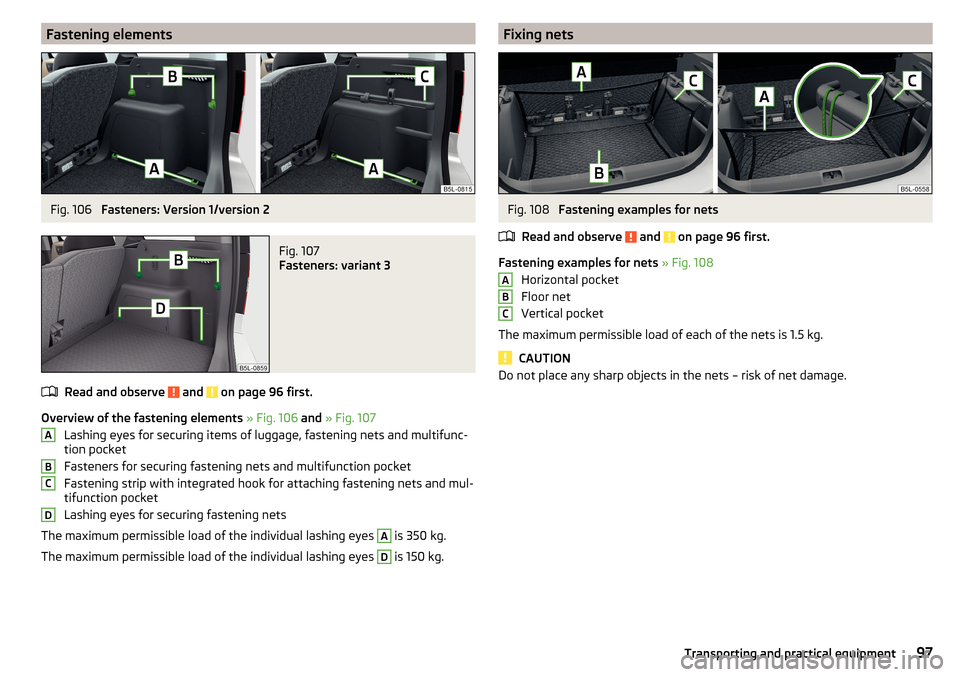
Fastening elementsFig. 106
Fasteners: Version 1/version 2
Fig. 107
Fasteners: variant 3
Read and observe and on page 96 first.
Overview of the fastening elements » Fig. 106 and » Fig. 107
Lashing eyes for securing items of luggage, fastening nets and multifunc-
tion pocket
Fasteners for securing fastening nets and multifunction pocket
Fastening strip with integrated hook for attaching fastening nets and mul-
tifunction pocket
Lashing eyes for securing fastening nets
The maximum permissible load of the individual lashing eyes
A
is 350 kg.
The maximum permissible load of the individual lashing eyes
D
is 150 kg.
ABCDFixing netsFig. 108
Fastening examples for nets
Read and observe
and on page 96 first.
Fastening examples for nets » Fig. 108
Horizontal pocket
Floor net
Vertical pocket
The maximum permissible load of each of the nets is 1.5 kg.
CAUTION
Do not place any sharp objects in the nets – risk of net damage.ABC97Transporting and practical equipment