2015 SKODA SUPERB weight
[x] Cancel search: weightPage 108 of 276
When transporting cargo the following the instructions must be adhered to
▶ When transporting heavy objects, the driving characteristics change due to
the shift in centre-of-gravity. The speed and style of driving must be adjus-
ted accordingly.
▶ The cargo is stowed in the luggage compartment. To prevent this from mov-
ing it should be secured with suitable lashing straps to the lashing eyes or
secured with fixing nets.
▶ Distribute loads as evenly as possible.
▶ Place heavy objects as far forward as possible.
▶ The transported items must be stowed in such a way that no objects are able
to slip forward on sudden driving or braking manoeuvres – risk of injury!
▶ Tyre pressure is to match the load.
▶ When transporting loads in the luggage compartment that has been en-
larged by folding the rear seats forward, ensure the safety of the passengers
transported on the other rear seats .
In the event of an accident, even small and light objects gain so much kinetic energy that they can cause severe injuries.
The magnitude of the kinetic energy is dependent on the speed at which the
vehicle is travelling and the weight of the object.
Example: In the event of a frontal collision at a speed of 50 km/h, an object
with a weight of 4.5 kg produces an energy, which corresponds to 20 times its
own weight. This means that it results in a weight of approx. 90 kg “ ”.
Luggage compartment light
The warning light turns on when tailgate is opened.
The warning light turns off when the tailgate is closed.
If the boot lid is open and the ignition switched off, the light will extinguish
automatically after around 10 minutes.
The luggage compartment illumination using the removable lamp » page 114.WARNING■
Never exceed the maximum permissible load of the respective fasteners,
nets, hooks etc. Heavy objects were not secured sufficiently – risk of injury!■
If the cargo is tied down with unsuitable or damaged lashing straps, inju-
ries can occur in the event of braking manoeuvres or accidents.
■
Loose cargo can be thrown forward during a sudden manoeuvre or in case
of an accident and can injure the occupants or other road users.
■
Loose cargo could hit a deployed airbag and injure occupants – danger of
death!
CAUTION■ Never exceed the maximum permissible load of the respective fasteners,
nets, hooks etc. - these could be damaged.■
Make sure that transported objects with sharp edges do not damage the
threads of the following devices. ■Rear window heater.
■ Rear window with an integrated antenna.
■ Integrated antenna in the rear side windows.
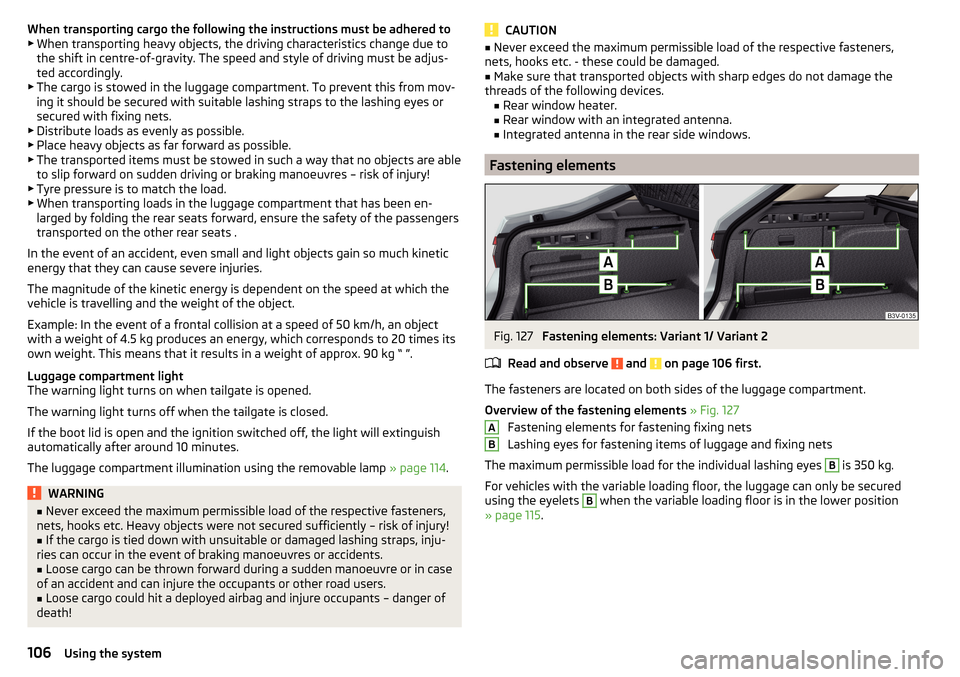
Fastening elements
Fig. 127
Fastening elements: Variant 1/ Variant 2
Read and observe
and on page 106 first.
The fasteners are located on both sides of the luggage compartment.
Overview of the fastening elements » Fig. 127
Fastening elements for fastening fixing nets
Lashing eyes for fastening items of luggage and fixing nets
The maximum permissible load for the individual lashing eyes
B
is 350 kg.
For vehicles with the variable loading floor, the luggage can only be secured
using the eyelets
B
when the variable loading floor is in the lower position
» page 115 .
AB106Using the system
Page 114 of 276

CAUTIONIf you want to stow the roll-up luggage compartment cover and the multifunc-
tion tray at the same time , then it is necessary that the rear part of the roll-up
luggage compartment is covering the multifunction tray.
Side storage compartment and trays
Fig. 138
Side shelf removal / open side pocket
Read and observe
and on page 106 first.
Located at the two sides of the luggage compartment, depending on vehicle equipment are side trays » Fig. 138 -
or lockable side compartments
» Fig. 138 -
.
The space behind the tray and in the tray is provided for storing small objects
up to a total weight of 2.5 kg.
Side shelf removing / Inserting
›
Take out the tray in the direction of arrow » Fig. 138 -
.
Insertion takes place in reverse order.
Open side compartment
›
Pull the handle to position
1
» Fig. 138 -
.
›
Remove the wiper blade in the direction of the arrow
2
.
The tray can be removed.
Close side compartment
›
Close the tray in the opposite direction of the arrow
2
» Fig. 138 -
.
CAUTION■
When using the side tray, take care not to damage it or the luggage compart-
ment lining.■
Only use the lockable side trays for storing smaller items, which do not
project out - there is a risk of damaging the trays.
Cargo element
Fig. 139
Removing cargo elements: variant 1 / variant 2
Fig. 140
Removing cargo elements : variant 3 / securing cargo using the
cargo elements
Read and observe
and on page 106 first.
The Cargo elements are equipment-dependent and are on the two sides of the
luggage compartment on the side trays or just in one of the lockable side com-
partments.
The cargo element is designed for attaching and securing objects with a maxi-
mum total weight of 8 kg.
112Using the system
Page 115 of 276

Usage of Cargo elements›Open the storage compartment » Fig. 138 on page 112 - .›
Remove the cargo elements in direction of arrow » Fig. 139 or » Fig. 140 -
.
›
Attach the Cargo elements with Velcro as close as possible to the rear seats
on the floor of the luggage compartment » Fig. 140 -
or attach to the fabric
side of the double-sided floor covering.
Storage compartments under the floor covering
Fig. 141
Variant 1: Lifting the floor covering / Storage compartments
Fig. 142
Variant 2: Lifting the floor covering / Storage compartments
Read and observe
and on page 106 first.
The storage compartments
B
» Fig. 141 or » Fig. 142 are located under the
floor covering of the luggage compartment in vehicles without a spare wheel.
Every storage compartment
B
is designed for storing small objects of up to 15
kg. in weight in total.
Transport of cargo - Version 1›Remove the fog floor covering in the direction of the arrow » Fig. 141.›
Fix the flooring with the loop
A
to the hook on the cargo cover or fold up in
the direction of the arrow.
›
Stow the cargo in the storage compartment.
›
Remove the flooring from the hook or fold back against the direction of the
arrow.
When transporting higher items in the trays
B
, the flooring must be flipped
forward, i.e. it must be attached to the hook of the luggage compartment cov-
er.
Transport of cargo - Version 2
›
Dividing the luggage compartment with variable loading floor » page 116.
›
Remove the fog floor covering in the direction of the arrow » Fig. 142.
›
Fix the hook
C
to the top edge of the variable loading floor.
›
Stow the cargo in the storage compartment.
›
Unhook the hook
C
and fold back the flooring opposite to the arrow.
When transporting high objects in the trays
B
the hook
C
must be hooked
onto the top edge of the variable loading floor.
CAUTION
■ The following instructions must be observed to avoid damage to the storage
compartments. ■Do not stored any sharp objects in the storage compartments.
■ Do not place any point-pressure in the storage compartment.
■ Carefully place the items in the storage compartments.■
Before closing the boot lid check that the flooring is not attached to the
hook with the loop
A
» Fig. 141 - there is a risk of damaging the hook.
■
Before closing the boot lid check that the cargo transported in the storage
compartments does not strike against the boot lid - there is a risk of damage
to the lid.
113Transporting and practical equipment
Page 119 of 276

›Fold back part of the roll-up luggage compartment cover A in the opposite
direction of the arrow » Fig. 149.
Using the net partition behind the rear seats›
Fold out part of the roll-up luggage compartment cover
A
in the direction of
the arrow » Fig. 149.
›
Pull the transverse rod back slightly first on one side and then on the other
and remove it from the mounts
E
» Fig. 150 .
›
Hold the crossbar
C
in such a way that the net partition can slowly roll up
into the housing
D
without being damaged.
›
Fold back part of the roll-up luggage compartment cover
A
in the opposite
direction of the arrow » Fig. 149.
CAUTION
If the net partition blocks when pulling it out of the housing, push the release
lever B in the direction of the arrow » Fig. 149.
Removing and refitting the net partition housing
Fig. 151
Removing the net partition
housing
Removing
›
Fold the rear seat backrests forward » page 85.
›
Open the rear right door » page 56.
›
Push the net partition housing
A
in the direction of the arrow
1
and re-
move it from the mounts on the right seat backrests in the direction of the
arrow
2
» Fig. 151 .
Fitting
›
Insert the recesses on the net partition housing into the mounts on the rear
seat backrests.
›
Push the net partition housing in the opposite direction of the arrow
1
» Fig. 151 as far as the stop.
›
Fold the rear seats back into their original positions » page 85.
Roof rack
Introduction
This chapter contains information on the following subjects:
fixing points for base support
118
Roof load
118WARNINGWhen transporting cargo the following the instructions must be adhered
to.■
The transported items on the roof rack must always be securely attached
– risk of accident!
■
Always secure the load with appropriate and undamaged lashing straps
or tensioning straps.
■
Distribute the load evenly over the roof rack system.
■
When transporting heavy objects or objects which take up a large area on
the roof rack system, the handling of the car may change as a result of the
displacement of the centre of gravity. The style of driving and speed must
therefore be adapted to the current circumstances.
■
Avoid abrupt and sudden driving/braking manoeuvres.
■
The permissible roof load, permissible axle loads and permissible total ve-
hicle weight must not be exceeded under any circumstances – risk of acci-
dent!
CAUTION
■ On models fitted with a sliding/tilting roof, ensure that the sliding/tilting roof
does not strike any items of luggage transported on the roof when tilting.■
Ensure that the boot lid does not hit the roof load when opened.
■
The height of the vehicle changes after mounting a roof luggage rack system
including the load that is being transported. Compare the vehicle height with
available clearances, such as underpasses and garage doors.
■
Ensure the roof aerial is not impaired by the load being transported.
Note
We recommend that you use a roof rack from ŠKODA Original Accessories.117Transporting and practical equipment
Page 141 of 276

DriveGreen function140Radiator blind140
The fuel consumption, degree of pollution and vehicle wear depend on driving
style, road condition, weather conditions and the like.
Running-in
Driving in the engine
The engine has to be run in during the first 1 500 kilometres. During this peri-
od, the driving style decides on the quality of the driving-in process.
During the first 1 000 km we recommend not driving faster than 3/4 of the
maximum permissible engine speed, not to drive at full throttle and to dis-
pense with the trailer.
In the area of 1,000 to 1,500 kilometres the engine load can be increased up
to the maximum permitted engine speed.
New tyres
New tyres must firstly be “run in”, as they do not offer optimal grip at first.
Therefore, drive especially carefully for the first 500 km or so.
New brake pads
New brake pads have to first “grind in” because these do not initially have the
best possible braking effect.
Therefore, drive especially carefully for the first 200 km or so.
Tips for economical driving
To achieve the lowest possible fuel consumption, the following instructions
must be observed.
Looking ahead when driving
Avoid unnecessary acceleration and braking.
Switch in an energy saving and timely manner Observe the recommended gear » page 42.
Avoid full throttle and high speeds
Fuel consumption can be reduced by half if only three-quarters of the possible
top speed of your vehicle is used.
Reducing idling
If the vehicle is fitted with the START - STOP system there is an automatic re-
duction of the idling. If the engine is stopped on vehicles without START-STOP
system, such as when waiting in a traffic jam, the fuel economy is already
greater after 30 - 40 s than the fuel quantity which is required for engine re-
start.
Avoid short distances
When driving a short distance of less than about 4 km, the engine cannot
reach its operating temperature. As long as the engine has not reached oper-
ating temperature, the fuel consumption is significantly higher than with the
engine hot.
Pay attention to the correct tyre inflation pressure being maintained
Further information » page 217.
Avoid unnecessary ballast
Per 100 kg of weight, consumption increases by about 0.3 l/100 km. At a speed
of 100 - 120 km/h, a vehicle fitted with a roof rack cross member without a load
will use about 10 % more fuel than normal due to the increased aerodynamic
drag.
Saving electricity
Only turn on electrical consumers (e.g. seat, window and mirror heating and
the like) for as long as necessary.
In Infotainment, the display is shown of up to three consumers which are cur-
rently showing the highest degree of fuel consumption » Owner´s Manual In-
fotainment , chapter CAR - Vehicle settings .
Use the cooling system economically
The air conditioning system compressor uses power from the engine when in
cooling mode, which will affect the fuel consumption.
It recommended to open the windows or the doors of a vehicle for which the
interior has been strongly heated through the effect of direct sunlight in order
to allow the heated air to escape.
The cooling system should not be on if the windows are open.139Starting-off and Driving
Page 187 of 276

WARNING■Take care with the towing device - it may cause injury.■Do not use the towing device, if the warning light is not green.■
If the tow bar cannot be correctly latched then do not use and have it
checked by a specialist.
■
Do not manipulate the handle
A
while a trailer is coupled to the tow bar.
■
Always swing the tow bar into the bumper when the towing device is not
being used.
CAUTION
■ Always check whether the handle A is properly seated in the starting posi-
tion.■
Take care with the towing device - there is a risk of damage to the swivel
mechanism.
Mount accessories
Fig. 221
Illustration of the maximum per-
missible projection of the ball
head of the towing hitch and the
permissible total weight of the
accessories including the load
depending on the load centre of
gravity
Read and observe on page 184 first.
An accessories can mounted on the ball head of the towing hitch (e.g. bike car-
riers).
If this accessory is used, the maximum permissible overhang of the ball head
of the towing hitch and the permissible gross vehicle weight of the accesso-
ries including load are to be checked.
The maximum permissible overhang of the ball head of the towing hitch is 70
cm » Fig. 221 .
The total permitted weight of the accessories including load changes varies
as the distance of the centre of gravity of the load from the ball head of the
towing hitch increases.
Distance of the centre of gravity of the load from the ball headPermissible total weight of the ac- cessories, including load0 cm90 kg30 cm75 kg60 cm35 kg70 cm0 kgWARNING■Never exceed the permissible gross weight of the accessory including
load - there is a risk of damaging the towing device.■
Never exceed the permissible protrusion of the ball head including towing
device - there is a risk of damaging the towing device.
Note
We recommend that you use accessories from ŠKODA Original Accessories.
Trailer
Introduction
This chapter contains information on the following subjects:
Coupling / uncoupling trainer
186
Loading a trailer
186
Trailer load
187
Towing a trailer
188
Anti-theft alarm system
189
The trailer can be hitched to the ball head of the towing device.
185Hitch and trailer
Page 188 of 276

Coupling / uncoupling trainerFig. 222
Housing of the 13 pin socket,
safety eyelet
Connect and disconnect
›
Swing out the tow bar » page 184.
›
Place the trailer onto the ball.
›
Plug the trailer cable into the 13-pin socket
A
» Fig. 222 .
If the trailer that is to be towed has a 7-pin connector, you can use a suitable
adapter from ŠKODA Original Accessories to establish a connection to the elec-
tricity.
›
Hook the breakaway cable of the trailer onto the safety eyelet
B
.
The breakaway cable of the trailer must sag in all trailer positions relative to
the vehicle (sharp curves, reverse driving and the like).
Uncoupling takes place in reverse order.
Exterior mirrors
You should have additional exterior mirrors fitted if you are not able to see the
traffic behind the trailer with the standard rear-view mirrors.
Headlights
The front of the vehicle may lift up when a trailer is being towed and the head-
lights may dazzle other road users.
Adjust the headlights using the headlight beam control » page 67, Operating
the lights 1)
.
Power to the trailer power grid
For the electrical connection between the vehicle and trailer, the power for the
trailer power grid is supplied by the vehicle.
The power supply works with ignition on or off.
With the ignition off, the battery of the towing vehicle is discharged by activa-
ted consumers.
At low charge state of the vehicle battery power to the trailer is interrupted.WARNING■ Improperly connected trailer electrical installations may cause accidents
or serious injury due to electric shock.■
Work on the electrical system must only be carried out by specialist ga-
rages.
■
Never directly connect the trailer's electrical system with the electrical
connections for the tail lights or other current sources.
■
After coupling the trailer and connecting up the power socket, check the
rear lights on the trailer to ensure they are working.
■
Never use the safety eyelet for towing!
CAUTION
Improperly connected trailer electrical installations may cause malfunction of
the entire vehicle electronics.
Note
■ The total power consumption of all the connected consumers on the trailer
must not exceed 350 watts.■
Coat the ball head of the towing device with a suitable grease whenever
necessary.
Loading a trailer
Distribution of the cargo
Distribute the cargo in the trailer in such a way that heavy items are located as
close to the trailer axle as possible. Secure the items from slipping.
The distribution of the weight is very poor if your vehicle is unladen and the
trailer is laden. Maintain a particularly low speed if you cannot avoid driving
with this combination.
Tyre pressure
Correct the tyre inflation pressure on your vehicle for a “full load” » page 217.
1)
Applies to vehicles with xenon headlights.
186Driving
Page 190 of 276

Permissible trailer load - Superb EstateEngineGearboxPermissible trailer load, braked (kg)Permissible trailer load, unbraked (kg)Gradients of up to 12 %Gradients of up to 8 %a)1.4 l/92 kW TSIMG16001800690
1.4 l/110 kW TSI ACT
MG16001900700MG 4x418002000750DSG160019007201.4 l/110 kW TSIMG16001900700DSG160019007101.8 l/132 kW TSIMG18002000740DSG180020007502.0 l/162 kW TSIDSG200020007502.0 l/206 kW TSIDSG 4x422002200750
1.6 l/88 kW TDI CR
MG15001800740MG (GreenLine)15001800750DSG15001800750
2.0 l/110 kW TDI CR
MG20002000750MG 4x422002200750DSG200020007502.0 l/130 kW TDI CRDSG20002000750
2.0 l/140 kW TDI CR
MG20002000750DSG20002100750DSG 4x422002200750a)
Only valid for some countries.
WARNINGNever exceed the maximum permissible axle and draw bar load or the per-
missible weight of the trailer - risk of accident!
Towing a trailer
Driving speed
For reasons of safety do not drive more than 100 km / h when the towing vehi-
cle is a passenger car of category M1.
For reasons of safety do not drive more than 80 km / h when the towing vehi-
cle is a lorry of category N1.
Immediately reduce your speed as soon as even the slightest swaying of the
trailer is detected. Never attempt to stop the trailer from “swaying” by acceler-
ating.
Brakes
Apply the brakes in good time! If the trailer is fitted with a trailer brake, apply
the brakes gently at first, then brake firmly. This will avoid brake jolts resulting
from the trailer wheels locking. 188Driving