2015 Seat Mii service
[x] Cancel search: servicePage 161 of 232

Care and maintenance
Advice
C ar
e and m
aintenance
Accessories, replacement of
parts and modifications Introduction WARNING
The use of spare parts and accessories, or in-
corr ectly
performed modifications or repairs
may result in damage to the vehicle, acci-
dents and serious injury.
● SEAT strongly recommends you to only use
SEAT ap
proved accessories and SEAT ®
origi-
nal spare parts. These parts and accessories
have been specially tested by SEAT for suita-
bility, reliability and safety.
● Have any repairs or modifications carried
out at a s
pecialised workshop. These work-
shops have the necessary tools, diagnostics
equipment, repair information and qualified
personnel.
● Only mount parts with the same specifica-
tions a
s the parts fitted at factory.
● Never mount, fasten or fit objects such as
drink hol
ders or telephone cradles over the
covers of the airbag modules or within their
deployment zones. ●
Only u
se wheels and tyre combinations
which have been approved by SEAT for your
vehicle type. Accessories and spare parts
SEAT recommends you consult an Official
Serv
ic
e before purchasing accessories and
spare parts or consumables. For example,
when fitting accessories at a later date, or
when replacing a component. A SEAT Official
Service will advise you as to the legal require-
ments and manufacturer's recommendations
regarding accessories, spare parts and other
components.
SEAT recommend you use only approved
SEAT accessories and genuine SEAT spare
parts ®
. These parts and accessories have
been specially tested by SEAT for suitability,
reliability and safety. In addition, SEAT tech-
nical services will guarantee that assembly is
performed professionally.
Although we continually monitor the market,
SEAT cannot guarantee that products not ap-
proved by SEAT are reliable, safe or suitable
for the vehicle. Therefore, SEAT cannot accept
liability, even in those cases authorised by
an officially recognised technical inspection
office or other official body.
Any retro-fitted equipment which has a direct
effect on vehicle control must be approved by SEAT for use in your vehicle and bear the
e
mark (the E
uropean Union's authorisation
symbol). This includes cruise control systems
or electronically controlled suspension.
If any additional electrical devices are fitted
which do not serve to control the vehicle it-
self, these must bear the mark (European
Union manufacturer conformity declaration).
This includes refrigerator boxes, laptops or
ventilator fans. WARNING
Unprofessional repairs or modifications to
the v ehic
le may affect the performance of the
airbags, and may cause operating faults or fa-
tal accidents.
● Never mount, fasten or fit objects such as
drink hol
ders or telephone cradles over or
next to the covers of the airbag modules or
within their deployment zones.
● Objects placed over the airbag covers, or
within their deplo
yment zones, could lead to
serious injury or loss of life if the airbags are
triggered. Service fluids and components
All vehicle fluids and consumables
, suc
h a
s
notched belts, tyres, coolant fluids, engine
oils, spark plugs and batteries are continual-
ly being developed. Therefore all fluids and »
159
Technical data
Advice
Operation
Emergencies
Safety
Page 162 of 232

Advice
consumables should be changed at a speci-
ali sed w
ork
shop. Technical services are per-
manently informed of any modifications. WARNING
The incorrect use or handling of fluids or con-
sum ab
les may result in accident, serious in-
jury, burns or intoxication.
● Therefore, fluids must always be stored
closed in their origin
al container.
● Never store fluids in empty food containers
or bottles
as other people may accidentally
drink the fluid.
● Keep all fluids and consumables out of
reac
h of children.
● Read and observe the information and
warning
s given on the fluid containers.
● Only work in the open air or in well-ventila-
ted z
ones, when using products which give
off harmful vapours.
● Never use fuel, turpentine, engine oil, ace-
tone or any
other volatile liquid in the main-
tenance of the vehicle. These are toxic and
highly flammable. They could lead to fire or
explosions! CAUTION
● Only u
se appropriate fluids. Do not confuse
fluids as this can cause serious malfunctions
or engine damage.
● Accessories and other components moun-
ted in front
of the air inlet reduce the cooling effect of the coolant. If the engine is running
under gr
e
at strain in high outside tempera-
tures, it could overheat. For the sake of the environment
Leaking fluids could pollute the environment.
C o l
lect any spilt fluids in suitable containers
and dispose of them in accordance with legis-
lation and with respect for the environment. Repairs and technical changes
When performing repairs and technical mod-
ific
ation
s,
SEAT's directives must be ob-
served! ››› Unauthorised modifications to the electronic
c
omponents
or sof
tware in the vehicle may
cause malfunctions. Due to the way the elec-
tronic components are linked together in net-
works, other indirect systems may be affec-
ted by the faults. This may significantly affect
the vehicle's performance, increase compo-
nent wear and could mean that the vehicle
registration documents are no longer valid.
Your SEAT Official Service cannot be held lia-
ble for any damage caused by technical mod-
ifications or repairs performed incorrectly.
The SEAT Official Service does not accept lia-
bility for damage resulting from technical
modifications or repairs performed incorrect- ly; neither is the SEAT warranty valid in these
case
s.
SEAT recommends you have any technical
modifications or repairs performed at a SEAT
Official Service and that you use genuine
SEAT spare parts ®
.
Vehicles with special accessories and equip-
ment
The manufacturers of additional equipment
guarantee that the equipment complies with
applicable laws and regulations with respect
to the environment, in particular Directives
2000/53/CE and 2003/11/CE. The first direc-
tive governs the disposal of end-of-life vehi-
cles while the second refers to the restric-
tions on the marketing and use of certain
dangerous substances and preparations.
The vehicle owner should keep the documen-
tation for the additional equipment safely
and hand it over to the scrap yard at the end
of the vehicle's service life. This ensures that
any additional equipment mounted in end-of-
life vehicles is correctly disposed of with re-
spect for the environment. WARNING
Repairs or modifications which are not per-
formed c orr
ectly may result in damage or er-
rors in the vehicle operation, affecting the ef-
fectiveness of the driver assist systems. This
could result in serious accident. 160
Page 164 of 232
Advice
The optimal reach of the equipment is only
ac hiev
ed w
ith an external aerial.
Check first with a specialised workshop that
understands the technical possibilities of in-
stallation if you wish to use a two-way radio
with a transmitting power of over 10 watts.
SEAT recommends taking your car in for tech-
nical service.
All legal requirements, together with the in-
structions for the use of two-way radios must
be observed. WARNING
If the two-way radio is not securely fastened
in pos ition, it
could be sent flying around the
vehicle in the event of sharp braking, sudden
manoeuvres or accident, causing injury.
● While driving, two-way radios must be se-
curely
fastened in position, outside the air-
bags deployment zones, or safely stowed
away. WARNING
When using a two-way radio without a con-
nection to an e xt
erior aerial, the maximum
permitted levels of electromagnetic radiation
may be exceeded. This is also the case if the
aerial has not been correctly installed.
● You should only use a two-way radio inside
the vehic
le if it has first been correctly con-
nected to an exterior aerial. Information stored by the control
u
nit
s Your vehicle is fitted at the factory with a ser-
ies
of
electronic control units responsible for
the engine and gearbox management. In ad-
dition, the control units supervise the per-
formance of the exhaust gas system and the
airbag systems.
Therefore, while the vehicle is being driven,
these electronic control units are continuous-
ly analysing the vehicle data. In the event of
faults or deviations from the theoretical val-
ues, only this data is stored. Normally, the
warning lamps on the instrument panel light
up in the event of faults.
This data can only be read and analysed us-
ing special equipment.
The storing of the data allows specialised
workshops to detect and repair faults. Stored
data may include:
● Data relating to the engine or the gearbox
● Speed
● Direction of travel
● Braking force
● Detection of seat belt
The v ehic
le control units never record conver-
sations held by passengers in the vehicle.
In vehicles equipped with an emergency call
function via the mobile phone or other appli- ances connected in the vehicle, it is possible
to send the v
ehicle position. If the control
unit records an accident with airbag activa-
tion, the system may automatically send a
signal. This will depend on the network oper-
ator. Normally, transmission is only possible
in areas with good coverage.
Event Data Recorder
The vehicle is not fitted with an event data re-
corder.
An event data recorder temporarily stores the
vehicle information. Therefore, in the event of
an accident, it is possible to obtain detailed
information about how the accident occur-
red. Vehicles with airbag systems can store
data relating to impact speed, seat belt sta-
tus, seat positions and airbag activation
times may be stored, etc. The volume of data
depends on the manufacturer.
Event data recorders can only be mounted
with authorisation from the vehicle owner
and, in some countries, they are governed by
local legislation.
Reprogramming control units
On the whole, all the data required for the
component management is stored in the con-
trol units. The programming of certain con-
venience functions, such as the turn signals,
individual door opening and instructions on
the display can be modified using special
162
Page 165 of 232

Care and maintenance
equipment at the workshop. If the comfort
f u
nction
s are reprogrammed, the information
and Instruction Manual descriptions will not
coincide with the modified functions. There-
fore, SEAT recommends that any modifica-
tions be recorded in the section “Other work-
shop notes” in the Maintenance Programme.
The SEAT Official Service must have a record
of any modification to the programming.
Reading the vehicle fault memory
There is a diagnostics connector in the vehi-
cle interior for reading the vehicle fault mem-
ory. The fault memory documents errors and
deviations from the theoretical values of the
electronic control units.
The diagnostics connector is in the driver
side footwell area, next to the lever for open-
ing the bonnet, below a cover.
The fault memory should only be read and re-
set by a specialised workshop.
Using a mobile telephone in a vehicle
without c
onnection to an exterior aer-
ial Mobile telephones transmit and receive radio
w
av
e
s also called high-frequency energy,
both when in use and when on stand-by. Sci-
entific studies state that radio waves exceed-
ing certain values may be harmful to the hu- man body. International committees and au-
thorities h
ave established limits and direc-
tives in order to ensure electromagnetic radi-
ation from mobile phones remains within cer-
tain limits that do not endanger health. Nev-
ertheless, there is no conclusive scientific
evidence that wireless telephones are totally
safe.
That is why some experts recommend moder-
ate use of the mobile telephone, and the ap-
pliance of measures to reduce radiation on
the human body.
When a mobile phone not connected to an
exterior aerial is used inside the vehicle, the
electromagnetic radiation may be greater
than if the mobile phone were connected to a
built-in aerial or to another exterior aerial.
If the vehicle is fitted with a suitable hands-
free device that allows the employment of
numerous additional mobile telephone func-
tions with compatible Bluetooth technolo-
gy ®
, it will comply with the legislation in
many countries which only permits the use of
mobile phones inside vehicles using a
hands-free device.
The hands-free system of the Portable Navi-
gation System (supplied by SEAT) has been
designed for use with conventional mobile
phones and phones with Bluetooth technolo-
gy ®
››› page 164. Mobile telephones must be
placed in a suitable telephone support or
stored safely in the vehicle. If a support is used for the telephone, it must be securely
fas
tened to the base plate. The mobile will be
secure on the instrument panel and always
within reach of the driver only by following
these procedures. Mobile telephone connec-
tion with an external aerial is carried out sub-
ject to the hands-free device, via the tele-
phone support or by the Bluetooth ®
connec-
tions present in the mobile telephone and
the vehicle.
If the mobile phone is connected to an aerial
incorporated into the vehicle or an exterior
aerial connected to the vehicle, it will help re-
duce the electromagnetic radiation transmit-
ted and the risk to human health. It will also
improve the quality of the connection.
If the phone is used inside the vehicle with-
out the hands-free system, it will not be se-
curely fastened and will not be connected to
the exterior aerial of the vehicle telephone.
Nor will the telephone charge if it is not on
the support. In addition, some calls may
break off and the quality of the connection
will be affected.
Mobile telephones should only be used in-
side the vehicle if they are connected to a
hands-free system. SEAT recommends using
an external aerial should you wish to use a
mobile telephone inside the vehicle.
Bluetooth ®
is a registered trademark of Blue-
tooth ®
SIG, Inc. »
163
Technical data
Advice
Operation
Emergencies
Safety
Page 167 of 232
Care and maintenance
● Sel ect
the r
equired chapter and press the
corresponding button.
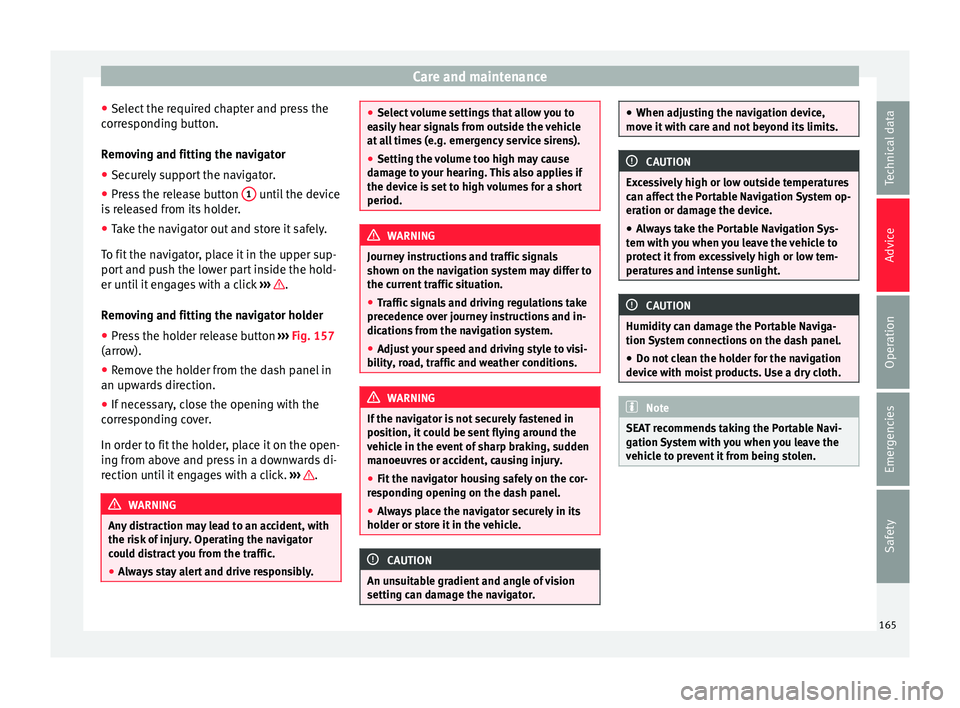
Removing and fitting the navigator
● Securely support the navigator.
● Press the release button 1 until the device
i s
r
eleased from its holder.
● Take the navigator out and store it safely.
To fit the n
avigator, place it in the upper sup-
port and push the lower part inside the hold-
er until it engages with a click ››› .
R emo
v
ing and fitting the navigator holder
● Press the holder release button ›››
Fig. 157
(arrow).
● Remove the holder from the dash panel in
an upwar
ds direction.
● If necessary, close the opening with the
corre
sponding cover.
In order to fit the holder, place it on the open-
ing from above and press in a downwards di-
rection until it engages with a click. ››› .
WARNING
Any distraction may lead to an accident, with
the risk of
injury. Operating the navigator
could distract you from the traffic.
● Always stay alert and drive responsibly. ●
Select
volume settings that allow you to
easily hear signals from outside the vehicle
at all times (e.g. emergency service sirens).
● Setting the volume too high may cause
damag
e to your hearing. This also applies if
the device is set to high volumes for a short
period. WARNING
Journey instructions and traffic signals
sho wn on the n av
igation system may differ to
the current traffic situation.
● Traffic signals and driving regulations take
precedenc
e over journey instructions and in-
dications from the navigation system.
● Adjust your speed and driving style to visi-
bility
, road, traffic and weather conditions. WARNING
If the navigator is not securely fastened in
pos ition, it
could be sent flying around the
vehicle in the event of sharp braking, sudden
manoeuvres or accident, causing injury.
● Fit the navigator housing safely on the cor-
res
ponding opening on the dash panel.
● Always place the navigator securely in its
holder or s
tore it in the vehicle. CAUTION
An unsuitable gradient and angle of vision
setting c an d
amage the navigator. ●
When adju s
ting the navigation device,
move it with care and not beyond its limits. CAUTION
Excessively high or low outside temperatures
c an aff ect
the Portable Navigation System op-
eration or damage the device.
● Always take the Portable Navigation Sys-
tem with
you when you leave the vehicle to
protect it from excessively high or low tem-
peratures and intense sunlight. CAUTION
Humidity can damage the Portable Naviga-
tion S y
stem connections on the dash panel.
● Do not clean the holder for the navigation
device w
ith moist products. Use a dry cloth. Note
SEAT recommends taking the Portable Navi-
gation S
ystem with you when you leave the
vehicle to prevent it from being stolen. 165
Technical data
Advice
Operation
Emergencies
Safety
Page 169 of 232

Care and maintenance
also be one of the requirements for acknowl-
edgin g w
arr
anty claims in the event of body-
work corrosion or paint defects.
Products suitable for the care of your vehicle
are available at any technical service. WARNING
Car-care products may be toxic and hazard-
ous. If c
ar care products are not suitable or
are used inappropriately, this could result in
accident, serious injury, burns or intoxica-
tion.
● Car care products must always be stored in
the original
container which should be kept
closed.
● Observe information provided by the manu-
factur
er.
● To prevent confusion, never store car care
products
in empty food cans, bottles or other
containers.
● Keep all care products out of reach of chil-
dren.
● Harmfu
l vapours may be produced when us-
ing car c
are products. Therefore, care prod-
ucts should only be used in well-ventilated
spaces or in the open air.
● Never use fuel, turpentine, engine oil, ace-
tone or any
other volatile liquid to wash,
clean or care for the vehicle. These are toxic
and highly flammable. WARNING
Inappropriate care and cleaning of vehicle
component s
may effect the vehicle safety
equipment, increasing the risk of severe in-
jury.
● Vehicle components should only be
cle
aned and maintained in accordance with
the manufacturer's instructions.
● Only use approved or recommended care
products. CAUTION
Cleaning products which contain solvents will
dam ag
e the material. For the sake of the environment
Only wash the vehicle in areas allocated for
this p
urpose, to prevent dirty water which
may be contaminated by oil, grease or fuel,
from entering the drains. In some places,
even washing it outside the planned areas is
banned. For the sake of the environment
Where possible, always use products which
re s
pect the environment. For the sake of the environment
The remains of car care products should not
be dis po
sed of with ordinary household waste. Observe information provided by the
manuf
act
urer. Washing the vehicle
The longer substances such as insects, bird
drop
pin
gs, resinous tree sap, road dirt, in-
dustrial deposits, tar, soot or road salt and
other aggressive materials remain on the ve-
hicle, the more damage they do to the paint-
work. High temperatures (for instance due to
strong sunlight) further intensify the corro-
sive effect. The vehicle undercarriage should
also be thoroughly washed at regular inter-
vals.
Automatic car washes
Always observe the instructions provided at
the automatic car wash. The standard pre-
cautionary measures prior to entering the car
wash should be taken to avoid damage to
the vehicle (close all windows, fold in exterior
mirrors). If the vehicle is fitted with additional
components (spoiler, roof-rack, aerial, etc.),
check with the car wash supervisor whether
these can enter the car wash ››› .
The v
ehic
le paintwork is so durable that the
vehicle can normally be washed without
problems in an automatic car wash tunnel.
However, wear and damage to the paintwork
will depend on the type of car wash used. »
167
Technical data
Advice
Operation
Emergencies
Safety
Page 171 of 232

Care and maintenance
and from the parking distance warning sys-
t em sen
sor
s. The sensors of the parking dis-
tance warning system are situated on the rear
bumper ››› .
Do not u
se a no
zzle that sprays the water out
in a direct stream or one that has a rotating
jet for forcing off dirt ››› .
WARNING
The incorrect use of high pressure cleaning
equipment c ou
ld result in permanent dam-
age, visible or invisible, to the tyres or other
materials. This could result in a serious acci-
dent.
● Ensure there is a suitable distance between
the nozzl
e and the tyres.
● Never wash tyres with a concentrated jet or
so-cal
led “dirt blasters”. Even at large spray-
ing distances and short cleaning times, you
may damage the tyres. WARNING
After the vehicle has been washed, the brak-
ing eff ect
will be reduced (and the braking
distance increased) due to moisture (and ice
in winter) on the brakes.
● “Dry the brakes and remove ice” by braking
caref
ully. Ensure that you are not endanger-
ing other road-users or breaking traffic regu-
lations in the process. CAUTION
● The wat er t
emperature should not exceed
+60 °C (+140 °F).
● To avoid damage to the paintwork, do not
wash the
vehicle in full sun.
● To ensure that the system functions well,
the sensors
located on the bumper must be
kept clean and free from ice. When cleaning
with pressure hoses and steam cleaners, the
sensors should be sprayed only briefly. A dis-
tance of 10 cm between the sensors and the
steam / hose nozzle must be observed.
● Do not use a high pressure cleaner to re-
move ic
e or snow from windows
● Washing the vehicle in low temperatures:
When washin
g the vehicle with a hose, do
not direct water into the lock cylinders or the
gaps around the doors or roof. Locks and
seals could freeze! Cleaning windows and exterior mir-
r
or
s Cleaning windows and exterior mirrors
S
pr
a
y windows and exterior windows with a
standard window cleaner containing alcohol.
Dry the windows with a clean chamois leath-
er or a lint-free cloth. The chamois leathers
used on painted surfaces are not suitable for
cleaning windows because they are soiled with wax deposits which could smear the
window
s.
Use window cleaner or a silicone remover to
clean rubber, oil, grease and silicone depos-
its off ››› .
R emo
v
ing wax residue
Automatic car washes and certain car care
products may leave wax deposits on the win-
dows. These deposits can only be removed
with a special product or cleaning cloths. If
wax deposits are left on the windscreen and
the rear window, the blades can scratch the
glass. SEAT recommends you wipe the wax
deposits off the windscreen and the rear win-
dow with a soft cloth each time after you
have washed the vehicle.
A window cleaning detergent which helps to
dissolve the wax may be added to the wind-
screen washer fluid to prevent the wiper
blades from scratching the windscreen.
Please ensure you add the cleaning product
in the correct proportions. Products for re-
moving grease do not eliminate the wax de-
posits ››› .
S pec
i
al cleaning products or window cloths
are available at any technical service. To re-
move wax deposits, SEAT recommends the
following products: »
169
Technical data
Advice
Operation
Emergencies
Safety
Page 175 of 232

Care and maintenance
●
Harmfu l
vapours may be produced when us-
ing car care products. Therefore, care prod-
ucts should only be used in well-ventilated
spaces or in the open air.
● Never use fuel, turpentine, engine oil, ace-
tone or any
other volatile liquid to wash,
clean or care for the vehicle. These are toxic
and highly flammable. WARNING
Inappropriate care and cleaning of vehicle
c omponent s
may effect the vehicle safety
equipment, increasing the risk of severe in-
jury.
● Vehicle components should only be
cle
aned and maintained in accordance with
the manufacturer's instructions.
● Only use approved or recommended care
products. CAUTION
● Cle
aning products which contain solvents
will damage the material.
● To avoid damage, stubborn stains should
be remov
ed by a specialised workshop. Note
Suitable vehicle care products are available
from y
our technical service. How to care for the upholstery
To treat and maintain your seat upholstery,
keep the f
o
llowing in mind ››› :
● Before entering the vehicle, close any Vel-
cr o f
asteners that might snag on the uphols-
tery or trim fabric. Any open Velcro fasteners
may damage the trim or upholstery fabrics.
● To prevent damage, avoid direct contact
between sharp dec
orative objects and the
upholstery and trim fabrics. Decorative ob-
jects include zips, rivets and rhinestones on
clothing and belts.
● From time to time, clean the dust that gath-
ers in the per
forations, folds and seams so
that the surfaces of the seats are not dam-
aged by its abrasive effect.
● Make sure clothes are colour-fast to avoid
them running and s
taining the upholstery.
This is especially important if the upholstery
is light in colour. CAUTION
If the instructions for upholstery and trim
car e ar
e not followed, they may deteriorate
and discolour. Note
SEAT recommends you take the vehicle to a
Spec i
alised workshop to treat any stains on
the upholstery caused by the discolouration
of clothing. Cleaning padding and textile covers
Normal cleaning
● Before applying cleaning products, please
re a
d the instructions for handling and the
warnings shown on the container.
● The upholstery, textile covers, and carpet
should be r
egularly vacuumed (with vacuum
brush).
● We recommend that you use a soft sponge
or lint-free, mic
ro-fibre cloth for normal clean-
ing ››› .
Gener al
s
uperficial dirt on upholstery and
textile covers can be cleaned with a normal
foam cleaning product.
If the upholstery and the material trims are
very dirty, we recommend you have them
cleaned by a specialist cleaning form.
Cleaning stains
It may be necessary to clean the whole sur-
face and not only the stain itself. Especially if
the surface has been dirtied through normal
use. Otherwise, the stained area may be-
come lighter than the rest of the surface after
treatment. »
173
Technical data
Advice
Operation
Emergencies
Safety