2015 Seat Alhambra refuelling
[x] Cancel search: refuellingPage 85 of 305

Lights and visibility
Windscreen wiper functionsWindscreen wiper performance in different sit-
uations
If the vehicle
is at a stand-
stillThe activated position provisionally
changes to the previous position.
During auto-
matic wipe
The air conditioner comes on for ap-
proximately 30 seconds in air recircula-
tion mode to prevent the smell of the
windscreen washer fluid entering the
inside the vehicle.
For the inter-
val wipeIntervals between wipes depend on the
vehicle's speed. The higher the vehicle
speed the shorter the intervals. Heated windscreen washer jets
The heating only thaws the frozen jets, it
does not thaw the water in the washer hoses.
The heated windscreen washer jets automati-
cally adjust the heat depending on the ambi-
ent temperature, when the ignition is switch-
ed on.
Headlight wash/wipe system
The headlight washers/wipers clean the
headlight lenses.
After the ignition is switched on, the first and
every fifth time the windscreen washer is
switched on, the headlights are also washed.
Therefore, the windscreen wiper lever should
be pulled towards the steering wheel when the dipped beam or main beam are on. Any
incrusted dirt (such as insects) should be
cleaned regularly (e.g. when refuelling).
To ensure the headlight washers work cor-
rectly in winter, any snow which has got into
the bumper jet supports should be cleaned
away. If necessary, remove snow with an anti-
icing spray.
Note
The wiper will try to wipe away any obstacles
that are on the windscreen. The wiper will
stop moving if the obstacle blocks its path.
Remove the obstacle and switch the wiper
back on again. Windscreen wipers service position
Fig. 66
Wipers in service position The wiper arms can be raised when the wip-
ers are in service position
››› Fig. 66 . To place the w
ind
screen wipers in the service posi-
tion, proceed as follows:
● The bonnet must be closed ››› page 214.
● Switch the ignition on and off.
● Press the windscreen wiper lever down-
wards briefly ››› Fig. 65 4 .
Before driving, always lower the wiper arms.
Using the windscreen wiper lever, the wind-
screen wiper arms return to their initial posi-
tion.
Lifting and returning windscreen wiper arms
● Place the wiper arms in the service position
››› .
● Only hold the wiper arms at the point
where the blade is fixed. CAUTION
● To prevent damage to the bonnet and the
wiper arms, only leave them in the service
position.
● Before driving, always lower the wiper
arms. 83
Technical specifications
Advice
Operation
Safety
Page 208 of 305

Advice
Note
If electrical equipment is used near an aerial
built-into the window, you may observe inter-
ference in the reception of AM stations. Notes on SEAT repairs
WARNING
Repairs or modifications which are not per-
formed correctly may result in damage or er-
rors in the vehicle operation, affecting the ef-
fectiveness of the driver assist and airbag
systems. This could result in serious acci-
dent.
● Have any repairs or modifications carried
out at a specialised workshop. Collection and scrapping of end-of-life
vehicles
Collection of end-of-life vehicles
An extensive network of used car reception
centres already exists in much of Europe. Af-
ter the vehicle has been delivered, you will
receive a certificate of destruction describing
the environmentally friendly scrapping of the
vehicle in accordance with applicable legisla-
tion. We will collect the used vehicle free of
charge, provided it complies with all national
legislation.
Please see your technical service for further
information about the collection and scrap-
ping of end-of-life vehicles.
Scrapping
The relevant safety requirements must be ob-
served when the vehicle or components of
the airbag or belt tensioner systems are
scrapped. These requirements are known to
specialised workshops. Checking and refilling levels
Filling the tank Introduction The fuel tank flap is on the rear right of the
vehicle.
WARNING
Refuelling or handling fuel carelessly can
cause an explosion or fire resulting in serious
burns and injuries.
● Always make sure that you correctly close
the fuel cap to avoid evaporation and fuel
spillage.
● Fuels are highly explosive and inflammable
substances that can cause serious burns and
injuries.
● Fuel could leak out or be spilt if the engine
is not switched off or if the filler fuel nozzle is
not fully inserted into the tank filler neck
when refuelling. This could lead to a fire, ex-
plosion and severe injuries.
● When refuelling, turn off the engine, the
auxiliary heating ( ››› page 128) and turn off
the ignition f or s
afety reasons.
● Always turn off mobile telephones, radio
apparatus and other radio wave emitting
equipment before refuelling. Electromagnetic
waves could cause sparks and lead to a fire. 206
Page 209 of 305

Checking and refilling levels
●
Never enter the vehicle while refuelling. If it
is absolutely necessary to enter, close the
door and touch a metal surface before touch-
ing the filler nozzle again. This will prevent
the generation of static electricity. Sparks
could cause a fire when refuelling.
● Never handle fuel close to flames, sparks or
objects with slow combustion (e.g. ciga-
rettes).
● Avoid static electricity and electro-magnet-
ic radiation when refuelling.
● Observe the safety regulations of the serv-
ice station.
● Never spill fuel on the vehicle or in the lug-
gage compartment. WARNING
For safety reasons, SEAT does not recommend
carrying a spare fuel canister in the vehicle.
Fuel could be spilled and catch fire, above all
in case of an accident and this applies to a
full container as well as empty containers.
This could lead to explosions, fires and inju-
ries.
● Observe the following if you exceptionally
have to carry fuel in a canister:
–Never place a fuel container to fill it in-
side the vehicle or on the vehicle, for ex-
ample, in the boot or on the hatch. Filling
in these circumstances could create an
electrostatic charge and spark that could
ignite fuel fumes. –
Always place the canister on the ground
to fill it.
– Insert the fuel nozzle into the neck of the
canister as far as possible.
– If you are using a metal fuel canister, the
nozzle must always touch the canister
while it is being filled to avoid static elec-
tricity.
– Follow the legal requirements for the use,
storage and transport of spare fuel canis-
ters.
– Insure that the fuel container complies
with manufacturing standards, for exam-
ple, ANSI or ASTM F852-86. CAUTION
● Always remove any fuel spilled on the vehi-
cle paintwork immediately to avoid damage
to the wheel housing, the tyre and vehicle
paintwork.
● Refuelling a petrol engine with diesel or a
diesel engine with petrol can cause serious
engine and fuel system damage; the resulting
malfunctions are not covered by the SEAT
warranty. If you refuel with the wrong type of
fuel, never start the engine. This applies to
even the smallest amount of the wrong fuel.
Seek specialist assistance. With the engine
running, the composition of the wrong fuel
could significantly damage the fuel system
and the engine itself.
● In vehicles with a diesel engine, under no
circumstances should you refuel or drive with petrol, kerosene, heating oil or any other
type of different fuel. Other types of fuels
could cause serious damage to the engine
and to the fuel supply system and the result-
ing problems are not covered by the SEAT
warranty.
For the sake of the environment
Fuels can contaminate the environment. Col-
lect any spilt service fluids and allow a pro-
fessional to dispose of them. Note
There is no emergency mechanism for the
manual release of the tank flap. If necessary,
request assistance from specialised person-
nel. 207Technical specifications
Advice
Operation
Safety
Page 210 of 305

Advice
Control lamps and fuel gauge Fig. 158
On the instrument panel: Fuel gauge
for petrol and diesel It lights up
Gauge posi-
tion
››› Fig. 158Possible cause
››› Solution
Red mark (ar- row)
The fuel tank is al-most empty.
The reserve tank is
being used
››› page 285.
Refuel as soon as
possible ››› .
It lights up
Fuel tank not
closed cor-
rectly.Stop the vehicle and close the tank
flap properly.
Several warning and control lamps light up
for a few seconds when the ignition is switch-
ed on, signalling that the function is being verified. They will switch off after a few sec-
onds.
When the control lamp lights up
or
the
auxiliary heating and heater running off pet-
rol automatically switch off. WARNING
Driving with insufficient fuel reserve could re-
sult in the vehicle breaking down in traffic
and a serious accident.
● If the fuel level is too low then the fuel sup-
ply to the engine can become irregular espe-
cially on slopes.
● If the engine “is choked” or stalls due to
lack of or irregularity of the fuel supply, the
power steering as well as all of the driver as-
sistance systems including braking assis-
tance will stop working.
● Always refuel when there is only one quar-
ter of the fuel tank left to avoid running out of
fuel. CAUTION
● Always pay attention to any lit control
lamps and to the corresponding descriptions
and instructions to avoid damage to the vehi-
cle.
● Never run the fuel tank completely dry. An
irregular fuel supply may lead to ignition
faults and unburnt fuel could enter the ex-
haust system. This could damage the catalyt-
ic converter filter or the diesel particulate fil-
ter! Note
The arrow next to the fuel pump symbol on
the instrument panel ››› Fig. 158 indicates the
s ide of
the vehicle on which the tank flap is
located. Filling the tank with petrol or diesel
Fig. 159
Open tank flap with tank cap attach-
ed to the holder Before
refuelling, always turn off the engine,
the ignition, mo b
ile telephones, auxiliary
heating and keep them off during refuelling.
Opening the fuel tank cap
● The tank flap is at the rear of the vehicle on
the right.
● Press the rear of the tank flap to open it.
208
Page 211 of 305

Checking and refilling levels
● Unscrew the tank cap anticlockwise and in-
sert it in the hole in the tank flap hinge
››› Fig. 159 .
R ef
uelling
The correct petrol type for the vehicle is loca-
ted on a sticker inside the fuel tank flap
››› page 209.
● If the aut
omatic filler nozzle is operated
correctly, it will switch itself off as soon as
the tank is full ››› .
● Do not continue to refuel if it is turned off!
Otherwise, this will fill the expansion cham-
ber and fuel may leak out if the ambient con-
ditions are warm.
Closing the fuel tank cap
● Screw on the tank cap clockwise until it you
hear it click into position.
● Press the tank flap until you hear it click in-
to place. The tank flap must be flush with the
body contour. WARNING
Do not continue refilling once the fuel nozzle
has switched itself off. The fuel tank may be
filled too much. As a result, fuel may spurt
out and spill. This could lead to a fire, explo-
sion and severe injuries. CAUTION
● Always remove any fuel spilled on the vehi-
cle paintwork immediately to avoid damage
to the wheel housing, the tyre and vehicle
paintwork. For the sake of the environment
Spilt fuel can contaminate the environment. Fuel
Introduction You will find a factory-fitted sticker containing
information on the type of fuel for your vehi-
cle on the inside of the fuel tank flap.
WARNING
Refuelling or handling fuel carelessly can
cause an explosion or fire resulting in serious
burns and injuries.
● Fuel is a highly explosive, easily flammable
substance.
● Observe current safety instructions and lo-
cal regulations concerning the handling of
fuel. Types of fuel
The type of fuel to use when refilling will de-
pend on the vehicle's engine. You will find a
factory-fitted sticker containing information
on the type of fuel for your vehicle on the in-
side of the fuel tank flap.
SEAT recommends the use of sulphur-free or
low sulphur fuel to reduce consumption and
prevent engine damage.
Possible
types of fuelAlternative namesFurther in-formation
91 a)
RONNormal petrol, normal
unleaded petrol
››› page 20995 a)
RONPremium unleaded
petrol (95 RON)
98 a)
RONPremium unleaded
petrol (98 RON)
Diesel ››› page 210
a)
RON = Regulation Octane Number
Petrol Petrol types
Vehicles with petrol engines must refuel us-
ing unleaded petrol according to European
norm EN 228
››› .
»
209
Technical specifications
Advice
Operation
Safety
Page 212 of 305

Advice
Petrol types are categorised according to
their octane number (e.g. 91, 95, 98 or 99
RON (RON = “Research Octane Number”).
You may use petrol with a high octane num-
ber than the one recommended for your en-
gine. However, this has no advantage in
terms of fuel consumption and engine power.
SEAT recommends refuelling with a low sul-
phur content or sulphur-free petrol to reduce
fuel consumption for petrol engines.
Petrol additives
The quality of the fuel influences the behav-
iour, power and service life of the engine.
This is why the petrol you use should carry
suitable additives already included by the
petrol industry, free of metals. These addi-
tives will help to prevent corrosion, keep the
fuel system clean and prevent deposits from
building up in the engine.
If good-quality petrol with metal-free addi-
tives is not available or engine problems
arise, the necessary additives must be added
when refuelling ››› .
Not all petrol additives have been shown to
be effective. The use of unsuitable petrol ad-
ditives may cause significant damage to the
engine and the catalytic converter. Metal ad-
ditives should never be used. Metal additives
may also be contained in petrol additives for
improving anti-detonation ratings or octane
ratings ››› . SEAT recommends “genuine Volkswagen
Group Fuel Additives for petrol engines”.
These additives can be bought at SEAT deal-
ers, where information on how to use them
can also be obtained.
CAUTION
● Do not refuel if the filler indicates that the
fuel contains metal. LRP (lead replacement
petrol) fuels contain high concentrations of
metal additives. Using them may damage the
engine!
● Only use fuel with an octane rating that is
in line with the norm EN 228, otherwise sig-
nificant damage could be caused to the en-
gine and fuel system. Furthermore, it could
lead to a loss of performance with the conse-
quent engine fault.
● The use of unsuitable petrol additives could
damage the engine.
● If, in exceptional circumstances, petrol with
a lower octane rating to that recommended is
used, only use moderate engine speeds and a
light throttle. Avoid using full throttle and
overloading the engine. Otherwise you may
damage the engine. Fill up with fuel of a suit-
able octane rating as soon as possible.
● Just one full tank of leaded fuel would seri-
ously impair the efficiency of the catalytic
converter and could damage it. Diesel
Diesel fuel
Diesel fuel must correspond to European
standard EN 590 (In Germany, EN 590 or
DIN 51628).
The use of diesel fuel with a high sulphur
percentage requires shorter service intervals
››› Booklet Maintenance Programme ››› .
Your technical service centre will be able to
tell you which countries have diesel with a
high sulphur content.
Do not mix fuel additives (thinners, or similar
additives) with diesel fuel.
Winter-grade diesel
When using “summer-grade diesel fuel”, dif-
ficulties may be experienced at temperatures
below 0 °C (+32 °F) because the fuel thickens
due to wax separation. For this reason, “win-
ter-grade diesel fuel” is available in Germany,
for example, during the cold months. It can
be used at temperatures as low as -20 °C
(-4 °F).
In countries with different climatic condi-
tions, other types of diesel fuel are available
that are suitable to local temperatures. Tech-
nical service centres and filling stations in
the country concerned will inform you on the
types of diesel fuels available.
210
Page 298 of 305
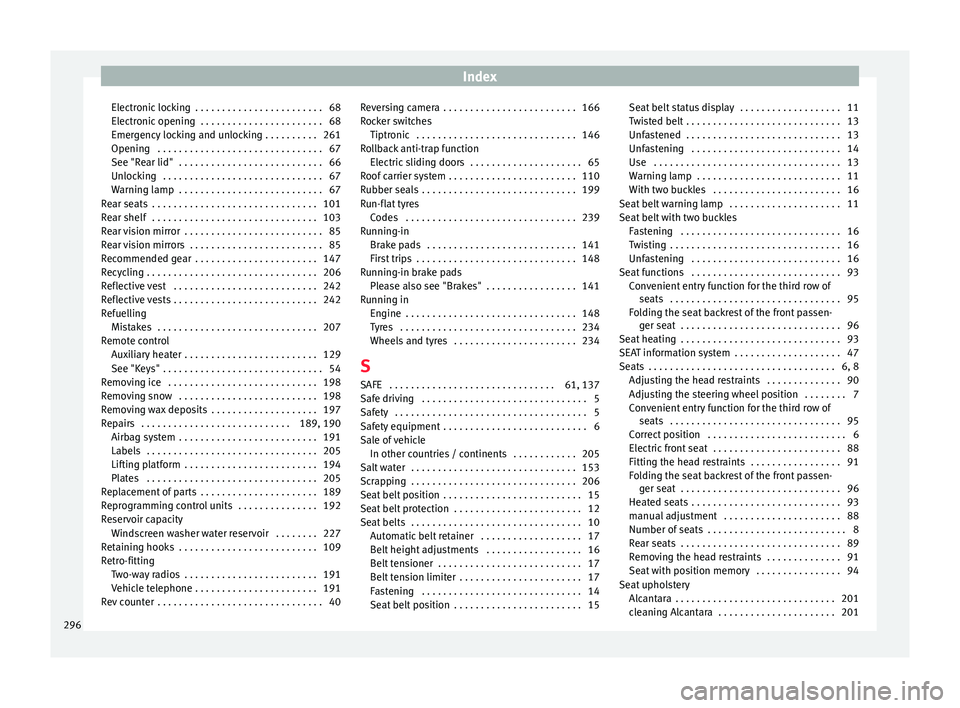
Index
Electronic locking . . . . . . . . . . . . . . . . . . . . . . . . 68
Electronic opening . . . . . . . . . . . . . . . . . . . . . . . 68
Emergency locking and unlocking . . . . . . . . . . 261
Opening . . . . . . . . . . . . . . . . . . . . . . . . . . . . . . . 67
See "Rear lid" . . . . . . . . . . . . . . . . . . . . . . . . . . . 66
Unlocking . . . . . . . . . . . . . . . . . . . . . . . . . . . . . . 67
Warning lamp . . . . . . . . . . . . . . . . . . . . . . . . . . . 67
Rear seats . . . . . . . . . . . . . . . . . . . . . . . . . . . . . . . 101
Rear shelf . . . . . . . . . . . . . . . . . . . . . . . . . . . . . . . 103
Rear vision mirror . . . . . . . . . . . . . . . . . . . . . . . . . . 85
Rear vision mirrors . . . . . . . . . . . . . . . . . . . . . . . . . 85
Recommended gear . . . . . . . . . . . . . . . . . . . . . . . 147
Recycling . . . . . . . . . . . . . . . . . . . . . . . . . . . . . . . . 206
Reflective vest . . . . . . . . . . . . . . . . . . . . . . . . . . . 242
Reflective vests . . . . . . . . . . . . . . . . . . . . . . . . . . . 242
Refuelling Mistakes . . . . . . . . . . . . . . . . . . . . . . . . . . . . . . 207
Remote control Auxiliary heater . . . . . . . . . . . . . . . . . . . . . . . . . 129
See "Keys" . . . . . . . . . . . . . . . . . . . . . . . . . . . . . . 54
Removing ice . . . . . . . . . . . . . . . . . . . . . . . . . . . . 198
Removing snow . . . . . . . . . . . . . . . . . . . . . . . . . . 198
Removing wax deposits . . . . . . . . . . . . . . . . . . . . 197
Repairs . . . . . . . . . . . . . . . . . . . . . . . . . . . . 189, 190 Airbag system . . . . . . . . . . . . . . . . . . . . . . . . . . 191
Labels . . . . . . . . . . . . . . . . . . . . . . . . . . . . . . . . 205
Lifting platform . . . . . . . . . . . . . . . . . . . . . . . . . 194
Plates . . . . . . . . . . . . . . . . . . . . . . . . . . . . . . . . 205
Replacement of parts . . . . . . . . . . . . . . . . . . . . . . 189
Reprogramming control units . . . . . . . . . . . . . . . 192
Reservoir capacity Windscreen washer water reservoir . . . . . . . . 227
Retaining hooks . . . . . . . . . . . . . . . . . . . . . . . . . . 109
Retro-fitting Two-way radios . . . . . . . . . . . . . . . . . . . . . . . . . 191
Vehicle telephone . . . . . . . . . . . . . . . . . . . . . . . 191
Rev counter . . . . . . . . . . . . . . . . . . . . . . . . . . . . . . . 40 Reversing camera . . . . . . . . . . . . . . . . . . . . . . . . . 166
Rocker switches
Tiptronic . . . . . . . . . . . . . . . . . . . . . . . . . . . . . . 146
Rollback anti-trap function Electric sliding doors . . . . . . . . . . . . . . . . . . . . . 65
Roof carrier system . . . . . . . . . . . . . . . . . . . . . . . . 110
Rubber seals . . . . . . . . . . . . . . . . . . . . . . . . . . . . . 199
Run-flat tyres Codes . . . . . . . . . . . . . . . . . . . . . . . . . . . . . . . . 239
Running-in Brake pads . . . . . . . . . . . . . . . . . . . . . . . . . . . . 141
First trips . . . . . . . . . . . . . . . . . . . . . . . . . . . . . . 148
Running-in brake pads Please also see "Brakes" . . . . . . . . . . . . . . . . . 141
Running in Engine . . . . . . . . . . . . . . . . . . . . . . . . . . . . . . . . 148
Tyres . . . . . . . . . . . . . . . . . . . . . . . . . . . . . . . . . 234
Wheels and tyres . . . . . . . . . . . . . . . . . . . . . . . 234
S SAFE . . . . . . . . . . . . . . . . . . . . . . . . . . . . . . . 61, 137
Safe driving . . . . . . . . . . . . . . . . . . . . . . . . . . . . . . . 5
Safety . . . . . . . . . . . . . . . . . . . . . . . . . . . . . . . . . . . . 5
Safety equipment . . . . . . . . . . . . . . . . . . . . . . . . . . . 6
Sale of vehicle In other countries / continents . . . . . . . . . . . . 205
Salt water . . . . . . . . . . . . . . . . . . . . . . . . . . . . . . . 153
Scrapping . . . . . . . . . . . . . . . . . . . . . . . . . . . . . . . 206
Seat belt position . . . . . . . . . . . . . . . . . . . . . . . . . . 15
Seat belt protection . . . . . . . . . . . . . . . . . . . . . . . . 12
Seat belts . . . . . . . . . . . . . . . . . . . . . . . . . . . . . . . . 10 Automatic belt retainer . . . . . . . . . . . . . . . . . . . 17
Belt height adjustments . . . . . . . . . . . . . . . . . . 16
Belt tensioner . . . . . . . . . . . . . . . . . . . . . . . . . . . 17
Belt tension limiter . . . . . . . . . . . . . . . . . . . . . . . 17
Fastening . . . . . . . . . . . . . . . . . . . . . . . . . . . . . . 14
Seat belt position . . . . . . . . . . . . . . . . . . . . . . . . 15 Seat belt status display . . . . . . . . . . . . . . . . . . . 11
Twisted belt . . . . . . . . . . . . . . . . . . . . . . . . . . . . . 13
Unfastened . . . . . . . . . . . . . . . . . . . . . . . . . . . . . 13
Unfastening . . . . . . . . . . . . . . . . . . . . . . . . . . . . 14
Use . . . . . . . . . . . . . . . . . . . . . . . . . . . . . . . . . . . 13
Warning lamp . . . . . . . . . . . . . . . . . . . . . . . . . . . 11
With two buckles . . . . . . . . . . . . . . . . . . . . . . . . 16
Seat belt warning lamp . . . . . . . . . . . . . . . . . . . . . 11
Seat belt with two buckles Fastening . . . . . . . . . . . . . . . . . . . . . . . . . . . . . . 16
Twisting . . . . . . . . . . . . . . . . . . . . . . . . . . . . . . . . 16
Unfastening . . . . . . . . . . . . . . . . . . . . . . . . . . . . 16
Seat functions . . . . . . . . . . . . . . . . . . . . . . . . . . . . 93 Convenient entry function for the third row ofseats . . . . . . . . . . . . . . . . . . . . . . . . . . . . . . . . 95
Folding the seat backrest of the front passen- ger seat . . . . . . . . . . . . . . . . . . . . . . . . . . . . . . 96
Seat heating . . . . . . . . . . . . . . . . . . . . . . . . . . . . . . 93
SEAT information system . . . . . . . . . . . . . . . . . . . . 47
Seats . . . . . . . . . . . . . . . . . . . . . . . . . . . . . . . . . . . 6, 8 Adjusting the head restraints . . . . . . . . . . . . . . 90
Adjusting the steering wheel position . . . . . . . . 7
Convenient entry function for the third row ofseats . . . . . . . . . . . . . . . . . . . . . . . . . . . . . . . . 95
Correct position . . . . . . . . . . . . . . . . . . . . . . . . . . 6
Electric front seat . . . . . . . . . . . . . . . . . . . . . . . . 88
Fitting the head restraints . . . . . . . . . . . . . . . . . 91
Folding the seat backrest of the front passen- ger seat . . . . . . . . . . . . . . . . . . . . . . . . . . . . . . 96
Heated seats . . . . . . . . . . . . . . . . . . . . . . . . . . . . 93
manual adjustment . . . . . . . . . . . . . . . . . . . . . . 88
Number of seats . . . . . . . . . . . . . . . . . . . . . . . . . . 8
Rear seats . . . . . . . . . . . . . . . . . . . . . . . . . . . . . . 89
Removing the head restraints . . . . . . . . . . . . . . 91
Seat with position memory . . . . . . . . . . . . . . . . 94
Seat upholstery Alcantara . . . . . . . . . . . . . . . . . . . . . . . . . . . . . . 201
cleaning Alcantara . . . . . . . . . . . . . . . . . . . . . . 201
296