Page 122 of 292
1.116
ADDITIVE TANK (2/3)
Maintenance/Range
Warning lights and messages on the instrument panel
The integrated indicator lights described below are accompanied by a bee\
p.
Indicator lights Message What to do?
� comes on each
time the vehicle is started. « ADBLUE LEVEL
LOW »
Have an Approved Dealer fill or top up the additive tank.
� comes on.« ADBLUE TO FILL »
� comes on.« XXXX KM FAILURE
TOP UP ADBLUE »
Have an Approved Dealer fill or top up the additive tank as soon as pos-
sible.
� comes on.« 0KM FAILURE TOP
UP ADBLUE » The engine will not start.
To get the engine started you can top up the tank with 10 litres of addit\
ive
yourself.
Page 123 of 292
1.117
ADDITIVE TANK (3/3)
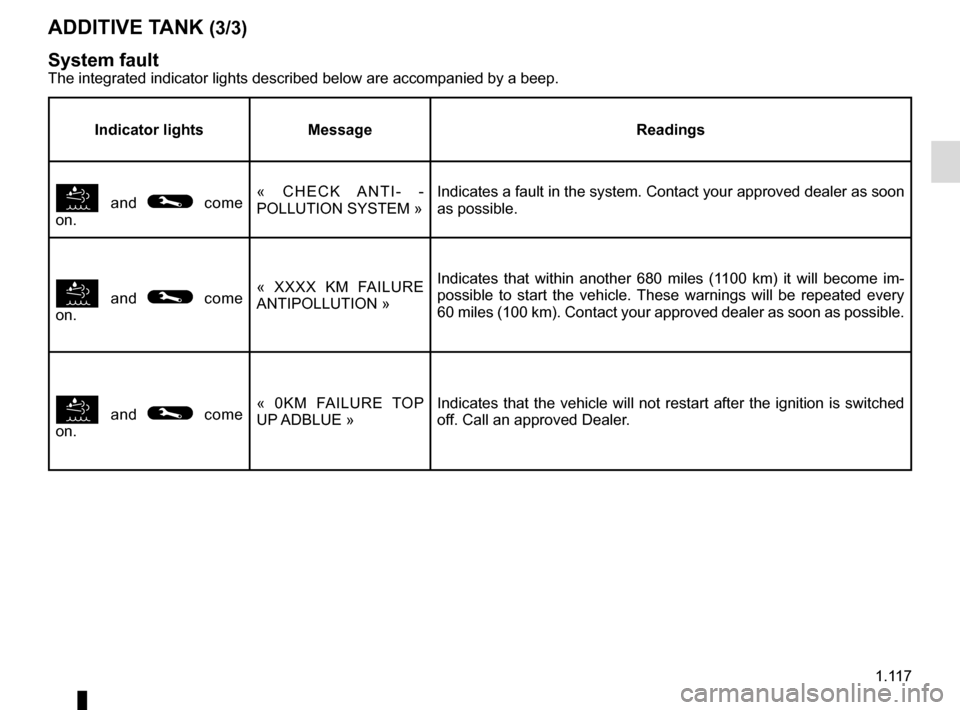
System fault
The integrated indicator lights described below are accompanied by a bee\
p.
Indicator lights Message Readings
� and © come
on. « CHECK ANTI- -
POLLUTION SYSTEM »
Indicates a fault in the system. Contact your approved dealer as soon
as possible.
� and © come
on. « XXXX KM FAILURE
ANTIPOLLUTION »
Indicates that within another 680 miles (1100 km) it will become im-
possible to start the vehicle. These warnings will be repeated every
60 miles (100 km). Contact your approved dealer as soon as possible.
� and © come
on. « 0KM FAILURE TOP
UP ADBLUE »
Indicates that the vehicle will not restart after the ignition is switch\
ed
off. Call an approved Dealer.
Page 126 of 292
2.2
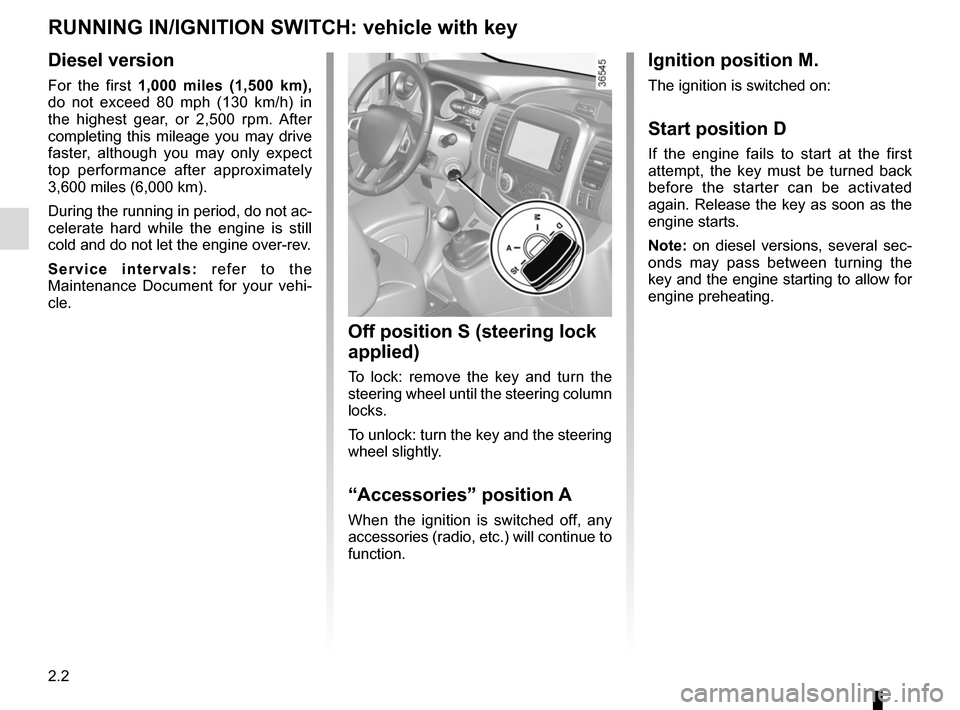
Ignition position M.
The ignition is switched on:
Start position D
If the engine fails to start at the first
attempt, the key must be turned back
before the starter can be activated
again. Release the key as soon as the
engine starts.
Note: on diesel versions, several sec-
onds may pass between turning the
key and the engine starting to allow for
engine preheating.
Off position S (steering lock
applied)
To lock: remove the key and turn the
steering wheel until the steering column
locks.
To unlock: turn the key and the steering
wheel slightly.
“Accessories” position A
When the ignition is switched off, any
accessories (radio, etc.) will continue to
function.
RUNNING IN/IGNITION SWITCH: vehicle with key
Diesel version
For the first 1,000 miles (1,500 km),
do not exceed 80 mph (130 km/h) in
the highest gear, or 2,500 rpm. After
completing this mileage you may drive
faster, although you may only expect
top performance after approximately
3,600 miles (6,000 km).
During the running in period, do not ac-
celerate hard while the engine is still
cold and do not let the engine over-rev.
Service intervals: refer to the
Maintenance Document for your vehi-
cle.
Page 127 of 292

2.3
STARTING, STOPPING THE ENGINE: vehicle with key
Starting the engine
Turn the ignition key to the “Ignition on”
position M and hold this position until
the engine preheating warning light
É goes out.
Turn the key to starter position D with-
out depressing the accelerator
pedal.
Release the key as soon as the engine
starts.
Stopping the engine
With the engine idling, turn the key to
the “Stop” position St.
Driver’s responsibility
Never leave your vehi-
cle with the key inside and
never leave a child (or a
pet) unsupervised, even for a short
while.
There is a risk that they could start
the engine or operate electrical
equipment (electric windows etc.)
and trap part of their body (neck,
arms, hands, etc.).
Risk of serious injury.
Never switch off the ignition before
the vehicle has stopped completely.
Once the engine has stopped, the
brake servo, power-assisted steer-
ing, etc. and the passive safety de-
vices such as air bags and preten-
sioners will no longer operate.
Never start your vehicle
while freewheeling on a
gradient. Risk of non-ac-
tivation of power-assisted
steering.
There is a risk of accidents.
Page 131 of 292

2.7
Warning light � is displayed on the
instrument panel. This notifies you that
the engine is on standby.
The vehicle equipment remain opera-
tional while the engine is stopped.
The engine will restart when you press
the clutch pedal and move into gear.
STOP AND START function (1/3)
This system enables a reduced fuel
consumption and lower greenhouse
gas emissions.
The system is activated automatically
when the vehicle is started.
While driving, the system stops the
engine (standby) when the vehicle is
at a standstill (traffic jam, traffic lights,
etc).
System operating conditionsEngine standby is activated if:
– the vehicle has been driven since its last stop;
– the gearbox is in neutral;
– the clutch pedal is released;
and
– the vehicle is travelling at less than 3 km/h. Special feature of the automatic
engine re-start
Under certain conditions, the engine
can restart on its own in order to gua-
rantee your safety and comfort.
This can occur especially when:
– the outdoor temperature is too low or
too high (less than around 0 °C or
higher than around 30 °C);
– the “Clear View” function is activated (please see the information on “Air
conditioning” in Section 3);
– the battery is not sufficiently char- ged;
– the vehicle speed is above 3 mph (5 km/h) (downhill slope, etc.);
– repeated pressing on the brake pedal or braking system require-
ment;
– ...
Special features of vehicles with
remote control
Some of these conditions prevent the
engine from automatically restarting
upon opening:
– one of the doors for vehicles using a key;
– the passenger side door for vehicles using a RENAULT card.
Engine on standby - braking
assistance is no longer ope-
rational.
Before getting out of the
vehicle, you must switch
off the ignition (please see
section on “Starting, stop-
ping the engine”).Do not drive off when the
engine is on standby (war-
ning light
� is dis-
played on the instrument panel).
If you get out of the vehicle, a beep
and the message “IGNITION OFF”
notifies you that the engine is on
standby and has not been switched
off.
Page 132 of 292

2.8
STOP AND START function (2/3)
Special cases
– For vehicles using a RENAULT card, while the system is operating and
the engine is stopped (traffic jam,
traffic lights, etc.), if the driver gets
out of their seat or unfastens their
seatbelt and opens the driver’s door,
the ignition will be switched off. To
restart and reactivate the Stop and
Start system, press the start button
(please see “Starting and stopping
the engine”).
– In the event of the engine stalling, if the system is operational, press
down the clutch pedal as far as it will
go to restart.
Conditions preventing the
standby of the engine
Depending on the vehicle, certain
conditions prevent the system from
using the engine standby function, in-
cluding when:
– reverse gear is engaged;
– the bonnet is not locked;
– for vehicles using a RENAULT card, the driver’s side door is not closed;
– for vehicles using a RENAULT card, the driver’s seat belt is not buckled;
– the outdoor temperature is too low or too high (less than around 0 °C or
higher than around 30 °C);
– the battery is not sufficiently char- ged;
– the difference between the vehicle interior temperature and the automa-
tic climate control instruction is too
high; – the “Clear View” function is activated
(please see the information on “Air
conditioning” in Section 3);
– the engine coolant temperature is too low;
– automatic particle filter cleaning is underway;
or
– ...
Warning light
� is displayed on the
instrument panel. This notifies you that
engine standby is not available.
To fill up with fuel, the engine must
be stopped (and not on standby):
stop the engine (please refer to the
information on “Starting and stop-
ping the engine” in Section 2).
Page 133 of 292

2.9
Operating faults
When the message “CHECK STOP
AND START” appears on the instru-
ment panel and the integrated warn-
ing light 2 lights up on the switch 1, the
system is deactivated.
Please consult an authorised dealer.
Deactivating, activating the
function
Press switch 1 to deactivate the func-
tion. The message “STOP AND START
DEACTIVATED” will appear on the in-
strument panel and the integrated
warning light 2 on the switch will light
up.
Pressing again will reactivate the
system. The message “STOP AND
START ACTIVATED” will appear on the
instrument panel and the integrated
warning light 2 on the switch 1 will go
out.
STOP AND START function (3/3)
The system is automatically reactivated
each time the vehicle is started (please
see section on “Starting, stopping the
engine”).
Special note: engine on standby,
press switch 1 to automatically restart
the engine.
1
2
The engine must be stopped
before leaving the vehicle
(and not on standby): stop
the engine (please refer
to the information on “Starting and
stopping the engine” in Section 2).
In the event of an emer-
gency, the engine can be
restarted by pressing on the
clutch pedal if the Stop and
Start function is activated.
Page 134 of 292

2.10
SPECIAL FEATURES OF DIESEL VERSIONS
Diesel engine speed
Diesel engines are fitted with injection
equipment which prevents the engine
speed being exceeded irrespective of
the gear selected.
If the message “Check antipollution
system” is displayed along with warn-
ing lights
Ä and ©, consult an
authorised dealer immediately.
When driving, depending on the fuel
grade used, it is possible that white
smoke may be emitted.
This is due to the exhaust particle filter
being cleaned automatically, and does
not affect the way the vehicle runs.
Running out of fuel
If the tank has been completely
drained, the system must be reprimed
after the tank is refilled: see information
on the “fuel tank” in section 1 before re-
starting the engine.
Do not park the vehicle or
run the engine in locations
where combustible sub-
stances or materials such
as grass or leaves can come into
contact with the hot exhaust system.
Precautions to be taken in
winter
To avoid any faults in icy weather:
– ensure that the battery is always fully charged,
– always keep the diesel tank rela- tively full to avoid water vapour con-
densing in it and accumulating at the
bottom of the tank.

Maintenance/Range
Warning lights and messages on the instrument panel
The integrated indicator lights described below are accompanied by a bee\
p.
Indicator lights Message Wh")