2015 RENAULT MEGANE HATCHBACK lock
[x] Cancel search: lockPage 54 of 268

1.48
2
Deactivating the front
passenger airbags
(on equipped vehicles)
You must deactivate certain devices
in addition to the front passenger seat
belt before fitting a child seat in the front
passenger seat. To deactivate the
airbags : when the
vehicle is stationary, push and turn
lock 1 to the OFF position.
With the ignition on, you must check
that the warning light 2
¹ is lit
on the central display and, depend-
ing on the vehicle, that the message
“Passenger airbag off” is displayed.
This light remains permanently lit to
let you know that you can fit a child
seat.
The passenger airbag must
only be deactivated or acti-
vated when the vehicle is
stationary.
If it is interfered with when the ve-
hicle is being driven, indicator lights
å and © will come on.
Switch the ignition off then on again
to reset the airbag in accordance
with the lock position.
CHILD SAFETY: deactivating/activating the front passenger air bag (1/3)
1
Page 56 of 268
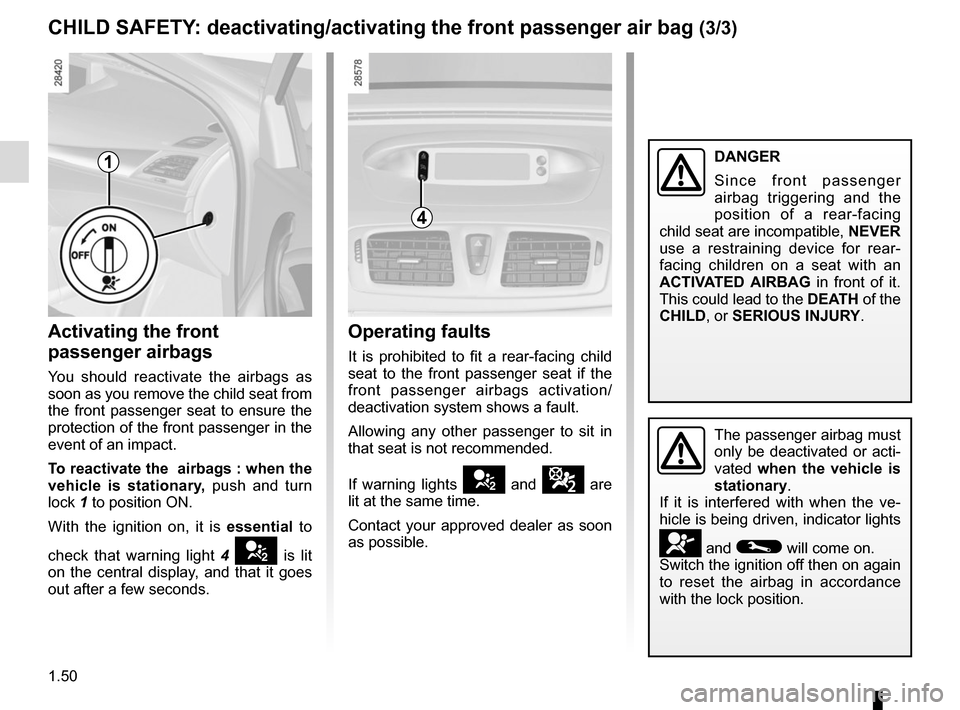
1.50
CHILD SAFETY: deactivating/activating the front passenger air bag (3/3)
4
Operating faults
It is prohibited to fit a rear-facing child
seat to the front passenger seat if the
front passenger airbags activation/
deactivation system shows a fault.
Allowing any other passenger to sit in
that seat is not recommended.
If warning lights
› and ¹ are
lit at the same time.
Contact your approved dealer as soon
as possible.
Activating the front
passenger airbags
You should reactivate the airbags as
soon as you remove the child seat from
the front passenger seat to ensure the
protection of the front passenger in the
event of an impact.
To reactivate the airbags : when the
vehicle is stationary, push and turn
lock 1 to position ON.
With the ignition on, it is essential to
check that warning light 4
› is lit
on the central display, and that it goes
out after a few seconds.
1
The passenger airbag must
only be deactivated or acti-
vated when the vehicle is
stationary.
If it is interfered with when the ve-
hicle is being driven, indicator lights
å and © will come on.
Switch the ignition off then on again
to reset the airbag in accordance
with the lock position.
DANGER
Since front passenger
airbag triggering and the
position of a rear-facing
child seat are incompatible, NEVER
use a restraining device for rear-
facing children on a seat with an
ACTIVATED AIRBAG in front of it.
This could lead to the DEATH of the CHILD, or SERIOUS INJURY.
Page 57 of 268

1.51
Operating faults
The steering may become stiff when
driving or when the steering wheel is
turned repeatedly. This is due to the
power assistance overheating. In this
case, it must be allowed to cool down.Power-assisted steering
Variable power-assisted steering
The variable power-assisted steering
system is equipped with an electronic
control system which alters the level of
assistance to suit the vehicle speed.
Steering is made easier during parking
manoeuvres (for added comfort) whilst
the force needed to steer increases
progressively as the speed rises (for
enhanced safety at high speeds).
STEERING WHEEL/POWER-ASSISTED STEERING
Height and reach adjustment
Pull lever 1 and move the steering
wheel to the required position.
Then, push the lever back fully, beyond
the point of resistance to lock the steer-
ing wheel.
Make sure that the steering wheel is
correctly locked.
For safety reasons, only
adjust the steering wheel
when the vehicle is station-
ary.
Never leave the steering wheel at
full lock while stationary.
1
Never switch off the igni-
tion when travelling down-
hill, and avoid doing so in
normal driving (assistance
is not provided).
With the engine switched off, or if
there is a system fault, it is still pos-
sible to turn the steering wheel. The
force required will be greater.
Page 59 of 268

1.53
DRIVING POSITION: LEFT-HAND DRIVE (2/2)
1 Side air vent.
2 Side window demister outlet.
3 Stalk for:
– direction indicator lights;
– exterior lights;
– front fog lights;
– rear fog light.
4 Instrument panel.
5 Driver’s air bag and horn location.
6 – Steering column stalk for wind-
screen and rear screen wash/
wipe;
– On-board computer information
read-out control and vehicle set-
tings customisation menu.
7 Centre air vents.
The equipment fitted, described below, DEPENDS ON THE VERSION AND COUNTRY.
19 Gear lever.
20 Engine start/stop button and
RENAULT card reader.
21 Central door locking/unlocking con-
trols and hazard warning lights
switch.
22 Cruise control/speed limiter controls.
23 Control for adjusting steering wheel
height and reach.
24 Bonnet release control.
25 Controls for: – headlight beam height remote ad-
justment;
– lighting rheostat for control instru-
ments;
– activation/deactivation of the trac-
tion control;
– activation/deactivation of the
function Stop and Start.
8 –
Display of time, temperature,
radio information, navigation
system information, etc.
– Driver and front passenger seat
belt reminder warning light and
front passenger airbag activated/
deactivated warning lights.
9 Location for passenger air bag.
10 Side window demister outlet.
11 Side air vent.
12 Glove box.
13 Heating and ventilation controls.
14 Location for radio, navigation
system, etc.
15 Accessories socket.
16 Control for some multimedia equip-
ment.
17 Cruise control/speed limiter main
control.
18 Electronic parking brake or manual
parking brake control.
Page 61 of 268

1.55
DRIVING POSITION: RIGHT-HAND DRIVE (2/2)
The equipment fitted, described below, DEPENDS ON THE VERSION AND COUNTRY.
1 Side air vent.
2 Side window demister outlet.
3 Location for passenger air bag.
4 – Display (depending on the vehi-
cle) of time, temperature, radio
information, navigation system in-
formation, etc.
– Driver and front passenger seat
belt unfastened and passenger
airbag deactivated warning lights.
5 Centre air vents.
6 Stalk for: – direction indicator lights;
– exterior lights;
– front fog lights;
– rear fog light.
7 Location for driver’s air bag and horn.
8 Instrument panel.
9 – Steering column stalk for winds-
creen and rear screen wash/wipe;
– On-board computer information
read-out control and vehicle set-
tings customisation menu.
10 Side window demister outlet.
11 Side air vent.
12 Controls for: – headlight beam height remote ad-
justment;
– lighting rheostat for control instru-
ments;
– activation/deactivation of the trac-
tion control;
– activation/deactivation of the
function Stop and Start.
13 Cruise control/speed limiter controls.
14 Control for adjusting steering wheel
height and reach. 15
Central door locking/unlocking
controls and hazard warning lights
switch.
16 Air-conditioning control.
17 Control for some multimedia equip-
ment.
18 Cruise control/speed limiter main
control.
19 Electronic parking brake or manual
parking brake control.
20 Gear lever.
21 Accessories socket.
22 Engine start/stop control and card
reader RENAULT.
23 Location for radio, navigation
system, etc.
24 Glove box.
25 Bonnet release control.
Page 63 of 268

1.57
WARNING LIGHTS (2/4)
A
xAnti-lock braking warning
light
This lights up when the ignition is
switched on and goes out after a few
seconds.
If it does not go out after the ignition is
switched on, or lights up when driving,
there is a fault with the ABS. Braking
will then be as normal, without the ABS.
Contact an approved Dealer as soon as
possible.
ÄToxic Fume Filter System
Warning Light
This lights up when the ignition is
switched on and goes out when the
engine is started.
– If it lights up continuously, consult your approved Dealer as soon as
possible;
– if it flashes, reduce the engine speed until the light stops flashing. Contact
your approved Dealer as soon as
possible.
Refer to the information on
“Antipollution, fuel economy and driv-
ing” in Section 2.
©Warning light
This lights up when the ignition
is switched on and goes out as soon as
the engine is started. It can light up in
conjunction with other indicator lights
and/or messages on the instrument
panel.
It means you should drive very care-
fully to an authorised dealer as soon
as possible. If you fail to follow this rec-
ommendation, you risk damaging your
vehicle.
åAir bag warning light
This comes on when the igni-
tion is switched on and goes out after a
few seconds.
If it does not light up when the ignition
is switched on, or comes on when the
engine is running, there is a fault in the
system.
Contact your approved Dealer as soon
as possible.
ÉPreheating warning light
(diesel version)
This should come on when the igni-
tion is switched on. It indicates that the
heater plugs are in operation. This goes
out as soon as the engine starts.
ÎSpeed limiter and cruise
control warning light
See the information on the “Speed lim-
iter” and “Cruise control” in Section 2.
\[Gear change indicator
This lights up to advise
you to change to a higher gear (up
arrow) or lower gear (down arrow). The presence and operation of the warning lights DEPEND ON THE EQUIPMENT\
AND COUNTRY.
Page 76 of 268

1.70
TRIP COMPUTER AND WARNING SYSTEM: information messages
Examples of messagesInterpreting the display selected
«Battery low start engine» Indicates that the vehicle must be started to recharge the battery (eg.\
after the engine has been
switched off for some time whilst listening to the radio).
«Please remove keycard» Request to remove the RENAULT card from the reader when you leave the vehicle.
«Checking control functions» Displayed with the ignition on when the vehicle is running self-diagnost\
ics.
«Traction control off» Indicates that you have deactivated the traction control function.
«Turn steering
wheel + START» Turn the steering wheel slightly whilst pressing the vehicle start button\
to unlock the steering
column.
«Auto Stop» Indicates that the engine is on standby (related to the Stop and Start \
function – please see the in-
formation on “Stop and Start function” in Section 2).
«Steering wheel not locked» Indicates that the steering column has not been locked.
«Stop vehicle» Indicates an electronic parking brake fault. Apply the electronic parking brake manually and ensure
that the vehicle is immobilised using a chock.
These can help in the vehicle starting phase, or give information about \
a selection or a driving status.
Examples of information messages are given in the following pages.
Page 78 of 268

1.72
TRIP COMPUTER AND WARNING SYSTEM: warning message
These appear with the ® warning light and require you to stop immediately, for your own safety, as soon as traffic
conditions allow. Stop your engine and do not restart it. Contact an approved Dealer.
Examples of warning messages are given in the following pages. Note: the messages appear on the display either individually
or alternately (when there are several messages to be displayed), and \
may be accompanied by a warning light and/or a beep.
Examples of messages Interpreting the display selected
“Engine failure hazard” Indicates engine overheating, or an injection or engine oil pressure fau\
lt.
“Power steering fault ” or
“Risk of steering locking ” Indicates a fault in the steering.
“Parking brake fault” Indicates an electronic parking brake fault. Apply the electronic parking brake manually
and ensure that the vehicle is immobilised using a chock.
“Battery charging fault” Indicates a fault in the vehicle battery charging circuit (alternator e\
tc.).
“Puncture” Indicates a puncture on the tyre displayed on the instrument panel.