2015 RENAULT ESPACE change
[x] Cancel search: changePage 237 of 316

4.1
Section 4: Maintenance
Bonnet . . . . . . . . . . . . . . . . . . . . . . . . . . . . . . . . . . . . \
. . . . . . . . . . . . . . . . . . . . . . . . . . . . . . . . . . . . 4.2
Engine oil level: general information . . . . . . . . . . . . . . . . . . . . . . . . . . . . . . . . . . . .\
. . . . . . . . . . . . . 4.4
Engine oil level: topping up/filling . . . . . . . . . . . . . . . . . . . . . . . . . . . . . . . . . . . .\
. . . . . . . . . . . . . . . 4.5
Oil change . . . . . . . . . . . . . . . . . . . . . . . . . . . . . . . . . . . . \
. . . . . . . . . . . . . . . . . . . . . . . . . . . . . . . . . 4.6
Levels: . . . . . . . . . . . . . . . . . . . . . . . . . . . . . . . . . . . . \
. . . . . . . . . . . . . . . . . . . . . . . . . . . . . . . . . . . . 4.7engine coolant . . . . . . . . . . . . . . . . . . . . . . . . . . . . . . . . . . . .\
. . . . . . . . . . . . . . . . . . . . . . . . 4.7
brake fluid . . . . . . . . . . . . . . . . . . . . . . . . . . . . . . . . . . . . \
. . . . . . . . . . . . . . . . . . . . . . . . . . . . 4.8
windscreen/headlight washer reservoir . . . . . . . . . . . . . . . . . . . . . . . . . . . . . . . . . . . .\
. . . . . 4.9
Filters . . . . . . . . . . . . . . . . . . . . . . . . . . . . . . . . . . . . \
. . . . . . . . . . . . . . . . . . . . . . . . . . . . . . . . . . . . . 4.9
Battery . . . . . . . . . . . . . . . . . . . . . . . . . . . . . . . . . . . . \
. . . . . . . . . . . . . . . . . . . . . . . . . . . . . . . . . . . . 4.10
Tyre Pressure . . . . . . . . . . . . . . . . . . . . . . . . . . . . . . . . . . . .\
. . . . . . . . . . . . . . . . . . . . . . . . . . . . . . 4.12
Bodywork maintenance . . . . . . . . . . . . . . . . . . . . . . . . . . . . . . . . . . . . \
. . . . . . . . . . . . . . . . . . . . . . . 4.14
Interior trim maintenance . . . . . . . . . . . . . . . . . . . . . . . . . . . . . . . . . . . . \
. . . . . . . . . . . . . . . . . . . . . . 4.16
Page 240 of 316

4.4
ENGINE OIL LEVEL: general information
It is normal for an engine to use oil for
lubrication and cooling of moving parts
and it is normal to top up the level be-
tween oil changes.
However, contact your approved
Dealer if more than 0.5 litres is being
consumed every 600 miles (1,000 km)
after the running in period.
Oil change frequency: check the oil
level from time to time and certainly
before any long journey to avoid the
risk of damaging your engine.
Reading the oil level
The oil level should be read with the ve-
hicle on level ground, after the engine
has been switched off for some time.
The dipstick must be used to read
the exact oil level and make sure
that the maximum level has not been
exceeded (risk of engine damage).
Refer to the following pages.
The instrument panel display only
alerts the driver when the oil level is at
its minimum. – remove the dipstick and wipe with a
clean, lint-free cloth;
– push the dipstick in as far as it will go (for vehicles equipped with a cap-
type dipstick C, screw the cap in as
far as it will go);
– take out the dipstick again;
– read the level: it should never fall below minimum mark A or exceed
maximum mark B.
Once the operation has been com-
pleted, ensure that the dipstick is
pushed in as far as it will go or that
the “cap-type dipstick” is completely
screwed in.
C
A
B
A
B
In order to prevent splashback, it is
recommended that a funnel be used
when topping up/filling with oil
Before performing any
action in the engine com-
partment, the ignition must
be switched off by pressing
the engine stop button (please see
the information on “Starting, stop-
ping the engine” in Section 2).
Exceeding the maximum
engine oil level
Under no circumstances
must the maximum fill
level B be exceeded: risk of damage
to the engine and catalytic con-
verter.
If the oil level exceeds the maximum
level, do not start your vehicle and
contact an approved Dealer.
Page 242 of 316

4.6
Engine oil grade
Refer to the Maintenance Service
Booklet for your vehicle.
Never run the engine in an
enclosed space as exhaust
gases are poisonous.
Engine oil change: if you
are changing the oil when
the engine is hot, be careful
not to scald yourself if the
oil overflows.
Filling: take care when
topping up the oil that
no oil drips onto engine
components - risk of fire.
Remember to refit the cap securely
as there is a risk of fire if oil splashes
onto hot engine components.
Consult your approved Dealer at
once if you notice an abnormal or
repeated drop in any of the fluid
levels.
ENGINE OIL LEVEL: topping up, filling (2/2)/OIL CHANGE
Exceeding the maximum
engine oil level
Under no circumstances
must the maximum fill level
be exceeded: risk of damage to the
engine and catalytic converter.
If the oil level exceeds the maximum
level, do not start your vehicle and
contact an approved Dealer.
Oil change
Service interval: refer to the
Maintenance Service Booklet for your
vehicle.
Oil change capacity
Please refer to the maintenance docu-
ment for your vehicle, or contact an au-
thorised dealer.
Always check the engine oil level using
the dipstick, as explained previously (it
should never fall below the minimum
level, or be over the maximum level on
the dipstick).
When working in the engine
compartment, ensure that
the windscreen wiper stalk
is in the park position.
Risk of injury.
The engine may be hot
when carrying out opera-
tions in close proximity. In
addition, the engine cooling
fan can come on at any moment.
Risk of injury.
Page 268 of 316

5.14
TYRES (3/3)
For safety reasons, this op-
eration must be carried out
by a specialist.
Fitting different tyres may
change your vehicle as follows:
– it may mean that your vehicle no longer conforms to current regu-
lations;
– it may change the way it handles when cornering;
– it may cause the steering to be heavy;
– It may affect the use of snow chains.
Use in winter
Chains
For safety reasons, fitting snow
chains to the rear axle is strictly for-
bidden.
Chains cannot be fitted to tyres which
are larger than those originally fitted to
the vehicle.
Snow or Winter tyres
We would recommend that these be
fitted to all four wheels to ensure that
your vehicle retains maximum adhe-
sion.
Warning : These tyres sometimes have
a specific direction of rotation and a
maximum speed index which may be
lower than the maximum speed of your
vehicle.
Snow chains may only be
fitted to tyres of the same
size as those originally
fitted to your vehicle.
In all cases, we would recommend
that you contact an authorised
dealer who will be able to advise you
on the choice of equipment which is
most suitable for your vehicle.
Changing a wheel
As the tyre pressure moni-
tor may take several min-
utes to correctly determine
the positions of the wheels and the
pressure values after driving, check
the tyre pressures following any op-
eration.
Studded tyres
This type of equipment may only be
used for a limited period and as laid
down by local legislation. It is neces-
sary to observe the speed specified by
current legislation.
These tyres must, at a minimum, be
fitted to the two front wheels.
19” wheels and larger
cannot be fitted with
chains.
If you wish to use special
equipment, please consult an au-
thorised dealer.
Fitting new tyres
Page 270 of 316
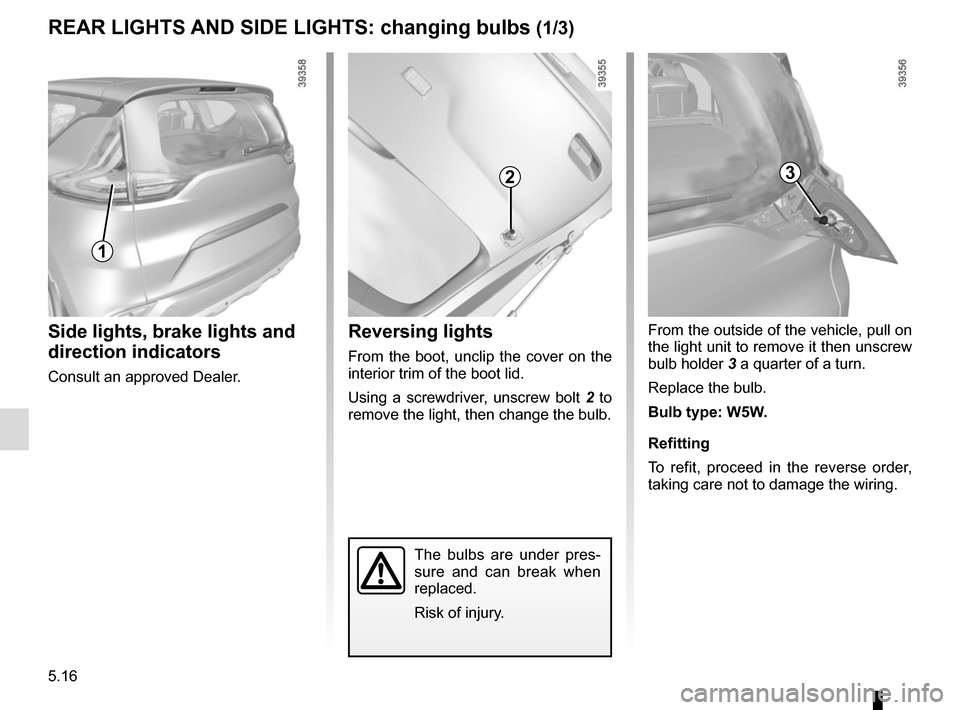
5.16
From the outside of the vehicle, pull on
the light unit to remove it then unscrew
bulb holder 3 a quarter of a turn.
Replace the bulb.
Bulb type: W5W.
Refitting
To refit, proceed in the reverse order,
taking care not to damage the wiring.
REAR LIGHTS AND SIDE LIGHTS: changing bulbs (1/3)
The bulbs are under pres-
sure and can break when
replaced.
Risk of injury.
Side lights, brake lights and
direction indicators
Consult an approved Dealer.
Reversing lights
From the boot, unclip the cover on the
interior trim of the boot lid.
Using a screwdriver, unscrew bolt 2 to
remove the light, then change the bulb.
23
1
Page 275 of 316

5.21
FUSES (1/2)
Fuse box
If any electrical component does not
work, check the condition of the fuses.
Unclip the access flap A.
Tweezers 1
Remove the fuse using tweezers 1, lo-
cated underneath the fuses.
To remove the fuse from the tweezers,
slide the fuse to the side.
It is not advisable to use the free fuse
locations.
Check the fuse in question
and replace it, if neces-
sary, by a fuse of the same
rating.
If a fuse is fitted where the rating is
too high, it may cause the electrical
circuit to overheat (risk of fire) in the
event of an item of equipment using
an excessive amount of current.
In accordance with local legislation
or as a precautionary measure:
obtain an emergency kit containing
a set of spare bulbs and fuses from
an approved Dealer.
A
1
Use the fuse allocation label in storage
compartment A to identify the fuses.
Certain fuses should only be replaced
by a qualified professional. These fuses
are not listed on the label.
Only change the fuses represented on
the label.
Page 312 of 316

Multi-Sense.............................................................\
.... 3.2 – 3.3
N
navigation ............................................................... 3.4")
7.4
ALPHABETICAL INDEX (4/5)
Multi-Sense.............................................................\
.... 3.2 – 3.3
N
navigation ............................................................... 3.43 – 3.44
navigation system ................................................... 3.43 – 3.44
O
oil change ..................................................................... 4.4, 4.6
opening the doors ....................................................1.8 → 1.13
operating faults ......................................................5.31 → 5.36
overspeed warning .......................................1.70, 2.49 → 2.51
P
paintwork maintenance ..................................................... 4.14 – 4.15
parking assistance: assisted parking 2.63 → 2.66, 2.69 → 2.72
parking distance control.........................................2.63 → 2.66
power-assisted steering.................................................\
.... 1.86
powered tailgate ....................................................1.15 → 1.19
puncture................................................. 5.2 → 5.4, 5.8 → 5.11
R
radio...................................................................\
..... 3.43 – 3.44
rear drive wheels ..........................................2.26 → 2.37, 2.37
rear parcel shelf ........................................................ 3.27, 3.36
rear screen de-icing/demisting .......................................... 3.11
rear seats functions ..........................................................3.30\
→ 3.34
rear view camera .................................................... 2.67 – 2.68
rear view mirrors ....................................................1.87 → 1.89
RENAULT ANTI-INTRUDER DEVICE (RAID) ................... 1.14
RENAULT card battery ................................................................\
.......... 5.25
use ....................................................................\
...1.2 → 1.7
RENAULT card battery ...................................................... 5.25
replacement parts ................................................................ 6.7 reverse gear
selecting ..................................................2.12, 2.74 → 2.79
reversing sensor ....................................................2.63 → 2.66
roof bars ........................................................................\
.... 3.42
roof rack roof bars ....................................................................... 3.42
running in ........................................................................\
..... 2.2
S
safety distance warning .......................................... 2.44 – 2.45
safety distances ...................................................... 2.44 – 2.45
screen fold-away screen .......................................................... 1.72
navigation display .................................. 1.71, 3.43 – 3.44
navigation screen ..................................... 1.71, 3.43 – 3.44
screen wash/wipe ............................................... 1.102 – 1.103
seat belt pretensioners ..........................................1.32 → 1.35
seat belts ................................ 1.28 → 1.30, 1.32 → 1.35, 1.38
see-me-home lighting ........................................................ 1.94
service sheets..........................................................\
6.8 → 6.13
shock absorbers ................................................................ 2.73
side indicator lights changing bulbs ............................................................. 5.18
sign detection: overspeed warning ........................2.49 → 2.51
signals and lights ...................................................1.91 → 1.95
special features of diesel versions.....................................\
2.11
special features of petrol vehicles ..................................... 2.10
speed limiter ..........................................................2.46 → 2.48
starting the engine .....................................................2.3 → 2.5
steering wheel adjustment .............................................................\
...... 1.86
Stop & Start ...............................................................2.6 → 2.9
Stop & Start function..................................................2.6 → 2.9
storage compartment.............................................3.23 → 3.27
storage compartments ..................................3.23 →
3.27, 3.37
sun blinds ........................................................................\
.. 3.22