2015 RENAULT ESPACE ECO mode
[x] Cancel search: ECO modePage 191 of 316

2.79
AUTOMATIC GEARBOX (6/6)
Special circumstances
– If the bends and road surface
do not allow you to stay in auto-
matic mode (e.g. in the mountains),
we recommend that you change
to either temporary or permanent
manual mode.
This will prevent the automatic gear-
box from changing gear repeatedly
when climbing, and permit engine
braking on long descents.
– In cold weather, wait a few seconds
before disengaging position P or N
and engage the lever in D or R to
prevent the engine stalling.
Operating faults
– When driving , if the “Check auto
gearbox” message appears on the
instrument panel, it indicates a fault.
Contact your approved Dealer as
soon as possible.
– When driving , if the message
“Gearbox overheating” appears on
the instrument panel, stop the ve-
hicle to allow the gearbox to cool
down.
Contact your approved Dealer as
soon as possible.
– If a vehicle with an automatic
gearbox breaks down, please refer
to the information on “Towing” in
Section 5.
An impact to the under-
side of the vehicle while
manoeuvring (e.g.: strik-
ing a post, raised kerb or
other street furniture) may result in
damage to the vehicle (e.g.: defor-
mation of an axle).
To avoid any risk of accident, have
your vehicle checked by an ap-
proved Dealer.
In very cold weather, the system
may prevent the gears from being
shifted in manual mode until the
gearbox reaches the right tempera-
ture.
Page 194 of 316

3.2
MULTI-SENSE (1/2)
The Multi-Sense system enables once
of five modes to be selected which, de-
pending on the vehicle, affect the drive,
the light environment, the comfort and
the engine noise:
– modes Comfort, Neutral, Eco and Sport are preset and associated with
customisable light environments and
engine noise;
– mode Perso is fully customisable.
The drive modes affect the:
– power-assisted steering;
– piloted suspension damping;
– four-wheel drive;
– engine and gearbox responsiveness;
– heating level.
They also affect the:
– passenger compartment and instru- ment panel lighting;
– instrument panel and multifunction screen information;
– engine noise;
– massage seat.
After each start-up, the vehicle uses the
mode set at the time the engine was
last switched off.
Mode Comfort
This mode favours flexibility in the sus-
pension and steering. The interior envi-
ronment is softened.
Mode Neutral
Default mode, mode Neutral selects the
vehicle factory settings.
Mode Eco
Mode Eco is geared towards saving
energy and the environment. The sus-
pension and steering are soft, engine
and gearbox management enable fuel
consumption to be lowered. Air con-
ditioning is managed to be used only
when necessary.
Please refer to the information on
“Driving advice, Eco-driving” in
Section 2.
Multi-Sense
Sport Eco
Neutral Comfort Perso
In all modes, it is possible to change
the colour of the ambient lighting as
well as the format of the information
displayed on the instrument panel
and multifunction display.
You can also reset to the default set-
tings.
Page 195 of 316

3.3
MULTI-SENSE (2/2)Accessing the menu
You can access Multi-Sense:
– from the multifunction screen 1.
Select menu “Vehicle” then “Multi-
Sense”;
– using switch 2;
– using button Eco 3 which automati-
cally launches Eco mode and opens
the 'Multi-Sense' menu on the multi-
function screen 1 for a few seconds.
Sport mode
This mode allows greater responsive-
ness from the engine and gearbox,
making the suspension and steering
firmer.
Mode Perso
This mode enables you to manually
configure the drive, light environment
and, depending on the vehicle, the
comfort and engine noise.
1
2
3
Depending on the vehicle, once the
“Multi-Sense” menu is displayed on
the multifunction screen 1 , pressing
switch 2 enables you to move between
the two preferential modes you have
selected. Refer to the handbook for the
equipment.
Stopping the engine in Sport
mode, or Perso mode with engine
setting in Sport mode.
When you restart the vehicle, a mes-
sage asks you if you wish to keep
the engine setting in Sportmode.
Page 206 of 316
3.14
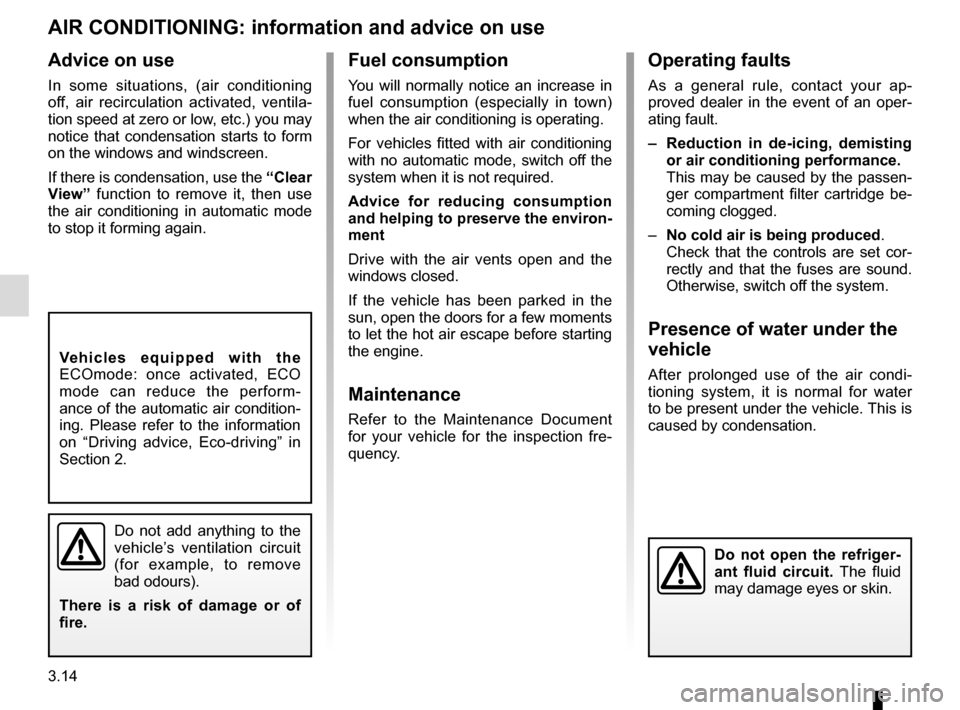
AIR CONDITIONING: information and advice on use
Do not add anything to the
vehicle’s ventilation circuit
(for example, to remove
bad odours).
There is a risk of damage or of
fire.
Do not open the refriger-
ant fluid circuit. The fluid
may damage eyes or skin.
Fuel consumption
You will normally notice an increase in
fuel consumption (especially in town)
when the air conditioning is operating.
For vehicles fitted with air conditioning
with no automatic mode, switch off the
system when it is not required.
Advice for reducing consumption
and helping to preserve the environ-
ment
Drive with the air vents open and the
windows closed.
If the vehicle has been parked in the
sun, open the doors for a few moments
to let the hot air escape before starting
the engine.
Maintenance
Refer to the Maintenance Document
for your vehicle for the inspection fre-
quency.
Operating faults
As a general rule, contact your ap-
proved dealer in the event of an oper-
ating fault.
– Reduction in de-icing, demisting or air conditioning performance.
This may be caused by the passen-
ger compartment filter cartridge be-
coming clogged.
– No cold air is being produced .
Check that the controls are set cor-
rectly and that the fuses are sound.
Otherwise, switch off the system.
Presence of water under the
vehicle
After prolonged use of the air condi-
tioning system, it is normal for water
to be present under the vehicle. This is
caused by condensation.
Advice on use
In some situations, (air conditioning
off, air recirculation activated, ventila-
tion speed at zero or low, etc.) you may
notice that condensation starts to form
on the windows and windscreen.
If there is condensation, use the “Clear
View” function to remove it, then use
the air conditioning in automatic mode
to stop it forming again.
Vehicles equipped with the
ECOmode: once activated, ECO
mode can reduce the perform-
ance of the automatic air condition-
ing. Please refer to the information
on “Driving advice, Eco-driving” in
Section 2.
Page 208 of 316

3.16
Operating faults
In case of a fault when closing a
window, the system reverts to normal
mode: pull the switch as many times as
necessary until the window closes com-
pletely, hold the switch (still on the clo-
sing side) for around one second, then
completely lower then raise the window
to reset the system.
If necessary, contact an approved
Dealer.
ELECTRIC WINDOWS (2/2)Remote control window
closing
(vehicles with 4 one-touch electric win-
dows).
When you lock the doors from the out-
side, press the locking button on the
RENAULTcard twice in quick suc-
cession, or on the driver’s door in
hands-free mode, and all the windows
will close automatically (and, depen-
ding on the vehicle, the sunroof).
It is recommended that the user only
operates the system when the vehi-
cle can be seen clearly and no one is
inside.
Closing windows can cause
serious injury.
One-touch mode
This mode works in addition to the ope-
ration of the electric windows described
previously.
Briefly press or pull the window switch
fully: the window is fully lowered or
raised. Pressing the switch again stops
the window moving.
Page 310 of 316
7.2
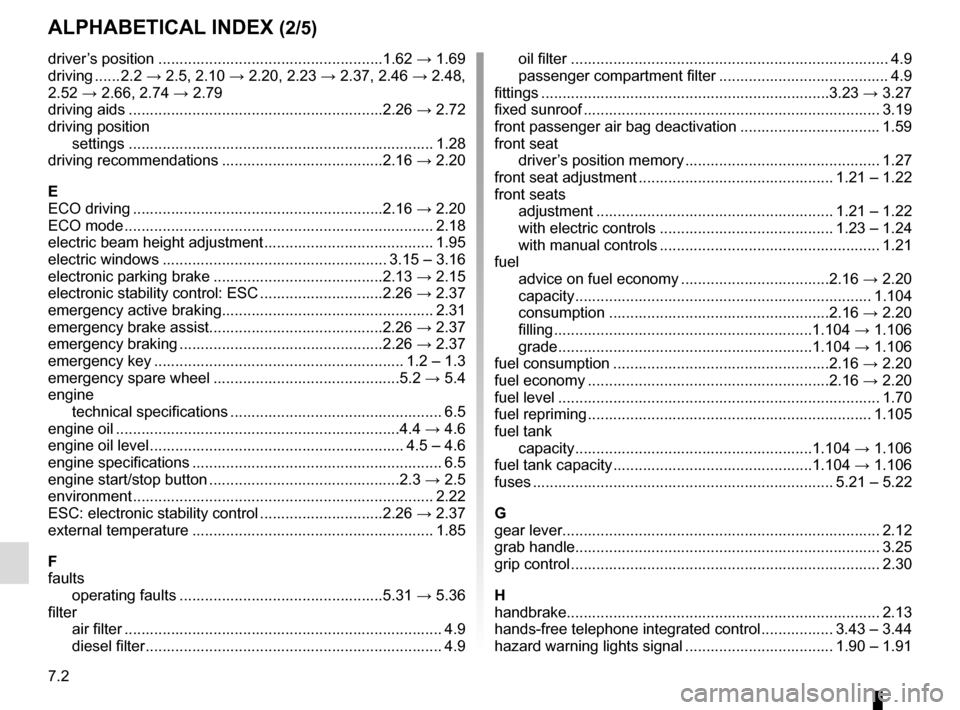
ALPHABETICAL INDEX (2/5)
driver’s position .....................................................1.62 → 1.69
driving ...... 2.2 → 2.5, 2.10 → 2.20, 2.23 → 2.37, 2.46 → 2.48,
2.52 → 2.66, 2.74 → 2.79
driving aids ............................................................2.26 → 2.72
driving position settings ...............................................................\
......... 1.28
driving recommendations ......................................2.16 → 2.20
E
ECO driving ...........................................................2.16 → 2.20
ECO mode ........................................................................\
. 2.18
electric beam height adjustment ........................................ 1.95
electric windows ..................................................... 3.15 – 3.16
electronic parking brake ........................................2.13 → 2.15
electronic stability control: ESC .............................2.26 → 2.37
emergency active braking................................................\
.. 2.31
emergency brake assist.........................................2.26 → 2.37
emergency braking ................................................2.26 → 2.37
emergency key ........................................................... 1.2 – 1.3
emergency spare wheel ............................................5.2 → 5.4
engine technical specifications .................................................. 6.5
engine oil ...................................................................4.4 → 4.6
engine oil level ............................................................ 4.5 – 4.6
engine specifications ........................................................... 6.5
engine start/stop button .............................................2.3 → 2.5
environment ............................................................\
........... 2.22
ESC: electronic stability control .............................2.26 → 2.37
external temperature ......................................................... 1.85
F
faults operating faults ................................................5.31 → 5.36
filter air filter ........................................................................\
... 4.9
diesel filter ...................................................................... 4.9 oil filter ........................................................................\
... 4.9
passenger compartment filter ........................................ 4.9
fittings ...............................................................\
.....3.23 → 3.27
fixed sunroof ...................................................................... 3.19
front passenger air bag deactivation ................................. 1.59
front seat driver’s position memory .............................................. 1.27
front seat adjustment .............................................. 1.21 – 1.22
front seats adjustment ........................................................ 1.21 – 1.22
with electric controls ......................................... 1.23 – 1.24
with manual controls .................................................... 1.21
fuel advice on fuel economy ...................................2.16 → 2.20
capacity ...............................................................\
....... 1.104
consumption ....................................................2.16 → 2.20
filling .............................................................1.1\
04 → 1.106
grade ............................................................1.104 \
→ 1.106
fuel consumption ...................................................2.16 → 2.20
fuel economy .........................................................2.16 → 2.20
fuel level ........................................................................\
.... 1.70
fuel repriming ................................................................... 1.105
fuel tank capacity ........................................................1.104 → 1.106
fuel tank capacity ...............................................1.104 → 1.106
fuses ....................................................................... 5.21 – 5.22
G
gear lever..............................................................\
............. 2.12
grab handle.............................................................\
........... 3.25
grip control ........................................................................\
.
2.30
H
handbrake...............................................................\
........... 2.13
hands-free telephone integrated control ................. 3.43 – 3.44
hazard warning lights signal ................................... 1.90 – 1.91