Page 44 of 316

1.38
ADDITIONAL METHODS OF RESTRAINT
The airbag is designed to complement the action of the seat belt. Both t\
he air bags and seat belts are integral parts of
the same protection system. It is therefore essential to wear seat belts\
at all times. If seat belts are not worn, the oc-
cupants are exposed to the risk of serious injury in the event of an acc\
ident. It may also increase the risk of minor su-
perficial injuries occurring when the airbag is deployed, although such \
minor injuries are always possible with air bags.
If the vehicle should overturn or in the event of a rear impact, however\
severe, the pretensioners and airbags are not always
triggered. Impacts to the underside of the vehicle, e.g. from pavements,\
potholes or stones, can all trigger these systems.
– No work or modification whatsoever may be carried out on any part of the airbag system (airbags, pretensi\
oners, computer,
wiring harness, etc.), except by qualified Network personnel.
– To ensure that the system is in good working order and to avoid accidenta\
l triggering of the system which may cause injury, only qualified Network personnel may work on the airbag system.
– As a safety precaution, have the airbag system checked if your vehicle h\
as been involved in an accident, or is stolen or broken into.
– When selling or lending the vehicle, inform the user of these points and\
hand over this handbook with the vehicle.
– When scrapping your vehicle, contact your approved Dealer for disposal o\
f the gas generator(s).
All of the warnings below are given so that the airbag is not obstructed in any way when it is inflated and also to prevent
the risk of serious injuries caused by items which may be dislodged when\
it inflates.
Page 48 of 316
1.42
CHILD SAFETY: choosing a child seat mounting (1/3)
There are two ways of attaching child
seats: via the seat belt or using the
ISOFIX system.
The seat belt must never
be twisted or the tension
relieved. Never pass the
shoulder strap under the
arm or behind the back.
Check that the seat belt has not
been damaged by sharp edges.
If the seat belt does not operate nor-
mally, it will not protect the child.
Consult an approved dealer. Do not
use this seat until the seat belt has
been repaired.
Do not use the child seat
if it may unfasten the seat
belt restraining it: the base
of the seat must not rest on
the buckle and/or catch of the seat
belt.
Attachment via the seat belt
The seat belt must be adjusted to
ensure that it is effective in the event of
harsh braking or an impact.
Ensure that the strap paths indicated
by the child seat manufacturer are re-
spected.
Always check that the seat belt is cor-
rectly fastened by pulling it up, then
pulling it out fully whilst pressing on the
child seat.
Check that the seat is correctly held by
moving it from side to side and back
to front: the seat should remain firmly
fixed.
Check that the child seat has not been
installed at an angle and that it is not
resting against a window.
Page 51 of 316

1.45
CHILD SAFETY: fitting a child seat, general information (1/2)
The types of child seat indicated may
not be available. Before using a differ-
ent child seat, check with the manufac-
turer that it can be fitted.
In the front seat
The laws concerning children travel-
ling in the front passenger seat differ in
every country. Consult the legislation in
force and follow the indications on the
diagram on the following page.
Before fitting a child seat in this seat (if
authorised):
– lower the seat belt as far as possible;
– move the seat as far back as possi-ble;
– gently tilt the seatback away from vertical (approximately 25°);
– on equipped vehicles, raise the seat base as far as possible.
In all situations, reinsert the headrest to
its full extent so that it does not interfere
with the child seat (see the information
on “Front headrests” in Section 1);
Some seats are not suitable for fitting
child seats. The diagram on the follow-
ing page shows you how to attach a
child seat.
Fit the child seat in a rear
seat wherever possible.
Make sure that the child
seat or the child’s feet do
not prevent the front seat from lock-
ing correctly. Refer to the informa-
tion on the “Front seat” in Section 1.
Check that when installing the child
seat in the vehicle it is not at risk of
coming loose from its base.
If you have to remove the headrest,
check that it is correctly stored so
that it does not come loose under
harsh braking or impact.
Always attach the child seat to the
vehicle even if it is not in use so that
it does not come loose under harsh
braking or impact.
RISK OF DEATH OR
SERIOUS INJURY: before
fitting a rear-facing child
seat to this seat, check
that the air bag has been deacti-
vated (refer to the information on
“Child safety: deactivating/activat-
ing the front passenger air bag” in
Section 1).
After installing the child seat, if neces-
sary, the seat may be advanced (so as
to leave enough space in the rear seats
for passengers or other child seats).
For a rear-facing child seat, do not let
it touch the dashboard or move it to the
furthest forward position.
Do not change other settings after in-
stalling the child seat.
Page 53 of 316
1.47
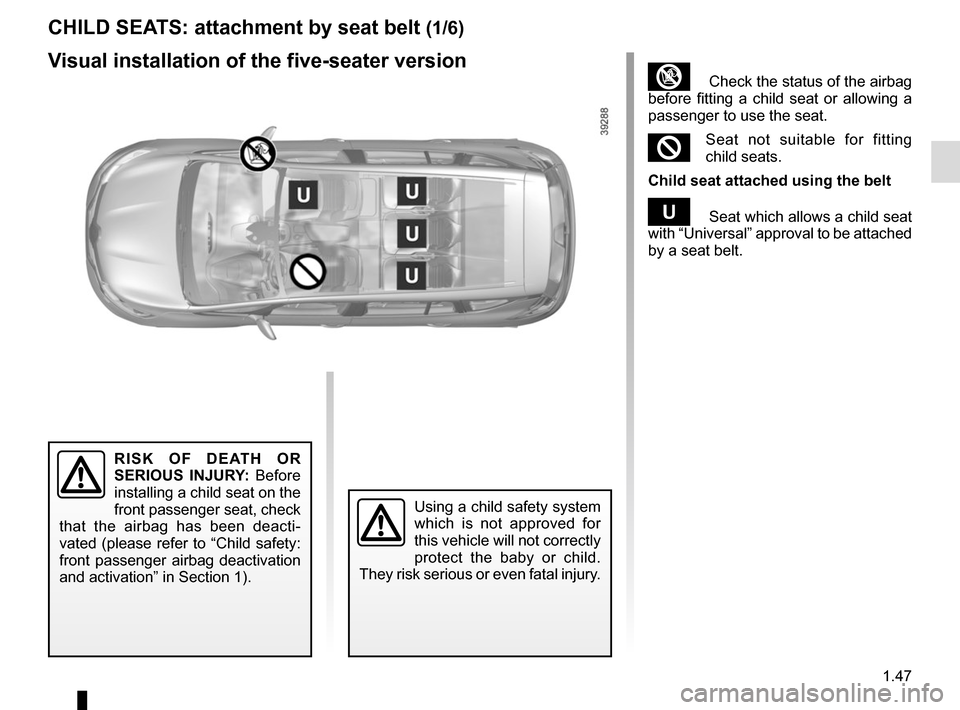
CHILD SEATS: attachment by seat belt (1/6)
Visual installation of the five-seater version
RISK OF DEATH OR
SERIOUS INJURY: Before
installing a child seat on the
front passenger seat, check
that the airbag has been deacti-
vated (please refer to “Child safety:
front passenger airbag deactivation
and activation” in Section 1).
Using a child safety system
which is not approved for
this vehicle will not correctly
protect the baby or child.
They risk serious or even fatal injury.
³ Check the status of the airbag
before fitting a child seat or allowing a
passenger to use the seat.
²Seat not suitable for fitting
child seats.
Child seat attached using the belt
¬ Seat which allows a child seat
with “Universal” approval to be attached
by a seat belt.
Page 54 of 316
1.48
CHILD SEATS: attachment by seat belt (2/6)
Five-seater version
Type of child seat Weight of the child Front passenger
seat (1) Rear side seats Rear centre seat
Carrycot fitted
across the vehicle
Group 0 < 10 kg X U (2) X
Rear-facing shell
seat
Groups 0 or 0 + < 10 kg and < 13 kg U (5) U (3) U (3)
Shell seat/rear-facing
seat
Groups 0+ and 1 < 13 kg and 9 to 18 kg U (5) U (3) U (3)
Forward-facing seat
Group 1 9 to 18 kg X U (3) (4) U (3) (4)
Booster seat
Groups 2 and 3 15 to 25 kg and 22 to
36 kg
X U (3) (4) U (3) (4)
(1) RISK OF DEATH OR SERIOUS INJURY: Before installing a child seat on the front passenger seat, check that \
the airbag has been deactivated (please refer to “Child safety: fron\
t passenger airbag deactivation and activation” in
Section 1).
The table below summarises the information already shown on the diagram \
on the previous page, to ensure the applica-
ble regulations are respected.
Page 56 of 316
1.50
CHILD SEATS: attachment by seat belt (4/6)
Seven-seat version
Type of child seat Weight of the child Front passenger
seat (1) Row 2 rear
side seats Row 2 rear
centre seat Row 3 rear
centre seat (5)
Carrycot fitted
across the vehicle
Group 0 < 10 kg X U (2) X U
Rear-facing shell
seat
Groups 0 or 0 + < 10 kg and < 13 kg U (6) U (3) U (3) U
Shell seat/rear-facing
seat
Groups 0+ and 1 < 13 kg and 9 to 18 kg U (6) U (3) U (3) U
Forward-facing seat
Group 1 9 to 18 kg X U (3) (4) U (3) (4) U
Booster seat
Groups 2 and 3 15 to 25 kg and 22 to
36 kg
X U (3) (4) U (3) (4) U
(1) RISK OF DEATH OR SERIOUS INJURY: Before installing a child seat on the front passenger seat, check that \
the airbag has been deactivated (please refer to “Child safety: fron\
t passenger airbag deactivation and activation” in
Section 1).
The table below summarises the information already shown in the diagram \
on the following pages, to ensure the appli-
cable regulations are respected.
Page 58 of 316
1.52
³ Check the status of the airbag
before fitting a child seat or allowing a
passenger to use the seat.
²Seat not suitable for fitting
child seats.
Child seat attached using the belt
¬ Seat which allows a child seat
with “Universal” approval to be attached
by a seat belt.
Using a child safety system
which is not approved for
this vehicle will not correctly
protect the baby or child.
They risk serious or even fatal injury.
RISK OF DEATH OR
SERIOUS INJURY: Before
installing a child seat on the
front passenger seat, check
that the airbag has been deacti-
vated (please refer to “Child safety:
front passenger airbag deactivation
and activation” in Section 1).
CHILD SEATS: attachment by seat belt (6/6)
Installation diagram, 7-seater version
Page 65 of 316
1.59
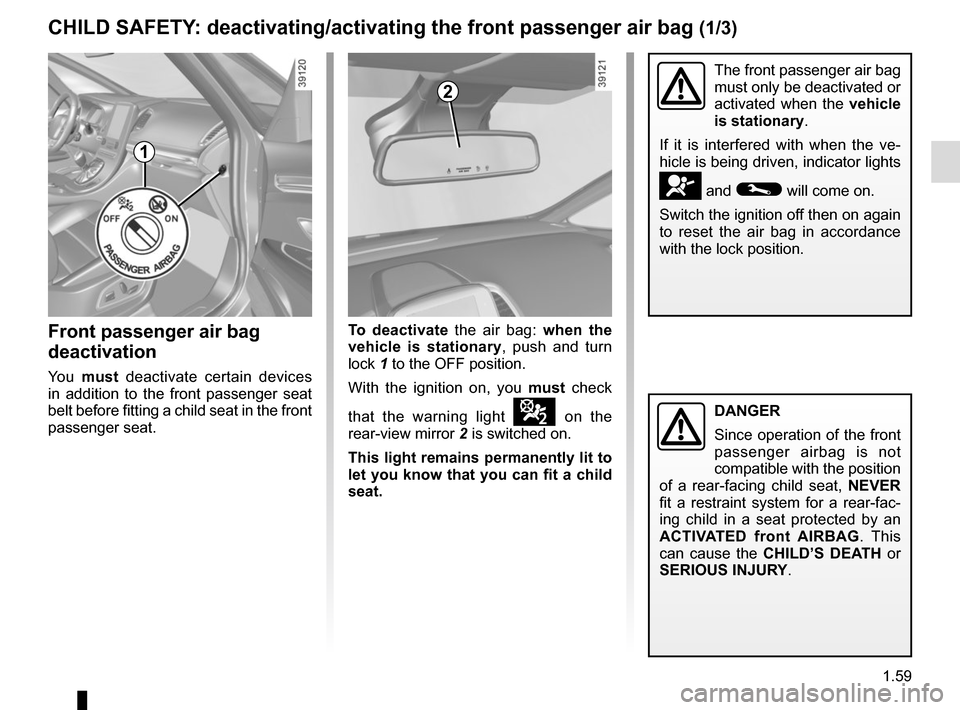
Front passenger air bag
deactivation
You must deactivate certain devices
in addition to the front passenger seat
belt before fitting a child seat in the front
passenger seat.
The front passenger air bag
must only be deactivated or
activated when the vehicle
is stationary.
If it is interfered with when the ve-
hicle is being driven, indicator lights
å and © will come on.
Switch the ignition off then on again
to reset the air bag in accordance
with the lock position.
CHILD SAFETY: deactivating/activating the front passenger air bag (1/3)
To deactivate the air bag: when the
vehicle is stationary, push and turn
lock 1 to the OFF position.
With the ignition on, you must check
that the warning light
¹ on the
rear-view mirror 2 is switched on.
This light remains permanently lit to
let you know that you can fit a child
seat.DANGER
Since operation of the front
passenger airbag is not
compatible with the position
of a rear-facing child seat, NEVER
fit a restraint system for a rear-fac-
ing child in a seat protected by an
ACTIVATED front AIRBAG . This
can cause the CHILD’S DEATH or
SERIOUS INJURY.
2
1