Page 3 of 130
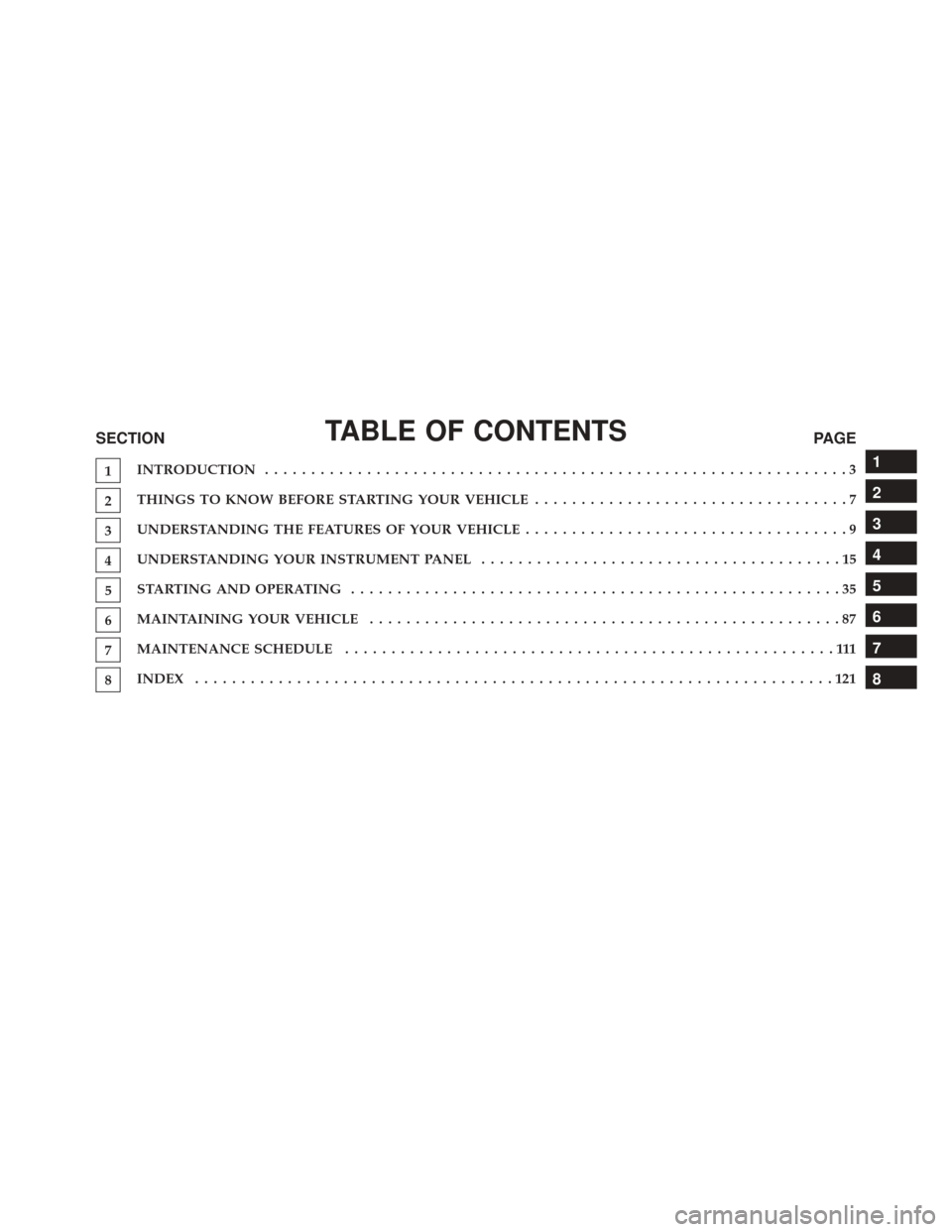
TABLE OF CONTENTSSECTIONPAGE
1INTRODUCTION .
..............................................................3
2THINGS TO KNOW BEFORE STARTING YOUR VEHICLE
..................................7
3UNDERSTANDING THE FEATURES OF YOUR VEHICLE
...................................9
4UNDERSTANDING YOUR INSTRUMENT PANEL
.......................................15
5STARTINGANDOPERATING .....................................................35
6MAINTAININGYOURVEHICLE ...................................................87
7MAINTENANCE SCHEDULE
.....................................................111
8INDEX .....................................................................121
1
2
3
4
5
6
7
8
Page 65 of 130
Biodiesel Fuel Requirements
A maximum blend of 5% biodiesel meeting ASTM speci-
fication D975 is recommended for use with your diesel
engine. If frequent operation with Biodiesel blends that
are between 6% and 20% (B6–B20) is desired, the main-
tenance schedule is subject to shorter intervals.
The oil and filter change along with fuel filter replace-
ment is subject to shorter intervals when operating your
engine on biodiesel greater than 5%. Do not use biodiesel
greater than 20%.
For regular use of biodiesel blends between 6% and 20%
(B6–B20) it is important that you understand and comply
with these requirements. Refer to the “Maintenance
Chart” in the “Maintenance Schedules” section for fur-
ther direction.
CAUTION!
Failure to comply with Oil Change requirements for
vehicles operating on biodiesel blends between 6%
and 20% (B6–B20) will result in premature engine
wear. Such wear is not covered by the New Vehicle
Limited Warranty.
Biodiesel is a fuel produced from renewable resources
typically derived from animal fat, rapeseed oil (Rapeseed
Methyl Ester (RME) base), or soybean oil (Soy Methyl
Ester (SME or SOME) base).
Biodiesel fuel has inherent limitations which require that
you understand and adhere to the following require-
ments if you use blends of Biodiesel between 6% and 20%
(B6–B20). There are no unique restrictions for the use of
B5.
5
STARTING AND OPERATING 63
Page 81 of 130
Perform the maintenance listed in the “Maintenance
Schedule.” Refer to “Maintenance Schedule” for the
proper maintenance intervals. When towing a trailer,
never exceed the GAWR or GCWR ratings.
WARNING!
Improper towing can lead to a collision. Follow these
guidelines to make your trailer towing as safe as
possible:
•Make certain that the load is secured in the trailer
and will not shift during travel. When trailering
cargo that is not fully secured, dynamic load shifts
can occur that may be difficult for the driver to
control. You could lose control of your vehicle and
have a collision.
• When hauling cargo or towing a trailer, do not
overload your vehicle or trailer. Overloading can
(Continued)
WARNING! (Continued)
cause a loss of control, poor performance or dam-
age to brakes, axle, engine, transmission, steering,
suspension, chassis structure or tires.
• Safety chains must always be used between your
vehicle and trailer. Always connect the chains to
the hook retainers of the vehicle hitch. Cross the
chains under the trailer tongue and allow enough
slack for turning corners.
• Vehicles with trailers should not be parked on a
grade. When parking, apply the parking brake on
the tow vehicle. For four-wheel drive vehicles,
make sure the transfer case is not in NEUTRAL.
Always, block or �chock�the trailer wheels.
• GCWR must not be exceeded.
(Continued)
5
STARTING AND OPERATING 79
Page 91 of 130
MAINTENANCE PROCEDURES
The pages that follow contain therequiredmaintenance
services determined by the engineers who designed your
vehicle.
Besides those maintenance items specified in the fixed
maintenance schedule, there are other components which
may require servicing or replacement in the future.
CAUTION!
• Failure to properly maintain your vehicle or per-
form repairs and service when necessary could
result in more costly repairs, damage to other
components or negatively impact vehicle perfor-
mance. Immediately have potential malfunctions
examined by an authorized dealership or qualified
repair center.
(Continued)
CAUTION! (Continued)
•Your vehicle has been built with improved fluids
that protect the performance and durability of your
vehicle and also allow extended maintenance inter-
vals. Do not use chemical flushes in these compo-
nents as the chemicals can damage your engine,
transmission, power steering or air conditioning.
Such damage is not covered by the New Vehicle
Limited Warranty. If a flush is needed because of
component malfunction, use only the specified
fluid for the flushing procedure.
6
MAINTAINING YOUR VEHICLE 89
Page 93 of 130

only when the level on the dipstick is below the mini-
mum notch. The total capacity from the minimum notch
to the maximum notch is 1.7 quarts (1.6 liters).
CAUTION!
Overfilling or underfilling the crankcase will cause
oil aeration or loss of oil pressure. This could damage
your engine.
NOTE: It is possible for your oil level to be slightly
higher than a previous check. This would be due to diesel
fuel that may temporarily be in the crankcase due to
operation of the diesel particulate filter regeneration
strategy. This fuel will evaporate out under normal
operation.
Never operate the engine with oil level below the mini-
mum notch or above the upper maximum notch.
Change Engine Oil
Refer to the “Maintenance Schedule” for the proper
maintenance intervals.
Engine Oil Viscosity (SAE Grade)
CAUTION!
Your vehicle is equipped with an advanced technol-
ogy Diesel Engine and an emission device designed
to limit Diesel Particulate Emissions from being
released into the atmosphere. The durability of your
engine and life expectancy of this diesel particulate
filter emission device is highly dependent on the use
of the correct engine oil.
Only use ACEA C3 SAE 5W-30 Synthetic Low Ash engine
oil meeting FCA US Material Standard MS-11106 or
Pennzoil Ultra Euro L full synthetic 5W-30 motor oil,
6
MAINTAINING YOUR VEHICLE 91
Page 94 of 130
which is recommended for all operating temperatures.
This engine oil improves low temperature starting and
vehicle fuel economy.
Materials Added To Engine Oil
The manufacturer strongly recommends against the ad-
dition of any additives (other than leak detection dyes) to
the engine oil. Engine oil is an engineered product and its
performance may be impaired by supplemental addi-
tives.
Engine Oil Filter
Refer to “Fluids, Lubricants, And Genuine Parts” in
“Maintaining Your Vehicle” for further information. The
engine oil filter should be changed at every engine oil
change.
Disposing Of Used Engine Oil And Oil Filters
Care should be taken in disposing of used engine oil and
oil filters from your vehicle. Used oil and oil filters,
indiscriminately discarded, can present a problem to the
environment. Contact your authorized dealer, service
station or governmental agency for advice on how and
where used oil and oil filters can be safely discarded in
your area.
Engine Air Cleaner Filter
Refer to the “Maintenance Schedule” for the proper
maintenance intervals.
CAUTION!
All air entering the engine intake must be filtered.
The abrasive particles in unfiltered air will cause
rapid wear to engine components.
92 MAINTAINING YOUR VEHICLE
Page 100 of 130

spraying water from a garden hose vertically down the
face of the A/C condenser (if equipped) or the back of the
radiator core.
Check the engine cooling system hoses for brittle rubber,
cracking, tears, cuts and tightness of the connection at the
coolant recovery bottle and radiator. Inspect the entire
system for leaks.
With the engine at normal operating temperature (but
not running), check the cooling system pressure cap for
proper vacuum sealing by draining a small amount of
engine coolant (antifreeze) from the radiator drain cock.
The radiator drain cock is located in the lower radiator
tank. If the cap is sealing properly, the engine coolant
(antifreeze) will begin to drain from the coolant expan-
sion bottle. DO NOT REMOVE THE COOLANT PRES-
SURE CAP WHEN THE COOLING SYSTEM IS HOT.Cooling System — Drain Flush And Refill
If the engine coolant (antifreeze) is dirty or contains a
considerable amount of sediment, clean and flush with a
reliable cooling system cleaner. Follow with a thorough
rinsing to remove all deposits and chemicals. Properly
dispose of old engine coolant (antifreeze).
Refer to the “Maintenance Schedule” for the proper
maintenance intervals.
Selection Of Coolant
Refer to “Fluids, Lubricants, And Genuine Parts” in
“Maintaining Your Vehicle” for further information.
98 MAINTAINING YOUR VEHICLE
Page 113 of 130
MAINTENANCE SCHEDULE
CONTENTS
�MAINTENANCE SCHEDULE — DIESEL
ENGINE .............................112
▫ Maintenance Chart — Diesel Fuel Up To B5
Biodiesel ............................114 ▫
ADDITIONAL MAINTENANCE — B6 TO B20
BIODIESEL ..........................118
7