Page 106 of 130

WARNING!(Continued)
•To avoid contamination from foreign matter or
moisture, use only new brake fluid or fluid that has
been in a tightly closed container. Keep the master
cylinder reservoir cap secured at all times. Brake
fluid in a open container absorbs moisture from the
air resulting in a lower boiling point. This may
cause it to boil unexpectedly during hard or pro-
longed braking, resulting in sudden brake failure.
This could result in a accident.
•
Overfilling the brake fluid reservoir can result in
spilling brake fluid on hot engine parts, causing the
brake fluid to catch fire. Brake fluid can also damage
painted and vinyl surfaces, care should be taken to
avoid its contact with these surfaces.
•Do not allow petroleum based fluid to contaminate
the brake fluid. Brake seal components could be
damaged, causing partial or complete brake failure.
This could result in an accident.
Automated Manual Transmission
Checking Fluid Levels
To check the gear oil and check/replace the hydraulic
clutch operating system fluid, contact only your autho-
rized dealer.
NOTE: Do not add or use leak detection dye in the
hydraulic clutch operating system fluid.
WARNING!
Used gear oil contains substances that are hazardous
for the environment. It is advisable to have oil
changed by your authorized dealer where used oil
will be disposed of according to the law.
104 MAINTAINING YOUR VEHICLE
Page 107 of 130
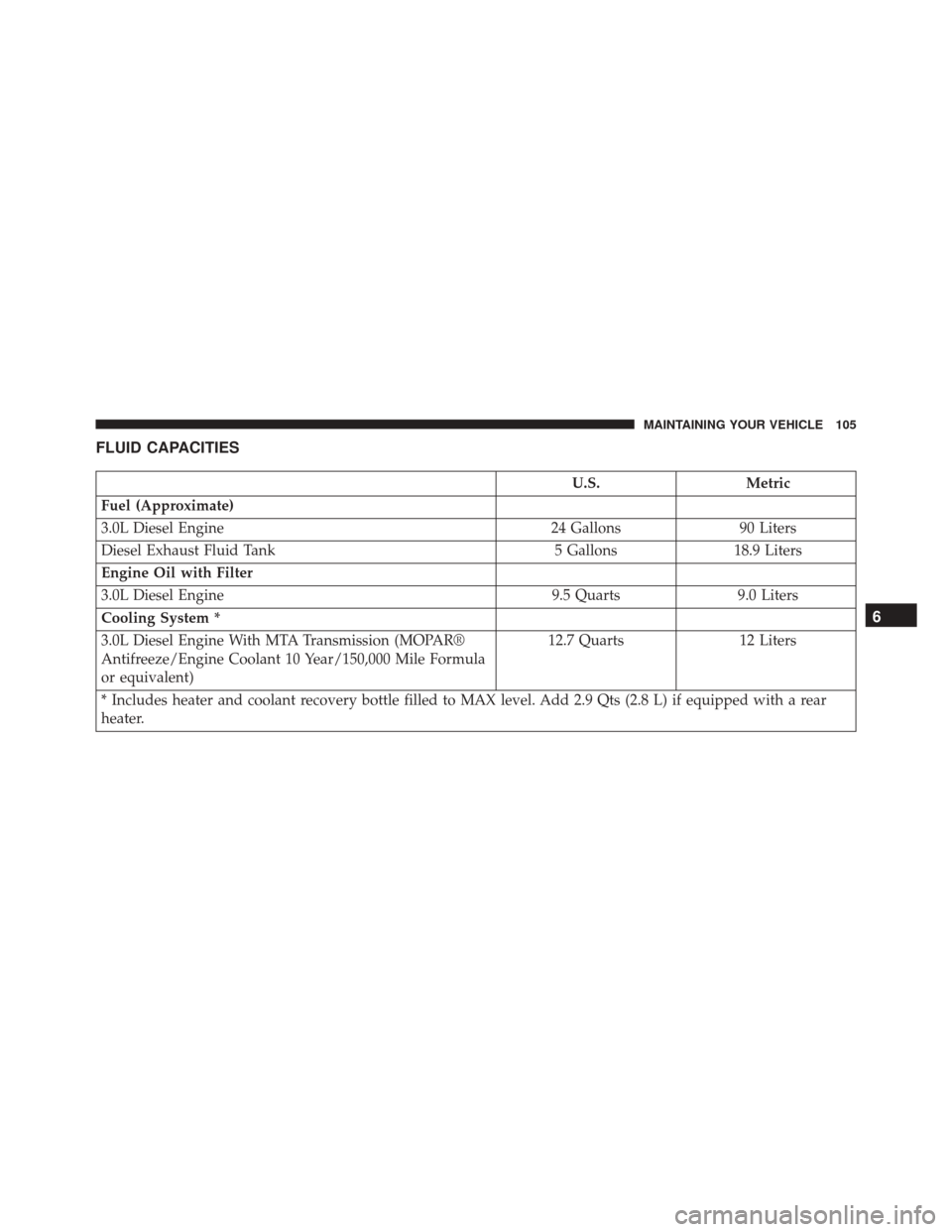
FLUID CAPACITIES
U.S.Metric
Fuel (Approximate)
3.0L Diesel Engine 24 Gallons90 Liters
Diesel Exhaust Fluid Tank 5 Gallons18.9 Liters
Engine Oil with Filter
3.0L Diesel Engine 9.5 Quarts9.0 Liters
Cooling System *
3.0L Diesel Engine With MTA Transmission (MOPAR®
Antifreeze/Engine Coolant 10 Year/150,000 Mile Formula
or equivalent) 12.7 Quarts
12 Liters
* Includes heater and coolant recovery bottle filled to MAX level. Add 2.9 Qts (2.8 L) if equipped with a rear
heater.
6
MAINTAINING YOUR VEHICLE 105
Page 108 of 130
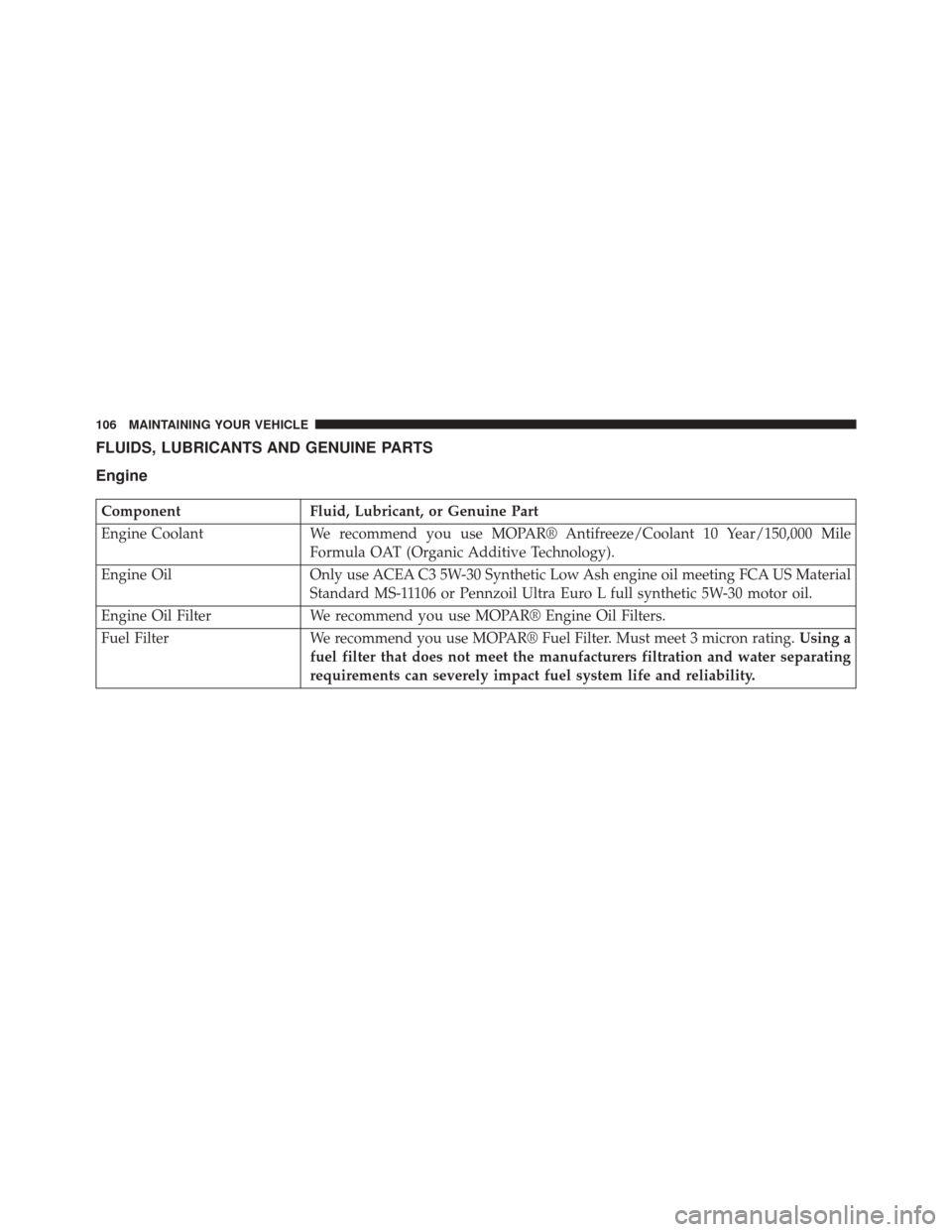
FLUIDS, LUBRICANTS AND GENUINE PARTS
Engine
ComponentFluid, Lubricant, or Genuine Part
Engine Coolant We recommend you use MOPAR® Antifreeze/Coolant 10 Year/150,000 Mile
Formula OAT (Organic Additive Technology).
Engine Oil Only use ACEA C3 5W-30 Synthetic Low Ash engine oil meeting FCA US Material
Standard MS-11106 or Pennzoil Ultra Euro L full synthetic 5W-30 motor oil.
Engine Oil Filter We recommend you use MOPAR® Engine Oil Filters.
Fuel Filter We recommend you use MOPAR® Fuel Filter. Must meet 3 micron rating. Using a
fuel filter that does not meet the manufacturers filtration and water separating
requirements can severely impact fuel system life and reliability.
106 MAINTAINING YOUR VEHICLE
Page 109 of 130
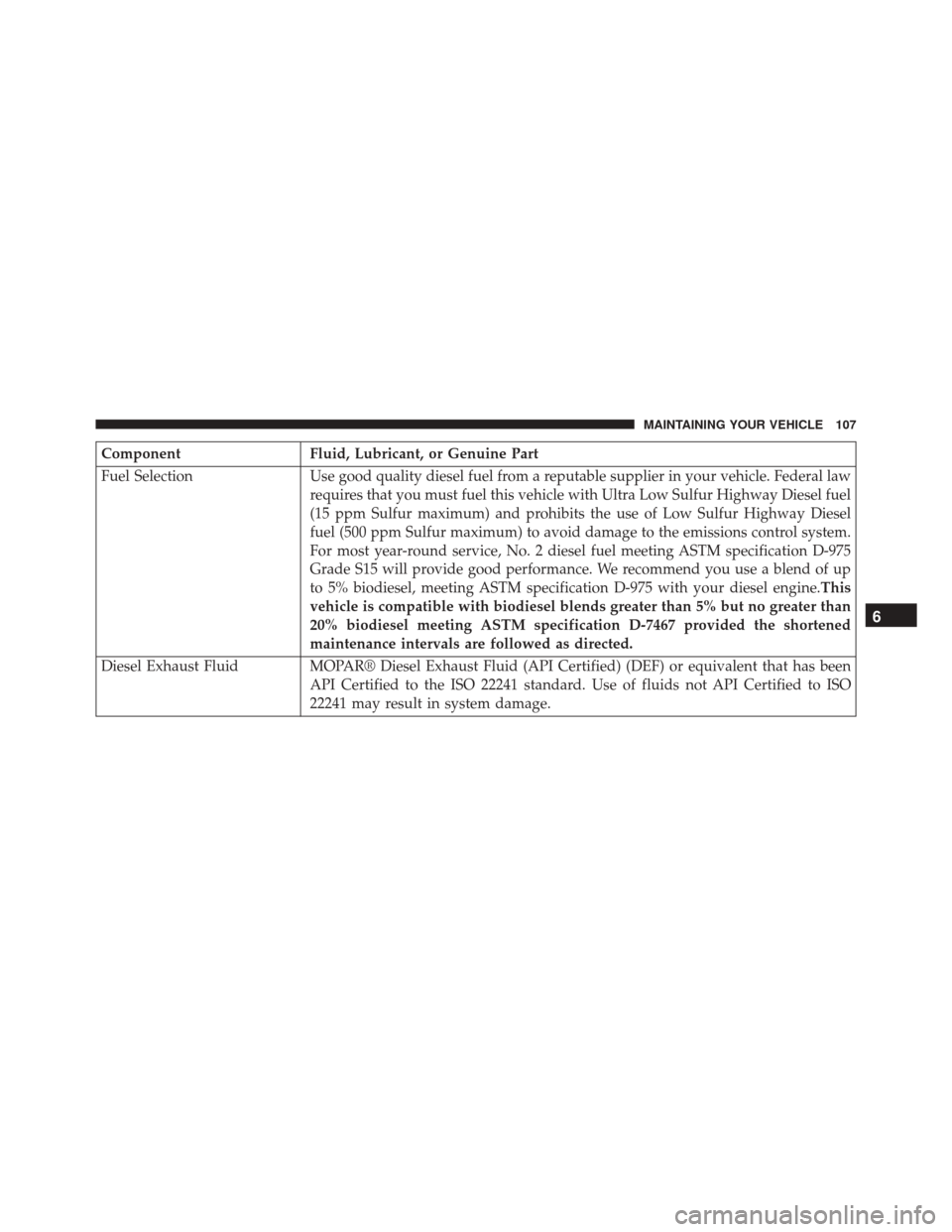
ComponentFluid, Lubricant, or Genuine Part
Fuel Selection Use good quality diesel fuel from a reputable supplier in your vehicle. Federal law
requires that you must fuel this vehicle with Ultra Low Sulfur Highway Diesel fuel
(15 ppm Sulfur maximum) and prohibits the use of Low Sulfur Highway Diesel
fuel (500 ppm Sulfur maximum) to avoid damage to the emissions control system.
For most year-round service, No. 2 diesel fuel meeting ASTM specification D-975
Grade S15 will provide good performance. We recommend you use a blend of up
to 5% biodiesel, meeting ASTM specification D-975 with your diesel engine. This
vehicle is compatible with biodiesel blends greater than 5% but no greater than
20% biodiesel meeting ASTM specification D-7467 provided the shortened
maintenance intervals are followed as directed.
Diesel Exhaust Fluid MOPAR® Diesel Exhaust Fluid (API Certified) (DEF) or equivalent that has been API Certified to the ISO 22241 standard. Use of fluids not API Certified to ISO
22241 may result in system damage.
6
MAINTAINING YOUR VEHICLE 107
Page 110 of 130
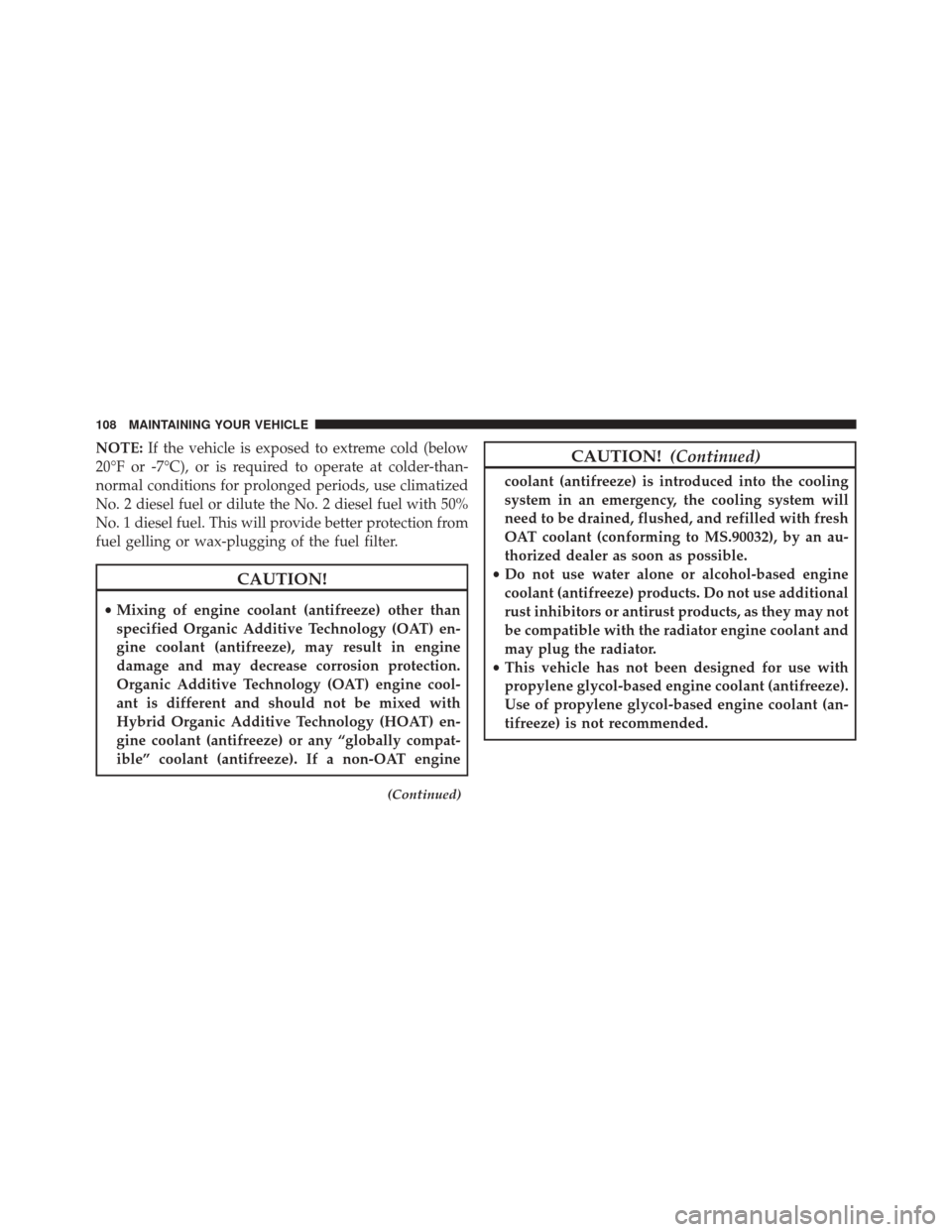
NOTE:If the vehicle is exposed to extreme cold (below
20°F or -7°C), or is required to operate at colder-than-
normal conditions for prolonged periods, use climatized
No. 2 diesel fuel or dilute the No. 2 diesel fuel with 50%
No. 1 diesel fuel. This will provide better protection from
fuel gelling or wax-plugging of the fuel filter.
CAUTION!
• Mixing of engine coolant (antifreeze) other than
specified Organic Additive Technology (OAT) en-
gine coolant (antifreeze), may result in engine
damage and may decrease corrosion protection.
Organic Additive Technology (OAT) engine cool-
ant is different and should not be mixed with
Hybrid Organic Additive Technology (HOAT) en-
gine coolant (antifreeze) or any “globally compat-
ible” coolant (antifreeze). If a non-OAT engine
(Continued)
CAUTION! (Continued)
coolant (antifreeze) is introduced into the cooling
system in an emergency, the cooling system will
need to be drained, flushed, and refilled with fresh
OAT coolant (conforming to MS.90032), by an au-
thorized dealer as soon as possible.
• Do not use water alone or alcohol-based engine
coolant (antifreeze) products. Do not use additional
rust inhibitors or antirust products, as they may not
be compatible with the radiator engine coolant and
may plug the radiator.
• This vehicle has not been designed for use with
propylene glycol-based engine coolant (antifreeze).
Use of propylene glycol-based engine coolant (an-
tifreeze) is not recommended.
108 MAINTAINING YOUR VEHICLE
Page 113 of 130
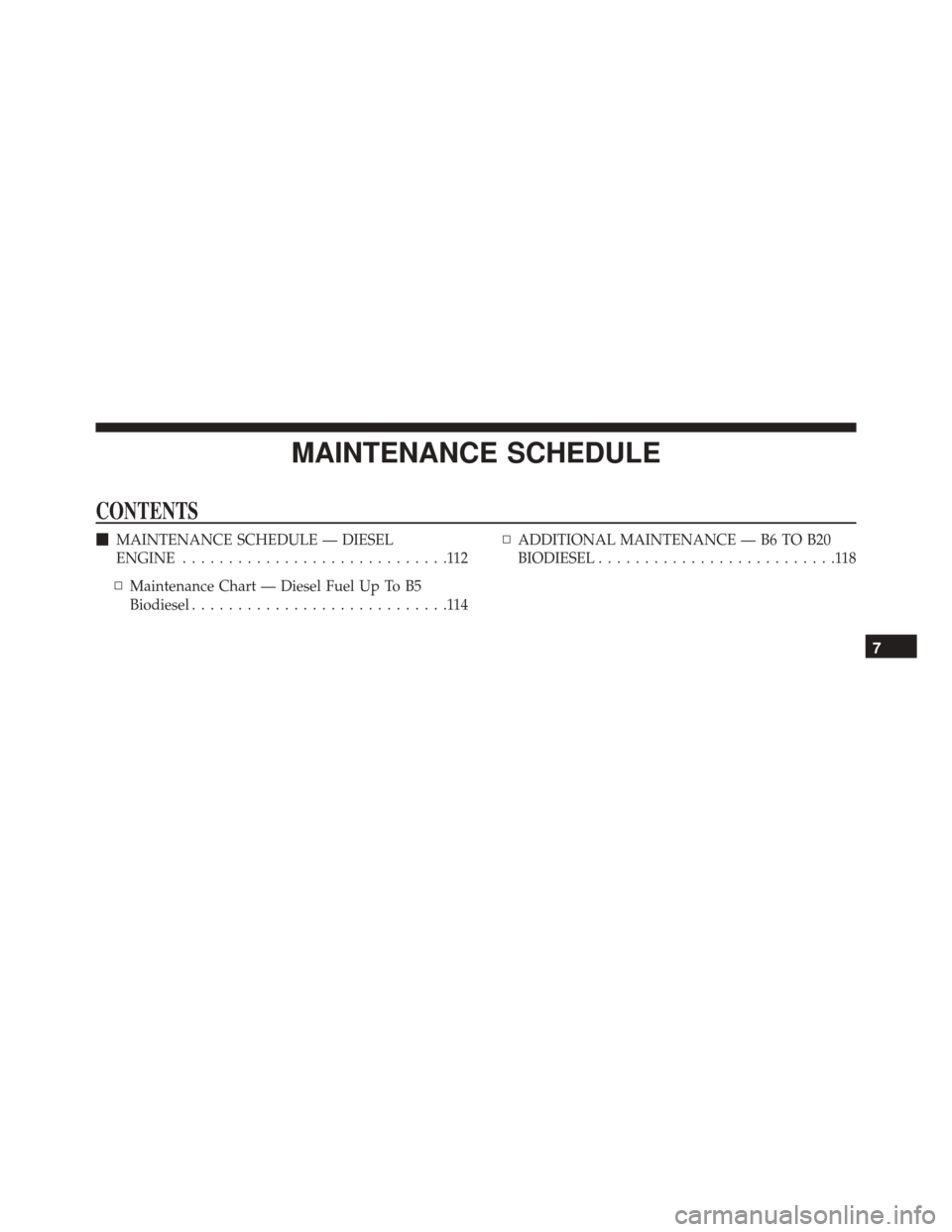
MAINTENANCE SCHEDULE
CONTENTS
�MAINTENANCE SCHEDULE — DIESEL
ENGINE .............................112
▫ Maintenance Chart — Diesel Fuel Up To B5
Biodiesel ............................114 ▫
ADDITIONAL MAINTENANCE — B6 TO B20
BIODIESEL ..........................118
7
Page 114 of 130

MAINTENANCE SCHEDULE — DIESEL ENGINE
Your vehicle is equipped with an automatic oil change
indicator system. The oil change indicator system will
remind you that it is time to take your vehicle in for
scheduled maintenance.
Based on engine operation conditions, the oil change
indicator message will illuminate in the instrument clus-
ter. This means that service is required for your vehicle.
Operating conditions such as frequent short-trips, trailer
tow, and extremely hot or cold ambient temperatures will
influence when the “Oil Change Required” message is
displayed. Severe Operating Conditions can cause the
change oil message to illuminate as early as 3,500 miles
(5,600 km) since last reset. Have your vehicle serviced as
soon as possible, within the next 500 miles (805 km).
Your authorized dealer will reset the oil change indicator
message after completing the scheduled oil change. If a
scheduled oil change is performed by someone otherthan your authorized dealer, the message can be reset by
referring to the steps described under “Electronic Vehicle
Information Center (EVIC)” in “Understanding Your
Instrument Panel” for further information.
NOTE:
Under no circumstances should oil change inter-
vals exceed 18,500 miles (29,773 km) or twelve months,
whichever comes first.
Once A Month Or Before A Long Trip:
• Check engine oil level
• Check windshield washer fluid level
• Check the tire inflation pressures and look for unusual
wear or damage
• Check the fluid levels of the coolant reservoir, brake
master cylinder, and power steering and fill as needed
• Check function of all interior and exterior lights
112 MAINTENANCE SCHEDULE
Page 115 of 130
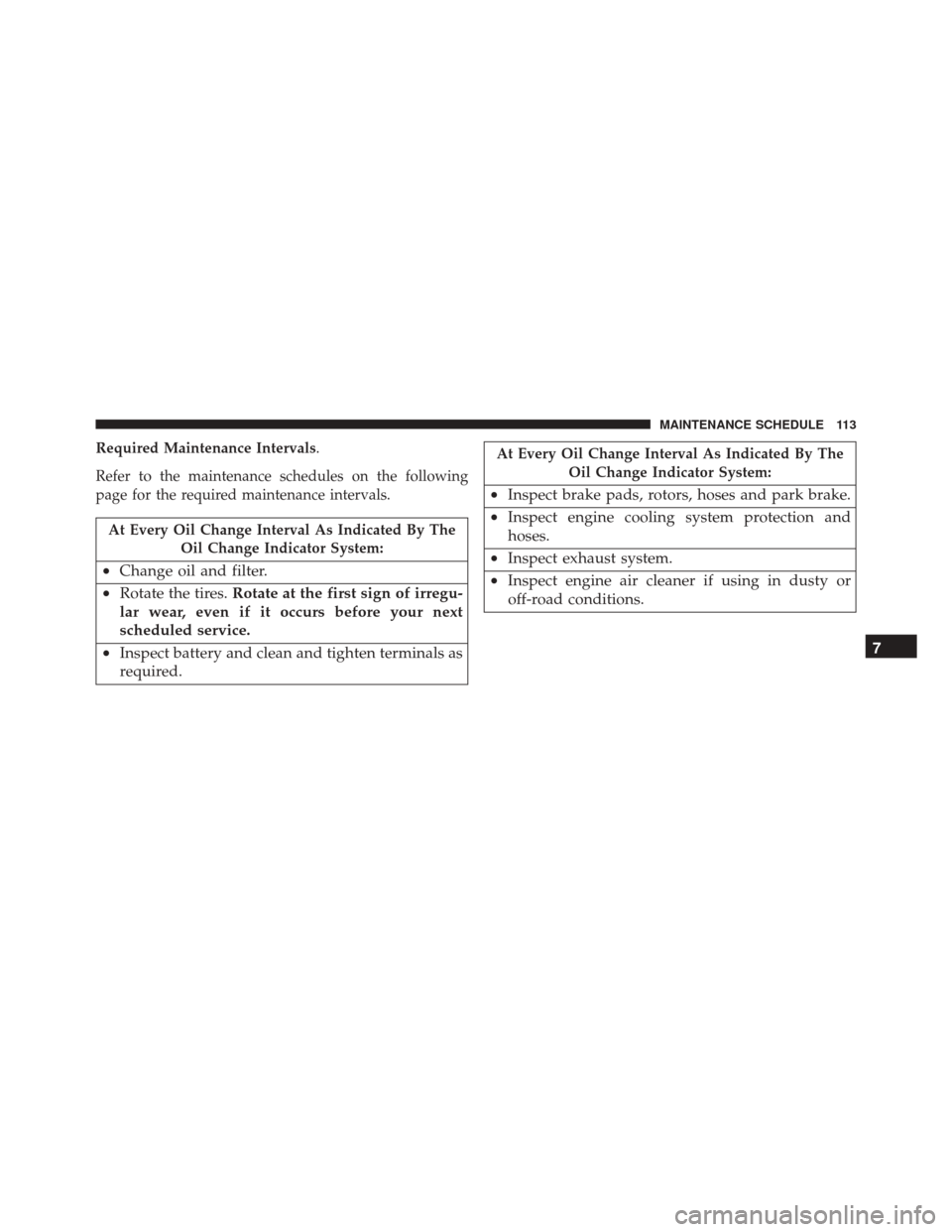
Required Maintenance Intervals.
Refer to the maintenance schedules on the following
page for the required maintenance intervals.
At Every Oil Change Interval As Indicated By TheOil Change Indicator System:
•Change oil and filter.
• Rotate the tires. Rotate at the first sign of irregu-
lar wear, even if it occurs before your next
scheduled service.
• Inspect battery and clean and tighten terminals as
required.
At Every Oil Change Interval As Indicated By The
Oil Change Indicator System:
•Inspect brake pads, rotors, hoses and park brake.
• Inspect engine cooling system protection and
hoses.
• Inspect exhaust system.
• Inspect engine air cleaner if using in dusty or
off-road conditions.
7
MAINTENANCE SCHEDULE 113