Page 146 of 347
REMOTE STARTING SYSTEM — IF EQUIPPED
This system uses the Remote Keyless Entry
(RKE) transmitter to start the engine conve-
niently from outside the vehicle while still
maintaining security. The system has a range of
approximately 300 ft (91 m).
NOTE:
• The vehicle must be equipped with an automatic
transmission to be equipped with Remote Start.
• The Remote Start system will wait for the “Wait To
Start” telltale to extinguish before cranking the engine.
This allows time for the intake heater to pre-heat the
incoming air, and is normal operation in cold weather.
Refer to “Wait To Start” in “Understanding Your
Instrument Panel”.
How To Use Remote Start
All of the following conditions must be met before the
engine will remote start:
• Transmission in PARK
• Doors closed
• Hood closed
• HAZARD switch off
• BRAKE switch inactive (brake pedal not pushed)
• Ignition key removed from ignition switch
• Battery at an acceptable charge level
• RKE PANIC button not pushed
• Fuel meets minimum requirement
• Water In Fuel Indicator Light is not illuminated
• Wait To Start Light is not illuminated
144 THINGS TO KNOW BEFORE STARTING YOUR VEHICLE
Page 147 of 347
WARNING!
•Do not start or run an engine in a closed garage or
confined area. Exhaust gas contains Carbon Mon-
oxide (CO) which is odorless and colorless. Carbon
Monoxide is poisonous and can cause serious in-
jury or death when inhaled.
• Keep Remote Keyless Entry (RKE) transmitters
away from children. Operation of the Remote Start
System, windows, door locks or other controls
could cause serious injury or death.
Remote Start Abort Message
The following messages will display in the EVIC/DID if
the vehicle fails to remote start or exits remote start
prematurely:
• Remote Start Aborted - Door Ajar
• Remote Start Aborted - Hood Ajar •
Remote Start Aborted - Fuel Low
• Remote Start Aborted - System Fault
The EVIC/DID message stays active until the ignition is
turned to the ON/RUN position.
To Enter Remote Start Mode
Push and release the REMOTE START button
on the RKE transmitter twice, within five sec-
onds. The parking lights will flash and the horn
will chirp twice (if programmed). In cold am-
bient temperature conditions, the diesel vehicle may
delay crank up to 30 seconds for the fuel and grid heater.
Once the vehicle has started, the engine will run for 15
minutes or 75 seconds in extreme cold and high
elevation.
2
THINGS TO KNOW BEFORE STARTING YOUR VEHICLE 145
Page 150 of 347
NOTE:Light duty operation such as light trailer towing
or no load operation will extend the time before the
engine is at full efficiency. Reduced fuel economy and
power may be seen at this time.
For additional vehicle break-in requirements, refer to
“Trailer Towing” in “Starting And Operating” of the
Owners Manual. Because of the construction of the Cummins® turbo-
charged diesel engine, engine run-in is enhanced by
loaded operating conditions which allow the engine
parts to achieve final finish and fit during the first 6,000
miles (10 000 km).
148 THINGS TO KNOW BEFORE STARTING YOUR VEHICLE
Page 151 of 347
UNDERSTANDING YOUR INSTRUMENT PANEL
CONTENTS
�INSTRUMENT CLUSTER .................150
▫ Instrument Cluster Descriptions ...........151
� INSTRUMENT CLUSTER .................163
▫ Instrument Cluster Descriptions ...........164
� ELECTRONIC VEHICLE INFORMATION
CENTER (EVIC) ...................... .174
▫ Instrument Cluster Messages .............175
▫ Vehicle Information (Customer Information
Features) ........................... .176
� Driver Information Display
(DID) — 7” Display .....................188 ▫
Diesel Indicator Lights ..................191
▫ Cold Ambient Derate Mode Messages .......191
▫ Diesel Particulate Filter (DPF) Messages .....192
▫ Diesel Exhaust Fluid (DEF) Warning
Messages .......................... .195
▫ Diesel Exhaust Fluid (DEF) Fault Warning
Messages .......................... .196
▫ RAM Active Air System .................198
▫ Fuel Filter Life Reset ...................199
▫ Oil Life Reset ....................... .2003
Page 153 of 347
Instrument Cluster Descriptions
1. Tachometer
1. The tachometer indicates engine speed in RevolutionsPer Minute (RPM x 1000).
2. Anti-Lock Brake (ABS) Light
This light monitors the Anti-lock Brake System
(ABS). The light will turn on when the ignition
switch is turned to the ON/RUN position and
may stay on for as long as four seconds.
If the ABS light remains on or turns on while driving, it
indicates that the anti-lock portion of the brake system is
not functioning and that service is required. However,
the conventional brake system will continue to operate
normally if the BRAKE warning light is not on.
If the ABS light is on, the brake system should be serviced
as soon as possible to restore the benefits of anti-lock
brakes. If the ABS light does not turn on when the ignition switch is turned to the ON/RUN position, have
the light inspected by an authorized dealer.
3. Malfunction Indicator Light (MIL)
The Malfunction Indicator Light (MIL) is part
of an Onboard Diagnostic (OBDII) system
which monitors the emissions and engine con-
trol system. If the vehicle is ready for emissions
testing, the light will come on when the ignition is first
turned on and remain on, as a bulb check, until the
engine is started. If the vehicle is not ready for emissions
testing the light will come on when the ignition is first
turned on and remain on for 15 seconds, then blink for 5
seconds, and remain on until the vehicle is started. If the
bulb does not come on during starting, have the condi-
tion investigated promptly.
If this light comes on and remains on while driving, it
suggests a potential engine control problem and the need
for system service.
3
UNDERSTANDING YOUR INSTRUMENT PANEL 151
Page 154 of 347
Although your vehicle will usually be drivable and not
need towing, see your authorized dealer for service as
soon as possible.
CAUTION!
Prolonged driving with the Malfunction Indicator
Light (MIL) on could cause damage to the engine
control system. It also could affect fuel economy and
driveability. If the MIL is flashing, severe catalytic
converter damage and power loss will soon occur.
Immediate service is required.
WARNING!
A malfunctioning catalytic converter, as referenced
above, can reach higher temperatures than in normal
operating conditions. This can cause a fire if you
(Continued)
WARNING!(Continued)
drive slowly or park over flammable substances such
as dry plants, wood, cardboard, etc. This could result
in death or serious injury to the driver, occupants or
others.
4. Electronic Stability Control (ESC) Activation/
Malfunction Indicator Light — If Equipped The “ESC Activation/Malfunction Indicator
Light” in the instrument cluster will come on
when the ignition switch is turned to the
ON/RUN position. It should go out with the
engine running. If the “ESC Activation/Malfunction In-
dicator Light” comes on continuously with the engine
running, a malfunction has been detected in the ESC
system. If this light remains on after several ignition
cycles, and the vehicle has been driven several miles
152 UNDERSTANDING YOUR INSTRUMENT PANEL
Page 155 of 347
(kilometers) at speeds greater than 30 mph (48 km/h), see
your authorized dealer as soon as possible to have the
problem diagnosed and corrected.
NOTE:
•The “ESC Off Indicator Light” and the “ESC
Activation/Malfunction Indicator Light” come on mo-
mentarily each time the ignition switch is turned to
ON/RUN.
• Each time the ignition is turned to ON/RUN, the ESC
system will be ON, even if it was turned off previously.
• The ESC system will make buzzing or clicking sounds
when it is active. This is normal; the sounds will stop
when ESC becomes inactive following the maneuver
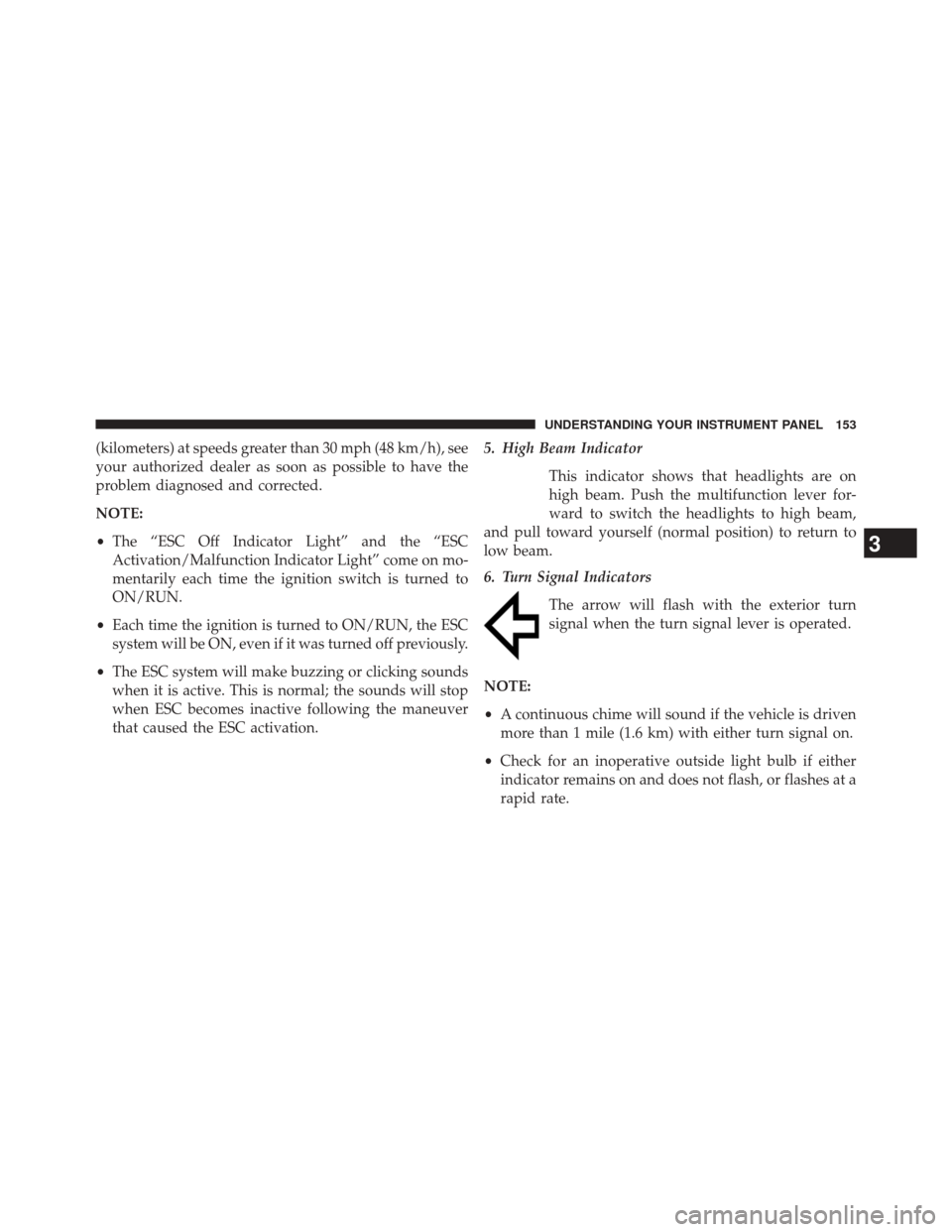
that caused the ESC activation. 5. High Beam Indicator
This indicator shows that headlights are on
high beam. Push the multifunction lever for-
ward to switch the headlights to high beam,
and pull toward yourself (normal position) to return to
low beam.
6. Turn Signal Indicators
The arrow will flash with the exterior turn
signal when the turn signal lever is operated.
NOTE:
• A continuous chime will sound if the vehicle is driven
more than 1 mile (1.6 km) with either turn signal on.
• Check for an inoperative outside light bulb if either
indicator remains on and does not flash, or flashes at a
rapid rate.
3
UNDERSTANDING YOUR INSTRUMENT PANEL 153
Page 156 of 347
7. Front Fog Light Indicator — If EquippedThis indicator will illuminate when the front
fog lights are on.
8. Park/Headlight ON Indicator — If Equipped This indicator will illuminate when the park
lights or headlights are turned on.
9. Electronic Vehicle Information Center (EVIC)
The Electronic Vehicle Information Center (EVIC) fea-
tures an interactive display that is located in the instru-
ment cluster. For further information, refer to “Electronic
Vehicle Information Center (EVIC)” in this section. 10. Tire Pressure Monitoring Telltale Light
Each tire, including the spare (if provided),
should be checked monthly when cold and
inflated to the inflation pressure recommended
by the vehicle manufacturer on the vehicle
placard or tire inflation pressure label. (If your vehicle
has tires of a different size than the size indicated on the
vehicle placard or tire inflation pressure label, you should
determine the proper tire inflation pressure for those
tires.)
As an added safety feature, your vehicle has been
equipped with a Tire Pressure Monitoring System
(TPMS) that illuminates a low tire pressure telltale when
one or more of your tires is significantly under-inflated.
Accordingly, when the low tire pressure telltale illumi-
nates, you should stop and check your tires as soon as
possible, and inflate them to the proper pressure. Driving
on a significantly under-inflated tire causes the tire to
overheat and can lead to tire failure. Under-inflation also
154 UNDERSTANDING YOUR INSTRUMENT PANEL