Page 227 of 347
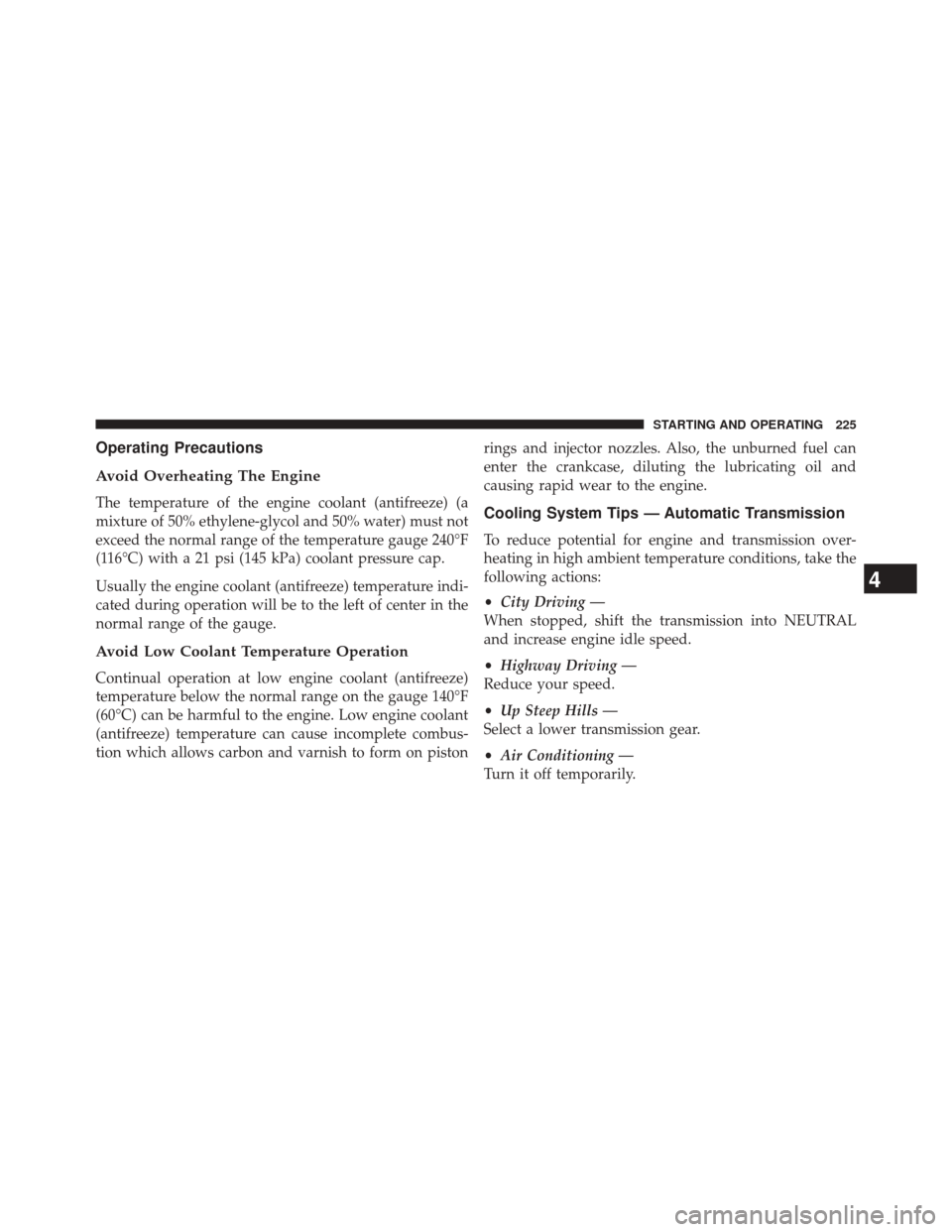
Operating Precautions
Avoid Overheating The Engine
The temperature of the engine coolant (antifreeze) (a
mixture of 50% ethylene-glycol and 50% water) must not
exceed the normal range of the temperature gauge 240°F
(116°C) with a 21 psi (145 kPa) coolant pressure cap.
Usually the engine coolant (antifreeze) temperature indi-
cated during operation will be to the left of center in the
normal range of the gauge.
Avoid Low Coolant Temperature Operation
Continual operation at low engine coolant (antifreeze)
temperature below the normal range on the gauge 140°F
(60°C) can be harmful to the engine. Low engine coolant
(antifreeze) temperature can cause incomplete combus-
tion which allows carbon and varnish to form on pistonrings and injector nozzles. Also, the unburned fuel can
enter the crankcase, diluting the lubricating oil and
causing rapid wear to the engine.
Cooling System Tips — Automatic Transmission
To reduce potential for engine and transmission over-
heating in high ambient temperature conditions, take the
following actions:
•
City Driving —
When stopped, shift the transmission into NEUTRAL
and increase engine idle speed.
• Highway Driving —
Reduce your speed.
• Up Steep Hills —
Select a lower transmission gear.
• Air Conditioning —
Turn it off temporarily.
4
STARTING AND OPERATING 225
Page 228 of 347
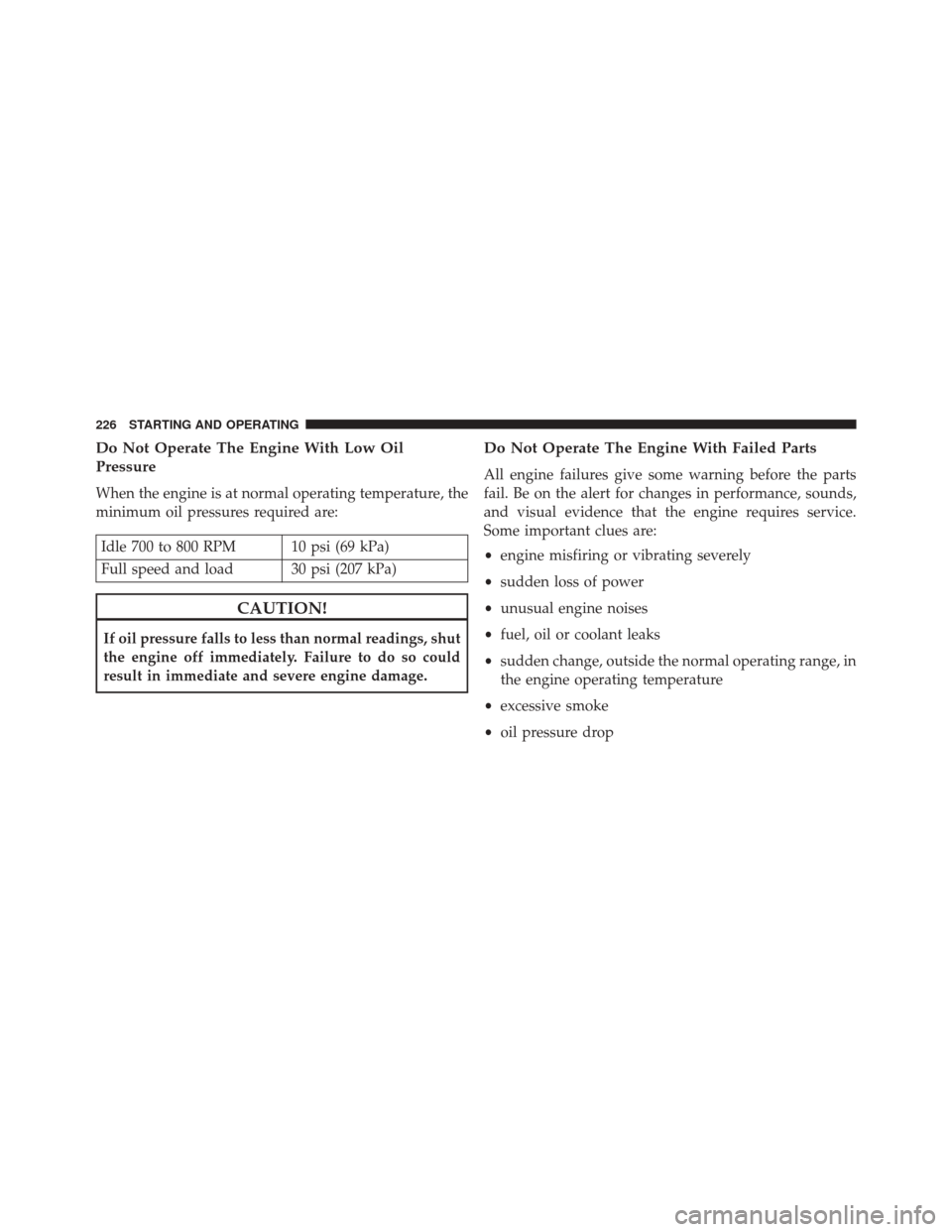
Do Not Operate The Engine With Low Oil
Pressure
When the engine is at normal operating temperature, the
minimum oil pressures required are:
Idle 700 to 800 RPM 10 psi (69 kPa)
Full speed and load 30 psi (207 kPa)
CAUTION!
If oil pressure falls to less than normal readings, shut
the engine off immediately. Failure to do so could
result in immediate and severe engine damage.
Do Not Operate The Engine With Failed Parts
All engine failures give some warning before the parts
fail. Be on the alert for changes in performance, sounds,
and visual evidence that the engine requires service.
Some important clues are:
•engine misfiring or vibrating severely
• sudden loss of power
• unusual engine noises
• fuel, oil or coolant leaks
• sudden change, outside the normal operating range, in
the engine operating temperature
• excessive smoke
• oil pressure drop
226 STARTING AND OPERATING
Page 258 of 347
approved ASTM standards, if stored properly, provides
for protection against fuel oxidation for up to six months.
Fuel Water Separation — Must Use MOPAR®/
Cummins® Approved Fuel Filter Elements
You must use MOPAR®/Cummins® approved fuel filter
elements in both your engine mounted filter and frame
mounted filter.
Biodiesel fuel has a natural affinity to water and water
accelerates microbial growth. Your MOPAR®/
Cummins® filtration system is designed to provide ad-
equate fuel water separation capabilities.
Bio-Diesel Fuel Properties — Low Ambient
Temperatures
Biodiesel fuel may gel or solidify at low ambient tem-
peratures, which may pose problems for both storage and
operation. Precautions can be necessary at low ambienttemperatures, such as storing the fuel in a heated build-
ing or a heated storage tank, or using cold temperature
additives.
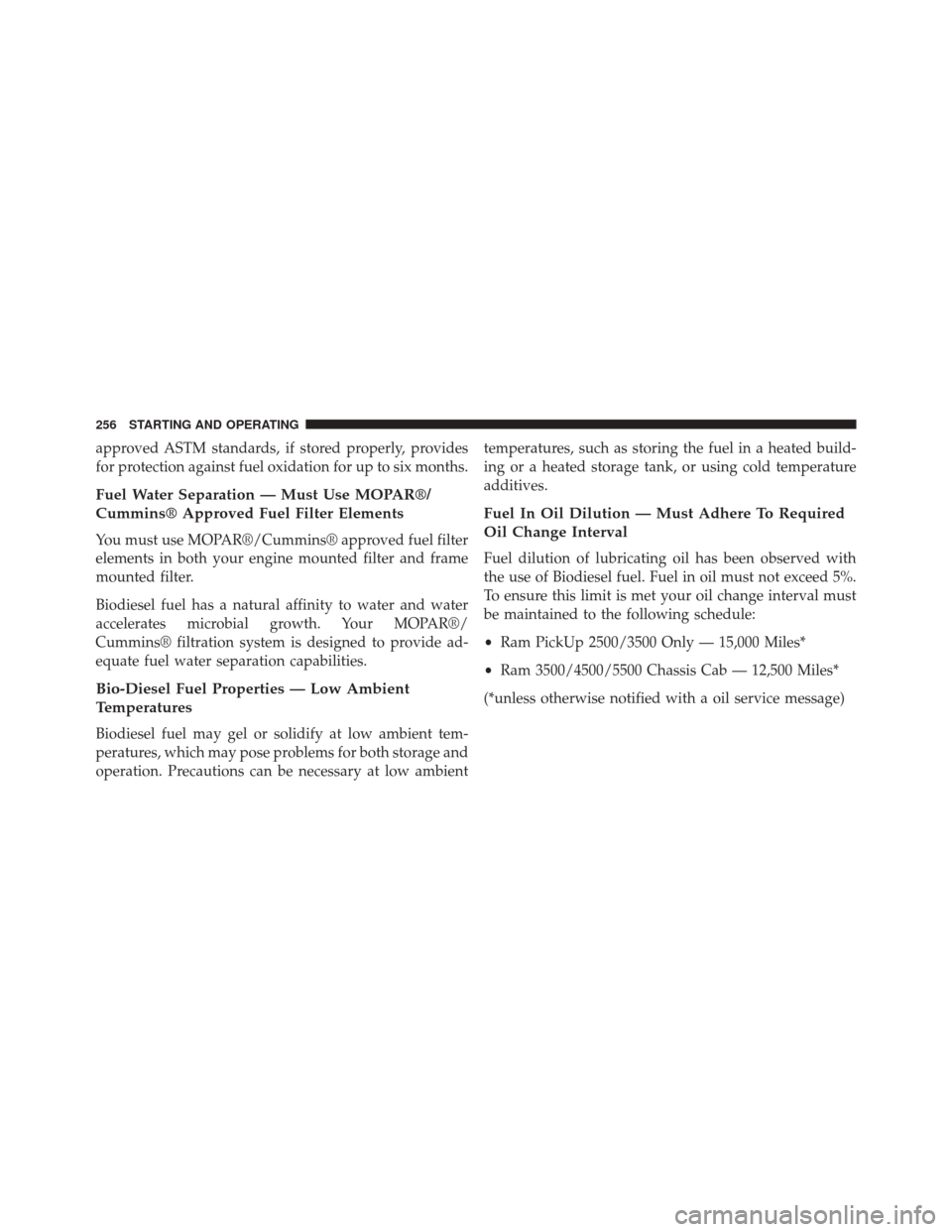
Fuel In Oil Dilution — Must Adhere To Required
Oil Change Interval
Fuel dilution of lubricating oil has been observed with
the use of Biodiesel fuel. Fuel in oil must not exceed 5%.
To ensure this limit is met your oil change interval must
be maintained to the following schedule:
•
Ram PickUp 2500/3500 Only — 15,000 Miles*
• Ram 3500/4500/5500 Chassis Cab — 12,500 Miles*
(*unless otherwise notified with a oil service message)
256 STARTING AND OPERATING
Page 284 of 347
Oils with a high ash content may produce damaging
deposits on cylinder head valves and/or aftertreatment
system damage. A maximum sulfated ash content of 1.00
mass % is recommended for all oil used in the engine.
The same oil change interval is to be followed for
synthetic oil as for petroleum based oil. Also, synthetic oil
must meet the same performance specifications as petro-
leum oil.
CAUTION!
Do not use chemical flushes in your engine oil as the
chemicals can damage your engine. Such damage is
not covered by the New Vehicle Limited Warranty.
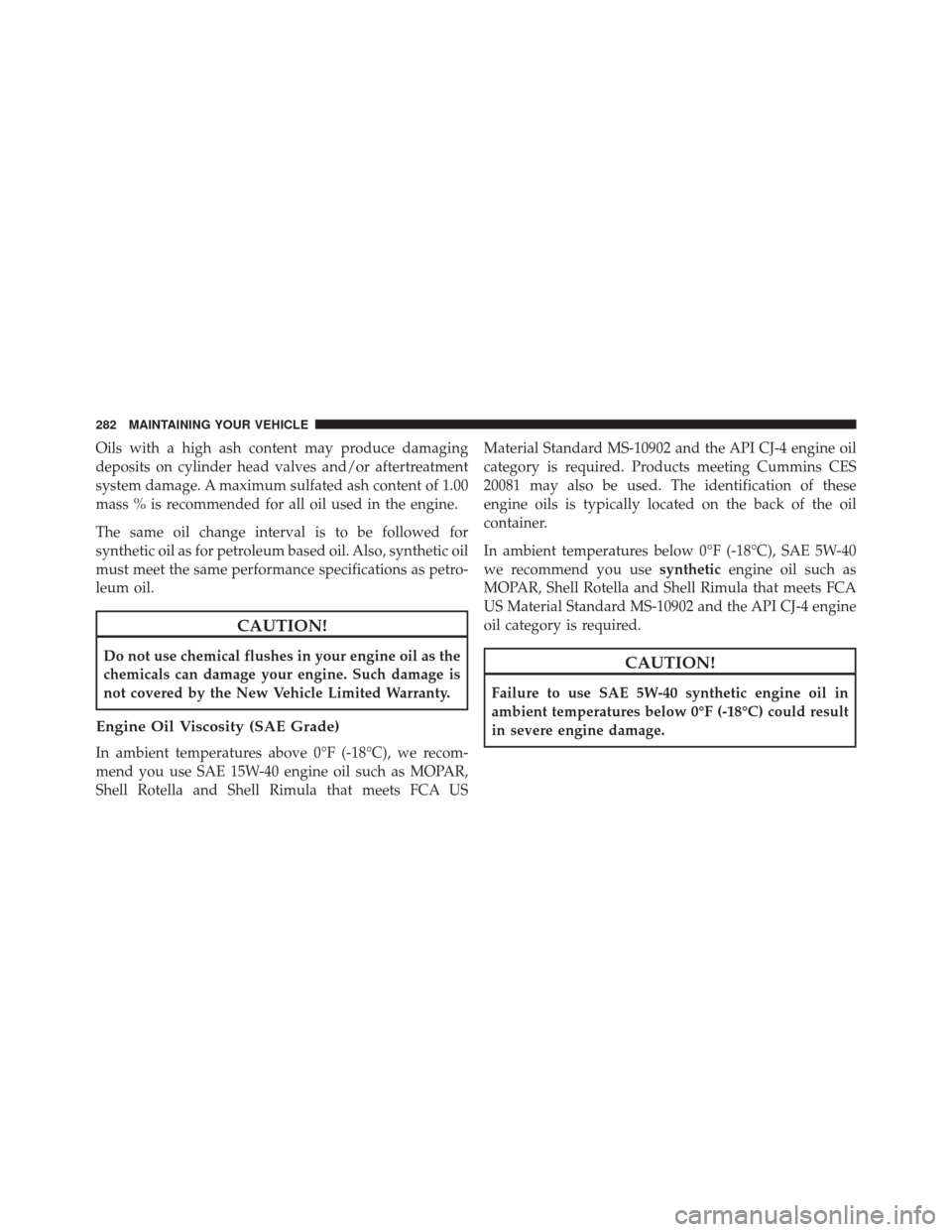
Engine Oil Viscosity (SAE Grade)
In ambient temperatures above 0°F (-18°C), we recom-
mend you use SAE 15W-40 engine oil such as MOPAR,
Shell Rotella and Shell Rimula that meets FCA USMaterial Standard MS-10902 and the API CJ-4 engine oil
category is required. Products meeting Cummins CES
20081 may also be used. The identification of these
engine oils is typically located on the back of the oil
container.
In ambient temperatures below 0°F (-18°C), SAE 5W-40
we recommend you use
syntheticengine oil such as
MOPAR, Shell Rotella and Shell Rimula that meets FCA
US Material Standard MS-10902 and the API CJ-4 engine
oil category is required.
CAUTION!
Failure to use SAE 5W-40 synthetic engine oil in
ambient temperatures below 0°F (-18°C) could result
in severe engine damage.
282 MAINTAINING YOUR VEHICLE
Page 310 of 347
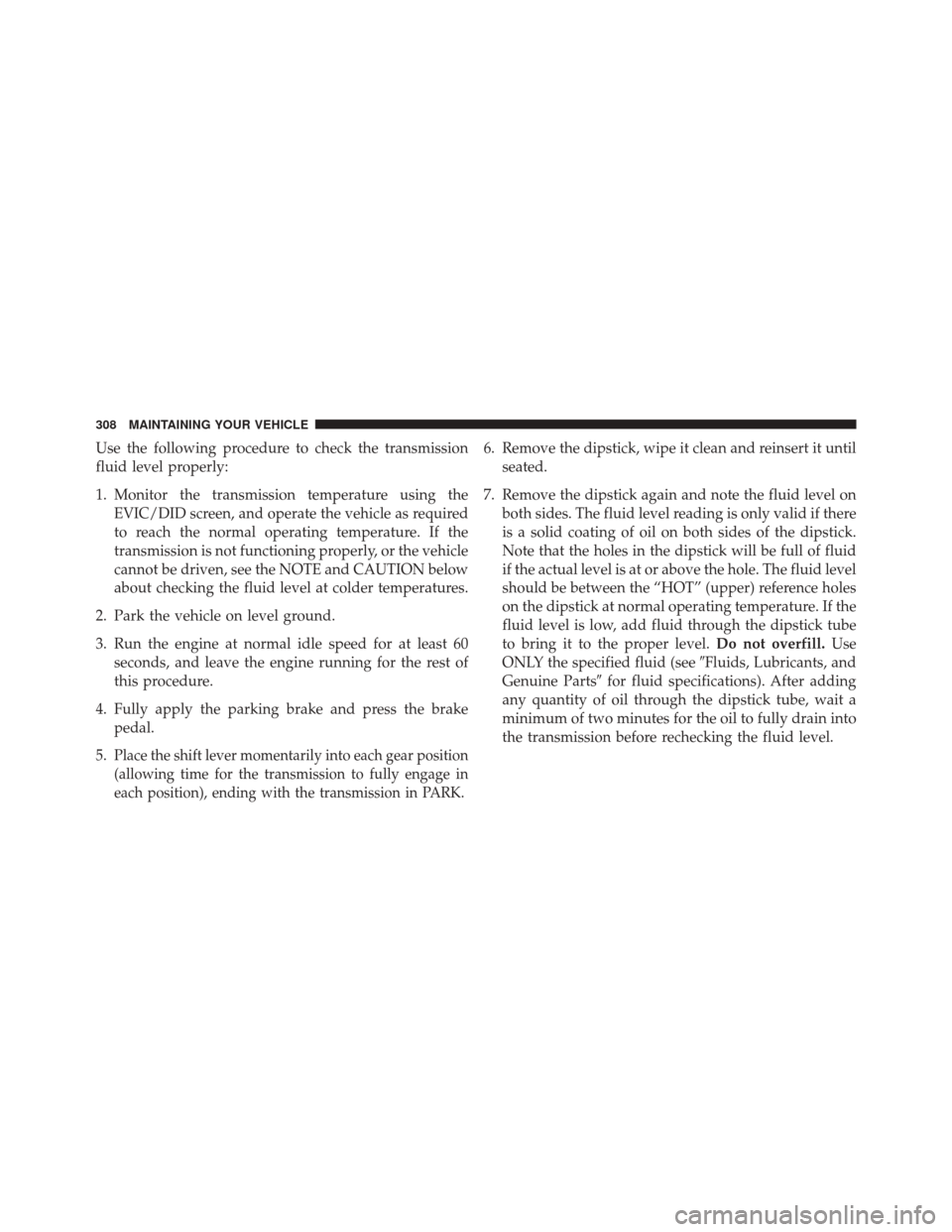
Use the following procedure to check the transmission
fluid level properly:
1. Monitor the transmission temperature using theEVIC/DID screen, and operate the vehicle as required
to reach the normal operating temperature. If the
transmission is not functioning properly, or the vehicle
cannot be driven, see the NOTE and CAUTION below
about checking the fluid level at colder temperatures.
2. Park the vehicle on level ground.
3. Run the engine at normal idle speed for at least 60 seconds, and leave the engine running for the rest of
this procedure.
4. Fully apply the parking brake and press the brake pedal.
5.
Place the shift lever momentarily into each gear position
(allowing time for the transmission to fully engage in
each position), ending with the transmission in PARK.
6. Remove the dipstick, wipe it clean and reinsert it until seated.
7. Remove the dipstick again and note the fluid level on both sides. The fluid level reading is only valid if there
is a solid coating of oil on both sides of the dipstick.
Note that the holes in the dipstick will be full of fluid
if the actual level is at or above the hole. The fluid level
should be between the “HOT” (upper) reference holes
on the dipstick at normal operating temperature. If the
fluid level is low, add fluid through the dipstick tube
to bring it to the proper level. Do not overfill.Use
ONLY the specified fluid (see �Fluids, Lubricants, and
Genuine Parts� for fluid specifications). After adding
any quantity of oil through the dipstick tube, wait a
minimum of two minutes for the oil to fully drain into
the transmission before rechecking the fluid level.
308 MAINTAINING YOUR VEHICLE
Page 318 of 347
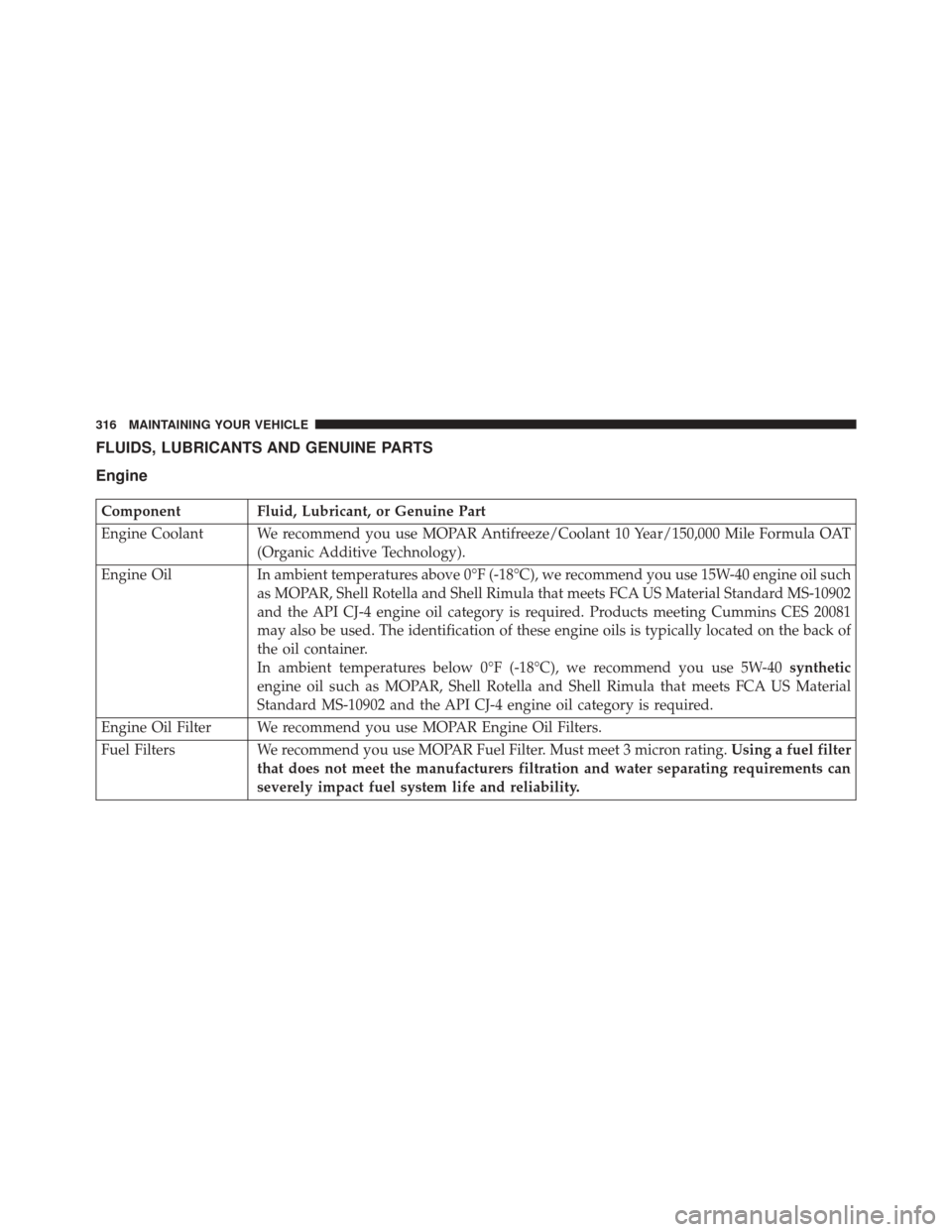
FLUIDS, LUBRICANTS AND GENUINE PARTS
Engine
ComponentFluid, Lubricant, or Genuine Part
Engine Coolant We recommend you use MOPAR Antifreeze/Coolant 10 Year/150,000 Mile Formula OAT (Organic Additive Technology).
Engine Oil In ambient temperatures above 0°F (-18°C), we recommend you use 15W-40 engine oil such
as MOPAR, Shell Rotella and Shell Rimula that meets FCA US Material Standard MS-10902
and the API CJ-4 engine oil category is required. Products meeting Cummins CES 20081
may also be used. The identification of these engine oils is typically located on the back of
the oil container.
In ambient temperatures below 0°F (-18°C), we recommend you use 5W-40 synthetic
engine oil such as MOPAR, Shell Rotella and Shell Rimula that meets FCA US Material
Standard MS-10902 and the API CJ-4 engine oil category is required.
Engine Oil Filter We recommend you use MOPAR Engine Oil Filters.
Fuel Filters We recommend you use MOPAR Fuel Filter. Must meet 3 micron rating. Using a fuel filter
that does not meet the manufacturers filtration and water separating requirements can
severely impact fuel system life and reliability.
316 MAINTAINING YOUR VEHICLE