2015 Ram 1500 cooling
[x] Cancel search: coolingPage 303 of 347
(antifreeze) solution. The use of lower quality water
will reduce the amount of corrosion protection in the
engine cooling system.
Please note that it is the owner’s responsibility to main-
tain the proper level of protection against freezing ac-
cording to the temperatures occurring in the area where
the vehicle is operated.
NOTE:
• Some vehicles require special tools to add coolant
properly. Failure to fill these systems properly could
lead to severe internal engine damage. If any coolant is
needed to be added to the system please contact your
local authorized dealer. •
Mixing engine coolant (antifreeze) types is not recom-
mended and can result in cooling system damage. If
HOAT and OAT coolant are mixed in an emergency,
have a authorized dealer drain, flush, and refill with
OAT coolant (conforming to MS.90032) as soon as
possible.
Cooling System Pressure Cap
The cap must be fully tightened to prevent loss of engine
coolant (antifreeze), and to ensure that the engine coolant
(antifreeze) will return to the radiator from the coolant
expansion bottle.
The cap should be inspected and cleaned if there is any
accumulation of foreign material on the sealing surfaces.
6
MAINTAINING YOUR VEHICLE 301
Page 304 of 347
WARNING!
•Do not open hot engine cooling system. Never add
engine coolant (antifreeze) when the engine is
overheated. Do not loosen or remove the cap to cool
an overheated engine. Heat causes pressure to
build up in the cooling system. To prevent scalding
or injury, do not remove the pressure cap while the
system is hot or under pressure.
• Do not use a pressure cap other than the one
specified for your vehicle. Personal injury or en-
gine damage may result.
Disposal Of Used Engine Coolant
Used ethylene glycol-based engine coolant (antifreeze) is
a regulated substance requiring proper disposal. Check
with your local authorities to determine the disposal
rules for your community. To prevent ingestion by ani-
mals or children, do not store ethylene glycol-based engine coolant (antifreeze) in open containers or allow it
to remain in puddles on the ground. If ingested by a child
or pet, seek emergency assistance immediately. Clean up
any ground spills immediately.
Points To Remember
NOTE:
When the vehicle is stopped after a few miles/
kilometers of operation, you may observe vapor coming
from the front of the engine compartment. This is nor-
mally a result of moisture from rain, snow, or high
humidity accumulating on the radiator and being vapor-
ized when the thermostat opens, allowing hot engine
coolant (antifreeze) to enter the radiator.
If an examination of your engine compartment shows no
evidence of radiator or hose leaks, the vehicle may be
safely driven. The vapor will soon dissipate.
• Do not overfill the coolant expansion bottle.
302 MAINTAINING YOUR VEHICLE
Page 305 of 347
•Check the coolant freeze point in the radiator and in
the coolant expansion bottle. If engine coolant (anti-
freeze) needs to be added, the contents of the coolant
expansion bottle must also be protected against freez-
ing.
• If frequent engine coolant (antifreeze) additions are
required, the cooling system should be pressure tested
for leaks.
• Maintain engine coolant (antifreeze) concentration at a
minimum of 50% OAT coolant (conforming to
MS.90032) and distilled water for proper corrosion
protection of your engine which contains aluminum
components.
• Make sure that the coolant expansion bottle overflow
hoses are not kinked or obstructed.
• Keep the front of the radiator clean. If your vehicle is
equipped with air conditioning, keep the front of the
condenser clean. •
Do not change the thermostat for Summer or Winter
operation. If replacement is ever necessary, install
ONLY the correct type thermostat. Other designs may
result in unsatisfactory engine coolant (antifreeze)
performance, poor gas mileage, and increased emis-
sions.
Charge Air Cooler — Inter-Cooler
The charge air cooler is positioned below the radiator and
the air conditioner condenser. Air enters the engine
through the air cleaner and passes through the turbo-
charger, where it is pressurized. This pressurized air
rapidly reaches high temperature. The air is then directed
through a hose to the charge air cooler and through
another hose to the intake manifold of the engine. The air
entering the engine has been cooled by about 50° to 100°F
(10° to 38°C). This cooling process enables more efficient
burning of fuel resulting in fewer emissions.
6
MAINTAINING YOUR VEHICLE 303
Page 314 of 347
Among those acts presumed to constitute tampering are
the acts listed below.
AIR CLEANER
•Removal of the air cleaner.
• Removal of the air cleaner filter element from the air
cleaner housing.
• Removal of the air ducting.
EXHAUST SYSTEM
• Removal or rendering inoperative exhaust system
components including the muffler or tailpipe.
ENGINE COOLING SYSTEM
• Removal or rendering inoperative the fan clutch.
• Removal of the fan shroud.Noise Emission Warranty
The manufacturer warrants that this vehicle as manu-
factured by the manufacturer, was designed, built and
equipped to conform at the time it left the manufactur-
er’s control with all applicable U.S. EPA Noise Control
Regulations.
This warranty covers this vehicle as designed, built and
equipped by the manufacturer, and is not limited to any
particular part, component or system of the vehicle
manufactured by the manufacturer. Defects in design,
assembly or in any part, component or system of the
vehicle as manufactured by the manufacturer, which, at
the time it left the manufacturer’s control, caused noise
emissions to exceed Federal standards, are covered by
this warranty for the life of the vehicle.
312 MAINTAINING YOUR VEHICLE
Page 317 of 347
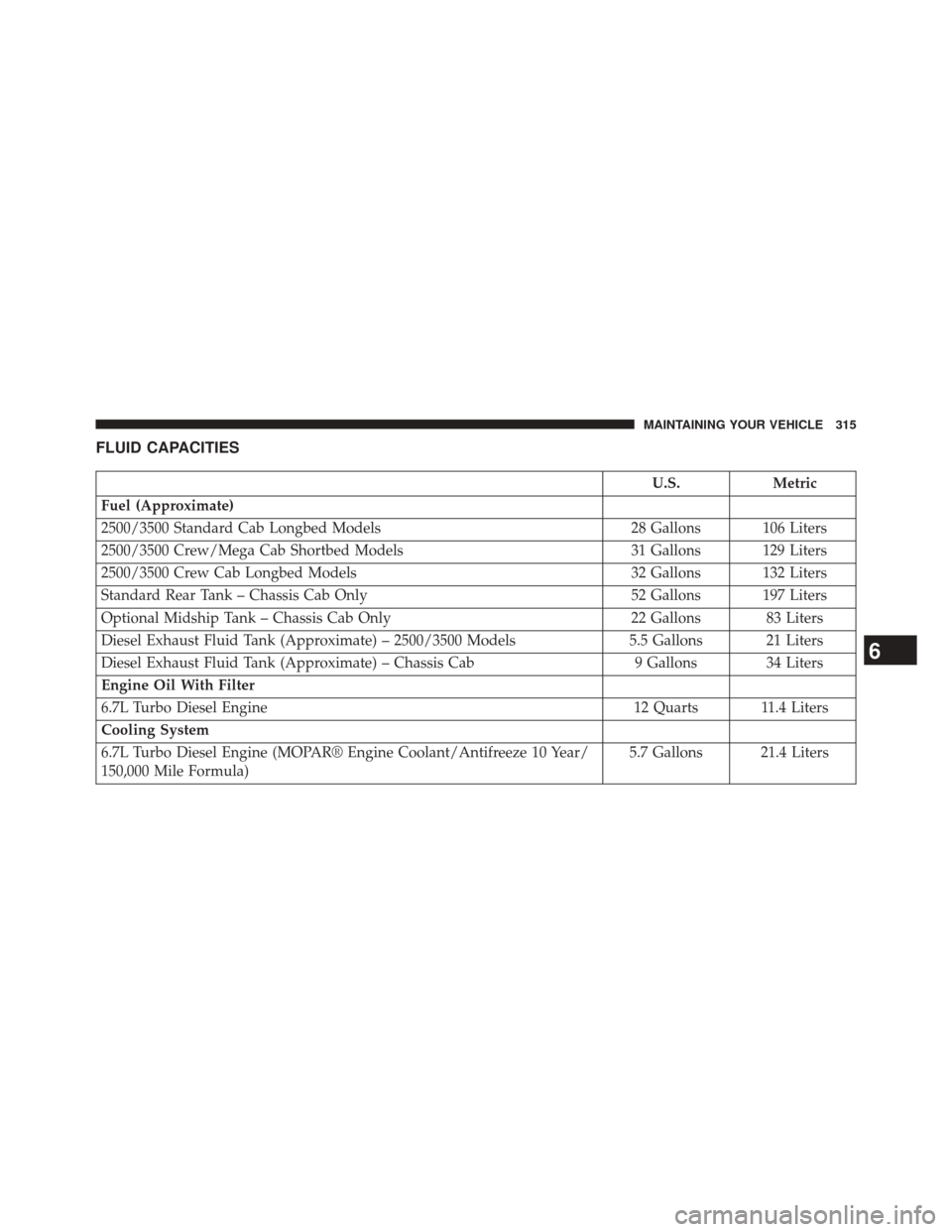
FLUID CAPACITIES
U.S.Metric
Fuel (Approximate)
2500/3500 Standard Cab Longbed Models 28 Gallons 106 Liters
2500/3500 Crew/Mega Cab Shortbed Models 31 Gallons 129 Liters
2500/3500 Crew Cab Longbed Models 32 Gallons 132 Liters
Standard Rear Tank – Chassis Cab Only 52 Gallons 197 Liters
Optional Midship Tank – Chassis Cab Only 22 Gallons 83 Liters
Diesel Exhaust Fluid Tank (Approximate) – 2500/3500 Models 5.5 Gallons 21 Liters
Diesel Exhaust Fluid Tank (Approximate) – Chassis Cab 9 Gallons 34 Liters
Engine Oil With Filter
6.7L Turbo Diesel Engine 12 Quarts 11.4 Liters
Cooling System
6.7L Turbo Diesel Engine (MOPAR® Engine Coolant/Antifreeze 10 Year/
150,000 Mile Formula) 5.7 Gallons 21.4 Liters
6
MAINTAINING YOUR VEHICLE 315
Page 333 of 347
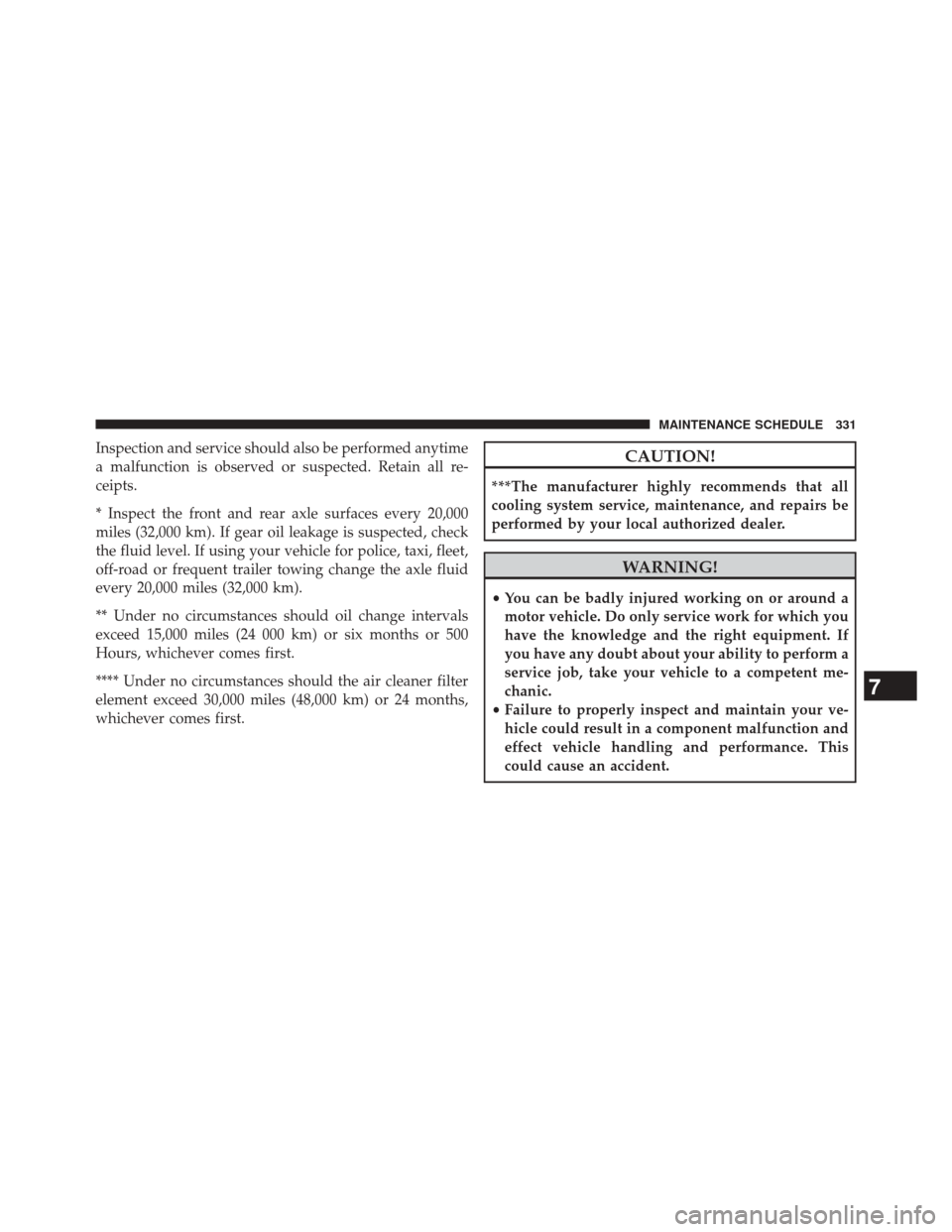
Inspection and service should also be performed anytime
a malfunction is observed or suspected. Retain all re-
ceipts.
* Inspect the front and rear axle surfaces every 20,000
miles (32,000 km). If gear oil leakage is suspected, check
the fluid level. If using your vehicle for police, taxi, fleet,
off-road or frequent trailer towing change the axle fluid
every 20,000 miles (32,000 km).
** Under no circumstances should oil change intervals
exceed 15,000 miles (24 000 km) or six months or 500
Hours, whichever comes first.
**** Under no circumstances should the air cleaner filter
element exceed 30,000 miles (48,000 km) or 24 months,
whichever comes first.CAUTION!
***The manufacturer highly recommends that all
cooling system service, maintenance, and repairs be
performed by your local authorized dealer.
WARNING!
•You can be badly injured working on or around a
motor vehicle. Do only service work for which you
have the knowledge and the right equipment. If
you have any doubt about your ability to perform a
service job, take your vehicle to a competent me-
chanic.
• Failure to properly inspect and maintain your ve-
hicle could result in a component malfunction and
effect vehicle handling and performance. This
could cause an accident.
7
MAINTENANCE SCHEDULE 331
Page 336 of 347
Adding Engine Coolant (Antifreeze)............116
Adding Fuel ..............................91
Air bag Light .............................17
Air Cleaner, Engine (Engine Air Cleaner Filter) . . . .104
Alarm Light ..............................17
Anti-Lock Warning Light .....................17
Antifreeze (Engine Coolant) ..................115
Capacities ........................... .122
Disposal ..............................118
Automatic Transmission Fluid Type ........................... .126
Axle Fluid ............................. .126
Battery .................................113
Brake Fluid ............................ .126
Brake System ........................... .120
Fluid Check .......................... .120
Master Cylinder ....................... .120
Warning Light .......................17,33 Capacities, Antifreeze (Engine Coolant)
..........122
Capacities, Fluid ......................... .122
Caps, Filler Oil (Engine) .......................... .103
Radiator (Coolant Pressure) ................118
Charge Air Cooler ........................ .120
Check Engine Light (Malfunction Indicator Light) . . .17
Coolant Pressure Cap (Radiator Cap) ...........118
Cooling System ...........................114
Adding Coolant (Antifreeze) ...............116
Coolant Capacity ...................... .122
Coolant Level ..........................114
Disposal of Used Coolant ..................118
Drain, Flush, and Refill ...................115
Points to Remember .....................119
Pressure Cap ..........................118
Radiator Cap ..........................118
Selection of Coolant (Antifreeze) .........115,123
334 INDEX - RAM 1500
Page 340 of 347
Adding Engine Coolant (Antifreeze)............300
Adding Fuel ............................ .257
Air bag Light ........................... .158
Air Cleaner, Engine (Engine Air Cleaner Filter) . . . .284
Air Filter .............................. .284
Alarm Light ............................ .159
Anti-Lock Warning Light ....................151
Antifreeze (Engine Coolant) ..................299
Capacities ........................... .315
Disposal ............................. .302
Automatic Transmission Adding Fluid ......................... .308
Fluid Level Check ...................... .307
Fluid Type ........................... .318
Shifting ............................. .232
Axle Fluid ............................. .318
Battery ................................ .297
Blanket .......................... .220 , 298Emergency Starting
..................... .270
Brake System ........................... .304
Fluid Check .......................... .304
Master Cylinder ....................... .304
Warning Light ..................... .159 , 167
Brake/Transmission Interlock .................232
Capacities, Antifreeze (Engine Coolant) ..........315
Capacities, Fluid ......................... .315
Caps, Filler Oil (Engine) .......................... .282
Radiator (Coolant Pressure) ................301
Charge Air Cooler ........................ .303
Check Engine Light (Malfunction Indicator Light) . .151
Coolant Pressure Cap (Radiator Cap) ...........301
Cooling System .......................... .298
Adding Coolant (Antifreeze) ...............300
Coolant Capacity ...................... .315
Coolant Level ......................... .298
338 INDEX - RAM 2500 / 3500 / 4500 / 5500