Page 282 of 347
Engine Oil
Checking Oil Level
To assure proper lubrication of your vehicle’s engine, the
engine oil must be maintained at the correct level. Check
the oil level at regular intervals. The best time to check
the oil level is before starting the engine after it has been
parked overnight. When checking oil after operating the
engine, first ensure the engine is at full operating tem-
perature, then wait for 30 minutes after engine shutdown
to check the oil.
Engine Oil Dipstick
1 — ADD Range
2—FullMark
3 — SAFE Range
280 MAINTAINING YOUR VEHICLE
Page 283 of 347
Checking the oil while the vehicle is on level ground will
improve the accuracy of the oil level readings. Add oil
only when the level on the dipstick is below the “ADD”
mark. The total capacity from the ADD mark to the Full
mark is 2 qts (1.9L).
CAUTION!
Overfilling or underfilling the crankcase will cause
oil aeration or loss of oil pressure. This could damage
your engine.
Never operate the engine with oil level below the “ADD”
mark or above the upper “SAFE” mark.
Change Engine Oil
Refer to the “Maintenance Schedule” for the proper
maintenance intervals.
Engine Oil Selection
For best performance and maximum protection under all
types of operating conditions, the manufacturer only
recommends engine oils that are API CJ-4 certified and
meet the requirements of FCA US LLC. Use MOPAR or
an equivalent oil meeting FCA US Material Standard
MS-10902. Products meeting Cummins CES 20081 may
also be used. The identification of these engine oils are
typically located on the back of the oil container.
American Petroleum Institute (API) Engine Oil
Identification Symbol
This symbol means that the oil has
been certified by the American Petro-
leum Institute (API). The manufac-
turer only recommends API Certified
engine oils.
6
MAINTAINING YOUR VEHICLE 281
Page 310 of 347
Use the following procedure to check the transmission
fluid level properly:
1. Monitor the transmission temperature using theEVIC/DID screen, and operate the vehicle as required
to reach the normal operating temperature. If the
transmission is not functioning properly, or the vehicle
cannot be driven, see the NOTE and CAUTION below
about checking the fluid level at colder temperatures.
2. Park the vehicle on level ground.
3. Run the engine at normal idle speed for at least 60 seconds, and leave the engine running for the rest of
this procedure.
4. Fully apply the parking brake and press the brake pedal.
5.
Place the shift lever momentarily into each gear position
(allowing time for the transmission to fully engage in
each position), ending with the transmission in PARK.
6. Remove the dipstick, wipe it clean and reinsert it until seated.
7. Remove the dipstick again and note the fluid level on both sides. The fluid level reading is only valid if there
is a solid coating of oil on both sides of the dipstick.
Note that the holes in the dipstick will be full of fluid
if the actual level is at or above the hole. The fluid level
should be between the “HOT” (upper) reference holes
on the dipstick at normal operating temperature. If the
fluid level is low, add fluid through the dipstick tube
to bring it to the proper level. Do not overfill.Use
ONLY the specified fluid (see �Fluids, Lubricants, and
Genuine Parts� for fluid specifications). After adding
any quantity of oil through the dipstick tube, wait a
minimum of two minutes for the oil to fully drain into
the transmission before rechecking the fluid level.
308 MAINTAINING YOUR VEHICLE
Page 324 of 347
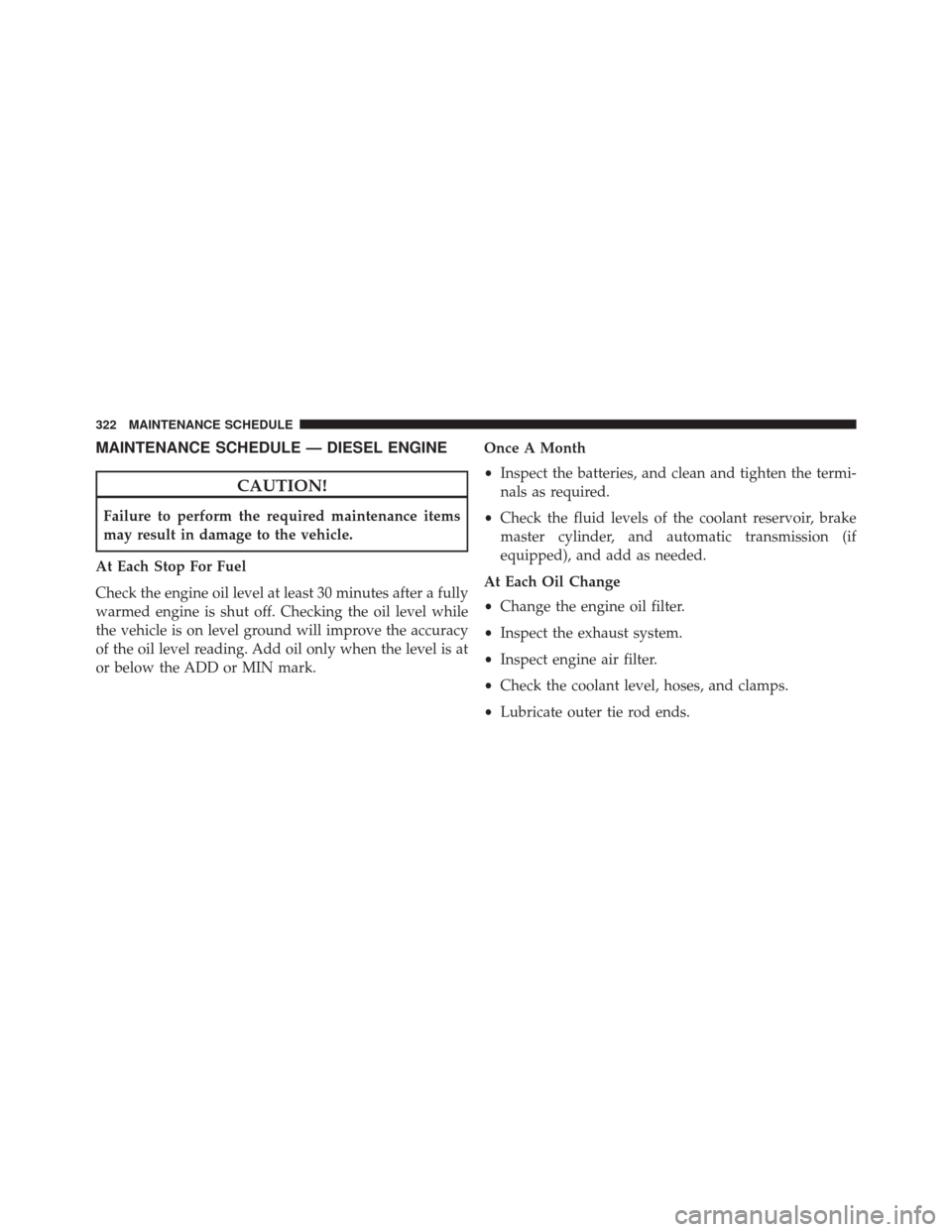
MAINTENANCE SCHEDULE — DIESEL ENGINE
CAUTION!
Failure to perform the required maintenance items
may result in damage to the vehicle.
At Each Stop For Fuel
Check the engine oil level at least 30 minutes after a fully
warmed engine is shut off. Checking the oil level while
the vehicle is on level ground will improve the accuracy
of the oil level reading. Add oil only when the level is at
or below the ADD or MIN mark. Once A Month
•
Inspect the batteries, and clean and tighten the termi-
nals as required.
• Check the fluid levels of the coolant reservoir, brake
master cylinder, and automatic transmission (if
equipped), and add as needed.
At Each Oil Change
• Change the engine oil filter.
• Inspect the exhaust system.
• Inspect engine air filter.
• Check the coolant level, hoses, and clamps.
• Lubricate outer tie rod ends.
322 MAINTENANCE SCHEDULE
Page 327 of 347
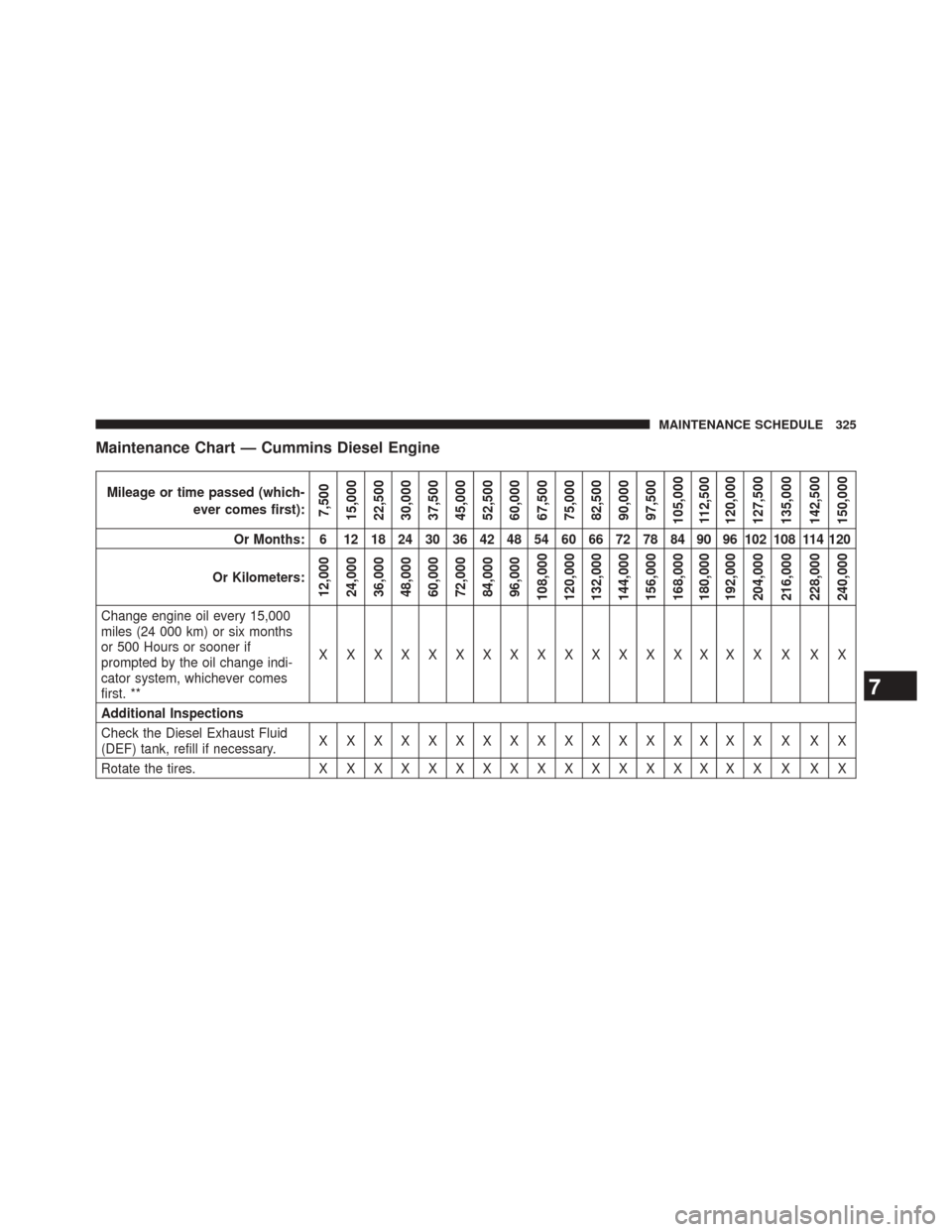
Maintenance Chart — Cummins Diesel Engine
Mileage or time passed (which-ever comes first):
7,500
15,000
22,500
30,000
37,500
45,000
52,500
60,000
67,500
75,000
82,500
90,000
97,500
105,000 112,500
120,000
127,500
135,000
142,500
150,000
Or Months: 6 12 18 24 30 36 42 48 54 60 66 72 78 84 90 96 102 108 114 120
Or Kilometers:
12,000
24,000
36,000
48,000
60,000
72,000
84,000
96,000
108,000
120,000
132,000
144,000
156,000
168,000
180,000
192,000
204,000
216,000
228,000
240,000
Change engine oil every 15,000
miles (24 000 km) or six months
or 500 Hours or sooner if
prompted by the oil change indi-
cator system, whichever comes
first. ** XXXXXXXXXXXXXXXXX X XX
Additional Inspections
Check the Diesel Exhaust Fluid
(DEF) tank, refill if necessary. XXXXXXXXXXXXXXXXX X XX
Rotate the tires. X X X X X X X X X X X X X X X X X X X X
7
MAINTENANCE SCHEDULE 325
Page 330 of 347
Mileage or time passed (which-ever comes first):
7,500
15,000
22,500
30,000
37,500
45,000
52,500
60,000
67,500
75,000
82,500
90,000
97,500
105,000 112,500
120,000
127,500
135,000
142,500
150,000
Or Months: 6 12 18 24 30 36 42 48 54 60 66 72 78 84 90 96 102 108 114 120
Or Kilometers:
12,000
24,000
36,000
48,000
60,000
72,000
84,000
96,000
108,000
120,000
132,000
144,000
156,000
168,000
180,000
192,000
204,000
216,000
228,000
240,000
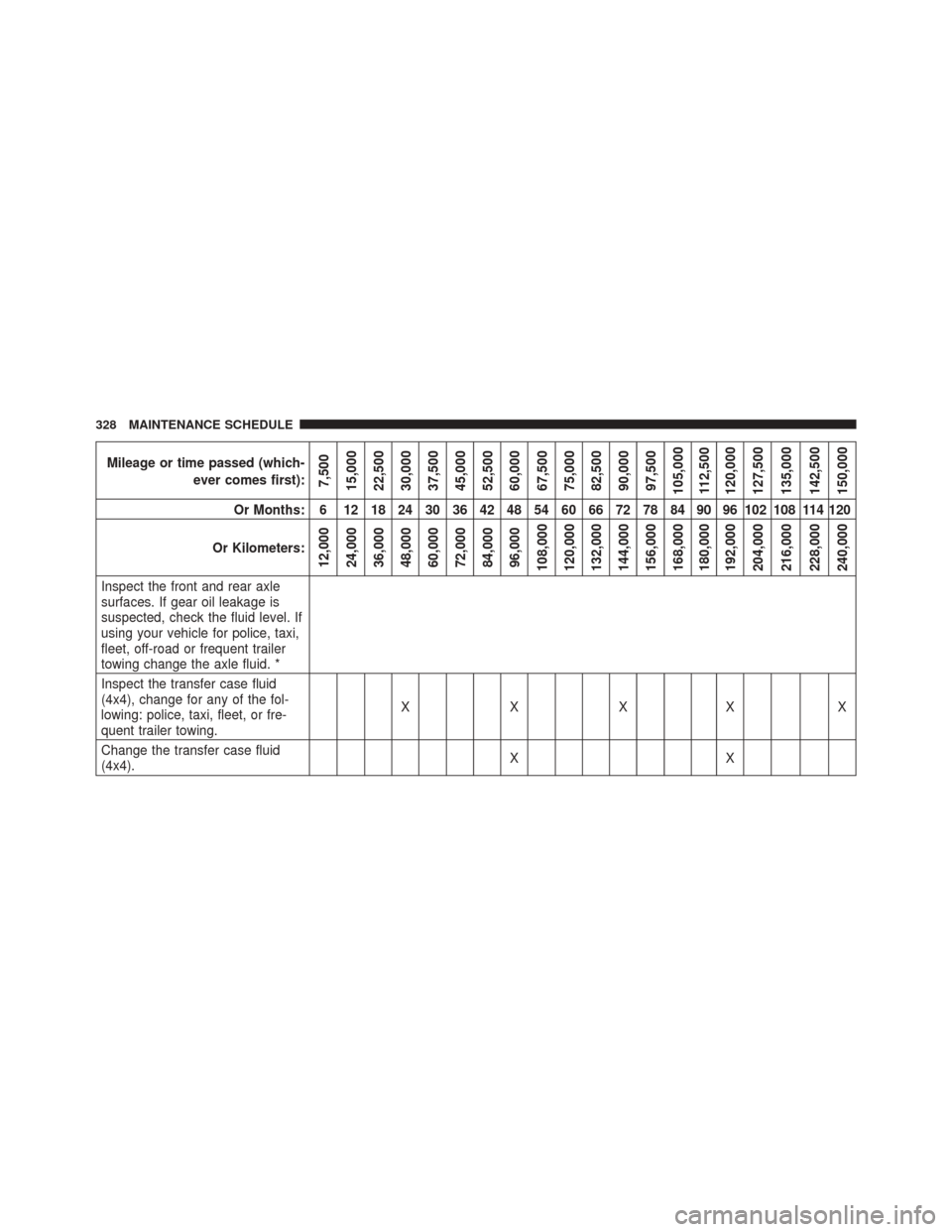
Inspect the front and rear axle
surfaces. If gear oil leakage is
suspected, check the fluid level. If
using your vehicle for police, taxi,
fleet, off-road or frequent trailer
towing change the axle fluid. *
Inspect the transfer case fluid
(4x4), change for any of the fol-
lowing: police, taxi, fleet, or fre-
quent trailer towing. XXXX X
Change the transfer case fluid
(4x4). XX
328 MAINTENANCE SCHEDULE
Page 333 of 347
Inspection and service should also be performed anytime
a malfunction is observed or suspected. Retain all re-
ceipts.
* Inspect the front and rear axle surfaces every 20,000
miles (32,000 km). If gear oil leakage is suspected, check
the fluid level. If using your vehicle for police, taxi, fleet,
off-road or frequent trailer towing change the axle fluid
every 20,000 miles (32,000 km).
** Under no circumstances should oil change intervals
exceed 15,000 miles (24 000 km) or six months or 500
Hours, whichever comes first.
**** Under no circumstances should the air cleaner filter
element exceed 30,000 miles (48,000 km) or 24 months,
whichever comes first.CAUTION!
***The manufacturer highly recommends that all
cooling system service, maintenance, and repairs be
performed by your local authorized dealer.
WARNING!
•You can be badly injured working on or around a
motor vehicle. Do only service work for which you
have the knowledge and the right equipment. If
you have any doubt about your ability to perform a
service job, take your vehicle to a competent me-
chanic.
• Failure to properly inspect and maintain your ve-
hicle could result in a component malfunction and
effect vehicle handling and performance. This
could cause an accident.
7
MAINTENANCE SCHEDULE 331
Page 336 of 347
Adding Engine Coolant (Antifreeze)............116
Adding Fuel ..............................91
Air bag Light .............................17
Air Cleaner, Engine (Engine Air Cleaner Filter) . . . .104
Alarm Light ..............................17
Anti-Lock Warning Light .....................17
Antifreeze (Engine Coolant) ..................115
Capacities ........................... .122
Disposal ..............................118
Automatic Transmission Fluid Type ........................... .126
Axle Fluid ............................. .126
Battery .................................113
Brake Fluid ............................ .126
Brake System ........................... .120
Fluid Check .......................... .120
Master Cylinder ....................... .120
Warning Light .......................17,33 Capacities, Antifreeze (Engine Coolant)
..........122
Capacities, Fluid ......................... .122
Caps, Filler Oil (Engine) .......................... .103
Radiator (Coolant Pressure) ................118
Charge Air Cooler ........................ .120
Check Engine Light (Malfunction Indicator Light) . . .17
Coolant Pressure Cap (Radiator Cap) ...........118
Cooling System ...........................114
Adding Coolant (Antifreeze) ...............116
Coolant Capacity ...................... .122
Coolant Level ..........................114
Disposal of Used Coolant ..................118
Drain, Flush, and Refill ...................115
Points to Remember .....................119
Pressure Cap ..........................118
Radiator Cap ..........................118
Selection of Coolant (Antifreeze) .........115,123
334 INDEX - RAM 1500