Page 274 of 347
2. Connect one end of the other jumper cable to negative(-) post of booster battery. Connect the other end of the
jumper cable to a good ground on the engine block of
the vehicle with the discharged battery. Make sure a
good connection is made, free of dirt and grease.
WARNING!
•Do not connect the cable to the negative post of the
discharge battery. The resulting electrical spark
could cause the battery to explode.
• During cold weather when temperatures are below
freezing point, electrolyte in a discharged battery
may freeze. Do not attempt jump starting because
the battery could rupture or explode. The battery
temperature must be brought up above freezing
point before attempting to jump start. 3. Take care that the clamps from one cable do not
inadvertently touch clamps from the other cable. Do
not lean over the battery when making connection.
The negative connection must provide good electrical
conductivity and current carrying capacity.
4. After the engine is started or if the engine fails to start, cables must be disconnected in the following order:
• Disconnect the negative cable at the engine ground.
• Disconnect the negative cable at the negative post on
booster battery.
• Disconnect the cable from the positive post of both
batteries.
272 WHAT TO DO IN EMERGENCIES
Page 275 of 347
WARNING!
Any procedure other than above could result in:
•Personal injury caused by electrolyte squirting out
the battery vent.
• Personal injury or property damage due to battery
explosion.
• Damage to charging system of booster vehicle or of
immobilized vehicle.
With Portable Starting Unit
There are many types of these units available. Follow the
manufacturer’s instructions for necessary precautions
and operation.
CAUTION!
It is very important that the starting unit operating
voltage does not exceed 12 Volts DC or damage to
battery, starter motor, alternator, or electrical system
may occur.
5
WHAT TO DO IN EMERGENCIES 273
Page 279 of 347
ENGINE COMPARTMENT — 6.7L DIESEL — SIX-SPEED 68RFE (2500/3500 Models)
1 — Battery7 — Washer Fluid Reservoir
2 — Engine Coolant Reservoir 8 — Power Steering Fluid Reservoir
3 — Automatic Transmission Dipstick 9 — Power Distribution Center
4 — Brake Fluid Reservoir 10 — Engine Oil Dipstick
5 — Battery 11 — Engine Oil Fill
6 — Aux Power Distribution Center 12 — Air Cleaner Filter
6
MAINTAINING YOUR VEHICLE 277
Page 280 of 347
ENGINE COMPARTMENT — 6.7L DIESEL — SIX-SPEED AS69RC HD (3500/CHASSIS CAB MODELS)
1 — Battery7 — Washer Fluid Reservoir
2 — Engine Coolant Reservoir 8 — Power Steering Fluid Reservoir
3 — Automatic Transmission Dipstick 9 — Power Distribution Center
4 — Brake Fluid Reservoir 10 — Engine Oil Dipstick
5 — Battery 11 — Engine Oil Fill
6 — Aux Power Distribution Center 12 — Air Cleaner Filter
278 MAINTAINING YOUR VEHICLE
Page 299 of 347
Refer to “Fluids, Lubricants, and Genuine Parts” in
“Maintaining Your Vehicle” for further information.
You can receive assistance in locating DEF in the United
States by calling 866-RAM-INFO (866-726-4636). In
Canada call 1–800–465–2001 (English) or 1–800–387–9983
(French)
Maintenance-Free Batteries
The top of the maintenance-free batteries are perma-
nently sealed. You will never have to add water, nor is
periodic maintenance required.
NOTE:Replacement batteries should both be of equal
capacity to prevent damage to the vehicle’s charging
system.
CAUTION!
It is essential when replacing the cables on the
battery that the positive cable is attached to the
positive post and the negative cable is attached to the
negative post. Battery posts are marked (+) positive
and negative (-) and are identified on the battery
case. Also, if a “fast charger” is used while the battery
is in vehicle, disconnect both vehicle battery cables
before connecting the charger to the battery. Do not
use a “fast charger” to provide starting voltage.
WARNING!
Battery posts, terminals, and related accessories con-
tain lead and lead compounds. Always wash hands
after handling the battery.
6
MAINTAINING YOUR VEHICLE 297
Page 300 of 347
Battery Blanket Usage
A battery loses 60% of its cranking power as the battery
temperature decreases to 0°F (-18°). For the same de-
crease in temperature, the engine requires twice as much
power to crank at the same RPM. The use of 120 Volt AC
powered battery blankets will greatly increase starting
capability at low temperatures. Suitable battery blankets
are available from your authorized MOPAR® dealer.
Cooling System
WARNING!
You or others can be badly burned by hot engine
coolant (antifreeze) or steam from your radiator. If
you see or hear steam coming from under the hood,
do not open the hood until the radiator has had time
to cool. Never try to open a cooling system pressure
cap when the radiator is hot.
Engine Coolant Checks
Check the engine coolant (antifreeze) protection every 12
months (before the onset of freezing weather, where
applicable). If the engine coolant (antifreeze) is dirty or
rusty in appearance, the system should be drained,
flushed and refilled with fresh coolant. Check the front of
the A/C condenser (if equipped) or radiator for any
accumulation of bugs, leaves, etc. If dirty, clean by gently
spraying water from a garden hose vertically down the
face of the A/C condenser (if equipped) or the back of the
radiator core.
Check the engine cooling system hoses for brittle rubber,
cracking, tears, cuts and tightness of the connection at the
coolant recovery bottle and radiator. Inspect the entire
system for leaks.
With the engine at normal operating temperature (but
not running), check the cooling system pressure cap for
proper vacuum sealing by draining a small amount of
298 MAINTAINING YOUR VEHICLE
Page 336 of 347
Adding Engine Coolant (Antifreeze)............116
Adding Fuel ..............................91
Air bag Light .............................17
Air Cleaner, Engine (Engine Air Cleaner Filter) . . . .104
Alarm Light ..............................17
Anti-Lock Warning Light .....................17
Antifreeze (Engine Coolant) ..................115
Capacities ........................... .122
Disposal ..............................118
Automatic Transmission Fluid Type ........................... .126
Axle Fluid ............................. .126
Battery .................................113
Brake Fluid ............................ .126
Brake System ........................... .120
Fluid Check .......................... .120
Master Cylinder ....................... .120
Warning Light .......................17,33 Capacities, Antifreeze (Engine Coolant)
..........122
Capacities, Fluid ......................... .122
Caps, Filler Oil (Engine) .......................... .103
Radiator (Coolant Pressure) ................118
Charge Air Cooler ........................ .120
Check Engine Light (Malfunction Indicator Light) . . .17
Coolant Pressure Cap (Radiator Cap) ...........118
Cooling System ...........................114
Adding Coolant (Antifreeze) ...............116
Coolant Capacity ...................... .122
Coolant Level ..........................114
Disposal of Used Coolant ..................118
Drain, Flush, and Refill ...................115
Points to Remember .....................119
Pressure Cap ..........................118
Radiator Cap ..........................118
Selection of Coolant (Antifreeze) .........115,123
334 INDEX - RAM 1500
Page 340 of 347
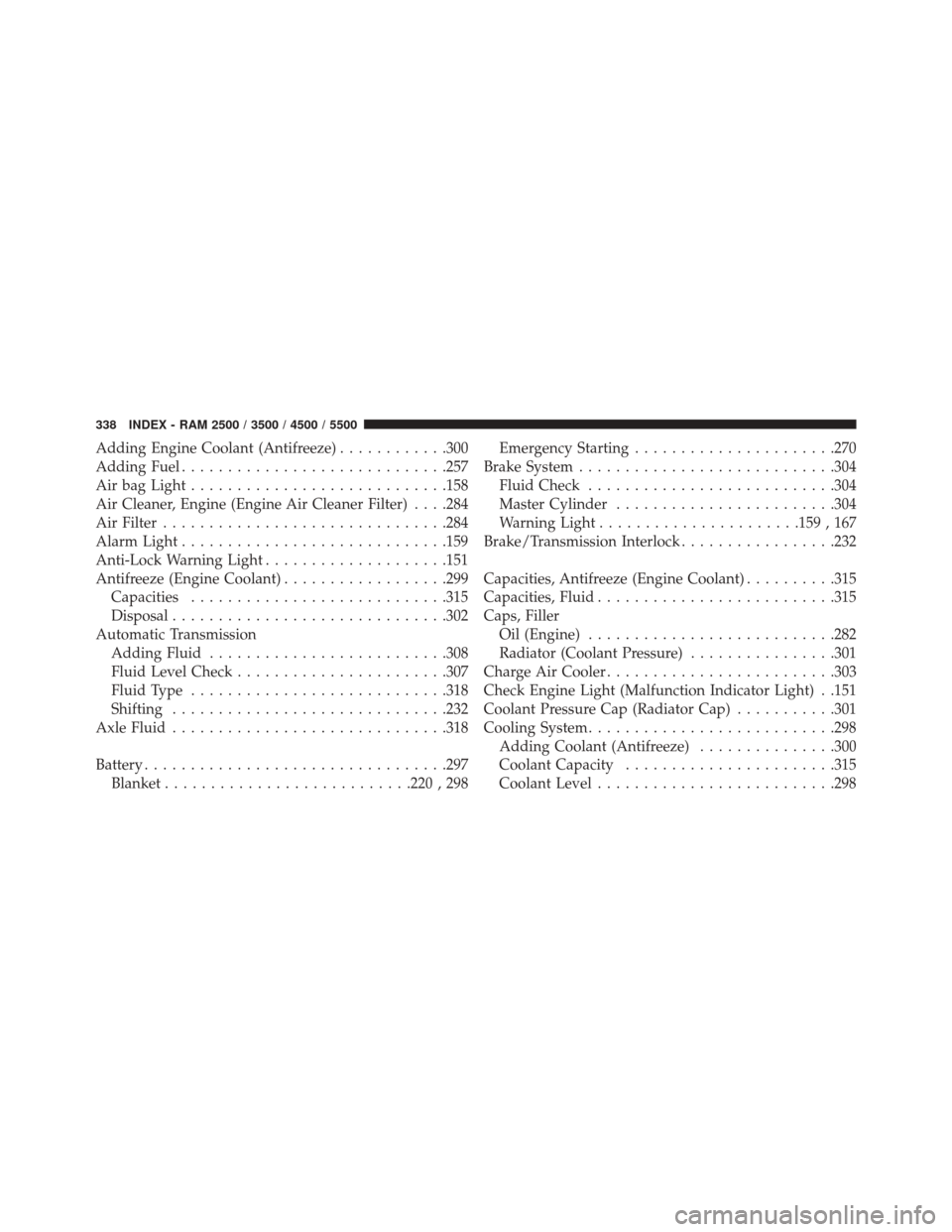
Adding Engine Coolant (Antifreeze)............300
Adding Fuel ............................ .257
Air bag Light ........................... .158
Air Cleaner, Engine (Engine Air Cleaner Filter) . . . .284
Air Filter .............................. .284
Alarm Light ............................ .159
Anti-Lock Warning Light ....................151
Antifreeze (Engine Coolant) ..................299
Capacities ........................... .315
Disposal ............................. .302
Automatic Transmission Adding Fluid ......................... .308
Fluid Level Check ...................... .307
Fluid Type ........................... .318
Shifting ............................. .232
Axle Fluid ............................. .318
Battery ................................ .297
Blanket .......................... .220 , 298Emergency Starting
..................... .270
Brake System ........................... .304
Fluid Check .......................... .304
Master Cylinder ....................... .304
Warning Light ..................... .159 , 167
Brake/Transmission Interlock .................232
Capacities, Antifreeze (Engine Coolant) ..........315
Capacities, Fluid ......................... .315
Caps, Filler Oil (Engine) .......................... .282
Radiator (Coolant Pressure) ................301
Charge Air Cooler ........................ .303
Check Engine Light (Malfunction Indicator Light) . .151
Coolant Pressure Cap (Radiator Cap) ...........301
Cooling System .......................... .298
Adding Coolant (Antifreeze) ...............300
Coolant Capacity ...................... .315
Coolant Level ......................... .298
338 INDEX - RAM 2500 / 3500 / 4500 / 5500


