Page 205 of 347
STARTING AND OPERATING
CONTENTS
�STARTING PROCEDURES ................206
▫ Manual Transmission — If Equipped .......207
▫ Automatic Transmission — If Equipped .....207
▫ Keyless Enter-N-Go™ — If Equipped .......207
▫ Extreme Cold Weather ..................211
▫ Normal Starting Procedure — Engine Manifold
Air Temperature Above 66° F (19° C) ........212
▫ Starting Procedure — Engine Manifold Air
Temperature 0°F To 66°F (–18°C to 19°C) .....213
▫ Starting Procedure — Engine Manifold Air
Temperature Below 0°F (-18°C) ............215▫
Starting Fluids ....................... .217
� NORMAL OPERATION — DIESEL ENGINE . . .218
▫ Cold Weather Precautions ................219
▫ Engine Idling ....................... .221
▫ Stopping The Engine ...................223
▫ Idle Shutdown ....................... .224
▫ Programmable Maximum Vehicle Speed
(Chassis Cab Only) ....................224
▫ Operating Precautions ..................225
4
Page 240 of 347
If the transmission temperature exceeds normal operat-
ing limits, the powertrain controller will modify the
transmission shift schedule and expand the range of
torque converter clutch engagement. This is done to
prevent transmission damage due to overheating.
If the transmission becomes extremely hot or is in danger
of overheating, the “Transmission Temperature Warning
Light” may illuminate and the transmission may operate
differently until the transmission cools down.
NOTE:Use caution when operating a heavily loaded
vehicle at low speeds (such as towing a trailer up a steep
grade, or in stop-and-go traffic) during hot weather. In
these conditions, torque converter slip can impose a
significant additional heat load on the cooling system.
Downshifting the transmission to the lowest possible
gear (when climbing a grade), or shifting to NEUTRAL
(when stopped in heavy traffic) can help to reduce this
excess heat generation. During cold temperatures, transmission operation may
be modified depending on engine and transmission
temperature as well as vehicle speed. This feature im-
proves warm up time of the engine and transmission to
achieve maximum efficiency. Engagement of the torque
converter clutch is inhibited until the transmission fluid
is warm (refer to the “Note” under “Torque Converter
Clutch” in this section). On Pickup models with 68RFE
transmission, top overdrive gear is also inhibited until
the transmission fluid is warm, and during extremely
cold temperatures (-16°F [-27°C] or below), operation
may briefly be limited to first and direct gears only. On
trucks with AS69RC transmission, fifth and sixth gears
may be inhibited briefly on cold starts below 41°F (5°C),
and during very cold temperatures (-4°F [-20°C] or
below), operation may briefly be limited to third gear
only. During this condition, the ability of the vehicle to
238 STARTING AND OPERATING
Page 243 of 347
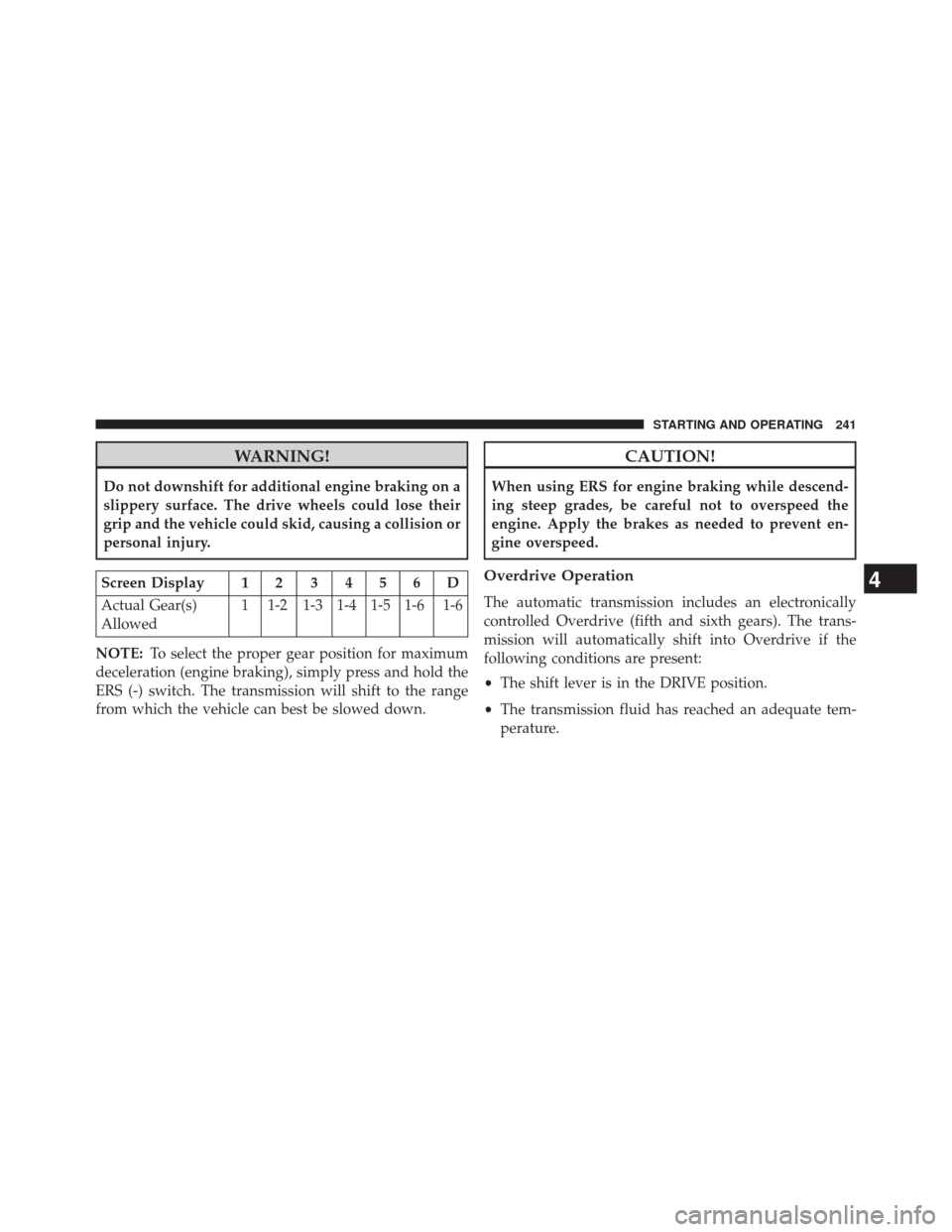
WARNING!
Do not downshift for additional engine braking on a
slippery surface. The drive wheels could lose their
grip and the vehicle could skid, causing a collision or
personal injury.
Screen Display 1 2 3 4 5 6 D
Actual Gear(s)
Allowed1 1-2 1-3 1-4 1-5 1-6 1-6
NOTE: To select the proper gear position for maximum
deceleration (engine braking), simply press and hold the
ERS (-) switch. The transmission will shift to the range
from which the vehicle can best be slowed down.
CAUTION!
When using ERS for engine braking while descend-
ing steep grades, be careful not to overspeed the
engine. Apply the brakes as needed to prevent en-
gine overspeed.
Overdrive Operation
The automatic transmission includes an electronically
controlled Overdrive (fifth and sixth gears). The trans-
mission will automatically shift into Overdrive if the
following conditions are present:
• The shift lever is in the DRIVE position.
• The transmission fluid has reached an adequate tem-
perature.
4
STARTING AND OPERATING 241
Page 245 of 347
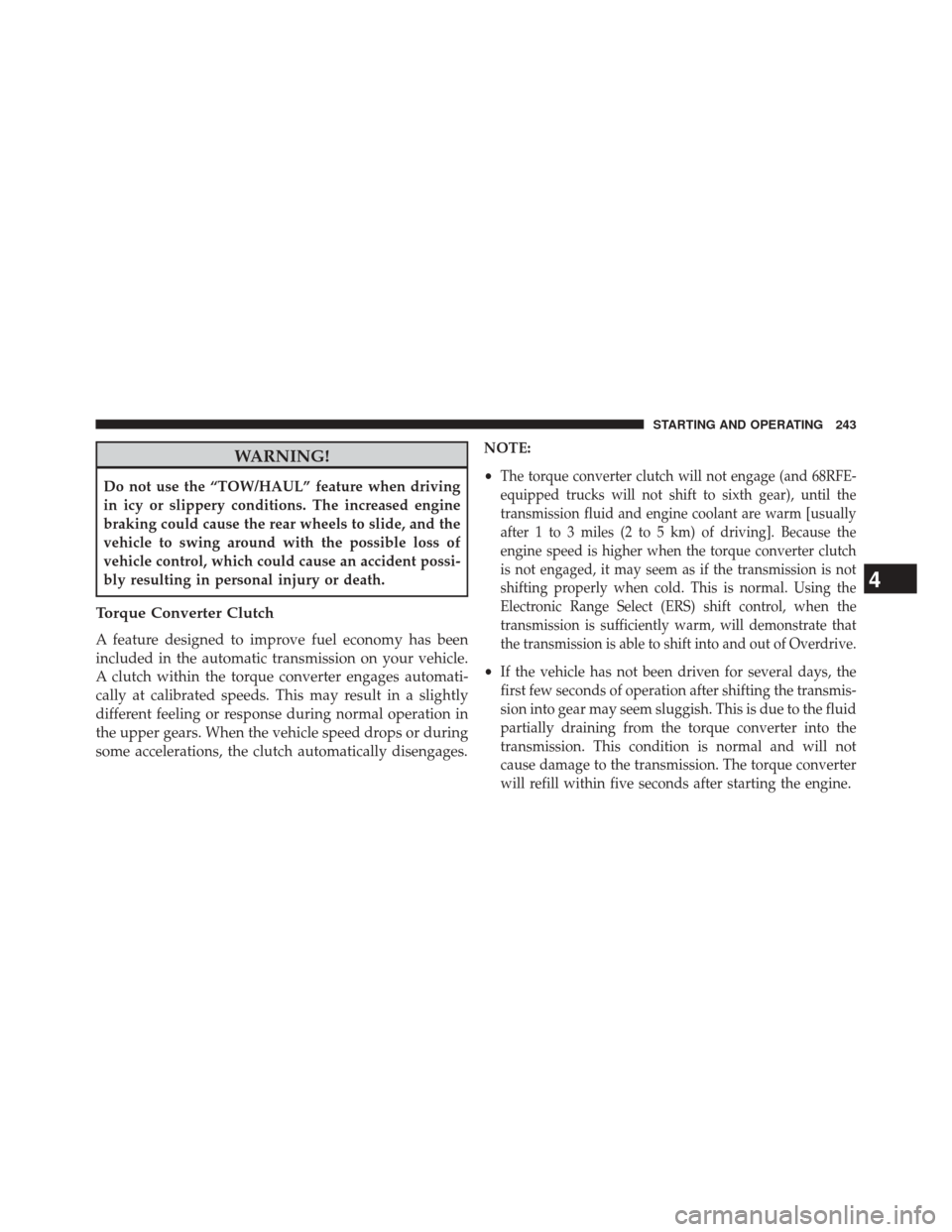
WARNING!
Do not use the “TOW/HAUL” feature when driving
in icy or slippery conditions. The increased engine
braking could cause the rear wheels to slide, and the
vehicle to swing around with the possible loss of
vehicle control, which could cause an accident possi-
bly resulting in personal injury or death.
Torque Converter Clutch
A feature designed to improve fuel economy has been
included in the automatic transmission on your vehicle.
A clutch within the torque converter engages automati-
cally at calibrated speeds. This may result in a slightly
different feeling or response during normal operation in
the upper gears. When the vehicle speed drops or during
some accelerations, the clutch automatically disengages.NOTE:
•
The torque converter clutch will not engage (and 68RFE-
equipped trucks will not shift to sixth gear), until the
transmission fluid and engine coolant are warm [usually
after 1 to 3 miles (2 to 5 km) of driving]. Because the
engine speed is higher when the torque converter clutch
is not engaged, it may seem as if the transmission is not
shifting properly when cold. This is normal. Using the
Electronic Range Select (ERS) shift control, when the
transmission is sufficiently warm, will demonstrate that
the transmission is able to shift into and out of Overdrive.
•If the vehicle has not been driven for several days, the
first few seconds of operation after shifting the transmis-
sion into gear may seem sluggish. This is due to the fluid
partially draining from the torque converter into the
transmission. This condition is normal and will not
cause damage to the transmission. The torque converter
will refill within five seconds after starting the engine.
4
STARTING AND OPERATING 243
Page 246 of 347
MANUAL TRANSMISSION — IF EQUIPPED
WARNING!
You or others could be injured if you leave the
vehicle unattended without having the parking
brake fully applied. The parking brake should al-
ways be applied when the driver is not in the vehicle,
especially on an incline.
CAUTION!
Never drive with your foot resting on the clutch
pedal, or attempt to hold the vehicle on a hill with the
clutch pedal partially engaged, as this will cause
abnormal wear on the clutch.
NOTE: During cold weather, you may experience in-
creased effort in shifting until the transmission fluid
warms up. This is normal.
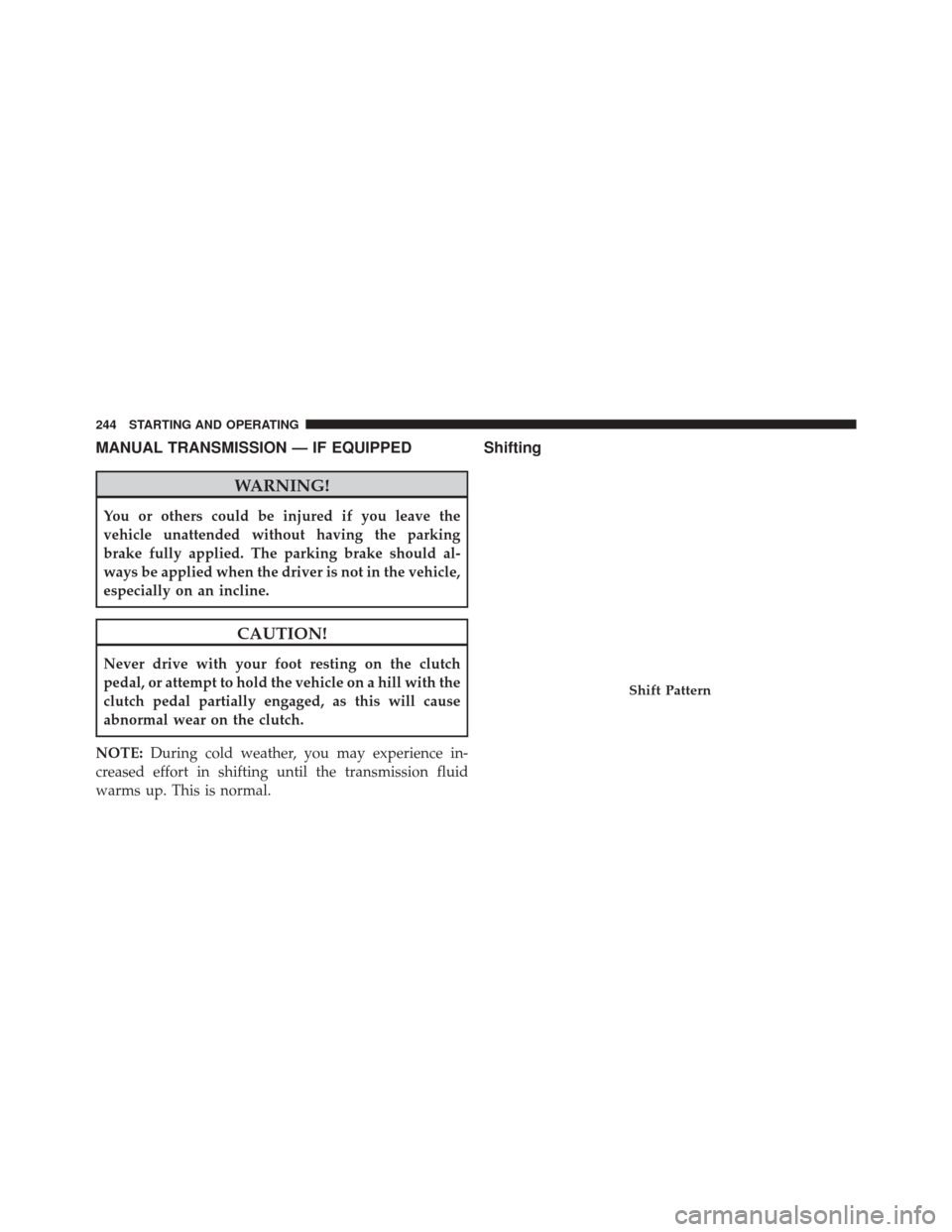
Shifting
Shift Pattern
244 STARTING AND OPERATING
Page 272 of 347
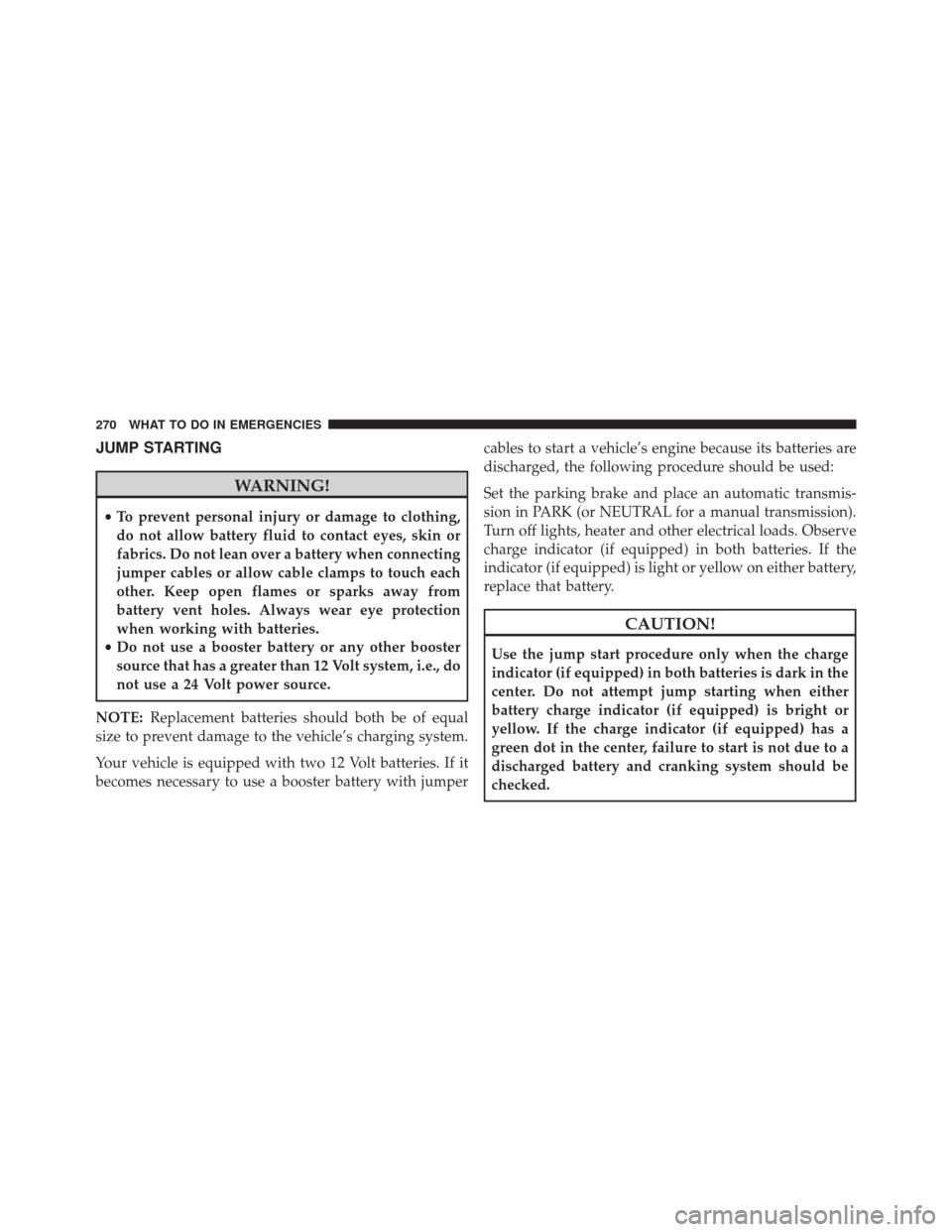
JUMP STARTING
WARNING!
•To prevent personal injury or damage to clothing,
do not allow battery fluid to contact eyes, skin or
fabrics. Do not lean over a battery when connecting
jumper cables or allow cable clamps to touch each
other. Keep open flames or sparks away from
battery vent holes. Always wear eye protection
when working with batteries.
• Do not use a booster battery or any other booster
source that has a greater than 12 Volt system, i.e., do
not use a 24 Volt power source.
NOTE: Replacement batteries should both be of equal
size to prevent damage to the vehicle’s charging system.
Your vehicle is equipped with two 12 Volt batteries. If it
becomes necessary to use a booster battery with jumper cables to start a vehicle’s engine because its batteries are
discharged, the following procedure should be used:
Set the parking brake and place an automatic transmis-
sion in PARK (or NEUTRAL for a manual transmission).
Turn off lights, heater and other electrical loads. Observe
charge indicator (if equipped) in both batteries. If the
indicator (if equipped) is light or yellow on either battery,
replace that battery.
CAUTION!
Use the jump start procedure only when the charge
indicator (if equipped) in both batteries is dark in the
center. Do not attempt jump starting when either
battery charge indicator (if equipped) is bright or
yellow. If the charge indicator (if equipped) has a
green dot in the center, failure to start is not due to a
discharged battery and cranking system should be
checked.
270 WHAT TO DO IN EMERGENCIES
Page 278 of 347
▫Manual Transmission — If Equipped ........306
▫ Automatic Transmission — If Equipped ......306
▫ Noise Control System Required Maintenance &
Warranty .......................... .310
� FLUID CAPACITIES ....................315 �
FLUIDS, LUBRICANTS AND GENUINE
PARTS ............................. .316
▫ Engine ............................ .316
▫ Chassis ........................... .318
276 MAINTAINING YOUR VEHICLE
Page 279 of 347
ENGINE COMPARTMENT — 6.7L DIESEL — SIX-SPEED 68RFE (2500/3500 Models)
1 — Battery7 — Washer Fluid Reservoir
2 — Engine Coolant Reservoir 8 — Power Steering Fluid Reservoir
3 — Automatic Transmission Dipstick 9 — Power Distribution Center
4 — Brake Fluid Reservoir 10 — Engine Oil Dipstick
5 — Battery 11 — Engine Oil Fill
6 — Aux Power Distribution Center 12 — Air Cleaner Filter
6
MAINTAINING YOUR VEHICLE 277