Page 221 of 347
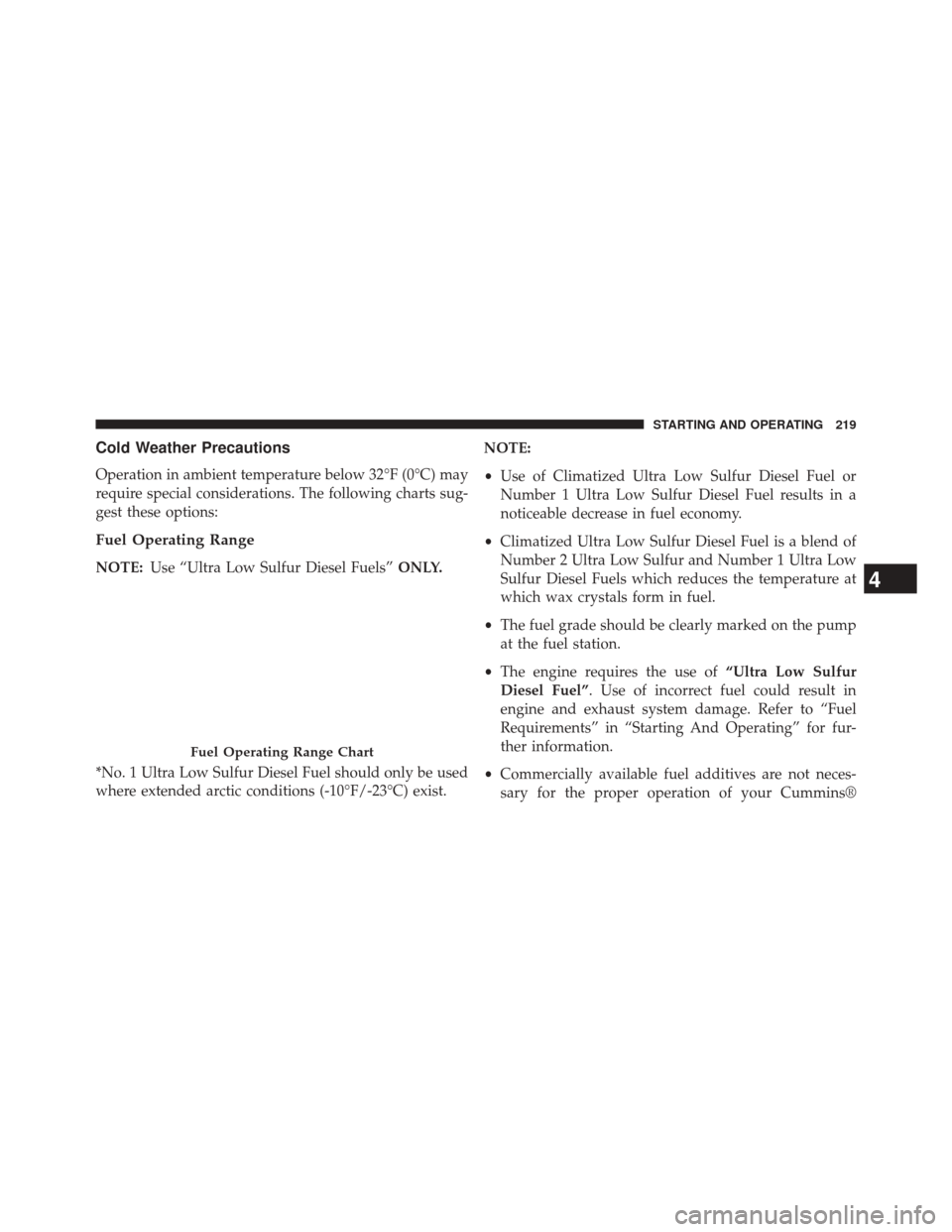
Cold Weather Precautions
Operation in ambient temperature below 32°F (0°C) may
require special considerations. The following charts sug-
gest these options:
Fuel Operating Range
NOTE:Use “Ultra Low Sulfur Diesel Fuels” ONLY.
*No. 1 Ultra Low Sulfur Diesel Fuel should only be used
where extended arctic conditions (-10°F/-23°C) exist. NOTE:
•
Use of Climatized Ultra Low Sulfur Diesel Fuel or
Number 1 Ultra Low Sulfur Diesel Fuel results in a
noticeable decrease in fuel economy.
• Climatized Ultra Low Sulfur Diesel Fuel is a blend of
Number 2 Ultra Low Sulfur and Number 1 Ultra Low
Sulfur Diesel Fuels which reduces the temperature at
which wax crystals form in fuel.
• The fuel grade should be clearly marked on the pump
at the fuel station.
• The engine requires the use of “Ultra Low Sulfur
Diesel Fuel”. Use of incorrect fuel could result in
engine and exhaust system damage. Refer to “Fuel
Requirements” in “Starting And Operating” for fur-
ther information.
• Commercially available fuel additives are not neces-
sary for the proper operation of your Cummins®
Fuel Operating Range Chart
4
STARTING AND OPERATING 219
Page 262 of 347
CAUTION!
To avoid fuel spillage and overfilling, do not “top
off” the fuel tank after filling.
WARNING!
•Never have any smoking materials lit in or near the
vehicle when the fuel door is open or the tank is
being filled.
• Never add fuel when the engine is running. This is
in violation of most state and federal fire regula-
tions and may cause the “Malfunction Indicator
Light” to turn on.
• A fire may result if fuel is pumped into a portable
container that is inside of a vehicle. You could be
burned. Always place fuel containers on the
ground while filling.
ADDING FUEL — CHASSIS CAB MODELS
CAUTION!
To avoid fuel spillage and overfilling, do not “top
off” the fuel tank after filling.
NOTE:
• When the fuel nozzle “clicks” or shuts off, the fuel tank
is full.
• Tighten the fuel filler cap until you hear a “clicking”
sound. This is an indication that the fuel filler cap is
properly tightened.
• Make sure that the fuel filler cap is tightened each time
the vehicle is refueled.
260 STARTING AND OPERATING
Page 263 of 347
WARNING!
A fire may result if fuel is pumped into a portable
container that is on a truck bed. You could be burned.
Always place fuel containers on the ground while
filling.
Fuel Filler Cap
If the fuel filler cap is lost or damaged, be sure the
replacement cap is for use with this vehicle.
CAUTION!
Damage to the fuel system or emission control sys-
tem could result from using an improper fuel tank
filler tube cap. A poorly fitting cap could let impuri-
ties into the fuel system.
WARNING!
•Never have any smoking materials lit in or near the
vehicle when the fuel filler cap is removed or the
tank filled.
• Never add fuel to the vehicle when the engine is
running.
Avoid Using Contaminated Fuel
Fuel that is contaminated by water or dirt can cause
severe damage to the engine fuel system. Proper main-
tenance of the engine fuel filter and fuel tank is essential.
Refer to “Maintenance Procedures” in “Maintaining Your
Vehicle” for further information.
Bulk Fuel Storage — Diesel Fuel
If you store quantities of fuel, good maintenance of the
stored fuel is also essential. Fuel contaminated with
water will promote the growth of “microbes.” These
4
STARTING AND OPERATING 261
Page 267 of 347
CAUTION!(Continued)
•DO NOT OVERFILL. DEF will freeze below 12ºF
(-11ºC). The DEF system is designed to work in
temperatures below the DEF freezing point, how-
ever, if the tank is overfilled and freezes, the
system could be damaged.
• When DEF is spilled, clean the area immediately
with water and use an absorbent material to soak
up the spills on the ground.
• Do not attempt to start your engine if DEF is
accidentally added to the diesel fuel tank as it can
result in severe damage to your engine, including
but not limited to failure of the fuel pump and
injectors.
3. Stop filling the DEF tank immediately when any of the following happen: DEF stops flowing from the fill
bottle into the DEF tank, DEF splashes out the filler
neck, or a DEF pump nozzle automatically shuts off. 4. Reinstall cap onto DEF tank.
Filling The Def Tank In Cold Climates
Since DEF will begin to freeze at 12°F (-11°C), your vehicle
is equipped with an automatic DEF heating system. This
allows the DEF injection system to operate properly at
temperatures below 12°F (-11°C). If your vehicle is not in
operation for an extended period of time with tempera-
tures below 12°F (-11°C), the DEF in the tank may freeze. If
the tank is overfilled and freezes, it could be damaged.
Therefore, do not overfill the DEF tank.
Extra care should be taken when filling with portable
containers to avoid overfilling. Note the level of the DEF
gauge in your instrument cluster. On pickup applications,
you may safely add a maximum of 2 gallons of DEF from
portable containers when your DEF gauge is reading ½ full.
On Chassis Cab applications a maximum of 2 gallons may
be added when the DEF gauge is reading ¾ full.
4
STARTING AND OPERATING 265
Page 269 of 347
•SCR catalyst
The DEF injection system and SCR catalyst enable the
achievement of diesel emissions requirements; while
maintaining outstanding fuel economy, drivability,
torque and power ratings.
Refer to “Electronic Vehicle Information Center (EVIC) or
�Driver Information Display (DID)” in “Understanding
Your Instrument Panel” for system messages and warn-
ings. NOTE:
•
Your vehicle is equipped with a DEF injection system.
You may occasionally hear an audible clicking noise.
This is normal operation.
• The DEF pump will run for a period of time after
engine shutdown to purge the DEF system. This is
normal operation.
4
STARTING AND OPERATING 267
Page 293 of 347
CAUTION!
•Diesel fuel will damage blacktop paving surfaces.
Drain the filter into an appropriate container.
• Do not prefill the fuel filter when installing a new
fuel filter. There is a possibility debris could be
introduced into the fuel filter during this action. It
is best to install the filter dry and allow the in-tank
lift pump to prime the fuel system.
1. Ensure engine is turned off.
2. Place drain pan under the fuel filter drain hose.
3. Open the water drain valve 1/4 turn counterclockwise and completely drain fuel and water into the ap-
proved container.
4. Close the water drain valve. 5. Remove lid using a socket or strap wrench. Rotate
counterclockwise for removal. Remove used o-ring
and discard it.
6. Remove the used filter cartridge from the housing and dispose of according to your local regulations.
7. Wipe clean the sealing surfaces of the lid and housing.
8. Install new o-ring back into ring groove on the filter housing and lubricate with clean engine oil.
9. Remove new filter cartridge from plastic bag and install into housing.
NOTE: Do not remove cartridge from bag until you reach
this step in order to keep cartridge clean.
10. Push down on the cartridge to ensure it is properly seated. Do not pre-fill the filter housing with fuel.
6
MAINTAINING YOUR VEHICLE 291
Page 295 of 347
CAUTION!
•Diesel fuel will damage blacktop paving surfaces.
Drain the filter into an appropriate container.
• Do not prefill the fuel filter when installing a new
fuel filter. There is a possibility debris could be
introduced into the fuel filter during this action. It
is best to install the filter dry and allow the in-tank
lift pump to prime the fuel system.
1. Ensure engine is turned off.
2. Place drain pan under the fuel filter drain hose.
3. Open the water drain valve 1 full turn counterclock- wise and completely drain fuel and water into the
approved container.
4. Close the water drain valve. 5. Remove lid using a socket or strap wrench. Rotate
counterclockwise for removal. Remove used o-ring
and discard it.
6. Remove the used filter cartridge from the housing and dispose of according to your local regulations.
7. Wipe clean the sealing surfaces of the lid and housing.
8. Install new o-ring back into ring groove on the filter housing and lubricate with clean engine oil.
NOTE: WIF sensor is re-usable. Service kit comes with
new o-ring for filter canister and WIF sensor.
6
MAINTAINING YOUR VEHICLE 293
Page 296 of 347
Priming If The Engine Has Run Out Of Fuel
WARNING!
Do not open the high pressure fuel system with the
engine running. Engine operation causes high fuel
pressure. High pressure fuel spray can cause serious
injury or death.
1. Add a substantial amount of fuel to the tank, approxi- mately 2 to 5 gal (8L to 19L).
2. Turn ignition switch to the start position to engage starter for one second, return ignition switch to run
position. This will activate in tank fuel pump for
approximately 15 seconds. Repeat this process twice.
3. Start the engine using the “Normal Starting” proce- dure. Refer to “Starting Procedures” in “Starting and
Operating” for further information.
CAUTION!
Do not engage the starter motor for more than 15
seconds at a time. Allow two minutes between the
cranking intervals.
NOTE: The engine may run rough until the air is forced
from all the fuel lines.
WARNING!
Do not use alcohol or gasoline as a fuel blending
agent. They can be unstable under certain conditions
and be hazardous or explosive when mixed with
diesel fuel.
294 MAINTAINING YOUR VEHICLE