Page 158 of 347
CAUTION!(Continued)
sensor to become inoperable. After using an after-
market tire sealant it is recommended that you take
your vehicle to an authorized dealership to have your
sensor function checked.
NOTE: The TPMS telltale is also accompanied by a “Low
Tire” message in the Electronic Vehicle Information Cen-
ter (EVIC) and Driver Information Display (DID) screen
indicating “Low Tire”.
11. Cargo Light
The cargo light will illuminate when the cargo
light is activated by pressing the cargo light
button on the headlight switch. 12. Electric Power Steering Malfunction Warning Light
— If Equipped
This telltale is on when the Electric Power
Steering is not operating and needs service.
13. Electronic Throttle Control (ETC) Light This light informs you of a problem with the
Electronic Throttle Control (ETC) system. The
light will come on when the ignition is first
turned ON and remain on briefly as a bulb
check. If the light does not come on during starting, have
the system checked by an authorized dealer.
If a problem is detected, the light will come on while the
engine is running. Cycle the ignition key when the
vehicle has completely stopped and the transmission is
placed in the PARK position. The light should turn off.
156 UNDERSTANDING YOUR INSTRUMENT PANEL
Page 172 of 347
14. Fuel Gauge
Shows level of fuel in tank when ignition switch is in the
ON/RUN position.
15. Vehicle Security Light — If EquippedThis light will flash at a fast rate for approxi-
mately 15 seconds, when the vehicle security
alarm is arming, and then will flash slowly
until the vehicle is disarmed.
16. Tire Pressure Monitoring Telltale Light
Each tire, including the spare (if provided),
should be checked monthly when cold and
inflated to the inflation pressure recommended
by the vehicle manufacturer on the vehicle
placard or tire inflation pressure label. (If your vehicle
has tires of a different size than the size indicated on the vehicle placard or tire inflation pressure label, you should
determine the proper tire inflation pressure for those
tires.)
As an added safety feature, your vehicle has been
equipped with a Tire Pressure Monitoring System
(TPMS) that illuminates a low tire pressure telltale when
one or more of your tires is significantly under-inflated.
Accordingly, when the low tire pressure telltale illumi-
nates, you should stop and check your tires as soon as
possible, and inflate them to the proper pressure. Driving
on a significantly under-inflated tire causes the tire to
overheat and can lead to tire failure. Under-inflation also
reduces fuel efficiency and tire tread life, and may affect
the vehicle’s handling and stopping ability.
Please note that the TPMS is not a substitute for proper
tire maintenance, and it is the driver ’s responsibility to
maintain correct tire pressure, even if under-inflation has
not reached the level to trigger illumination of the TPMS
low tire pressure telltale.
170 UNDERSTANDING YOUR INSTRUMENT PANEL
Page 173 of 347
Your vehicle has also been equipped with a TPMS
malfunction indicator to indicate when the system is not
operating properly. The TPMS malfunction indicator is
combined with the low tire pressure telltale. When the
system detects a malfunction, the telltale will flash for
approximately one minute and then remain continuously
illuminated. This sequence will continue upon subse-
quent vehicle start-ups as long as the malfunction exists.
When the malfunction indicator is illuminated, the sys-
tem may not be able to detect or signal low tire pressure
as intended. TPMS malfunctions may occur for a variety
of reasons, including the installation of replacement or
alternate tires or wheels on the vehicle that prevent the
TPMS from functioning properly. Always check the
TPMS malfunction telltale after replacing one or more
tires or wheels on your vehicle, to ensure that the
replacement or alternate tires and wheels allow the TPMS
to continue to function properly.CAUTION!
The TPMS has been optimized for the original
equipment tires and wheels. TPMS pressures and
warning have been established for the tire size
equipped on your vehicle. Undesirable system opera-
tion or sensor damage may result when using re-
placement equipment that is not of the same size,
type, and/or style. Aftermarket wheels can cause
sensor damage. Using aftermarket tire sealants may
cause the Tire Pressure Monitoring System (TPMS)
sensor to become inoperable. After using an after-
market tire sealant it is recommended that you take
your vehicle to an authorized dealership to have your
sensor function checked.
NOTE: The TPMS telltale is also accompanied by a “Low
Tire” message in the Driver Information Display (DID)
screen indicating “Low Tire”.
3
UNDERSTANDING YOUR INSTRUMENT PANEL 171
Page 338 of 347
Tank Capacity......................... .122
Fueling .................................91
Gauges Speedometer ........................17,35
Tachometer .........................17,30
Voltmeter ..............................80
Information Center, Vehicle ...................41
Instrument Cluster .........................16
Intervention Regeneration Strategy ..............49
Keyless Enter-N-Go ........................77
Lights Airbag .............................17,35
Alarm .............................17,36
Anti-Lock ..........................17,30
Brake Warning .......................17,33 Check Engine (Malfunction Indicator)
......17,30
Fog ...............................17,38
High Beam .........................17,34
High Beam Indicator ..................17,34
Instrument Cluster ....................17,30
Seat Belt Reminder ....................17,35
Security Alarm ...................... .17, 36
Tire Pressure Monitoring (TPMS) .............36
Warning (Instrument Cluster Description) . . . .17 , 30
Maintenance Procedures ....................101
Maintenance Schedule ..................... .128
New Vehicle Break-In Period ..................13
Oil, Engine ............................. .102
Capacity ............................ .122
Change Interval ....................... .103
Dipstick ............................. .102
336 INDEX - RAM 1500
Page 343 of 347
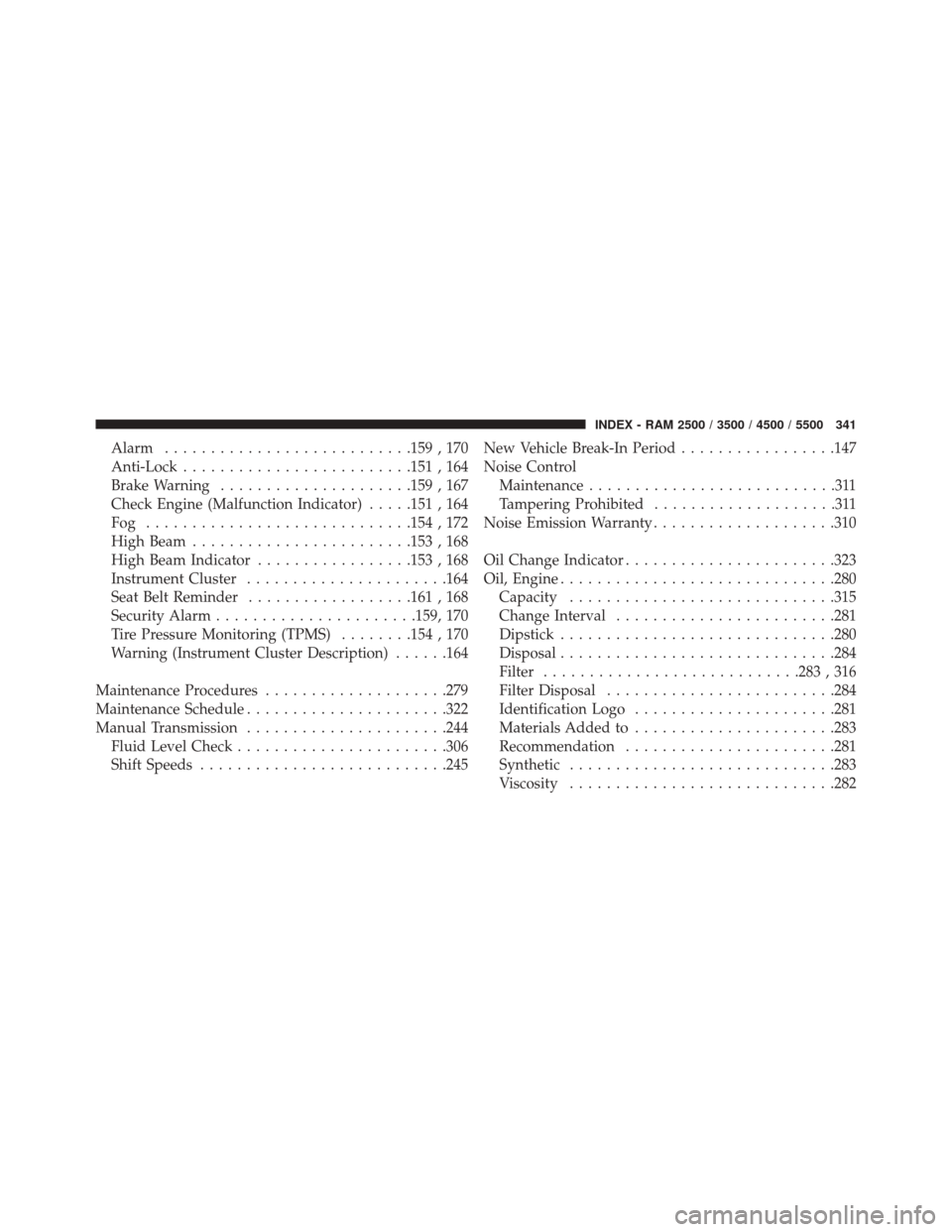
Alarm.......................... .159 , 170
Anti-Lock ........................ .151 , 164
Brake Warning .....................159 , 167
Check Engine (Malfunction Indicator) .....151 , 164
Fog ............................ .154 , 172
High Beam ....................... .153 , 168
High Beam Indicator .................153 , 168
Instrument Cluster ..................... .164
Seat Belt Reminder ..................161 , 168
Security Alarm ..................... .159, 170
Tire Pressure Monitoring (TPMS) ........154 , 170
Warning (Instrument Cluster Description) ......164
Maintenance Procedures ....................279
Maintenance Schedule ..................... .322
Manual Transmission ..................... .244
Fluid Level Check ...................... .306
Shift Speeds .......................... .245New Vehicle Break-In Period
.................147
Noise Control Maintenance ...........................311
Tampering Prohibited ....................311
Noise Emission Warranty ....................310
Oil Change Indicator ...................... .323
Oil, Engine ............................. .280
Capacity ............................ .315
Change Interval ....................... .281
Dipstick ............................. .280
Disposal ............................. .284
Filter ........................... .283 , 316
Filter Disposal ........................ .284
Identification Logo ..................... .281
Materials Added to ..................... .283
Recommendation ...................... .281
Synthetic ............................ .283
Viscosity ............................ .282
INDEX - RAM 2500 / 3500 / 4500 / 5500 341