Page 306 of 347
To guarantee optimum performance of the system, keep
the surfaces of the charge air cooler, condenser and
radiator clean and free of debris. Periodically check the
hoses leading to and from the charge air cooler for cracks
or loose clamps resulting in loss of pressure and reduced
engine performance.
Brake System
Brake Master Cylinder — Brake Fluid Level Check
The fluid level of the master cylinder should be checked
when performing under the hood service, or immedi-
ately if the “Brake System Warning Light” indicates
system failure.
The brake master cylinder has a translucent plastic
reservoir. On the outboard side of the reservoir, there is a
“MAX” mark and a “MIN” mark. The fluid level must be
kept within these two marks. Do not add fluid above the
full mark because leakage may occur at the cap.With disc brakes, the fluid level can be expected to fall as
the brake linings wear. However, an unexpected drop in
fluid level may be caused by a leak and a system check
should be conducted.
Refer to “Fluids, Lubricants, and Genuine Parts” in
“Maintaining Your Vehicle” for further information.
WARNING!
•
Use only manufacturer’s recommended brake
fluid. Refer to “Fluids, Lubricants, and Genuine
Parts” in “Maintaining Your Vehicle” for further
information. Using the wrong type of brake fluid
can severely damage your brake system and/or
impair its performance. The proper type of brake
fluid for your vehicle is also identified on the
original factory installed hydraulic master cylinder
reservoir.
(Continued)
304 MAINTAINING YOUR VEHICLE
Page 307 of 347
WARNING!(Continued)
•To avoid contamination from foreign matter or
moisture, use only new brake fluid or fluid that has
been in a tightly closed container. Keep the master
cylinder reservoir cap secured at all times. Brake
fluid in a open container absorbs moisture from the
air resulting in a lower boiling point. This may
cause it to boil unexpectedly during hard or pro-
longed braking, resulting in sudden brake failure.
This could result in a accident.
• Overfilling the brake fluid reservoir can result in
spilling brake fluid on hot engine parts, causing
the brake fluid to catch fire. Brake fluid can also
damage painted and vinyl surfaces, care should be
taken to avoid its contact with these surfaces.
(Continued)
WARNING! (Continued)
•Do not allow petroleum based fluid to contaminate
the brake fluid. Brake seal components could be
damaged, causing partial or complete brake failure.
This could result in an accident.
Clutch Hydraulic System
The clutch hydraulic system is a sealed maintenance-free
system. In the event of leakage or other malfunction, the
system must be replaced.
Transfer Case — If Equipped
Drain And Refill
Refer to the “Maintenance Schedule” for the proper
maintenance intervals.
6
MAINTAINING YOUR VEHICLE 305
Page 310 of 347
Use the following procedure to check the transmission
fluid level properly:
1. Monitor the transmission temperature using theEVIC/DID screen, and operate the vehicle as required
to reach the normal operating temperature. If the
transmission is not functioning properly, or the vehicle
cannot be driven, see the NOTE and CAUTION below
about checking the fluid level at colder temperatures.
2. Park the vehicle on level ground.
3. Run the engine at normal idle speed for at least 60 seconds, and leave the engine running for the rest of
this procedure.
4. Fully apply the parking brake and press the brake pedal.
5.
Place the shift lever momentarily into each gear position
(allowing time for the transmission to fully engage in
each position), ending with the transmission in PARK.
6. Remove the dipstick, wipe it clean and reinsert it until seated.
7. Remove the dipstick again and note the fluid level on both sides. The fluid level reading is only valid if there
is a solid coating of oil on both sides of the dipstick.
Note that the holes in the dipstick will be full of fluid
if the actual level is at or above the hole. The fluid level
should be between the “HOT” (upper) reference holes
on the dipstick at normal operating temperature. If the
fluid level is low, add fluid through the dipstick tube
to bring it to the proper level. Do not overfill.Use
ONLY the specified fluid (see �Fluids, Lubricants, and
Genuine Parts� for fluid specifications). After adding
any quantity of oil through the dipstick tube, wait a
minimum of two minutes for the oil to fully drain into
the transmission before rechecking the fluid level.
308 MAINTAINING YOUR VEHICLE
Page 311 of 347
NOTE:If it is necessary to check the transmission below
the operating temperature, the fluid level should be
between the two “COLD” (lower) holes on the dipstick
with the fluid at 60-70°F / 16-21°C for 68RFE transmis-
sion, or 68-86°F / 20-30°C for AS69RC transmission. Only
use the COLD region of the dipstick as a rough reference
when setting the fluid level after a transmission service
or fluid change. Re-check the fluid level, and adjust as
required, once the transmission reaches normal operating
temperature.
CAUTION!
If the fluid temperature is below 50°F (10°C) it may
not register on the dipstick. Do not add fluid until
the temperature is elevated enough to produce an
accurate reading. Run the engine at idle, in PARK, to
warm the fluid. 8. Reinsert the dipstick. Check for leaks. Release the
parking brake.
NOTE: To prevent dirt and water from entering the
transmission after checking or replenishing fluid, make
sure that the dipstick cap is properly reseated. It is
normal for the dipstick cap to spring back slightly from
its fully seated position, as long as its seal remains
engaged in the dipstick tube.
Fluid And Filter Changes
Refer to the “Maintenance Schedule” for the proper
maintenance intervals.
In addition, change the fluid and filter(s) if the fluid
becomes contaminated (with water, etc.), or if the trans-
mission is disassembled for any reason.6
MAINTAINING YOUR VEHICLE 309
Page 324 of 347
MAINTENANCE SCHEDULE — DIESEL ENGINE
CAUTION!
Failure to perform the required maintenance items
may result in damage to the vehicle.
At Each Stop For Fuel
Check the engine oil level at least 30 minutes after a fully
warmed engine is shut off. Checking the oil level while
the vehicle is on level ground will improve the accuracy
of the oil level reading. Add oil only when the level is at
or below the ADD or MIN mark. Once A Month
•
Inspect the batteries, and clean and tighten the termi-
nals as required.
• Check the fluid levels of the coolant reservoir, brake
master cylinder, and automatic transmission (if
equipped), and add as needed.
At Each Oil Change
• Change the engine oil filter.
• Inspect the exhaust system.
• Inspect engine air filter.
• Check the coolant level, hoses, and clamps.
• Lubricate outer tie rod ends.
322 MAINTENANCE SCHEDULE
Page 329 of 347
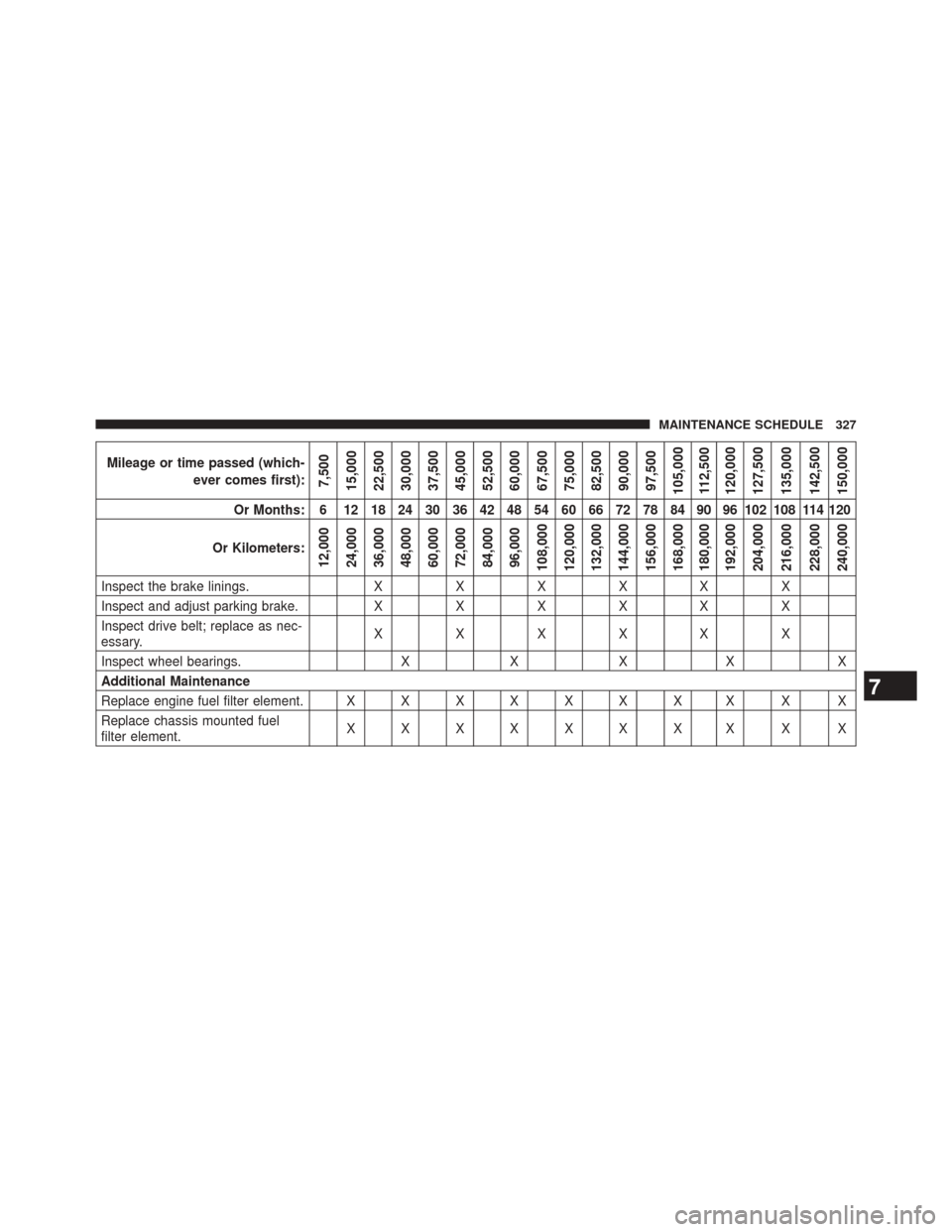
Mileage or time passed (which-ever comes first):
7,500
15,000
22,500
30,000
37,500
45,000
52,500
60,000
67,500
75,000
82,500
90,000
97,500
105,000 112,500
120,000
127,500
135,000
142,500
150,000
Or Months: 6 12 18 24 30 36 42 48 54 60 66 72 78 84 90 96 102 108 114 120
Or Kilometers:
12,000
24,000
36,000
48,000
60,000
72,000
84,000
96,000
108,000
120,000
132,000
144,000
156,000
168,000
180,000
192,000
204,000
216,000
228,000
240,000
Inspect the brake linings. XXXXX X
Inspect and adjust parking brake. XXXXX X
Inspect drive belt; replace as nec-
essary. XXXXXX
Inspect wheel bearings. XXXX X
Additional Maintenance
Replace engine fuel filter element. X X X X X X X X X X
Replace chassis mounted fuel
filter element. XXXXXXXX X X
7
MAINTENANCE SCHEDULE 327
Page 336 of 347
Adding Engine Coolant (Antifreeze)............116
Adding Fuel ..............................91
Air bag Light .............................17
Air Cleaner, Engine (Engine Air Cleaner Filter) . . . .104
Alarm Light ..............................17
Anti-Lock Warning Light .....................17
Antifreeze (Engine Coolant) ..................115
Capacities ........................... .122
Disposal ..............................118
Automatic Transmission Fluid Type ........................... .126
Axle Fluid ............................. .126
Battery .................................113
Brake Fluid ............................ .126
Brake System ........................... .120
Fluid Check .......................... .120
Master Cylinder ....................... .120
Warning Light .......................17,33 Capacities, Antifreeze (Engine Coolant)
..........122
Capacities, Fluid ......................... .122
Caps, Filler Oil (Engine) .......................... .103
Radiator (Coolant Pressure) ................118
Charge Air Cooler ........................ .120
Check Engine Light (Malfunction Indicator Light) . . .17
Coolant Pressure Cap (Radiator Cap) ...........118
Cooling System ...........................114
Adding Coolant (Antifreeze) ...............116
Coolant Capacity ...................... .122
Coolant Level ..........................114
Disposal of Used Coolant ..................118
Drain, Flush, and Refill ...................115
Points to Remember .....................119
Pressure Cap ..........................118
Radiator Cap ..........................118
Selection of Coolant (Antifreeze) .........115,123
334 INDEX - RAM 1500
Page 337 of 347
Diesel Fuel...............................85
Diesel Fuel Requirements ....................85
Bulk Storage of .........................94
Diesel Fuel System, Re-Priming ...............111
Disposal Antifreeze (Engine Coolant) ................118
Draining Fuel/Water Separator Filter ...........107
Electronic Vehicle Information Center (EVIC) ......41
Engine ................................ .100
Air Cleaner .......................... .104
Block Heater ........................78,84
Break-In Recommendations .................13
Compartment ......................... .100
Coolant (Antifreeze) .....................123
Identification ......................... .100
Idling ................................82
Oil............................. .102 , 123
Oil Filler Cap ......................... .103Filters
Air Cleaner .......................... .104
Engine Fuel .......................... .107
Engine Oil ....................... .104 , 123
Engine Oil Disposal .....................104
Flashers Turn Signal .........................17,32
Fluid Capacities ......................... .122
Fluid Level Checks Brake ............................... .120
Fluid, Brake ............................ .126
Fluids, Lubricants and Genuine Parts ...........123
Fog Lights ...............................17
Fuel ...................................85
Adding ...............................91
Diesel ............................85,123
Filter ............................... .107
Requirements ...........................85
Specifications ...........................86
INDEX - RAM 1500 335