Page 247 of 347
Truck models with manual transmission are equipped
with a clutch interlocking ignition system. The clutch
pedal must be fully pressed to start the vehicle.
Fully press the clutch pedal before shifting gears. As you
release the clutch pedal, lightly press the accelerator
pedal.
This transmission has a “creeper” first gear which should
be used to start from a standing position when carrying a
payload or towing a trailer. Damage to the clutch can result
from starting in second or third gear with a loaded vehicle.
An unloaded vehicle may be launched in second gear. Use
each gear in numerical order – do not skip a gear.
NOTE:When loaded, pulling a trailer or on a grade, the
truck should always start in first gear and not skip gears.
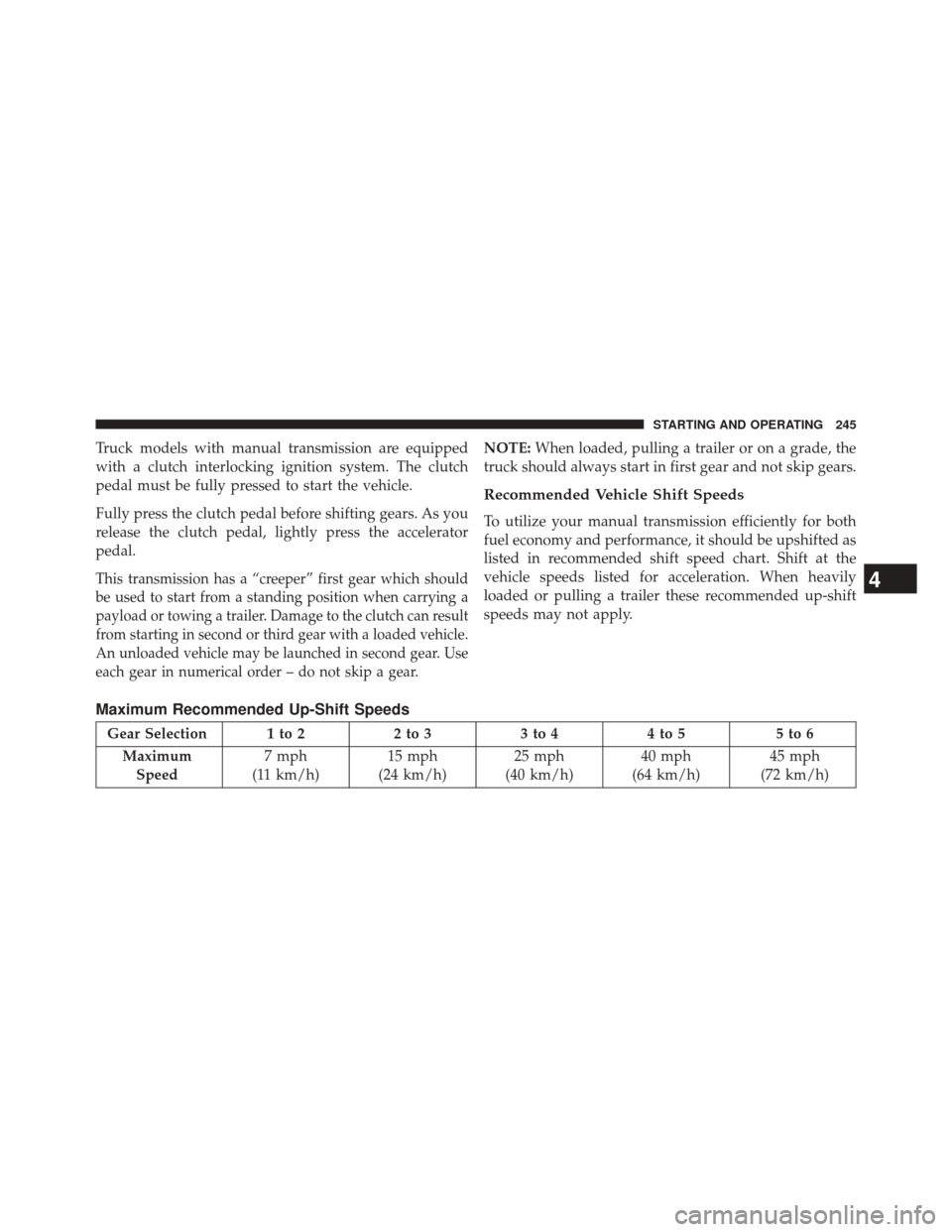
Recommended Vehicle Shift Speeds
To utilize your manual transmission efficiently for both
fuel economy and performance, it should be upshifted as
listed in recommended shift speed chart. Shift at the
vehicle speeds listed for acceleration. When heavily
loaded or pulling a trailer these recommended up-shift
speeds may not apply.
Maximum Recommended Up-Shift Speeds
Gear Selection 1 to 2 2 to 33 to 44 to 5 5 to 6
Maximum Speed 7 mph
(11 km/h) 15 mph
(24 km/h) 25 mph
(40 km/h) 40 mph
(64 km/h) 45 mph
(72 km/h)
4
STARTING AND OPERATING 245
Page 250 of 347
To shift out of REVERSE bring the vehicle to a complete
stop and press the clutch. Shifting out of REVERSE prior
to a complete stop may cause high shift effort.
AUXILIARY SWITCHES — IF EQUIPPED
There can be up to five auxiliary switches located in the
lower switch bank of the instrument panel which can be
used to power various electronic devices and PTO
(Power Take Off) – If Equipped. Connections to the
switches are found under the hood in the connectors
attached to the auxiliary Power Distribution Center.
You have the ability to configure the functionality of the
auxiliary switches via the Electronic Vehicle Information
Center (EVIC) or Driver Information Display (DID). All
switches can now be configured for ignition or battery
power, saving or not saving state across a key cycle, and
momentary or latching switch operation.For further information on using the auxiliary switches,
please refer to the Ram Body Builders Guide by accessing
www.rambodybuilder.comand choosing the appropri-
ate links.
POWER TAKE OFF OPERATION — IF EQUIPPED
(CHASSIS CAB ONLY)
This vehicle when equipped with PTO Prep and either
the AS69RC automatic six-speed or G-56 manual six-
speed transmissions, will allow for an aftermarket upfit
with a transmission driven PTO (power take off). The
customer will have the ability to operate the PTO in
either a “stationary” or “mobile” mode. The vehicles will
be factory set to the “stationary” mode. To select ’mobile
mode’ You will need to enter the commercial vehicle
menu on the EVIC/DID screen and select mobile PTO
mode. Details of the PTO selection modes and further
PTO information is available at the Ram Truck Body-
builders web site. www.rambodybuilder.com
248 STARTING AND OPERATING
Page 254 of 347
WARNING!
In case of engine runaway due to flammable fumes
from fuel spills or turbocharger oil leaks being
sucked into the engine, do the following to help
avoid personal injury and/or vehicle damage:
1. Turn the ignition switch to the OFF position.
2. Using a CO2 or dry chemical type fire extinguisher,
direct the spray from the fire extinguisher into the
grille on the passenger side so that the spray enters
the engine air intake.
The inlet for the engine air intake is located behind
the passenger side headlamp and receives air
through the grille.
FUEL REQUIREMENTS
Use good quality diesel fuel from a reputable supplier in
your vehicle. Federal law requires that you must fuel this
vehicle with Ultra Low Sulfur Highway Diesel fuel (15
ppm Sulfur maximum) and prohibits the use of Low
Sulfur Highway Diesel fuel (500 ppm Sulfur maximum)
to avoid damage to the emissions control system.
For most year-round service, No. 2 diesel fuel meeting
ASTM (formerly known as the American Society for
Testing and Materials) specification D-975 Grade S15 will
provide good performance. If the vehicle is exposed to
extreme cold (below 20°F or -7°C), or is required to
operate at colder-than-normal conditions for prolonged
periods, use climatized No. 2 diesel fuel or dilute the No.
2 diesel fuel with 50% No. 1 diesel fuel. This will provide
better protection from fuel gelling or wax-plugging of the
fuel filters.
252 STARTING AND OPERATING
Page 290 of 347
Engine Air Cleaner Filter Installation
NOTE:Inspect and clean the housing if dirt or debris is
present before replacing the air filter element.
1. Install the air cleaner filter element into the housing assembly with the air cleaner filter inspection surface
facing downward.
2. Install the air cleaner cover onto the housing assembly locating tabs.
3. Install screws to secure the air cleaner cover to the housing assembly.
Draining Fuel/Water Separator Filter
There are two fuel filter assemblies. One is located on the
driver’s side of the engine. The best access to this water
drain valve is from under the hood. The second one is on
the under body, located in front of the rear axle above the
drive shaft on pick-up models. The Chassis Cab models second filter location is on the frame behind the front
axle. The best access to this water drain valve is from
under the vehicle.
CAUTION!
•
Do not drain the fuel/water separator filters when
the engine is running.
• Diesel fuel will damage blacktop paving surfaces.
Drain the filters into an appropriate container.
If water is detected in the water separator while the
engine is running, or while the ignition switch is in the
ON position, the “Water In Fuel Indicator Light” will
illuminate and an audible chime will be heard five times.
At this point you should stop the engine and drain the
water from both of the filters.
288 MAINTAINING YOUR VEHICLE
Page 291 of 347
CAUTION!
If the “Water In Fuel Indicator Light” remains on, DO
NOT START the engine before you drain water from
the fuel filters to avoid engine damage.
If the “Water In Fuel Indicator Light” comes on and a
single chime is heard while you are driving, or with the
ignition switch in the ON position, there may be a
problem with your water separator wiring or sensor. See
your authorized dealer for service.
Upon proper draining of the water from both fuel filters,
the “Water In Fuel Indicator Light” will remain illumi-
nated for approximately 10 seconds. If the water was
drained while the engine was running, the “Water In Fuel
Indicator Light” may remain on for approximately three
minutes. NOTE:
Care should be taken in disposing of used fluids
from your vehicle. Used fluids, indiscriminately dis-
carded, can present a problem to the environment. Con-
tact an authorized dealer, service station, or government
agency for advice on recycling programs and for where
used fluids and filters can be properly disposed of in
your area.
Drain the fuel/water separator filters when the “Water In
Fuel Indicator Light” is ON. Within 10 minutes of vehicle
shutdown, turn the engine mounted filter drain valve
(located on the side of the filter assembly) counterclock-
wise 1/4 turn, and turn the under body mounted filter
drain valve (located on the bottom of the filter assembly)
counterclock wise 1 full turn. Then turn the ignition
switch to the ON position, and allow any accumulated
water to drain. Leave the drain valve open until all water
and contaminants have been removed. When clean fuel is
visible, close the drain valves by turning them fully
clockwise, and turn the ignition switch to OFF.
6
MAINTAINING YOUR VEHICLE 289
Page 296 of 347
Priming If The Engine Has Run Out Of Fuel
WARNING!
Do not open the high pressure fuel system with the
engine running. Engine operation causes high fuel
pressure. High pressure fuel spray can cause serious
injury or death.
1. Add a substantial amount of fuel to the tank, approxi- mately 2 to 5 gal (8L to 19L).
2. Turn ignition switch to the start position to engage starter for one second, return ignition switch to run
position. This will activate in tank fuel pump for
approximately 15 seconds. Repeat this process twice.
3. Start the engine using the “Normal Starting” proce- dure. Refer to “Starting Procedures” in “Starting and
Operating” for further information.
CAUTION!
Do not engage the starter motor for more than 15
seconds at a time. Allow two minutes between the
cranking intervals.
NOTE: The engine may run rough until the air is forced
from all the fuel lines.
WARNING!
Do not use alcohol or gasoline as a fuel blending
agent. They can be unstable under certain conditions
and be hazardous or explosive when mixed with
diesel fuel.
294 MAINTAINING YOUR VEHICLE