2015 Peugeot Partner brake
[x] Cancel search: brakePage 155 of 292
153
Partner-2-VU_en_Chap08_Aide-rapide_ed01-2015
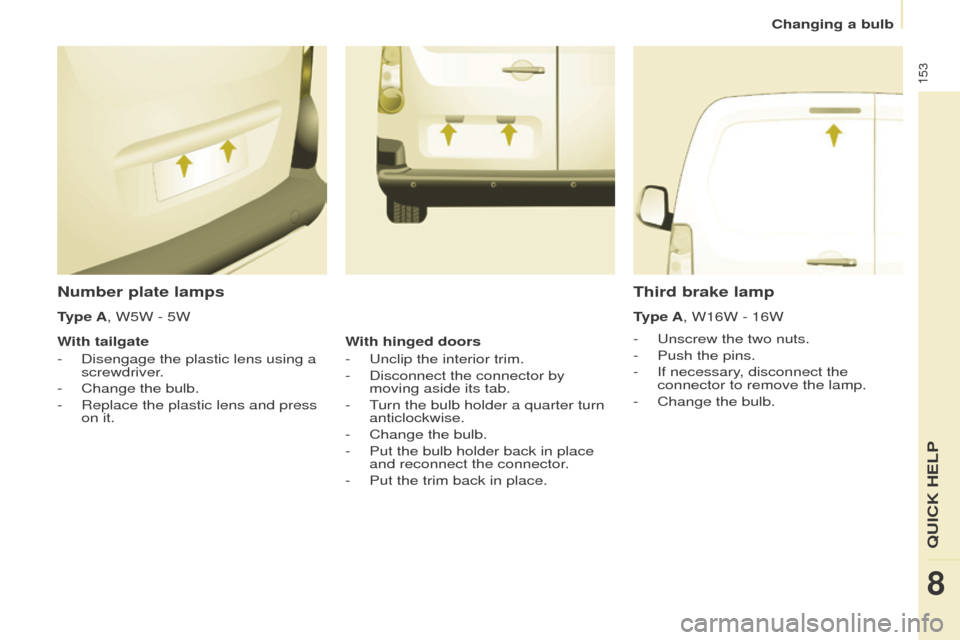
Number plate lamps
- Unscrew the two nuts.
-
Push the pins.
-
If necessary
, disconnect the
connector to remove the lamp.
-
Change the bulb.
Third brake lamp
Type A, W16W - 16W
Type A, W5W - 5W
With tailgate
-
Disengage the plastic lens using a
screwdriver
.
-
Change the bulb.
-
Replace the plastic lens and press
on it. W
ith hinged doors
-
Unclip the interior trim.
-
Disconnect the connector by
moving aside its tab.
-
T
urn the bulb holder a quarter turn
anticlockwise.
-
Change the bulb.
-
Put the bulb holder back in place
and reconnect the connector
.
-
Put the trim back in place.
Changing a bulb
QUICK HELP
8
Page 159 of 292
157
Partner-2-VU_en_Chap08_Aide-rapide_ed01-2015
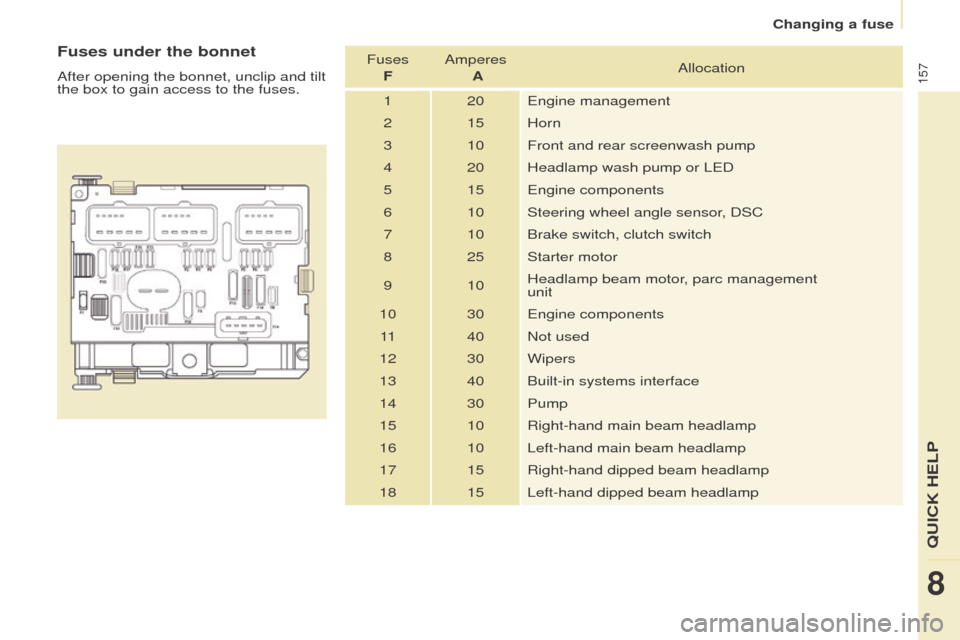
Fuses under the bonnet
After opening the bonnet, unclip and tilt
the box to gain access to the fuses.Fuses
F Amperes
A Allocation
1 20 Engine management
2 15 Horn
3 10 Front and rear screenwash pump
4 20 Headlamp wash pump or LED
5 15 Engine components
6 10 Steering wheel angle sensor, DSC
7 10 Brake switch, clutch switch
8 25 Starter motor
9 10 Headlamp beam motor, parc management
unit
10 30 Engine components 11 40 Not used
12 30 Wipers
13 40 Built-in systems interface
14 30 Pump
15 10 Right-hand main beam headlamp
16 10 Left-hand main beam headlamp
17 15 Right-hand dipped beam headlamp
18 15 Left-hand dipped beam headlamp
Changing a fuse
QUICK HELP
8
Page 169 of 292
167
Partner-2-VU_en_Chap09_Caract-technique_ed01-2015
WEIGHTS AND TOWED LOADS
These values, expressed in kg, can be
found on the manufacturer's VIN plate
or label.
The maximum weights and towed
loads for your vehicle can be found on
the vehicle's registration certificate. The recommended nose weight is
the downward force on the towball
(removable with or without tools).
In each country, it is imperative that
the maximum towed loads authorised
by local legislation are complied
with. To find out your vehicle's towing
capacities and its gross train weight,
consult a PEUGEOT dealer.
The kerb weight is equal to the weight
without load + driver (75 kg) + fuel tank
filled to 90%.
The GTW and towed load values
indicated are valid up to a maximum
altitude of 1000 metres. The value of
the towed load mentioned must be
reduced by 10 % for each additional
1000 metres.
With load transfer, the braked trailer
weight can be increased, on condition
that the equivalent of this load is
removed from the vehicle so that the
GTW is not exceeded. High ambient temperatures
may result in a reduction in the
performance of the vehicle in
order to protect the engine. When
the ambient temperature is higher
than 37 °C, limit the towed weight.
The location of the manufacturer's
plate is given in chapter 9,
"Identification markings" section.
ENGINE CHARACTERISTICS
The engine characteristics (capacity,
maximum power, maximum power
speed, fuel, CO
2 emissions...) for your
vehicle are given in the registration
document.
These characteristics correspond
to the values type-approved
on a test bed, under conditions
defined in European legislation
(Directive
1999/99/EC).
For more information, refer to the
manufacturer's website or sales
brochure for the model. Contact
a PEUGEOT dealer or a qualified
workshop. GVW: gross vehicle weight, the
maximum authorised weight.
GTW: gross train weight, the maximum
weight for vehicle plus trailer.
Towing with a lightly loaded
vehicle can adversely affect road
holding.
Towing a trailer increases braking
distances.
When towing, the maximum permitted
speed is reduced (comply with the
legislation in force in the country).
Weights
TECHNICAL DATA
9
Page 269 of 292
11
INSTRUMENTS AND CONTROLS
Starting the vehicle
- To start the vehicle, the
drive selector must be in
position P
,
- press the brake pedal,
- torn the ignition key in the
switch.
STARTING PROCEDURE
This indicator lamp comes on
when the vehicle is ready to drive.
-
Press the brake pedal,
-
select R
or D
,
-
release the brake pedal and
press the accelerator pedal to
move off.
The selection appears in the current
energy consumption screen in the
instrument panel.
Drive selector
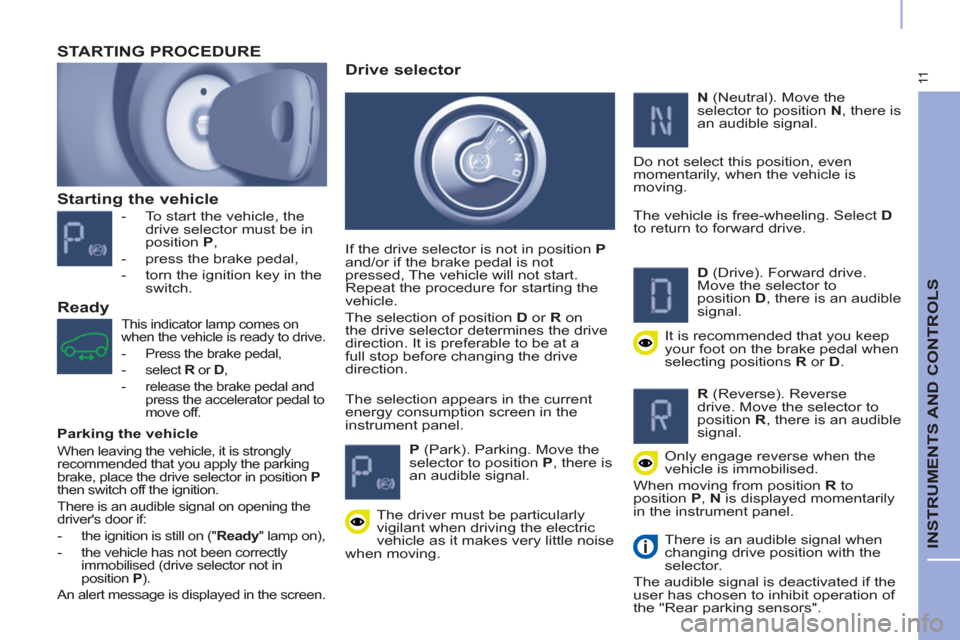
If the drive selector is not in position P
and/or if the brake pedal is not
pressed, The vehicle will not start.
Repeat the procedure for starting the
vehicle.
The selection of position D
or R
on
the drive selector determines the drive
direction. It is preferable to be at a
full stop before changing the drive
direction.
P
(Park). Parking. Move the
selector to position P
, there is
an audible signal.
N
(Neutral). Move the
selector to position N
, there is
an audible signal.
Do not select this position, even
momentarily, when the vehicle is
moving.
The vehicle is free-wheeling. Select D
to return to forward drive.
D
(Drive). Forward drive.
Move the selector to
position D
, there is an audible
signal.
It is recommended that you keep
your foot on the brake pedal when
selecting positions R
or D
.
R
(Reverse). Reverse
drive. Move the selector to
position R
, there is an audible
signal.
Only engage reverse when the
vehicle is immobilised.
When moving from position R
to
position P
, N
is displayed momentarily
in the instrument panel.
There is an audible signal when
changing drive position with the
selector.
The audible signal is deactivated if the
user has chosen to inhibit operation of
the "Rear parking sensors".
The driver must be particularly
vigilant when driving the electric
vehicle as it makes very little noise
when moving.
Ready
Parking the vehicle
When leaving the vehicle, it is strongly
recommended that you apply the parking
brake, place the drive selector in position P
then switch off the ignition.
There is an audible signal on opening the
driver's door if:
-
the ignition is still on (" Ready
" lamp on),
-
the vehicle has not been correctly
immobilised (drive selector not in
position P
).
An alert message is displayed in the screen.
Page 282 of 292
24
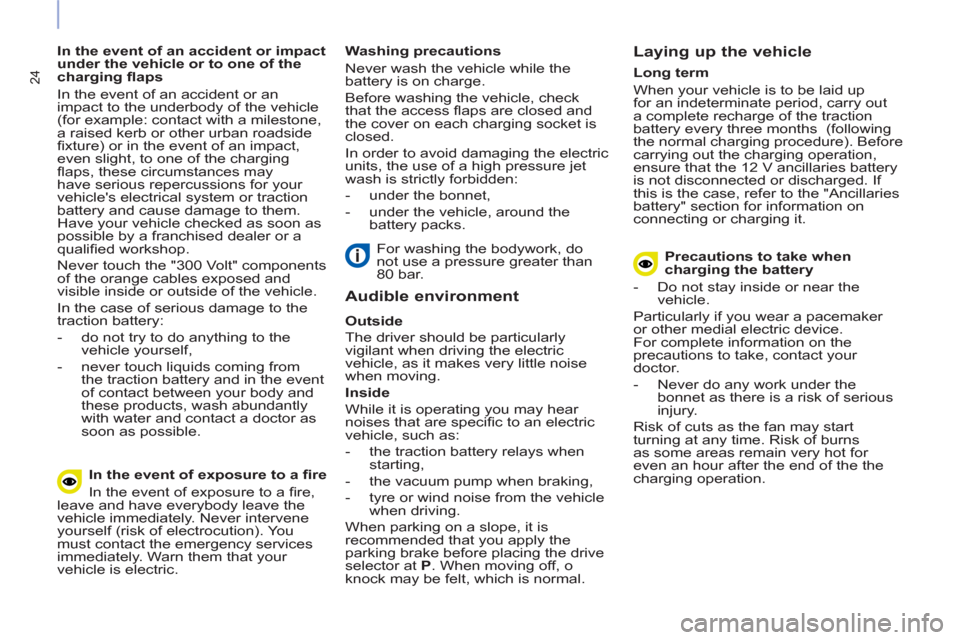
In the event of an accident or impact
under the vehicle or to one of the
charging fl aps
In the event of an accident or an
impact to the underbody of the vehicle
(for example: contact with a milestone,
a raised kerb or other urban roadside
fi xture) or in the event of an impact,
even slight, to one of the charging
fl aps, these circumstances may
have serious repercussions for your
vehicle's electrical system or traction
battery and cause damage to them.
Have your vehicle checked as soon as
possible by a franchised dealer or a
qualifi ed workshop.
Never touch the "300 Volt" components
of the orange cables exposed and
visible inside or outside of the vehicle.
In the case of serious damage to the
traction battery:
- do not try to do anything to the
vehicle yourself,
- never touch liquids coming from
the traction battery and in the event
of contact between your body and
these products, wash abundantly
with water and contact a doctor as
soon as possible.
For washing the bodywork, do
not use a pressure greater than
80 bar.
In the event of exposure to a fi re
In the event of exposure to a fi re,
leave and have everybody leave the
vehicle immediately. Never intervene
yourself (risk of electrocution). You
must contact the emergency services
immediately. Warn them that your
vehicle is electric.
Audible environment
Outside
The driver should be particularly
vigilant when driving the electric
vehicle, as it makes very little noise
when moving.
Inside
While it is operating you may hear
noises that are specifi c to an electric
vehicle, such as:
- the traction battery relays when
starting,
- the vacuum pump when braking,
- tyre or wind noise from the vehicle
when driving.
When parking on a slope, it is
recommended that you apply the
parking brake before placing the drive
selector at P
. When moving off, o
knock may be felt, which is normal.
Washing precautions
Never wash the vehicle while the
battery is on charge.
Before washing the vehicle, check
that the access fl aps are closed and
the cover on each charging socket is
closed.
In order to avoid damaging the electric
units, the use of a high pressure jet
wash is strictly forbidden:
- under the bonnet,
- under the vehicle, around the
battery packs.
Long term
When your vehicle is to be laid up
for an indeterminate period, carry out
a complete recharge of the traction
battery every three months (following
the normal charging procedure). Before
carrying out the charging operation,
ensure that the 12 V ancillaries battery
is not disconnected or discharged. If
this is the case, refer to the "Ancillaries
battery" section for information on
connecting or charging it.
Laying up the vehicle
Precautions to take when
charging the battery
- Do not stay inside or near the
vehicle.
Particularly if you wear a pacemaker
or other medial electric device.
For complete information on the
precautions to take, contact your
doctor.
- Never do any work under the
bonnet as there is a risk of serious
injury.
Risk of cuts as the fan may start
turning at any time. Risk of burns
as some areas remain very hot for
even an hour after the end of the the
charging operation.
Page 287 of 292
29
SUPPLEMENT FOR ELECTRIC MODE
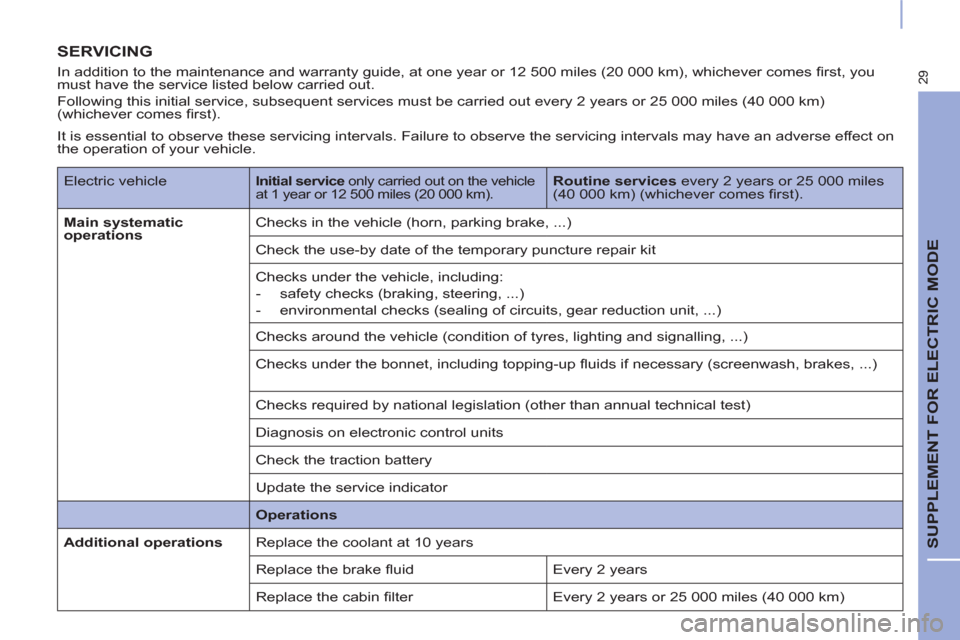
SERVICING
In addition to the maintenance and warranty guide, at one year or 12 500 miles (20 000 km), whichever comes fi rst, you
must have the service listed below carried out.
Following this initial service, subsequent services must be carried out every 2 years or 25 000 miles (40 000 km)
(whichever comes fi rst).
Electric vehicle
Initial service
only carried out on the vehicle
at 1 year or 12 500 miles (20 000 km).
Routine services
every 2 years or 25 000 miles
(40 000 km) (whichever comes fi rst).
Main systematic
operations
Checks in the vehicle (horn, parking brake, ...)
Check the use-by date of the temporary puncture repair kit
Checks under the vehicle, including:
- safety checks (braking, steering, ...)
- environmental checks (sealing of circuits, gear reduction unit, ...)
Checks around the vehicle (condition of tyres, lighting and signalling, ...)
Checks under the bonnet, including topping-up fl uids if necessary (screenwash, brakes, ...)
Checks required by national legislation (other than annual technical test)
Diagnosis on electronic control units
Check the traction battery
Update the service indicator
Operations
Additional operations
Replace the coolant at 10 years
Replace the brake fl uid Every 2 years
Replace the cabin fi lter Every 2 years or 25 000 miles (40 000 km)
It is essential to observe these servicing intervals. Failure to observe the servicing intervals may have an adverse effect on
the operation of your vehicle.