Page 194 of 364
192
With Stop & Start, never refuel with the
system in STOP mode; you must switch
off the ignition with the key.
To fill the tank safely:
F
t
he engine must be switched off,
F
o
pen the fuel filler flap,
F
i
nsert the key in the cap, then turn it to the
left,
When refuelling is complete:
F
p
ut the cap back in place,
F
t
urn the key to the right, then remove it
from the cap,
F
c
lose the filler flap.
F
r
emove the cap and secure it on the hook,
located on the inside of the flap,
F
f
ill the tank, but do not continue after the
3rd cut- off of the nozzle ; this could cause
malfunctions.
Operating fault
A malfunction of the fuel gauge is indicated by
the return to zero of the fuel gauge needle.
Have it checked by a PEUGEOT
dealer or a
qualified workshop.
Checks
Page 198 of 364

196
Bonnet
F Push the exterior safety catch B to the left and raise the bonnet. F
U
nclip the stay C from its housing.
F
F
ix the stay in the notch to hold the bonnet
open.
Closing
F Take the stay out of the support notch.
F C lip the stay in its housing.
F
L
ower the bonnet and release it at the end
of its travel.
F
P
ull on the bonnet to check that it is
secured correctly.
Opening
F Open the front left door.
F P ull the interior bonnet release lever A ,
located at the bottom of the door aperture. Before doing anything under the
bonnet, switch off the Stop & Start
system to avoid any risk of injury
resulting from an automatic change to
S TA R T m o d e . The location of the interior bonnet
release lever prevents opening of
the bonnet while the front left door is
closed.
Do not open the bonnet in high winds.
When the engine is hot, handle the
exterior safety catch and the bonnet
stay with care (risk of burns).
The cooling fan may star t after
switching off the engine: take care
with articles and clothing that might
become caught by the fan blades.
Because of the presence of electrical
equipment under the bonnet, it is
recommended that exposure to water
(rain, washing, ...) be limited.
Checks
Page 214 of 364

212
Tool kit
This is a set of tools provided with your vehicle. The content depends on your vehicle's equipment
(temporary puncture repair kit or spare wheel).
List of tools
5a. Temporary puncture repair kit (5-seat).
5b. T emporary puncture repair kit (7-seat).
C
omprises a 12 V compressor and a
sealant cartridge for the temporary repair
of a puncture and can be used for adjusting
tyre pressure.
S
ee the "Temporary puncture repair kit"
section. 6.
Wheelbrace.
F
or removing the wheel trim and the wheel
fixing bolts.
7.
W
heelbrace extension.
F
or unwinding/winding up the spare wheel
carrier drive.
8.
J
ack with integral handle.
F
or raising the vehicle.
1. A c
hock to immobilise the vehicle in the
event of a flat battery (depending on
equipment).
2.
R
emovable towing eye.
S
ee the "Towing the vehicle" section.
3.
S
ocket for the security bolts (stowed in the
glove box) (depending on equipment).
F
or adapting the wheelbrace to the special
security bolts.
4.
W
heel bolt cap removal tool (depending on
equipment).
F
or removing the finisher caps from the
heads of the wheel bolts with alloy wheels. All of these tools are specific to your
vehicle. Do not use them for other
purposes.
For versions without spare
wheel:
For versions with spare
wheel:
Practical information
Page 215 of 364
213
To o l s 1, 2, 6 and 7 are stowed in the interior
boot trim.
To gain access to them:
F
o
pen the boot,
F
r
aise the concertina boards. The tools 4 and 8 are stowed in a box, in the
middle of the spare wheel secured underneath
the vehicle. Remove the spare wheel for
access to it.
See the "Changing a wheel" section.
Access to the tools
The temporary puncture repair kit 5a
is stowed
in the boot, under the right hand concertina
boards; the kit 5b is stowed in the boot, under
the left hand seat in the third row. F
P
ress the tab, slide the lid of the box half
way and remove it.
10
Practical information
Page 227 of 364
225
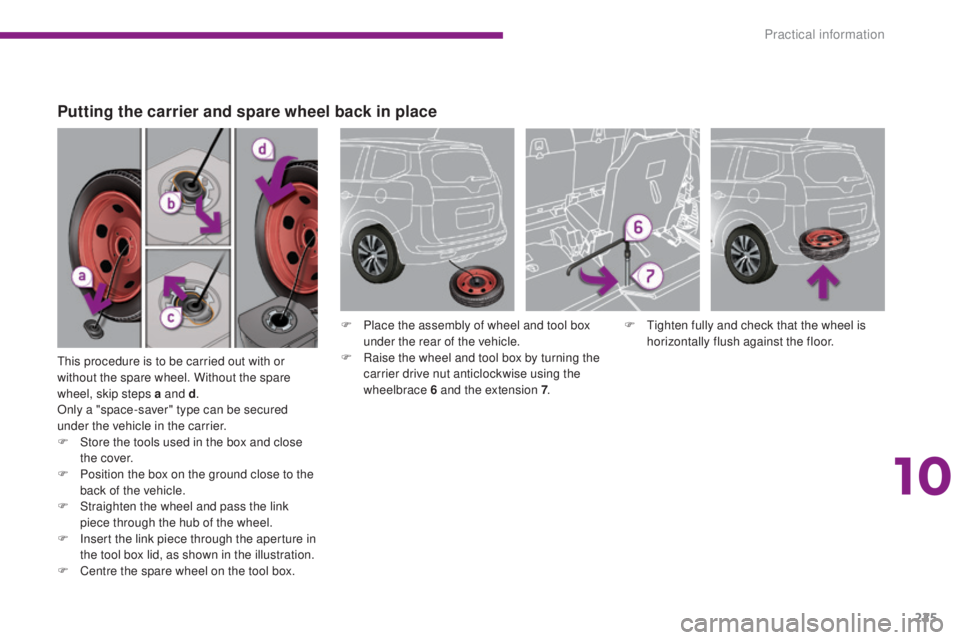
This procedure is to be carried out with or
without the spare wheel. Without the spare
wheel, skip steps a and d.
Only a "space-saver" type can be secured
under the vehicle in the carrier.
F
S
tore the tools used in the box and close
the cover.
F
P
osition the box on the ground close to the
back of the vehicle.
F
S
traighten the wheel and pass the link
piece through the hub of the wheel.
F
I
nsert the link piece through the aperture in
the tool box lid, as shown in the illustration.
F
C
entre the spare wheel on the tool box. F
T
ighten fully and check that the wheel is
horizontally flush against the floor.
F
P
lace the assembly of wheel and tool box
under the rear of the vehicle.
F R aise the wheel and tool box by turning the
carrier drive nut anticlockwise using the
wheelbrace 6 and the extension 7 .
Putting the carrier and spare wheel back in place
10
Practical information
Page 228 of 364

226
Removing a wheel
F Depending on equipment, clip the tool 4 to the finisher cap on each wheel bolt with
alloy wheels to remove them.
F
D
epending on equipment, slacken the
security bolt using the socket 3 fitted to the
wheelbrace 6 .
F
S
lacken the other bolts using the
wheelbrace 6 .
Parking the vehicle
Immobilise the vehicle where it does not
block traffic: the ground must be level,
stable and non-slippery ground.
Apply the parking brake unless it has
been programmed to automatic mode.
Switch off the ignition.
With a manual gearbox, engage first
gear to block the wheels.
With an electronic gearbox, place the
lever in position R to block the wheels.
With an automatic gearbox, place the
lever in position P to block the wheels.
Check that the braking warning lamp
and the P warning lamp in the parking
brake control come on.
If necessary, place a chock under the
wheel diagonally opposite the wheel to
be changed.
The occupants must get out of the
vehicle and wait where they are safe.
Never go underneath a vehicle raised
using a jack; use an axle stand. F
P
osition the foot of the jack 8 on the
ground and ensure that it is directly below
one of the front A or rear B jacking points
provided on the underbody, whichever is
closest to the wheel to be changed.
Wheel with wheel trim
When removing the wheel , first
remove the wheel trim using the
wheelbrace 6 by pulling at the valve
cut-out.
When refitting the wheel , refit the
wheel trim by placing its cut-out at the
valve, and press round its edge with the
palm of your hand.
Practical information
Page 230 of 364
228
Fitting a wheel
F Put the wheel in place on the hub.
F S crew in the bolts fully by hand.
F
U
sing the wheelbrace 6 fitted with the
security socket 3 , pre-tighten the security
bolt (if your vehicle has them).
F
P
re-tighten the other bolts using the
wheelbrace 6 o n l y. F
L ower the vehicle fully.
F F old the jack 8 and detach it.F
U sing the wheelbrace 6 fitted with the
security socket 3 , tighten the security bolt
(if your vehicle has them).
F
T
ighten the other bolts using the
wheelbrace 6 .
F
R
efit the bolt covers to each of the bolts
(according to equipment).
F
S
tore the tools in the box.
Fitting the "space-saver"
spare wheel
If your vehicle is fitted with alloy wheels,
when tightening the bolts on fitting it
is normal to notice that the washers
do not come into contact with the
"space-saver" spare wheel. The wheel
is secured by the conical contact of
each bolt.
Practical information
Page 246 of 364

244
12 V battery
Access to the battery
The battery is located under the bonnet.
To gain access to it:
F
o
pen the bonnet using the interior release
lever, then the exterior safety catch,
F
s
ecure the bonnet stay,
F
r
emove the plastic cover on the (+) terminal,
Disconnecting the (+) cable
F Raise the locking tab D fully to release the cable terminal clamp E .
Reconnecting the (+) cable
F Position the open clamp E of the cable on
the positive post (+) of the battery.
F
P
ress vertically on the clamp E to position
it correctly on the battery.
F
L
ock the clamp by spreading the
positioning lug and then lowering the tab D .
The presence of this label, in particular with the
Stop & Start system, indicates the use of a
12 V lead-acid battery with special technology
and specification; the involvement of a
PEUGEOT dealer or a qualified workshop is
essential when replacing or disconnecting the
battery.
After refitting the battery, the Stop & Start system
will only be active after a continuous period of
immobilisation of the vehicle, a period which
depends on the climatic conditions and the state of
charge of the battery (up to about 8 hours).
With Stop & Start, the battery does not have to
be disconnected for charging. Procedure for starting the engine using another
battery or charging a discharged battery.
Do not apply excessive force on the
tab as locking will not be possible if the
clamp is not positioned correctly; start
the procedure again.
Practical information