Page 5 of 416

.
308_en_Chap00a_sommaire_ed01-2015
M i r r o r s 178
Lighting
181
Daytime running lamps
1
85
Automatic illumination of headlamps
1
86
Headlamp adjustment
1
88
Wipers
189
Automatic rain sensitive wipers
1
91
Courtesy lamps
1
93
Interior mood lighting
1
94te mporary puncture repair kit 2 29
Changing a wheel
2
35
Snow chains
2
42
Changing a bulb
2
43
Changing a fuse
2
53
12 V battery
2
59
en
ergy economy mode
26
3
Changing a wiper blade
2
64
to
w i n g
2 6 5
Very cold climate screen
2
67
to
wing a trailer
2
68
Fitting roof bars
2
70
Accessories
272
Bonnet
275
Petrol engine
2
76
Diesel engine
2
77
Running out of fuel (Diesel)
2
78
AdBlue
® additive and SCR system
(BlueHDi Diesel) 2 79
Checking levels
2
88
Checks
2
91
en
gines
293
Weights
2
93
Dimensions
2
94
Identification markings
2
96
Direction indicators
1
95
Hazard warning lamps
1
95
em
ergency or assistance call
1
96
Horn
19
6
Under-inflation detection 1
97
e
SC system
2
01
Seat belts
20
4
Airbags
207
Child seats
2
12
Deactivating the passenger's front airbag
215
ISOFIX child seats
2
21
Child lock
2
28
Visibility
Safety Practical information
Checkste chnical data
emergency or assistance 297
D
eN
ON equipment
2
99
7-inch touch screen
3
01
Peuge
O
t Connect Sound (RD5)
3
73
Audio equipment and telematics
Alphabetical index
Contents
Page 26 of 416

24
308_en_Chap01_controle-de-marche_ed01-2015
Engine oil
pressurefixed.th
ere is a fault with the engine
lubrication system. You must stop as soon it is safe to do so.
Park, switch off the ignition and contact a Pe
ugeOt
dealer or a qualified workshop.
Deflated tyre fixed.
th
e pressure in one or more tyres is
too low. Check the pressures of the tyres as soon as possible.
th
is check should preferably carried out with the tyres
cold.
flashing then fixed.
th
e under-inflation detection system
has a fault. Have it checked by a P
e
uge
Ot
dealer or a qualified
workshop.
For more information on under-inflation detection,
refer to the corresponding section.
Warning
/ indicator lamp
State Cause Action
/ Observations
Foot on the
brake pedal fixed.
th
e brake pedal must be pressed. With an automatic gearbox, press the brake pedal, engine running, before releasing the parking brake, to
unlock the lever and come out of position P .
If you wish to release the parking brake without
pressing the brake pedal, this warning lamp will
remain on.
Foot on the
clutch fixed.
In the S
tO
P mode of Stop & Start,
changing to S
tA
R
t
mode is refused
because the clutch pedal is not fully
down. You must declutch fully to allow the change to engine
S
t
A R
t m
o d e .
Monitoring
Page 43 of 416
41
308_en_Chap01_controle-de-marche_ed01-2015
"Driving assistance" menu
the systems with settings that can be adjusted are detailed in the table below.Button Corresponding function Comments
Speed settings Memorisation of speeds for use with the speed limiter or cruise control.
Under-inflation initialisation Reinitialisation of the under-inflation system.
Blind spot sensors Activation of the function.
1
Monitoring
Page 199 of 416

197
308_en_Chap06_securite_ed01-2015
Under-inflation detection
the system monitors the pressures in the four
tyres, once the vehicle is moving.
It compares the information given by the four
wheel speed sensors with reference values,
which must be reinitialised ever y time the
tyre pressures are adjusted or a wheel
changed.
th
e system triggers an alert as soon as it
detects a drop in the inflation pressure of one
or more tyres.th e under-inflation detection system
does not replace the vigilance or the
responsibility of the driver.
th
is system does not avoid the need to
check the tyre pressures (including the
spare wheel) every month as well as
before a long journey.
Driving with under-inflated tyres impairs
road holding, extends braking distances
and causes premature tyre wear,
particularly under arduous condition
(high loading, high speed, long journey).
System which automatically checks the pressures of the tyres while driving.th
e inflation pressures defined for
your vehicle can be found on the tyre
pressure label.
See the "Identification markings"
section.
ty
re pressures should be checked
when the tyres are "cold" (vehicle
stopped for 1 hour or after a journey of
less than 6 miles (10 km) at moderate
speeds).
Other wise (when hot), add 0.3 bar to
the pressures shown on the label.
Driving with under-inflated tyres
increases fuel consumption.
6
Safety
Page 200 of 416
198
308_en_Chap06_securite_ed01-2015
Under-inflation alertReinitialisation
Before reinitialising the system, ensure
that the pressures of the four tyres are
correct for the use of the vehicle and in
line with the recommendations on the
tyre pressure label.
th
e under-inflation detection system
does not give a warning if a pressure is
incorrect at the time of reinitialisation.
th
is is given by fixed illumination of
this warning lamp, accompanied by
an audible signal and, depending on
equipment, the display of a message.
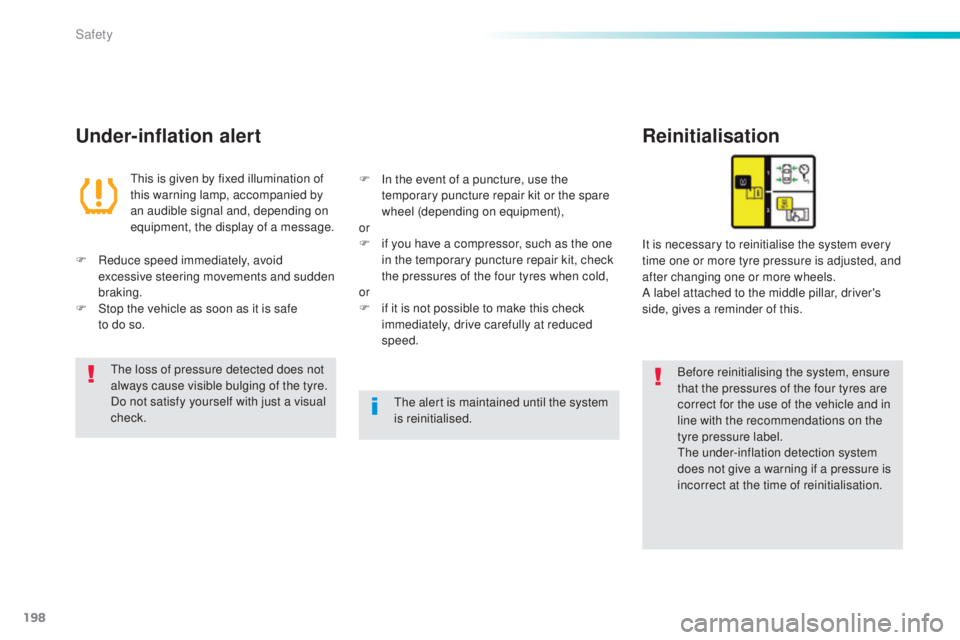
It is necessary to reinitialise the system every
time one or more tyre pressure is adjusted, and
after changing one or more wheels.
A label attached to the middle pillar, driver's
side, gives a reminder of this.
F
R
educe speed immediately, avoid
excessive steering movements and sudden
braking.
F
S
top the vehicle as soon as it is safe
to do so. F
I
n the event of a puncture, use the
temporary puncture repair kit or the spare
wheel (depending on equipment),
or
F
i
f you have a compressor, such as the one
in the temporary puncture repair kit, check
the pressures of the four tyres when cold,
or
F
i
f it is not possible to make this check
immediately, drive carefully at reduced
speed.th
e loss of pressure detected does not
always cause visible bulging of the tyre.
Do not satisfy yourself with just a visual
check.
th
e alert is maintained until the system
is reinitialised.
Safety
Page 201 of 416
199
308_en_Chap06_securite_ed01-2015
Reinitialisation of the system is done with the
ignition on and the vehicle stationary.F
P
ress "Under-inflation
initialisation ".
F
C
onfirm the instruction by pressing " Ye s",
an audible signal and a message confirm
the reinitialisation.
th
e under-inflation alert can only be
considered reliable if reinitialisation of
the system is done with the the four tyre
pressures correctly set.
Touch screen
the new pressure settings registered
are considered to be reference values
by the system.
Screen C
F Press the MENU button for access to the
main menu.
F
P
ress the " 7" or " 8" buttons to select the
Personalisation-configuration menu,
then confirm by pressing the OK button.
Snow chains
the system does not have to be
reinitialised after fitting or removing
snow chains.
From the "
Driving assistance " menu
of the touch screen:
6
Safety
Page 202 of 416
200
308_en_Chap06_securite_ed01-2015
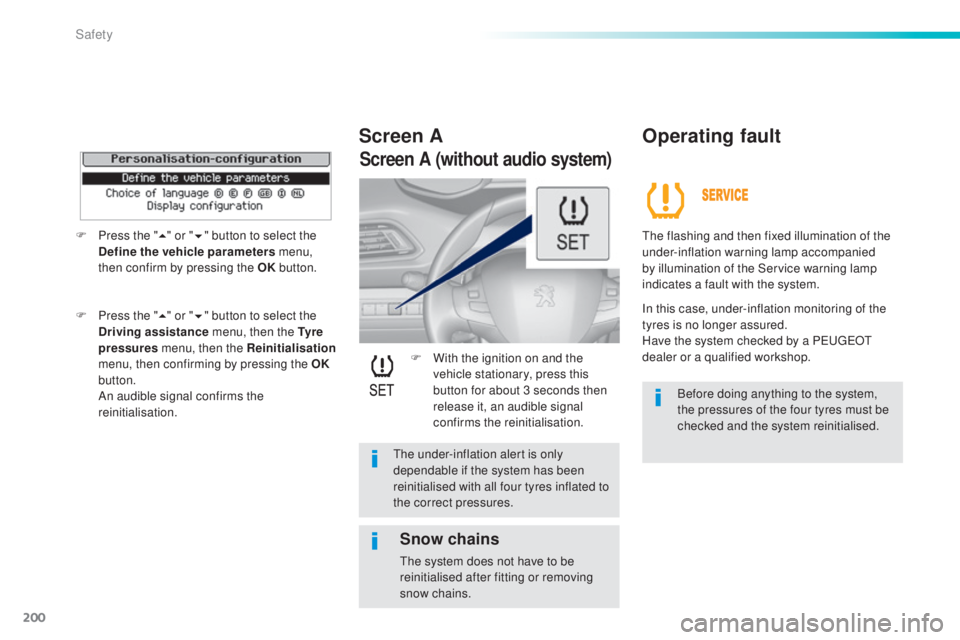
F With the ignition on and the vehicle stationary, press this
button for about 3 seconds then
release it, an audible signal
confirms the reinitialisation.
Screen A Operating fault
the flashing and then fixed illumination of the
under-inflation warning lamp accompanied
by illumination of the Service warning lamp
indicates a fault with the system.
In this case, under-inflation monitoring of the
tyres is no longer assured.
Have the system checked by a P
e
uge
Ot
dealer or a qualified workshop.
Before doing anything to the system,
the pressures of the four tyres must be
checked and the system reinitialised.F Press the " 5" or " 6" button to select the
Define the vehicle parameters menu,
then confirm by pressing the OK button.
F
P
ress the " 5" or " 6" button to select the
Driving assistance menu, then the Ty r e
pressures menu, then the Reinitialisation
menu, then confirming by pressing the OK
button.
A
n audible signal confirms the
reinitialisation.
Screen A (without audio system)
the under-inflation alert is only
dependable if the system has been
reinitialised with all four tyres inflated to
the correct pressures.
Snow chains
the system does not have to be
reinitialised after fitting or removing
snow chains.
Safety
Page 243 of 416
241
308_en_Chap07_info-pratiques_ed01-2015
F tighten the security bolt using the wheelbrace 1 fitted with the security
socket
4 (according to equipment).
F
t
i
ghten the other bolts using the
wheelbrace 1 o n l y.
F
R
efit the bolt covers on each of the bolts
(according to equipment).
F
S
tore the tools in the box.
th
e tyre inflation pressures are given on
this
label.
After changing a wheel
to store the punctured wheel in the boot
correctly, first remove the central cover.
When using the "space-saver" type
spare wheel, do not exceed 50 mph
(80
km/h).
Have the tightening of the bolts and the
pressure of the spare wheel checked
by a P
e
uge
Ot
dealer or a qualified
workshop without delay.
Have the punctured wheel repaired
and refitted to the vehicle as soon as
possible.
If your vehicle has tyre under-inflation
detection, check the tyre pressures then
refer to the corresponding section.
7
Practical information