Page 178 of 340
176
2008_en_Chap09_info-pratiques_ed01-2015
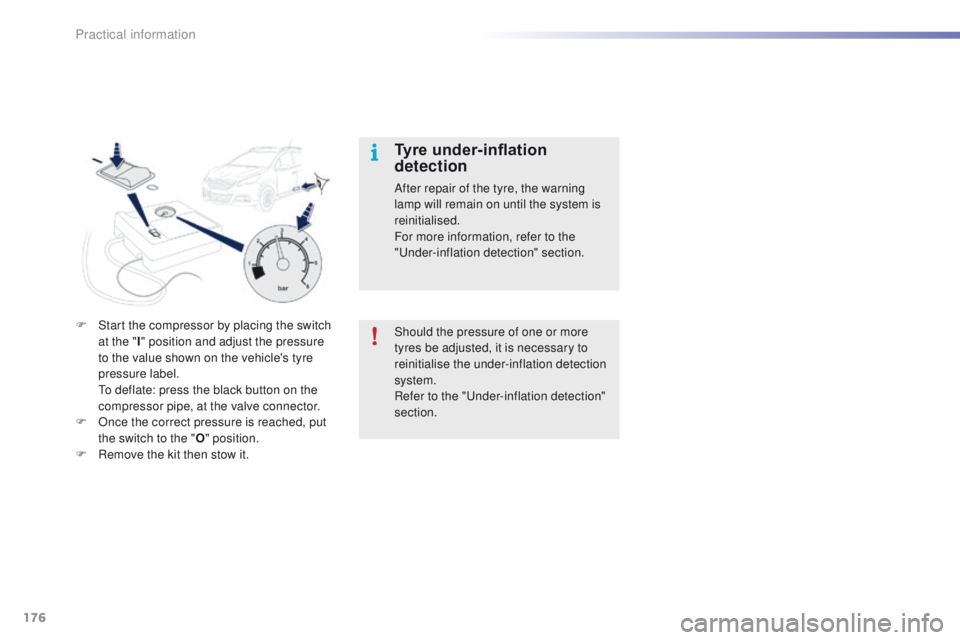
F Start the compressor by placing the switch at the " I" position and adjust the pressure
to the value shown on the vehicle's tyre
pressure label.
T
o deflate: press the black button on the
compressor pipe, at the valve connector.
F
O
nce the correct pressure is reached, put
the switch to the " O" position.
F
R
emove the kit then stow it.
Tyre under-inflation
detection
After repair of the tyre, the warning
lamp will remain on until the system is
reinitialised.
For more information, refer to the
"Under-inflation detection" section.
Should the pressure of one or more
tyres be adjusted, it is necessary to
reinitialise the under-inflation detection
system.
Refer to the "Under-inflation detection"
section.
Practical information
Page 179 of 340
177
2008_en_Chap09_info-pratiques_ed01-2015
Changing a wheel
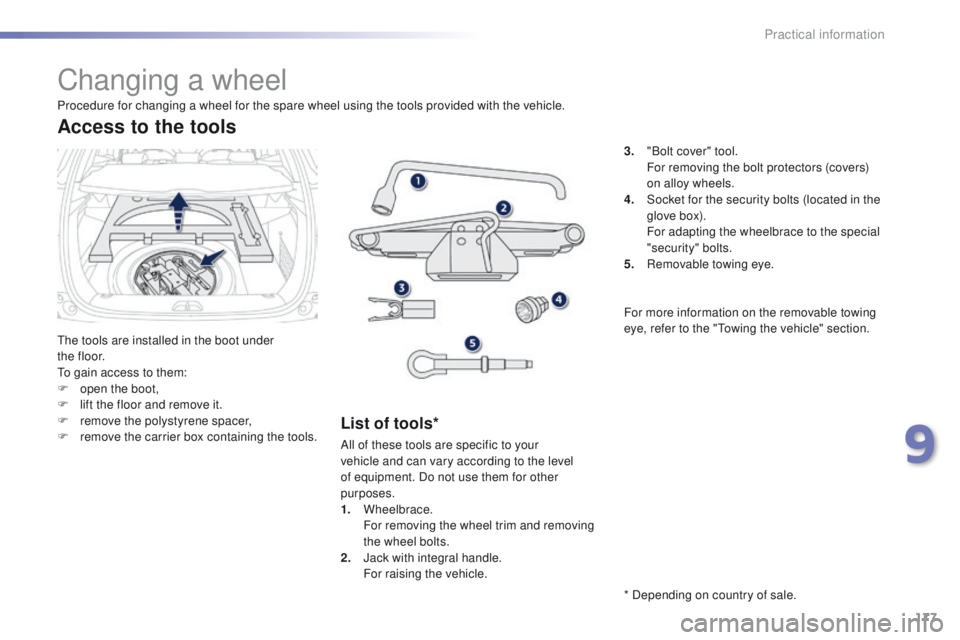
The tools are installed in the boot under
t h e f l o o r.
To gain access to them:
F
o
pen the boot,
F
l
ift the floor and remove it.
F
r
emove the polystyrene spacer,
F
r
emove the carrier box containing the tools.
Access to the tools
List of tools*
3. "Bolt cover" tool. F or removing the bolt protectors (covers)
on alloy wheels.
4.
S
ocket for the security bolts (located in the
glove box).
F
or adapting the wheelbrace to the special
"security" bolts.
5.
R
emovable towing eye.
Procedure for changing a wheel for the spare wheel using the tools provided with the vehicle.
All of these tools are specific to your
vehicle and can vary according to the level
of equipment. Do not use them for other
purposes.
1.
Wheelbrace.
F
or removing the wheel trim and removing
the wheel bolts.
2.
J
ack with integral handle.
F
or raising the vehicle. * Depending on country of sale. For more information on the removable towing
eye, refer to the "Towing the vehicle" section.
9
Practical information
Page 180 of 340
178
2008_en_Chap09_info-pratiques_ed01-2015
Wheel with trim
When refitting the wheel, refit the trim
starting by placing its notch facing the
valve and press around its edge with
the palm of your hand.
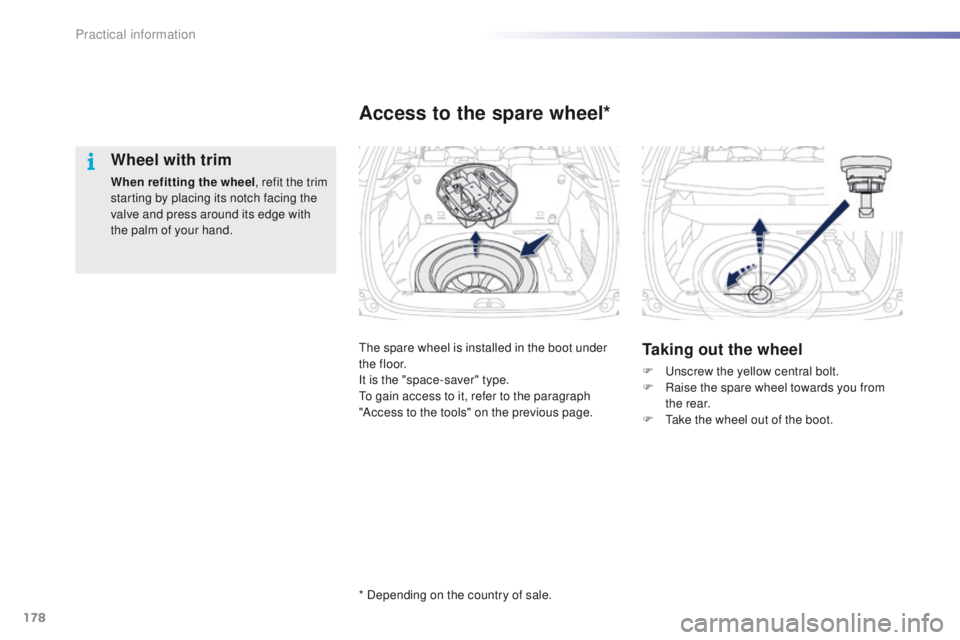
The spare wheel is installed in the boot under
t h e f l o o r.
It is the "space-saver" type.
To gain access to it, refer to the paragraph
"Access to the tools" on the previous page.
Access to the spare wheel*
Taking out the wheel
F Unscrew the yellow central bolt.
F R aise the spare wheel towards you from
the rear.
F
T
ake the wheel out of the boot.
* Depending on the country of sale.
Practical information
Page 187 of 340
185
2008_en_Chap09_info-pratiques_ed01-2015
Changing a bulb
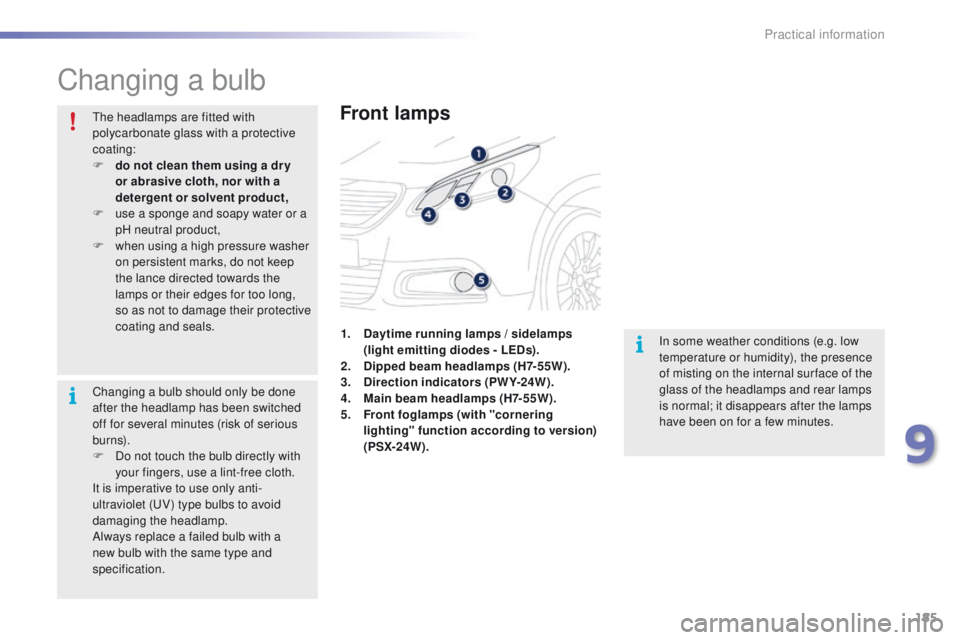
Front lamps
In some weather conditions (e.g. low
temperature or humidity), the presence
of misting on the internal sur face of the
glass of the headlamps and rear lamps
is normal; it disappears after the lamps
have been on for a few minutes.
The headlamps are fitted with
polycarbonate glass with a protective
coating:
F
d
o not clean them using a dr y
or abrasive cloth, nor with a
detergent or solvent product,
F
u
se a sponge and soapy water or a
pH neutral product,
F
w
hen using a high pressure washer
on persistent marks, do not keep
the lance directed towards the
lamps or their edges for too long,
so as not to damage their protective
coating and seals. 1. D
aytime running lamps / sidelamps
(light emitting diodes - LEDs).
2.
D
ipped beam headlamps (H7-55W).
3.
D
irection indicators (PWY-24W).
4.
M
ain beam headlamps (H7-55W).
5.
F
ront foglamps (with "cornering
lighting" function according to version)
(PSX-24W).
Changing a bulb should only be done
after the headlamp has been switched
off for several minutes (risk of serious
burns).
F
D
o not touch the bulb directly with
your fingers, use a lint-free cloth.
It is imperative to use only anti-
ultraviolet (UV) type bulbs to avoid
damaging the headlamp.
Always replace a failed bulb with a
new bulb with the same type and
specification.
9
Practical information
Page 192 of 340
190
2008_en_Chap09_info-pratiques_ed01-2015
Changing brake lamp and
direction indicator bulbs
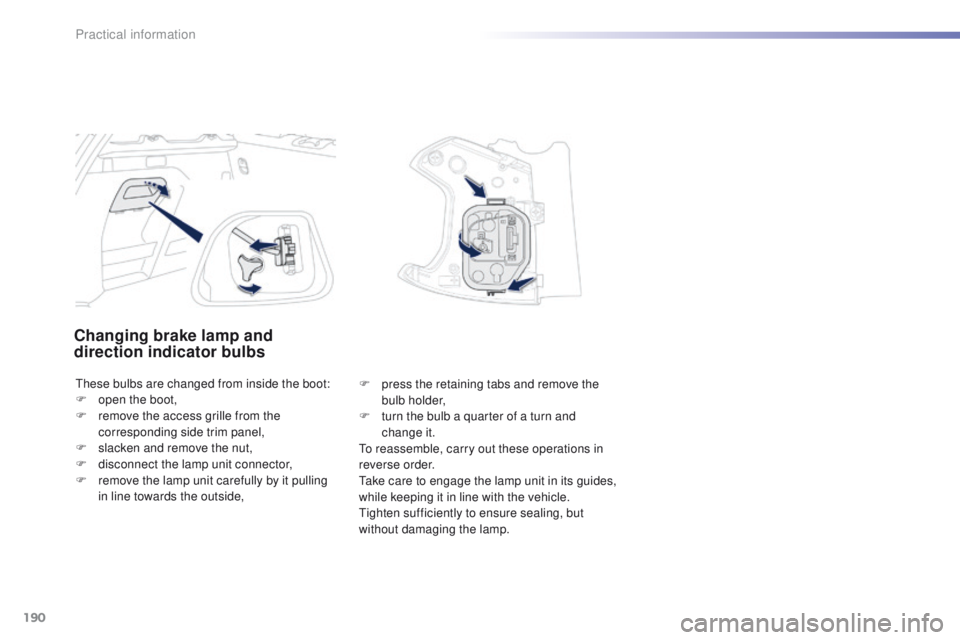
These bulbs are changed from inside the boot:
F o pen the boot,
F
r
emove the access grille from the
corresponding side trim panel,
F
s
lacken and remove the nut,
F
d
isconnect the lamp unit connector,
F
r
emove the lamp unit carefully by it pulling
in line towards the outside, F
p ress the retaining tabs and remove the
bulb holder,
F
t
urn the bulb a quarter of a turn and
change
it.
To reassemble, carry out these operations in
reverse order.
Take care to engage the lamp unit in its guides,
while keeping it in line with the vehicle.
Tighten sufficiently to ensure sealing, but
without damaging the lamp.
Practical information
Page 205 of 340
203
2008_en_Chap09_info-pratiques_ed01-2015
To w i n g
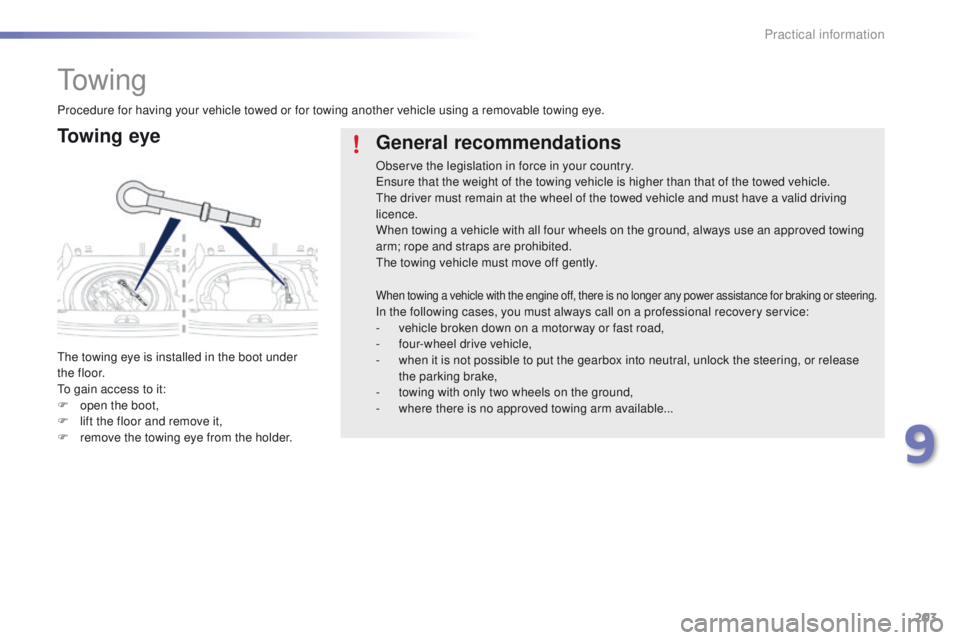
To w i n g e y e
The towing eye is installed in the boot under
t h e f l o o r.
To gain access to it:
F
o
pen the boot,
F
l
ift the floor and remove it,
F
r
emove the towing eye from the holder.
General recommendations
Observe the legislation in force in your country.
Ensure that the weight of the towing vehicle is higher than that of the towed vehicle.
The driver must remain at the wheel of the towed vehicle and must have a valid driving
licence.
When towing a vehicle with all four wheels on the ground, always use an approved towing
arm; rope and straps are prohibited.
The towing vehicle must move off gently.
When towing a vehicle with the engine off, there is no longer any power assistance for braking or steering.In the following cases, you must always call on a professional recovery service:
- v ehicle broken down on a motor way or fast road,
-
f
our-wheel drive vehicle,
-
w
hen it is not possible to put the gearbox into neutral, unlock the steering, or release
the parking brake,
-
t
owing with only two wheels on the ground,
-
w
here there is no approved towing arm available...
Procedure for having your vehicle towed or for towing another vehicle using a removable towing eye.
9
Practical information
Page 206 of 340
204
2008_en_Chap09_info-pratiques_ed01-2015
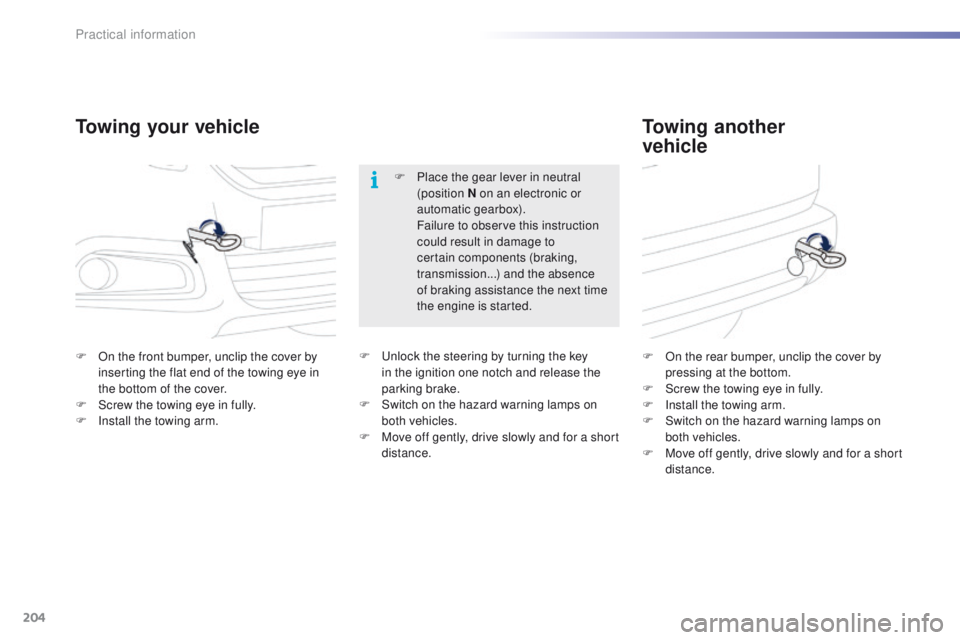
Towing your vehicleTowing another
vehicle
F On the front bumper, unclip the cover by
inserting the flat end of the towing eye in
the bottom of the cover.
F
S
crew the towing eye in fully.
F
I
nstall the towing arm. F
O n the rear bumper, unclip the cover by
pressing at the bottom.
F
S
crew the towing eye in fully.
F
I
nstall the towing arm.
F
S
witch on the hazard warning lamps on
both vehicles.
F
M
ove off gently, drive slowly and for a short
distance.
F
P
lace the gear lever in neutral
(position N on an electronic or
automatic gearbox).
F
ailure to observe this instruction
could result in damage to
certain components (braking,
transmission...) and the absence
of braking assistance the next time
the engine is started.
F U nlock the steering by turning the key
in the ignition one notch and release the
parking brake.
F
S
witch on the hazard warning lamps on
both vehicles.
F
M
ove off gently, drive slowly and for a short
distance.
Practical information
Page 207 of 340
205
2008_en_Chap09_info-pratiques_ed01-2015
Towing a trailer
We recommend the use of genuine
PEUGEOT towbars and their harnesses
that have been tested and approved
from the design stage of your vehicle,
and that the fitting of the towbar is
entrusted to a PEUGEOT dealer or a
qualified workshop.
If the towbar is not fitted by a
PEUGEOT dealer, it is imperative that it
is fitted in accordance with the vehicle
manufacturer's instructions.
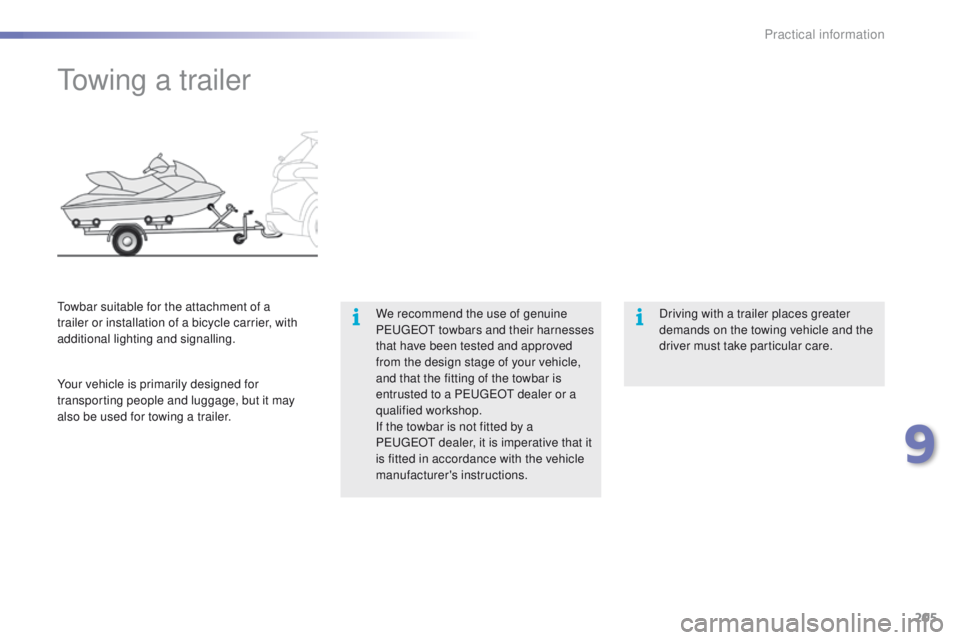
Towbar suitable for the attachment of a
trailer or installation of a bicycle carrier, with
additional lighting and signalling.
Driving with a trailer places greater
demands on the towing vehicle and the
driver must take particular care.
Your vehicle is primarily designed for
transporting people and luggage, but it may
also be used for towing a trailer.
9
Practical information