Page 109 of 340

107
2008_en_Chap05_conduite_ed01-2015
Park Assist
This system provides active assistance with parking, detecting a parking space then controlling the steering to park in the space.
It controls the steering while the driver manages the accelerator, brakes, gears and clutch (manual gearbox). During phases of entry into and exit from
a parking space, the system provides visual and audible information to the driver in order to make the manoeuvre safe. It may be necessary to move
forwards and backwards more than once.The Park Assist system cannot in any
circumstances replace the care and
responsibility of the driver.
The driver must remain in control of
their vehicle ensuring that the space
remains clear during the manoeuvre.
In some circumstances, the sensors
may not detect small obstacles located
in their blind spots.
Changing tyre sizes (out-size tyres,
winter tyres, ...) can inter fere with
the correct operation of the parking
assistance system.
During a manoeuvre the steering wheel
turns quickly: do not hold the steering
wheel, do not place your hand between
the spokes of the steering wheel and
take care with loose and bulky clothing,
scarves, handbags... There is a risk of
injury. For entry into a parking space (parallel
parking) the system does not detect
spaces which are clearly much smaller
or larger than the size of the vehicle.
This "parking assistance" system
is activated automatically during
manoeuvres; it is therefore possible
that a symbol comes on in the screen,
accompanied by an audible signal,
without affecting the manoeuvre.
The system provides assistance in entering and
exiting a parking space when parallel parking. The driver can take control at any time by
gripping the steering wheel.
The selection of the type of manoeuvre
(entering or exiting a parallel parking
space) prevents a change to STOP
mode of Stop & Start.
In STOP mode, this selection restarts
the engine.
5
Driving
Page 135 of 340
133
2008_en_Chap07_securite_ed01-2015
A set of the following Electronic Stability
systems:
-
a
nti-lock braking system (ABS) and
electronic brake force distribution (EBFD),
-
em
ergency braking assistance,
-
w
heel anti-slip regulation (ASR) or traction
control,
-
d
ynamic stability control (DSC).
Electronic stability control (ESC)
Definitions
Anti-lock braking system (ABS)
and electronic brake force
distribution (EBFD)
These systems improve the stability and
manoeuvrability of your vehicle when braking
and contribute towards improved control in
corners, in particular on poor or slippery road
surfaces.
The ABS prevents wheel lock in the event of
emergency braking.
The electronic brake force distribution system
manages the braking pressure wheel by wheel.
Emergency braking assistance
In an emergency, this system enables you to
reach the optimum braking pressure more
quickly and therefore reduce the stopping
distance.
It is triggered in relation to the speed at which
the brake pedal is pressed. This is felt by a
reduction in the resistance of the pedal and an
increase in the effectiveness of the braking.
Anti-slip regulation (ASR)
This system (also known as Traction Control)
optimises traction in order to avoid wheel
slip by acting on the brakes of the driving
wheels and on the engine. It also improves
the directional stability of the vehicle on
acceleration.
Dynamic stability control
(DSC)
If there is a difference between the path
followed by the vehicle and that required by the
driver, this system monitors each wheel and
automatically acts on the brake of one or more
wheels and on the engine to return the vehicle
to the required path, within the limits of the laws
of physics.
7
Safety
Page 136 of 340
134
2008_en_Chap07_securite_ed01-2015
Operation
Anti-lock braking system (ABS)
and electronic brake force
distribution (EBFD)
In emergency braking, press
very firmly without releasing the
pressure. When changing wheels (tyres and rims),
make sure that these are approved for
your vehicle.
Normal operation of the ABS may make
itself felt by slight vibrations of the brake
pedal.
When this warning lamp comes on,
accompanied by an audible signal
and a message, it indicates that
there is a fault with the ABS, which
could cause loss of control of the vehicle when
braking.
When this warning lamp comes on,
coupled with the STOP warning
lamp, accompanied by an audible
signal and a message, it indicates
that there is a fault with the electronic brake
force distribution (EBFD), which could cause
loss of control of the vehicle when braking.
You must stop as soon as it is safe to do so.
In both cases, contact a PEUGEOT dealer or a
qualified workshop.
Safety
Page 137 of 340
135
2008_en_Chap07_securite_ed01-2015
Dynamic stability control (DSC)
and anti-slip regulation (ASR)
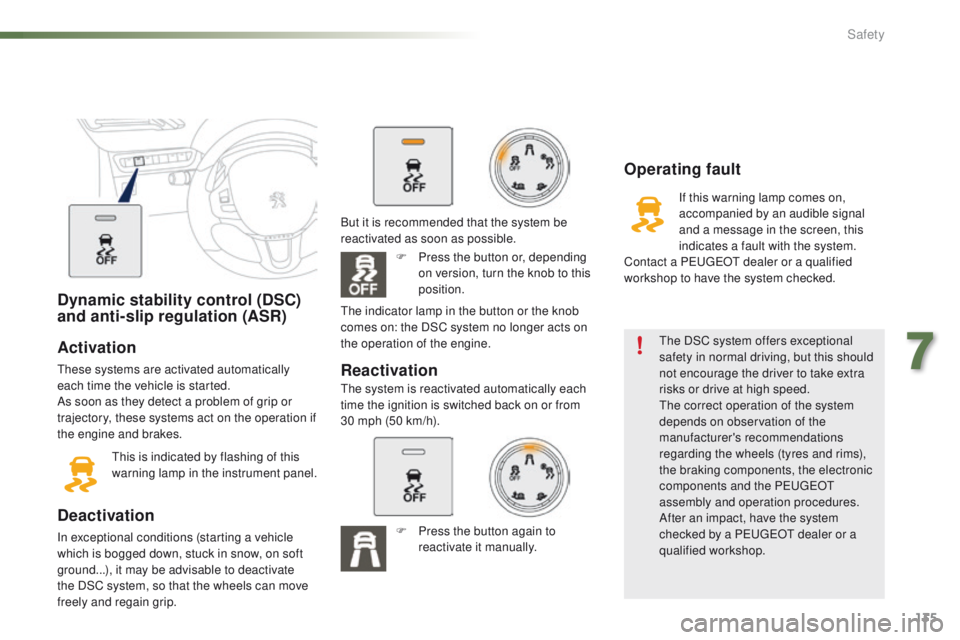
Activation
These systems are activated automatically
each time the vehicle is started.
As soon as they detect a problem of grip or
trajectory, these systems act on the operation if
the engine and brakes.This is indicated by flashing of this
warning lamp in the instrument panel.
Deactivation
In exceptional conditions (starting a vehicle
which is bogged down, stuck in snow, on soft
ground...), it may be advisable to deactivate
the DSC system, so that the wheels can move
freely and regain grip. The DSC system offers exceptional
safety in normal driving, but this should
not encourage the driver to take extra
risks or drive at high speed.
The correct operation of the system
depends on observation of the
manufacturer's recommendations
regarding the wheels (tyres and rims),
the braking components, the electronic
components and the PEUGEOT
assembly and operation procedures.
After an impact, have the system
checked by a PEUGEOT dealer or a
qualified workshop.
Operating fault
If this warning lamp comes on,
accompanied by an audible signal
and a message in the screen, this
indicates a fault with the system.
Contact a PEUGEOT dealer or a qualified
workshop to have the system checked.
Reactivation
But it is recommended that the system be
reactivated as soon as possible.
F
P
ress the button or, depending
on version, turn the knob to this
position.
The system is reactivated automatically each
time the ignition is switched back on or from
30 mph (50 km/h). The indicator lamp in the button or the knob
comes on: the DSC system no longer acts on
the operation of the engine.
F
P
ress the button again to
reactivate it manually.
7
Safety
Page 182 of 340
180
2008_en_Chap09_info-pratiques_ed01-2015
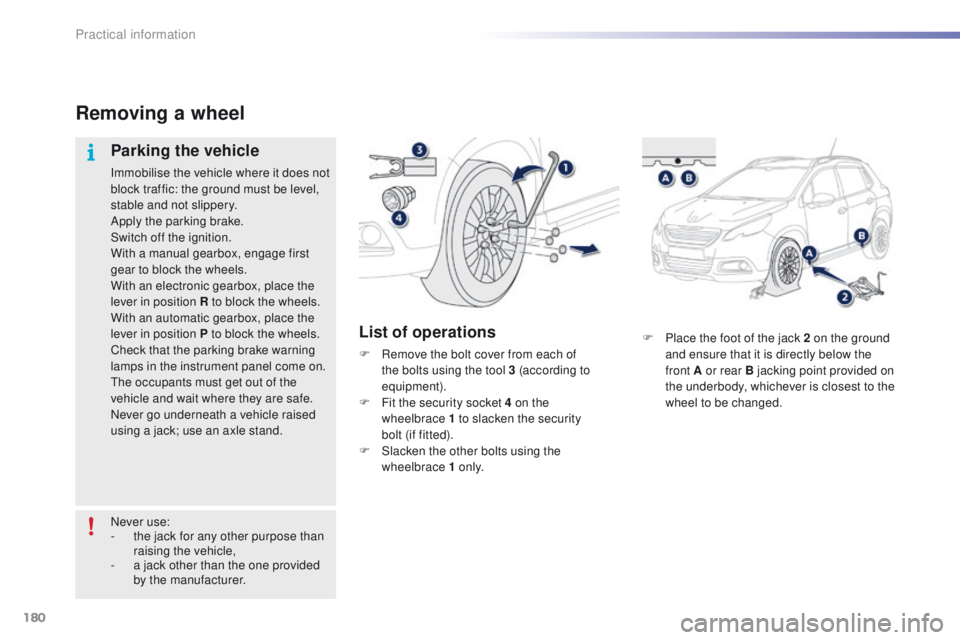
F Place the foot of the jack 2 on the ground and ensure that it is directly below the
front
A or rear B jacking point provided on
the underbody, whichever is closest to the
wheel to be changed.
Removing a wheel
Parking the vehicle
Immobilise the vehicle where it does not
block traffic: the ground must be level,
stable and not slippery.
Apply the parking brake.
Switch off the ignition.
With a manual gearbox, engage first
gear to block the wheels.
With an electronic gearbox, place the
lever in position R to block the wheels.
With an automatic gearbox, place the
lever in position P to block the wheels.
Check that the parking brake warning
lamps in the instrument panel come on.
The occupants must get out of the
vehicle and wait where they are safe.
Never go underneath a vehicle raised
using a jack; use an axle stand.
List of operations
F Remove the bolt cover from each of the bolts using the tool 3 (according to
equipment).
F
F
it the security socket 4 on the
wheelbrace
1 to slacken the security
bolt (if fitted).
F
S
lacken the other bolts using the
wheelbrace 1 o n l y.
Never use:
-
t
he jack for any other purpose than
raising the vehicle,
-
a j
ack other than the one provided
by the manufacturer.
Practical information
Page 186 of 340
184
2008_en_Chap09_info-pratiques_ed01-2015
Snow chains
In wintry conditions, snow chains improve
traction as well as the behaviour of the vehicle
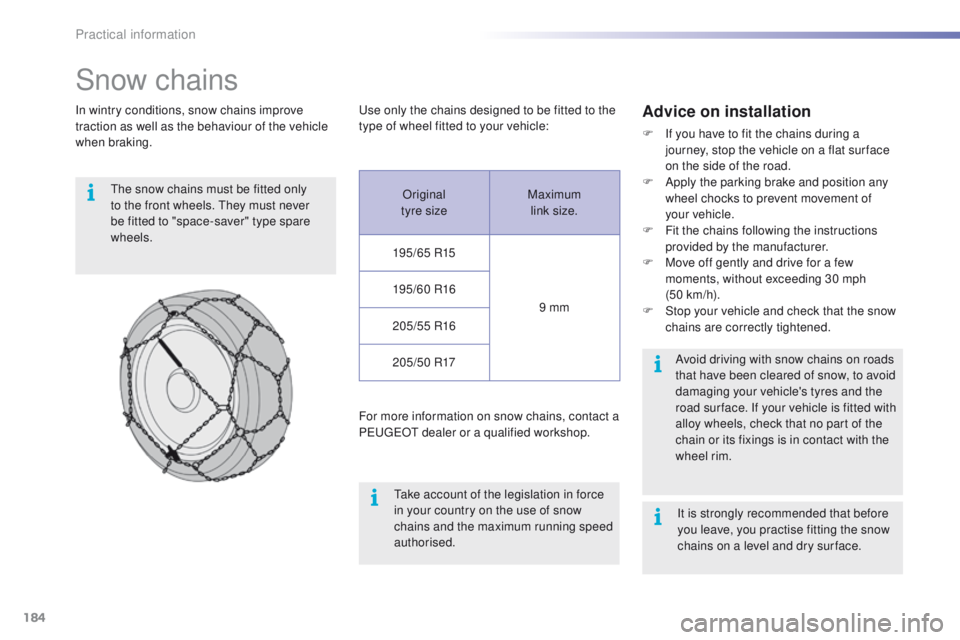
when braking.The snow chains must be fitted only
to the front wheels. They must never
be fitted to "space-saver" type spare
wheels.
Take account of the legislation in force
in your country on the use of snow
chains and the maximum running speed
authorised.
Use only the chains designed to be fitted to the
type of wheel fitted to your vehicle:
For more information on snow chains, contact a
PEUGEOT dealer or a qualified workshop.Advice on installation
F If you have to fit the chains during a
journey, stop the vehicle on a flat sur face
on the side of the road.
F
A
pply the parking brake and position any
wheel chocks to prevent movement of
your
vehicle.
F
F
it the chains following the instructions
provided by the manufacturer.
F
M
ove off gently and drive for a few
moments, without exceeding 30 mph
(50 km/h).
F
S
top your vehicle and check that the snow
chains are correctly tightened.
Avoid driving with snow chains on roads
that have been cleared of snow, to avoid
damaging your vehicle's tyres and the
road sur face. If your vehicle is fitted with
alloy wheels, check that no part of the
chain or its fixings is in contact with the
wheel rim.
Original
tyre size Maximum
link size.
195/65 R15
9 mm
195/60 R16
205/55 R16 205/50 R17
It is strongly recommended that before
you leave, you practise fitting the snow
chains on a level and dry sur face.
Practical information
Page 191 of 340
189
2008_en_Chap09_info-pratiques_ed01-2015
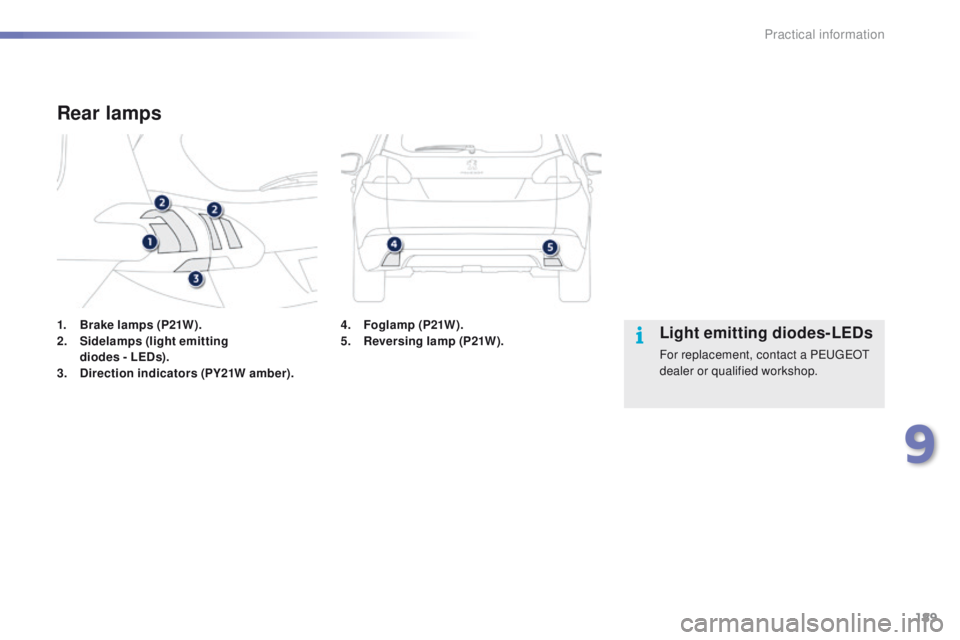
1. Brake lamps (P21W).
2. Sidelamps (light emitting
diodes - LEDs).
3.
D
irection indicators (PY21W amber).
Rear lamps
Light emitting diodes-LEDs
For replacement, contact a PEUGEOT
dealer or qualified workshop.
4.
F
oglamp (P21W).
5. R
eversing lamp (P21W).
9
Practical information
Page 192 of 340
190
2008_en_Chap09_info-pratiques_ed01-2015
Changing brake lamp and
direction indicator bulbs
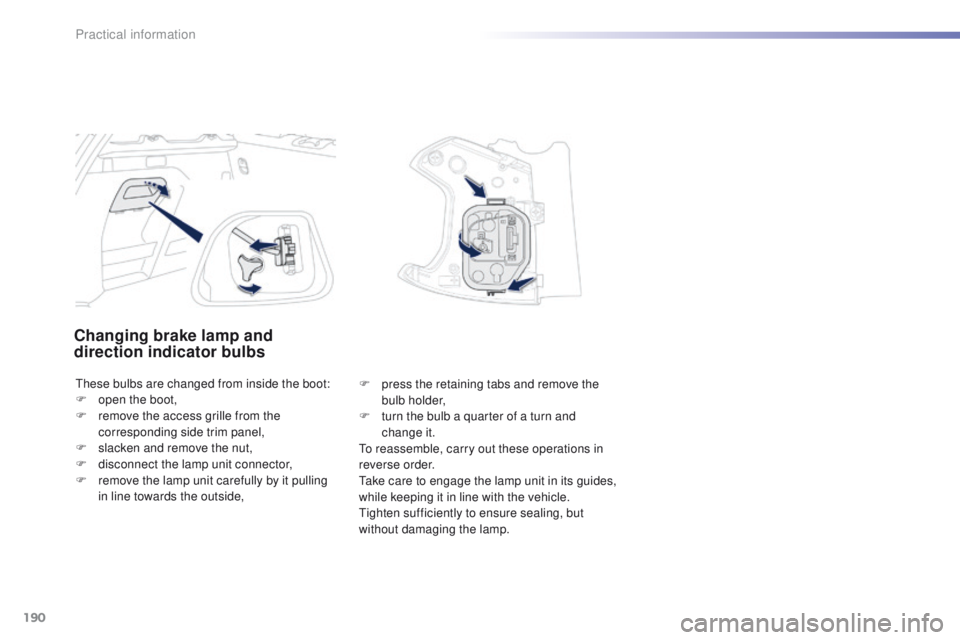
These bulbs are changed from inside the boot:
F o pen the boot,
F
r
emove the access grille from the
corresponding side trim panel,
F
s
lacken and remove the nut,
F
d
isconnect the lamp unit connector,
F
r
emove the lamp unit carefully by it pulling
in line towards the outside, F
p ress the retaining tabs and remove the
bulb holder,
F
t
urn the bulb a quarter of a turn and
change
it.
To reassemble, carry out these operations in
reverse order.
Take care to engage the lamp unit in its guides,
while keeping it in line with the vehicle.
Tighten sufficiently to ensure sealing, but
without damaging the lamp.
Practical information