Page 104 of 340
102
2008_en_Chap05_conduite_ed01-2015
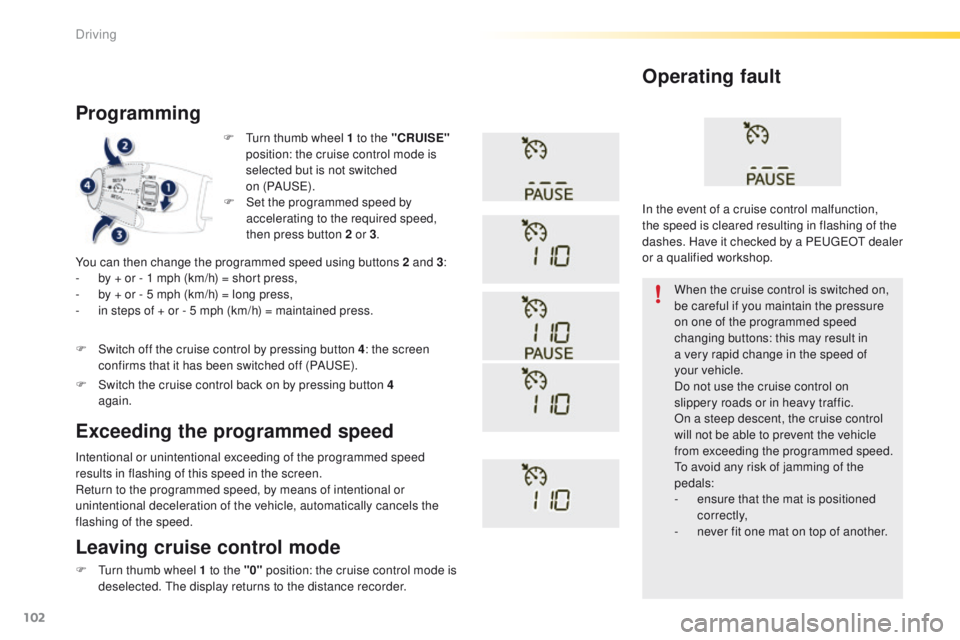
F Turn thumb wheel 1 to the "CRUISE"
position: the cruise control mode is
selected but is not switched
on (PAUS E).
Programming
You can then change the programmed speed using buttons 2 and 3 :
- b y + or - 1 mph (km/h) = short press,
-
b
y + or - 5 mph (km/h) = long press,
-
i
n steps of + or - 5 mph (km/h) = maintained press.
Intentional or unintentional exceeding of the programmed speed
results in flashing of this speed in the screen.
Return to the programmed speed, by means of intentional or
unintentional deceleration of the vehicle, automatically cancels the
flashing of the speed. When the cruise control is switched on,
be careful if you maintain the pressure
on one of the programmed speed
changing buttons: this may result in
a very rapid change in the speed of
your
vehicle.
Do not use the cruise control on
slippery roads or in heavy traffic.
On a steep descent, the cruise control
will not be able to prevent the vehicle
from exceeding the programmed speed.
To avoid any risk of jamming of the
pedals:
-
e
nsure that the mat is positioned
c o r r e c t l y,
-
n
ever fit one mat on top of another.
Operating fault
Leaving cruise control mode
F Turn thumb wheel 1 to the "0" position: the cruise control mode is
deselected. The display returns to the distance recorder.
Exceeding the programmed speed
F Set the programmed speed by accelerating to the required speed,
then press button 2 or 3 .
F
S
witch off the cruise control by pressing button 4 : the screen
confirms that it has been switched off (PAUSE).
F
S
witch the cruise control back on by pressing button 4
again. In the event of a cruise control malfunction,
the speed is cleared resulting in flashing of the
dashes. Have it checked by a PEUGEOT dealer
or a qualified workshop.
Driving
Page 115 of 340
113
2008_en_Chap06_visibilite_ed01-2015
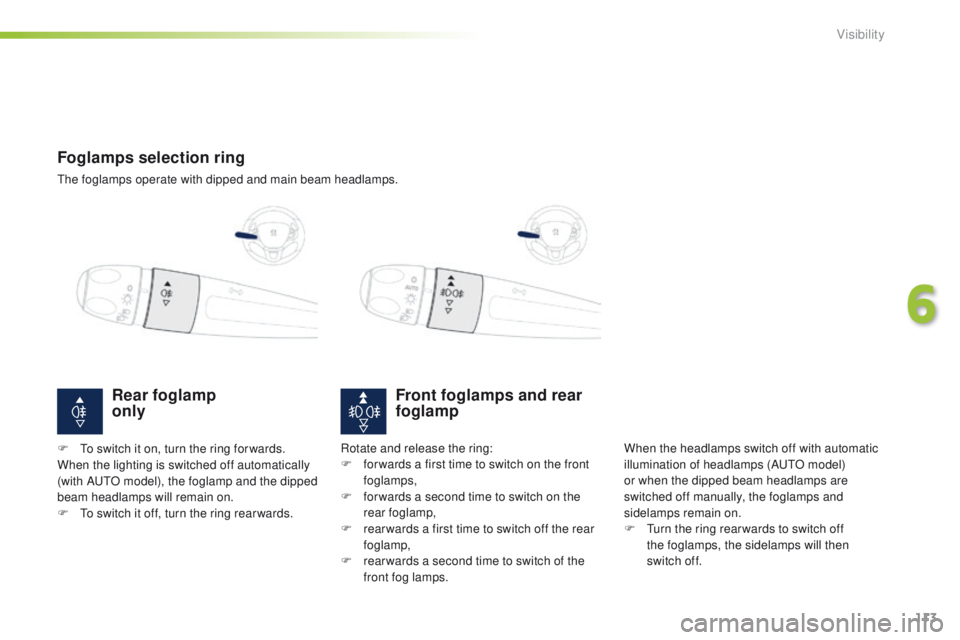
Foglamps selection ring
The foglamps operate with dipped and main beam headlamps.
Front foglamps and rear
foglamp
When the headlamps switch off with automatic
illumination of headlamps (AUTO model)
or when the dipped beam headlamps are
switched off manually, the foglamps and
sidelamps remain on.
F
T
urn the ring rear wards to switch off
the foglamps, the sidelamps will then
switch
off.
Rotate and release the ring:
F
f
or wards a first time to switch on the front
foglamps,
F
f
or wards a second time to switch on the
rear foglamp,
F
r
ear wards a first time to switch off the rear
foglamp,
F
r
ear wards a second time to switch of the
front fog lamps.
Rear foglamp
only
F To switch it on, turn the ring for wards.
When the lighting is switched off automatically
(with AUTO model), the foglamp and the dipped
beam headlamps will remain on.
F
T
o switch it off, turn the ring rear wards.
6
Visibility
Page 126 of 340
124
2008_en_Chap06_visibilite_ed01-2015
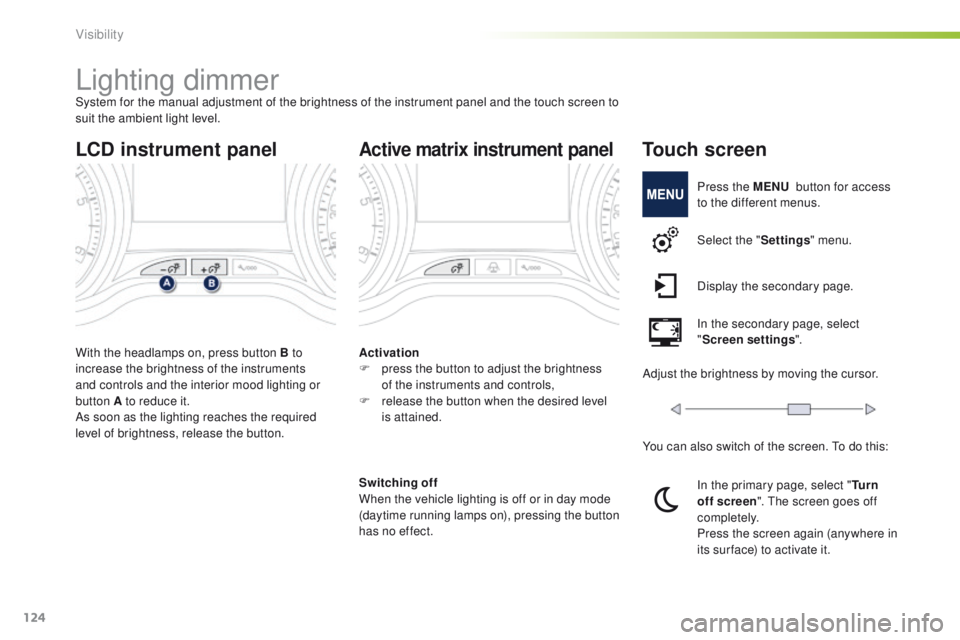
Lighting dimmerSystem for the manual adjustment of the brightness of the instrument panel and the touch screen to
suit the ambient light level.
With the headlamps on, press button B to
increase the brightness of the instruments
and controls and the interior mood lighting or
button A to reduce it.
As soon as the lighting reaches the required
level of brightness, release the button.
LCD instrument panel
Activation
F p ress the button to adjust the brightness
of the instruments and controls,
F
r
elease the button when the desired level
is attained.
Active matrix instrument panel
Switching off
When the vehicle lighting is off or in day mode
(daytime running lamps on), pressing the button
has no effect.
Touch screen
Press the MENU button for access
to the different menus.
Select the " Settings" menu.
Display the secondary page.
In the secondary page, select
" Screen settings ".
Adjust the brightness by moving the cursor.
You can also switch of the screen. To do this:
In the primary page, select " Tu r n
off screen ". The screen goes off
completely.
Press the screen again (anywhere in
its sur face) to activate it.
Visibility
Page 127 of 340
125
2008_en_Chap06_visibilite_ed01-2015
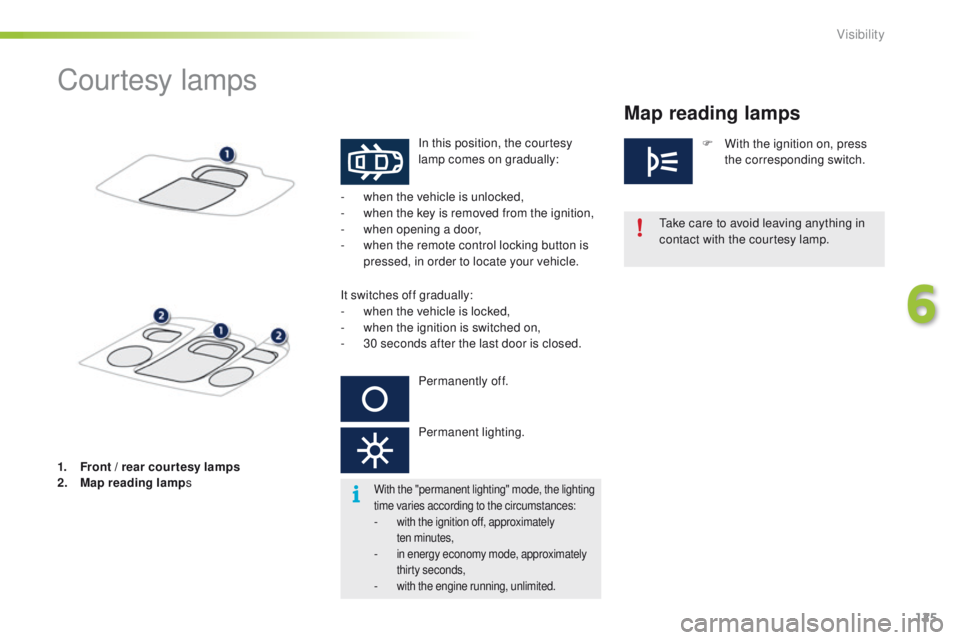
Courtesy lamps
In this position, the courtesy
lamp comes on gradually:Take care to avoid leaving anything in
contact with the courtesy lamp.
-
w
hen the vehicle is unlocked,
-
w
hen the key is removed from the ignition,
-
w
hen opening a door,
-
w
hen the remote control locking button is
pressed, in order to locate your vehicle.
It switches off gradually:
-
w
hen the vehicle is locked,
-
w
hen the ignition is switched on,
-
3
0 seconds after the last door is closed. Permanently off.
Permanent lighting. F
W ith the ignition on, press
the corresponding switch.
1.
F
ront / rear cour tesy lamps
2.
M
ap reading lamp s
With the "permanent lighting" mode, the lighting
time varies according to the circumstances:
- with the ignition off, approximately
ten
minutes,
- in energy economy mode, approximately thirty seconds,
- with the engine running, unlimited.
Map reading lamps
6
Visibility
Page 139 of 340
137
2008_en_Chap07_securite_ed01-2015
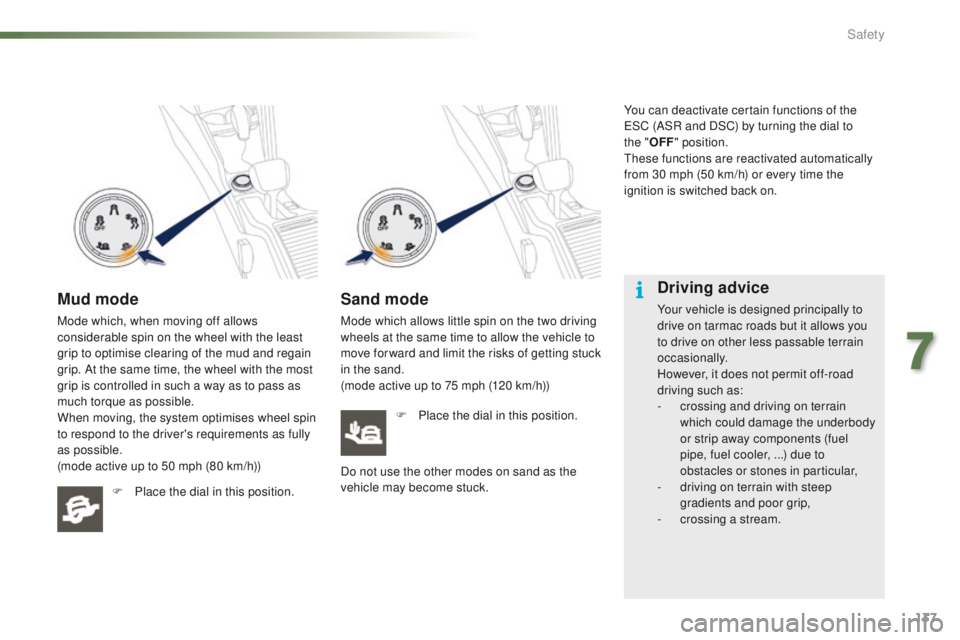
Mud mode
Mode which, when moving off allows
considerable spin on the wheel with the least
grip to optimise clearing of the mud and regain
grip. At the same time, the wheel with the most
grip is controlled in such a way as to pass as
much torque as possible.
When moving, the system optimises wheel spin
to respond to the driver's requirements as fully
as possible.
(mode active up to 50 mph (80 km/h))F
P
lace the dial in this position.
Sand mode
Mode which allows little spin on the two driving
wheels at the same time to allow the vehicle to
move for ward and limit the risks of getting stuck
in the sand.
(mode active up to 75 mph (120 km/h))F
P
lace the dial in this position.
Do not use the other modes on sand as the
vehicle may become stuck. You can deactivate certain functions of the
ESC (ASR and DSC) by turning the dial to
the "
OFF" position.
These functions are reactivated automatically
from 30 mph (50 km/h) or every time the
ignition is switched back on.
Driving advice
Your vehicle is designed principally to
drive on tarmac roads but it allows you
to drive on other less passable terrain
occasionally.
However, it does not permit off-road
driving such as:
-
c
rossing and driving on terrain
which could damage the underbody
or strip away components (fuel
pipe, fuel cooler, ...) due to
obstacles or stones in particular,
-
d
riving on terrain with steep
gradients and poor grip,
-
c
rossing a stream.
7
Safety
Page 203 of 340
201
2008_en_Chap09_info-pratiques_ed01-2015
System which manages the duration of use of certain functions to retain a sufficient level of charge
in the battery.
After the engine has stopped, you can still use functions such as the audio and telematics
system, windscreen wipers, dipped beam headlamps, courtesy lamps, etc. for a maximum
combined duration of about thirty minutes.
Electrical energy economy mode
Switching to economy mode
Once this time has elapsed, a message
appears in the screen indicating that the
vehicle has switched to economy mode and the
active functions are put on standby.
If a telephone call is being made at this time, it
will be maintained for around 10 minutes with
the Bluetooth hands-free system of your audio
system.
Exiting economy mode
These functions are reactivated automatically
next time the vehicle is driven.
F
T
o restore these functions immediately,
start the engine and let it run for at least
five minutes.
A flat battery prevents the engine from
starting (refer to the corresponding
section).
Load reduction mode
System which manages the use of certain
functions according to the level of charge
remaining in the battery.
When the vehicle is being driven, the load
reduction function temporarily deactivates
certain functions, such as the air conditioning,
the heated rear screen...
The deactivated functions are reactivated
automatically as soon as conditions permit.
9
Practical information
Page 224 of 340

222
2008_en_Chap11_caracteristiques-techniques_ed01-2015
* The kerb weight is equal to the unladen weight + driver (75 kg).
** T he weight of the braked trailer can be increased, within the GTW limit, if the GV W of the towing vehicle is reduced by an equal amount; warning,
towing using a lightly loaded towing vehicle may have an adverse effect on its road holding.
Weights and towed loads (in kg) - PETROL
Engine 1.2 litre PureTech 821.2 litre PureTech 82
S&S 1.2 litre PureTech 110
S&S
Gearbox Manual
(5-speed) ETG5 electronic
(5-speed) ETG5 electronic
(5-speed) Manual
(5-speed)
Model code:
C
UHMZ0
HMZ6 HMZ0/P
HMZ6/PS HNZ6/S
-
U
nladen weight 1 0451 0551 0551 090
-
K
erb weight* 1 1201 13 0 1 13 01 165
-
G
ross vehicle weight
(GV W) 1 582
1 5731 593 1 656
-
G
ross train weight (GTW)
o
n a 12 % gradient 2 362
2 0232 043 2 606
-
B
raked trailer (within GTW limit)
o
n a 10 % or 12 % gradient 780
450 450950
-
B
raked trailer** with load transfer
(within the GTW limit) 1 10 0
7707701 270
-
U
nbraked trailer 560450450580
-
R
ecommended nose weight 51515151
The GTW and towed load values indicated are valid up to a maximum altitude of 1 000 metres; the towed load mentioned must be reduced by 10 % for
each additional 1 000 metres of altitude.
The speed of a towing vehicle must not exceed 60 mph (100 km/h) (comply with the legislation in force in your country).
High ambient temperatures may result in a reduction in the per formance of the vehicle to protect the engine; if the ambient temperature is above 37 °C,
limit the towed load.
Technical data
Page 225 of 340

223
2008_en_Chap11_caracteristiques-techniques_ed01-2015
Weights and towed loads (in kg) - PETROL
Engine1.2 litre PureTech 130
S&S 1.6 litre VTi 120
Gearbox Manual
(6-speed) Manual
(5-speed) Automatic
(4-speed)
Model code:
C
UHNYM/S 5FS05FS9
-
U
nladen weight 1 1601 080 1 140
-
K
erb weight* 1 2351 1551 215
-
G
ross vehicle weight
(GV W) 1 675
1 644 1 666
-
G
ross train weight (GTW)
o
n a 12 % gradient 2 625
2 6142 616
-
B
raked trailer (within GTW limit)
o
n a 10 % or 12 % gradient 950
970950
-
B
raked trailer** with load transfer
(within the GTW limit) 1 270
1 270 1270
-
U
nbraked trailer 580570600
-
R
ecommended nose weight 515151
The GTW and towed load values indicated are valid up to a maximum altitude of 1 000 metres; the towed load mentioned must be reduced by 10 % for
each additional 1 000 metres of altitude.
The speed of a towing vehicle must not exceed 60 mph (100 km/h) (comply with the legislation in force in your country).
High ambient temperatures may result in a reduction in the per formance of the vehicle to protect the engine; if the ambient temperature is above 37 °C,
limit the towed load.
*
T
he kerb weight is equal to the unladen weight + driver (75 kg).
**
T
he weight of the braked trailer can be increased, within the GTW limit, if the GV W of the towing vehicle is reduced by an equal amount; warning,
towing using a lightly loaded towing vehicle may have an adverse effect on its road holding.
11
Technical data