2015 PEUGEOT 2008 heating
[x] Cancel search: heatingPage 69 of 340
67
2008_en_Chap03_confort_ed01-2015
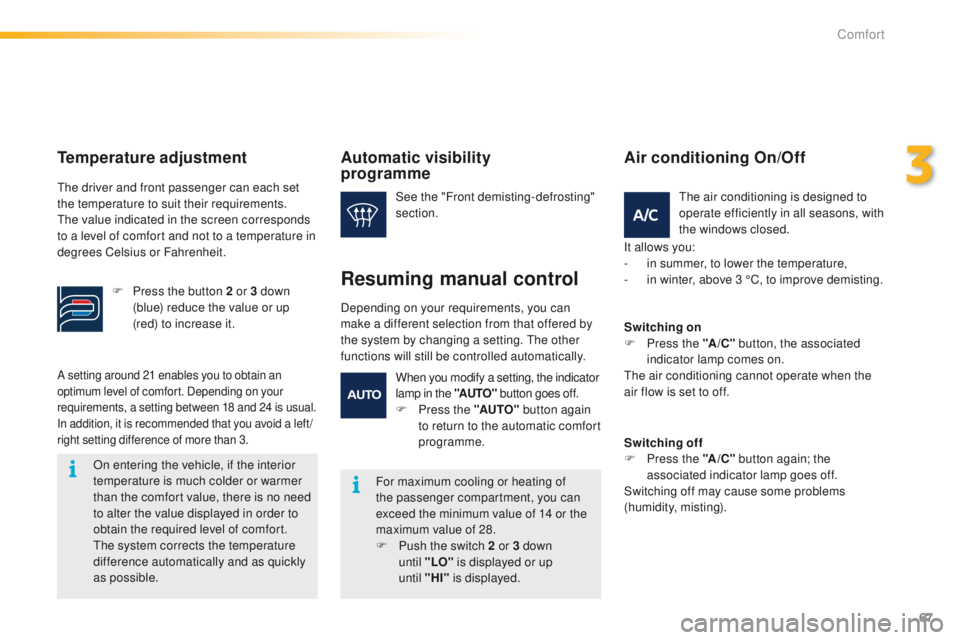
A setting around 21 enables you to obtain an
optimum level of comfort. Depending on your
requirements, a setting between 18 and 24 is usual.
In addition, it is recommended that you avoid a left /
right setting difference of more than 3.
On entering the vehicle, if the interior
temperature is much colder or warmer
than the comfort value, there is no need
to alter the value displayed in order to
obtain the required level of comfort.
The system corrects the temperature
difference automatically and as quickly
as possible.
Automatic visibility
programme
For maximum cooling or heating of
the passenger compartment, you can
exceed the minimum value of 14 or the
maximum value of 28.
F
P
ush the switch 2 or 3 down
until
"LO" is displayed or up
until
"HI" is displayed.
See the "Front demisting-defrosting"
section.
Depending on your requirements, you can
make a different selection from that offered by
the system by changing a setting. The other
functions will still be controlled automatically.
Resuming manual control
The air conditioning is designed to
operate efficiently in all seasons, with
the windows closed.
Air conditioning On/Off
It allows you:
- i n summer, to lower the temperature,
-
i
n winter, above 3 °C, to improve demisting.
Switching on
F
P
ress the " A/C" button, the associated
indicator lamp comes on.
The air conditioning cannot operate when the
air flow is set to off.
Switching off
F
P
ress the "A /C " button again; the
associated indicator lamp goes off.
Switching off may cause some problems
(humidity, misting).
When you modify a setting, the indicator
lamp in the "AUTO"
button goes off.
F
P
ress the "AUTO" button again
to return to the automatic comfort
programme.
Temperature adjustment
The driver and front passenger can each set
the temperature to suit their requirements.
The value indicated in the screen corresponds
to a level of comfort and not to a temperature in
degrees Celsius or Fahrenheit.
F
P
ress the button 2 or 3 down
(blue) reduce the value or up
(red) to increase it.
3
Comfort
Page 80 of 340
78
2008_en_Chap05_conduite_ed01-2015
Driving recommendations
Observe the driving regulations and remain
vigilant whatever the traffic conditions.
Pay close attention to the traffic and keep your
hands on the wheel so that you are ready to
react at any time to any eventuality.
On a long journey, a break every two hours is
strongly recommended.
In difficult weather, drive smoothly, anticipate
the need to brake and increase the distance
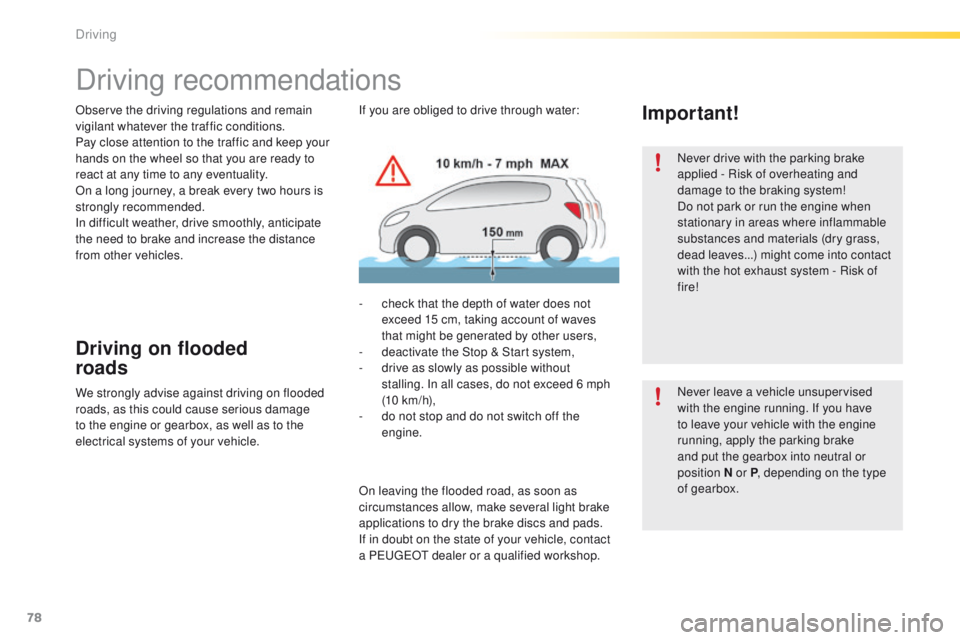
from other vehicles.If you are obliged to drive through water:Important!
Driving on flooded
roads
- check that the depth of water does not exceed 15 cm, taking account of waves
that might be generated by other users,
-
d
eactivate the Stop & Start system,
-
d
rive as slowly as possible without
stalling. In all cases, do not exceed 6 mph
(10
km/h),
-
d
o not stop and do not switch off the
engine.
We strongly advise against driving on flooded
roads, as this could cause serious damage
to the engine or gearbox, as well as to the
electrical systems of your vehicle.
On leaving the flooded road, as soon as
circumstances allow, make several light brake
applications to dry the brake discs and pads.
If in doubt on the state of your vehicle, contact
a PEUGEOT dealer or a qualified workshop. Never drive with the parking brake
applied - Risk of overheating and
damage to the braking system!
Do not park or run the engine when
stationary in areas where inflammable
substances and materials (dry grass,
dead leaves...) might come into contact
with the hot exhaust system - Risk of
fire!
Never leave a vehicle unsupervised
with the engine running. If you have
to leave your vehicle with the engine
running, apply the parking brake
and put the gearbox into neutral or
position
N or P, depending on the type
of gearbox.
Driving
Page 196 of 340

194
2008_en_Chap09_info-pratiques_ed01-2015
Dashboard fuses
The fusebox is placed in the lower dashboard
(left-hand side).
Access to the fuses
F Refer to the paragraph "Access to the tools".Fuse N°
Rating Functions
F2 5 ADoor mirrors, headlamps, diagnostic socket.
F9 5 AAlarm.
F10 5 AIndependent telematic unit, trailer interface.
F11 5 AElectrochrome rear view mirror, additional heating.
F13 5 AHi-Fi amplifier, parking sensors
F16 15 AFront 12 V socket.
F17 15 AAudio system, audio system (accessory).
F18 20 ATouch screen.
Fuse tables
Practical information
Page 208 of 340

206
2008_en_Chap09_info-pratiques_ed01-2015
Driving advice
Distribution of loads
F Distribute the load in the trailer so that the heaviest items are as close as possible to
the axle and the nose weight approaches
the maximum permitted without
exceeding
it.
Air density decreases with altitude, thus
reducing engine performance. Above
1
000 metres, the maximum towed load must
be reduced by 10
% for every 1 000 metres of
altitude.
Side wind
F Take into account the increased sensitivity to side wind.
Cooling
Towing a trailer on a slope increases the
temperature of the coolant.
As the fan is electrically controlled, its cooling
capacity is not dependent on the engine speed.
F
T
o lower the engine speed, reduce your
speed.
The maximum towed load on a long incline
depends on the gradient and the ambient
temperature.
In all cases, keep a check on the coolant
temperature.
F
I
f the warning lamp and
the
STOP warning lamp come
on, stop the vehicle and switch
off the engine as soon as
possible.
Braking
Towing a trailer increases the braking distance.
To avoid overheating of the brakes on a long
mountain type of descent, the use of engine
braking is recommended.
Ty r e s
F Check the tyre pressures of the towing vehicle and of the trailer, observing the
recommended pressures.
Lighting
F Check the electrical lighting and signalling on the trailer.
The rear parking sensors will be
deactivated automatically if a genuine
PEUGEOT towbar is used.
Refer to the "Technical data" section for details
of the weights and towed loads which apply to
your vehicle.
Practical information
Page 332 of 340
330
2008_en_Chap13_index-alpha_ed01-2015
Emergency warning lamps .....................7 7, 1 2 8
Emissions control system, SCR
.............................................................. 25
Energy economy mode
.................................201
Engine compartment
............................212, 213
Engine, Diesel
............... 1
62, 163, 213, 224, 226
Engine oil level indicator
...................................................... 214
Engine, petrol
........................ 162, 212, 220, 222
Engines
................................................. 220, 224
Environment
...............................
...............12, 4 5
Filling the fuel tank
........................1
59, 161, 162
Fitting a wheel
...............................
................180
Fitting roof bars
............................................. 207
Fittings, boot
................................................... 74
F
ittings, interior
......................................... 70, 71
Flap, fuel filler
...............................
.........159, 161
Flashing indicators
........................116, 128, 186
Foglamp, rear
...............................
.........189, 191
Foglamps, front
............................................. 188
Folding/unfolding the door mirrors
............................................ 59
Frequency (radio)
.................................. 260, 261
Front foglamps
...................................... 113 , 11 9
Fuel .......................................................... 12, 162
Fuel consumption
............................................ 12
Fu
el tank ................................................ 159, 161
Fusebox, dashboard
..................................... 192
Fusebox, engine compartment
.............................................. 19
2
Fuses
............................................................. 192Hazard warning lamps
............................7 7, 1 2 8
Headlamps, automatic illumination
..................................................117
Headlamps, dipped beam
.............................18 6
Headlamps, main beam
................................ 18
6
Head restraints, front
......................................56
Head restraints, rear
.......................................58
Heating
................................................12, 63, 64
Hill start assist
.................................................98
G
FH
EBA (Emergency braking assistance) ..........13 3
Eco-driving ..................................................... 12
Eco-driving (advice)
........................................ 12
Economy mode
............................................. 201
Electronic brake force distribution (EBFD)
........................................................ 13 3
Electronic gearbox system
...............83, 86, 218
Emergency call
..................................... 12
9, 232
E
DAB (Digital Audio Broadcasting) - Digital radio ......................................... 262, 263
Date (setting)
...............................
....................41
Daytime running lamps
.................................115
Daytime running lamps, LED
........................115
Deactivating the passenger airbag
.......................................................... 1
41
Defrosting
..................................................64, 69
Demisting
...............................
...................64, 69
Dials and gauges
...................................... 14, 15
Diesel additive level
...................................... 216
Dimensions
................................................... 229
Dipped beam
...............................
..................111
Dipstick
................
.................................... 31, 214
Directional lighting
........................................ 11 9
Direction indicators
.......116, 128, 186, 189, 190
Display screen, instrument panel
....................................................... 14, 15
Door pockets
................................................... 70
D
oors
............................................................... 47
Driving economically ....................................... 12
Dynamic stability control (DSC)
.................................... 23, 13 3, 13 5, 13 6 Gauge, fuel
.................................................... 159
Gearbox, automatic
..................12, 90, 200, 218
Gearbox, electronic
..........................12, 95, 200
Gearbox, manual
........................12, 82, 95, 218
Gear lever
..............................
.........................12
Gear lever, automatic gearbox
....................... 90
G
ear lever, manual gearbox
...........................82
Gear shift indicator
.........................................94
Glove box
........................................................71
Grip control
...................................................13 6
Guide-me-home
............................................117
D
Identification plates .......................................23 0
Ignition ................ ............................................. 80
Ignition switch
................................................. 79
Imm
obiliser, electronic
..............................44, 46
I
Alphabetical index