Page 151 of 205
Vehicle care149Tail lightsRear brake, turn signal and tail
lights
1. Remove the 3 screws (using the tool supplied).
2. Carefully pull lamp assembly from
retaining pins on the outer side
and remove.
3. Rotate bulb holder anticlockwise to separate from lamp assembly.
4. Renew bulb.
5. Push to install the bulb holder into
the lamp assembly, then rotate
clockwise to secure.
6. Check that the wiring harness is located correctly.
7. Replace lamp assembly into original position, ensuring that it isseated correctly.
8. Fit lamp assembly onto retaining pins and replace the 3 screws.
Side turn signal lights
1.Release clips from fender using a
flat blade screwdriver and lift out
lamp assembly from aperture.
2. Remove bulb holder from lamp assembly by rotating
anticlockwise and renew bulb.
3. Install bulb holder in lamp assembly and install lamp
assembly into aperture.
Centre high-mounted
brake light
1. Open the rear doors/tailgate.
Page 152 of 205
150Vehicle care
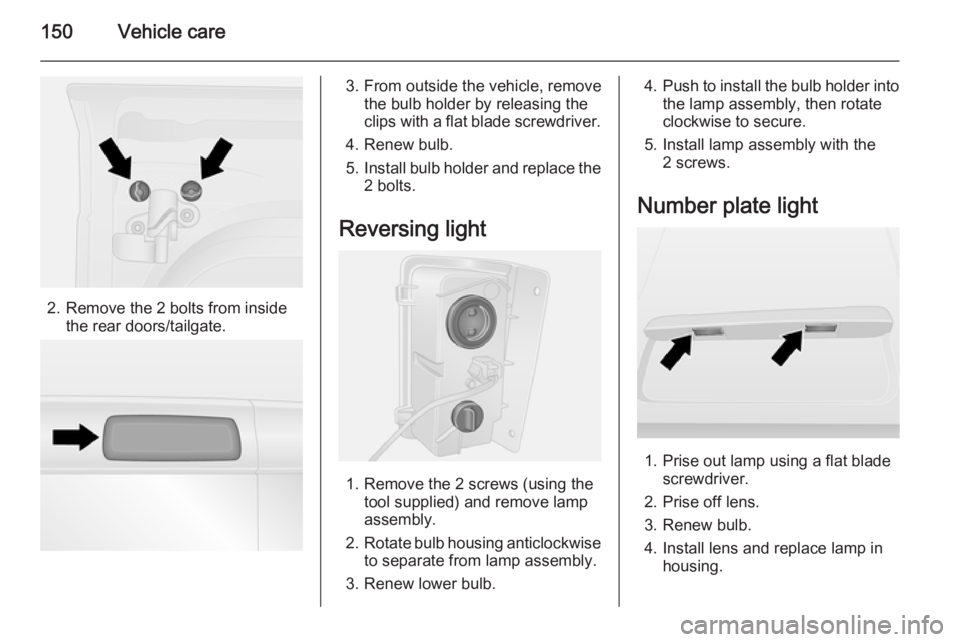
2. Remove the 2 bolts from insidethe rear doors/tailgate.
3. From outside the vehicle, removethe bulb holder by releasing the
clips with a flat blade screwdriver.
4. Renew bulb.
5. Install bulb holder and replace the
2 bolts.
Reversing light
1. Remove the 2 screws (using the tool supplied) and remove lamp
assembly.
2. Rotate bulb housing anticlockwise
to separate from lamp assembly.
3. Renew lower bulb.
4. Push to install the bulb holder into
the lamp assembly, then rotate
clockwise to secure.
5. Install lamp assembly with the 2 screws.
Number plate light
1. Prise out lamp using a flat blade screwdriver.
2. Prise off lens.
3. Renew bulb.
4. Install lens and replace lamp in housing.
Page 153 of 205
Vehicle care151Fog tail light
1. Remove the 2 screws (using thetool supplied) and remove lamp
assembly.
2. Rotate bulb housing anticlockwise
to separate from lamp assembly.
3. Renew upper bulb.
4. Push to install the bulb holder into
the lamp assembly, then rotate
clockwise to secure.
5. Install lamp assembly with the 2 screws.
Interior lights
Front and rear courtesy lights
1. Remove lens assembly using a flat blade screwdriver.
2. Renew bulb.
3. Install lens assembly.
Load compartment light
1. Remove lamp assembly using a flat blade screwdriver.
2. Remove rear cover on lamp assembly.
3. Renew bulb.
4. Install rear cover and lamp assembly.
Page 157 of 205

Vehicle care155
No.Circuit1Vehicle battery (with electronic
key system)2APC battery backup (with elec‐
tronic key system)3Heating and ventilation system4Adaptations5Adaptations6Heating and ventilation system7Additional heating and ventila‐
tion, air conditioning system8Supplementary heating and
ventilation system9Electric exterior mirrors, addi‐
tional adaptations10Heated exterior mirrors11Radio, multimedia, electric exte‐ rior mirrors, diagnostic socket12Multimedia, trailer hitchNo.Circuit13Courtesy lights, battery
discharge protection14Fuel injection system, tyre pres‐ sure monitoring system, elec‐
tronic key system15Hazard warning flashers, turn and lane-change signals16Central locking17Left-hand high beam, right-hand
low beam, tail lights, left-hand
daytime running light18Front fog lights, rear fog lights,
number plate lighting19Alarm, horn, lighting, wiper20Instrument cluster21Light switch22Rear window wiper, windscreen
washer pump, horn23APC general battery24Reversing lightsNo.Circuit25Brake switch26Fuel injection, starter27Airbag, steering column lock28Passenger power window29Power steering30Brake lights31APC battery backup (with elec‐
tronic key system)32Service display33Cigarette lighter, power outlet34Right-hand high beam, left-
hand low beam, sidelights,
right-hand daytime running light35Brake lights, ABS, immobiliser36Interior lighting, air conditioning37Starting with electronic key
system38Rear window wiper
Page 164 of 205

162Vehicle care
Tyre chains are only permitted on thefront wheels.
Always use fine mesh chains that add
no more than 15 mm to the tyre tread
and the inboard sides (including chain
lock).
For tyre size 215/60 R17, consult a
workshop.9 Warning
Damage may lead to tyre blowout.
Wheel covers on steel wheels may
come into contact with parts of the
chains. In such cases, remove the
wheel covers.
Tyre chains may only be used at
speeds up to 50 km/h and, when
travelling on roads that are free of
snow, they may only be used for brief
periods since they are subject to rapid wear on a hard road and may snap.
The use of tyre chains is not permitted on the temporary spare wheel.
Tyre repair kit
Minor damage to the tyre tread or
sidewall can be repaired with the tyre
repair kit.
Do not remove foreign bodies from
the tyres.
Tyre damage exceeding 4 mm or that
is at tyre sidewall near the rim cannot
be repaired with the tyre repair kit.9 Warning
Do not drive faster than 80 km/h.
Do not use for a lengthy period.
Steering and handling may be
affected.
If the vehicle has a flat tyre:
Apply the parking brake and engage
first gear or reverse gear.
The tyre repair kit is located under the
driver's seat. Vehicle tools 3 156.
1. Remove the compressor and sealant bottle from the tyre repairkit case.
2. Remove the electrical connection cable and air hose from the
compartments on the underside
of the compressor.
3. Screw the air hose to the connection on the sealant bottle.
4. Fit the sealant bottle into the retainer on the compressor.
Set the compressor near the tyre
in such a way that the sealant
bottle is upright.
5. Unscrew valve cap from defective
tyre.
Page 167 of 205

Vehicle care165
Replace the used sealant bottle.
Dispose of the sealant bottle as
prescribed by applicable laws.
Wheel changing
Some vehicles are equipped with a
tyre repair kit instead of a spare wheel 3 162.
Make the following preparations and
observe the following information:
■ Park the vehicle on a level, firm and
non-slippery surface. The front wheels must be in the straight-ahead position.
■ Apply the parking brake and engage first gear or reverse gear.
■ Remove the spare wheel 3 166.
■ Never change more than one wheel
at a time.
■ Use the jack only to change wheels
in case of puncture, not for a
seasonal winter or summer tyre
change.
■ If the ground on which the vehicle is standing is soft, a solid board
(max. 1 cm thick) should be placed
under the jack.■ Take heavy objects out of the vehicle before jacking up.
■ No people or animals may be in the
vehicle when it is jacked-up.
■ Never crawl under a jacked-up vehicle.
■ Do not start the engine when the vehicle is raised on the jack.
1. Remove the wheel cover (using the hook supplied). Vehicle tools
3 156.
2. Loosen each of the wheel bolts by
half a turn using the wheel
wrench. Ensure the wrench
locates securely. The wrench
should turn anticlockwise to
loosen the bolts. Invert the wrench if necessary.
3. Place lifting pad spigot of the jack
under the jacking hole located
nearest the wheel concerned.
Ensure the jack is positioned
correctly. The jack base must be
on the ground directly below the
jacking hole in a manner that
prevents it from slipping.
4. Install wrench onto the jack and raise the vehicle by turning the
wrench until the wheel is clear of
the ground.
Page 168 of 205

166Vehicle care
5. Unscrew wheel bolts completelyby turning anticlockwise and wipe
clean with a cloth.
Put wheel bolts somewhere
where the threads will not be
soiled.
6. Change the wheel. Spare wheel 3 166.
7. Screw in the wheel bolts.
8. Lower the vehicle and remove jack.
9. Tighten each of the wheel bolts in
a crosswise sequence using the
wheel wrench. Ensure the wrench
locates securely. The wrench
should turn clockwise to tighten
the bolts. Invert the wrench if
necessary.
Tightening torque is 160 Nm.
10. Replace the wheel cover, ensuring that the valve hole in thewheel cover is aligned with the
tyre valve before installing.Note
If applicable, fit anti-theft bolts
nearest the tyre valve (otherwise it
may not be possible to refit the wheel
cover).
11. Stow the replaced wheel 3 166
and the vehicle tools 3 156.
12. Have the new wheel balanced on the vehicle.
Check the tyre pressure of the
installed tyre 3 192.
Check the wheel bolt torque.
Have the defective tyre renewed or
repaired as soon as possible.
Spare wheel
Some vehicles are equipped with a
tyre repair kit instead of a spare wheel 3 162.
If mounting a spare wheel which is
different from the other wheels, this
wheel might be classified as a
temporary spare wheel and the
corresponding speed limits apply,even though no label indicates this.
Seek the assistance of a workshop to
check the applicable speed limit.Caution
The use of a spare wheel that is smaller than the other wheels or in combination with winter tyres
could affect driveability. Have the defective tyre replaced as soon as
possible.
It may be necessary to jack the
vehicle up to gain access to the spare
wheel on a fully loaded vehicle with a flat rear tyre.
Wheel changing 3 165.
Page 171 of 205

Vehicle care169
Lead connection order:1. Connect the red lead to the positive terminal (1) of the booster
battery.
2. Connect the other end of the red lead to the positive terminal (2) of
the discharged battery.
3. Connect the black lead to the negative terminal (3) of the
booster battery.
4. Connect the other end of the black
lead to a vehicle grounding point
(4), such as the engine block or an
engine mounting bolt. Connect as
far away from the discharged
vehicle battery as possible,
however at least 60 cm.
Route the leads so that they cannot
catch on rotating parts in the engine
compartment.
To start the engine: 1. Start the engine of the vehicle providing the jump start.
2. After 5 minutes, start the other engine. Start attempts should be
made for no longer than
15 seconds at an interval of
1 minute.
3. Allow both engines to idle for approx. 3 minutes with the leads
connected.
4. Switch on electrical consumers (e.g. headlights, heated rear
window) of the vehicle receiving
the jump start.
5. Reverse above sequence exactly when removing leads.Towing
Towing the vehicle The towing eye is stowed with thevehicle tools 3 156.
Release cap using a suitable tool.
Screw the towing eye clockwise into
the front towing point and tighten fully
using the wheel wrench.
Attach a tow rope - or better still a tow rod - to the towing eye, never to the
bumper or front suspension units.