2015 NISSAN TITAN turn signal
[x] Cancel search: turn signalPage 297 of 457
●When a spare tire is mounted or a wheel
is replaced, tire pressure will not be
indicated, the TPMS will not function
and the low tire pressure warning light
will flash for approximately 1 minute.
The light will remain on after 1 minute.
Contact your NISSAN dealer as soon as
possible for tire replacement and/or
system resetting.
● Replacing tires with those not originally
specified by NISSAN could affect the
proper operation of the TPMS.
● Do not inject any tire liquid or aerosol
tire sealant into the tires, as this may
cause a malfunction of the tire pressure
sensors.
CAUTION
Do not place metalized film or any metal
parts (antenna, etc.) on the windows. This
may cause poor reception of the signals
from the tire pressure sensors, and the
TPMS will not function properly.
Some devices and transmitters may temporarily
interfere with the operation of the TPMS and
cause the low tire pressure warning light to illu-
minate. Some examples are:
– Facilities or electric devices using similar radio
frequencies are near the vehicle.
– If a transmitter set to similar frequencies is being used in or near the vehicle.
– If a computer (or similar equipment) or a DC/AC converter is being used in or near the
vehicle.
FCC Notice:
For USA:
This device complies with Part 15 of the
FCC Rules. Operation is subject to the fol-
lowing two conditions: (1) This device may
not cause harmful interference, and (2) this
device must accept any interference re-
ceived, including interference that may
cause undesired operation.
NOTE:
Changes or modification not expressly ap-
proved by the party responsible for compli-
ance could void the user’s authority to op-
erate the equipment.
For Canada:
This device complies with Industry Canada
license-exempt RSS standard(s) . Opera- tion is subject to the following two condi-
tions: (1) this device may not cause harmful
interference, and (2) this device must ac-
cept any interference received, including
interference that may cause undesired op-
eration of the device.
ON-PAVEMENT AND OFF-ROAD
DRIVING PRECAUTIONS
Utility vehicles have a significantly higher
rollover rate than other types of vehicles.
They have higher ground clearance than passen-
ger cars to make them capable of performing in a
variety of on-pavement and off-road applications.
This gives them a higher center of gravity than
ordinary vehicles. An advantage of higher ground
clearance is a better view of the road, allowing
you to anticipate problems. However, they are not
designed for cornering at the same speeds as
conventional 2-wheel drive vehicles any more
than low-slung sports cars are designed to per-
form satisfactorily under off-road conditions. If at
all possible, avoid sharp turns at high speeds. As
with other vehicles of this type, failure to operate
this vehicle correctly may result in loss of control
or vehicle rollover. In a rollover crash, an unbelted
person is significantly more likely to die than a
person wearing a seat belt.
Starting and driving5-5
Page 336 of 457
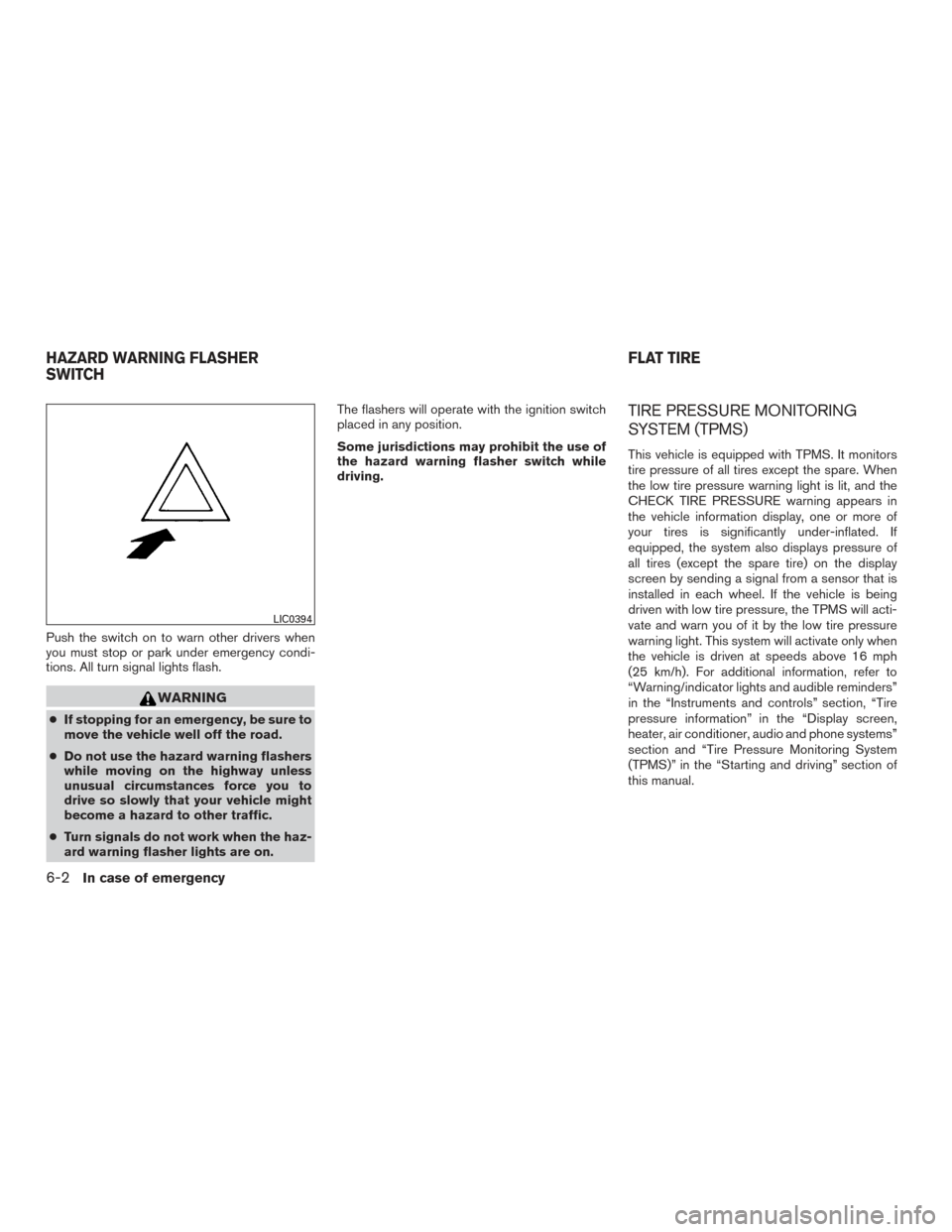
Push the switch on to warn other drivers when
you must stop or park under emergency condi-
tions. All turn signal lights flash.
WARNING
●If stopping for an emergency, be sure to
move the vehicle well off the road.
● Do not use the hazard warning flashers
while moving on the highway unless
unusual circumstances force you to
drive so slowly that your vehicle might
become a hazard to other traffic.
● Turn signals do not work when the haz-
ard warning flasher lights are on. The flashers will operate with the ignition switch
placed in any position.
Some jurisdictions may prohibit the use of
the hazard warning flasher switch while
driving.
TIRE PRESSURE MONITORING
SYSTEM (TPMS)
This vehicle is equipped with TPMS. It monitors
tire pressure of all tires except the spare. When
the low tire pressure warning light is lit, and the
CHECK TIRE PRESSURE warning appears in
the vehicle information display, one or more of
your tires is significantly under-inflated. If
equipped, the system also displays pressure of
all tires (except the spare tire) on the display
screen by sending a signal from a sensor that is
installed in each wheel. If the vehicle is being
driven with low tire pressure, the TPMS will acti-
vate and warn you of it by the low tire pressure
warning light. This system will activate only when
the vehicle is driven at speeds above 16 mph
(25 km/h). For additional information, refer to
“Warning/indicator lights and audible reminders”
in the “Instruments and controls” section, “Tire
pressure information” in the “Display screen,
heater, air conditioner, audio and phone systems”
section and “Tire Pressure Monitoring System
(TPMS)” in the “Starting and driving” section of
this manual.
LIC0394
HAZARD WARNING FLASHER
SWITCH
FLAT TIRE
6-2In case of emergency
Page 337 of 457
WARNING
●Radio waves could adversely affect
electric medical equipment. Those who
use a pacemaker should contact the
electric medical equipment manufac-
turer for the possible influences before
use.
● If the low tire pressure warning light
illuminates while driving, avoid sudden
steering maneuvers or abrupt braking,
reduce vehicle speed, pull off the road
to a safe location and stop the vehicle
as soon as possible. Driving with under-
inflated tires may permanently damage
the tires and increase the likelihood of
tire failure. Serious vehicle damage
could occur and may lead to an accident
and could result in serious personal in-
jury. Check the tire pressure for all four
tires. Adjust the tire pressure to the
recommended COLD tire pressure
shown on the Tire and Loading Informa-
tion label to turn the low tire pressure
warning light OFF. If you have a flat tire,
replace it with a spare tire as soon as
possible. ●
When a spare tire is mounted or a wheel
is replaced, tire pressure will not be
indicated, the TPMS will not function
and the low tire pressure warning light
will flash for approximately 1 minute.
The light will remain on after 1 minute.
Contact your NISSAN dealer as soon as
possible for tire replacement and/or
system resetting.
● Replacing tires with those not originally
specified by NISSAN could affect the
proper operation of the TPMS.
● Do not inject any tire liquid or aerosol
tire sealant into the tires, as this may
cause a malfunction of the tire pressure
sensors.
CHANGING A FLAT TIRE
If you have a flat tire, follow the instructions be-
low:
Stopping the vehicle
1. Safely move the vehicle off the road and
away from traffic.
2. Turn on the hazard warning flashers.
3. Park on a level surface and apply the parking brake. Move the shift lever to P (Park) . 4. Turn off the engine.
5. Raise the hood to warn other traffic and to
signal professional road assistance person-
nel that you need assistance.
6. Have all passengers get out of the vehicle and stand in a safe place, away from traffic
and clear of the vehicle.
WARNING
●Make sure the parking brake is securely
applied and the shift lever is shifted into
P (Park) .
● Never change tires when the vehicle is
on a slope, ice or slippery areas. This is
hazardous.
● Never change tires if oncoming traffic is
close to your vehicle. Wait for profes-
sional road assistance.
In case of emergency6-3
Page 359 of 457
When driving in areas using road salt or other
corrosive materials, check lubrication frequently.
Lights*Clean the headlights on a regular basis.
Make sure that the headlights, stop lights, tail
lights, turn signal lights, and other lights are all
operating properly and installed securely. Also
check headlight aim.
Road wheel nuts (lug nuts)* When checking
the tires, make sure no wheel nuts are missing,
and check for any loose wheel nuts. Tighten if
necessary.
Tire rotation* Tires should be rotated every
5,000 miles (8,000 km).
Tires* Check the pressure with a gauge often
and always prior to long distance trips. If neces-
sary, adjust the pressure in all tires, including the
spare, to the pressure specified. Check carefully
for damage, cuts or excessive wear.
Tire Pressure Monitoring System (TPMS)
transmitter components Replace the TPMS
transmitter grommet seal, valve core and cap
when the tires are replaced due to wear or age.
Wheel alignment and balance If the vehicle
should pull to either side while driving on a
straight and level road, or if you detect uneven or
abnormal tire wear, there may be a need for wheel alignment. If the steering wheel or seat vibrates at
normal highway speeds, wheel balancing may be
needed.
● For additional information regarding tires,
refer to “Important Tire Safety Information”
(US) or “Tire Safety Information” (Canada) in
the Warranty Information Booklet.
Windshield Clean the windshield on a regular
basis. Check the windshield at least every six
months for cracks or other damage. Have a dam-
aged windshield repaired by a qualified repair
facility.
Windshield wiper blades* Check for cracks or
wear if they do not wipe properly.
Inside the vehicle
The maintenance items listed here should be
checked on a regular basis, such as when per-
forming periodic maintenance, cleaning the ve-
hicle, etc.
Additional information on the following
items with an “*” is found in this section.
Accelerator pedal Check the pedal for smooth
operation and make sure the pedal does not bind
or require uneven effort. Keep the floor mat away
from the pedal.
Automatic transmission P (Park) position
mechanism On a fairly steep hill check that your vehicle is held securely with the shift lever in the P
(Park) position without applying any brakes.
Brake pedal
Check the pedal for smooth opera-
tion. If the brake pedal suddenly goes down fur-
ther than normal, the pedal feels spongy or the
vehicle seems to take longer to stop, see a
NISSAN dealer immediately. Keep the floor mat
away from the pedal.
Brakes Check that the brakes do not pull the
vehicle to one side when applied.
Parking brake Check the parking brake opera-
tion regularly. The vehicle should be securely held
on a fairly steep hill with only the parking brake
applied. If the parking brake needs adjustment,
see a NISSAN dealer.
Seats Check seat position controls such as seat
adjusters, seatback recliner, etc. to ensure they
operate smoothly and all latches lock securely in
every position. Check that the head
restraints/headrests move up and down
smoothly and the locks (if so equipped) hold
securely in all latched positions.
Seat belts Check that all parts of the seat belt
system (for example, buckles, anchors, adjusters
and retractors) operate properly and smoothly,
and are installed securely. Check the belt web-
bing for cuts, fraying, wear or damage.
Maintenance and do-it-yourself8-3
Page 435 of 457
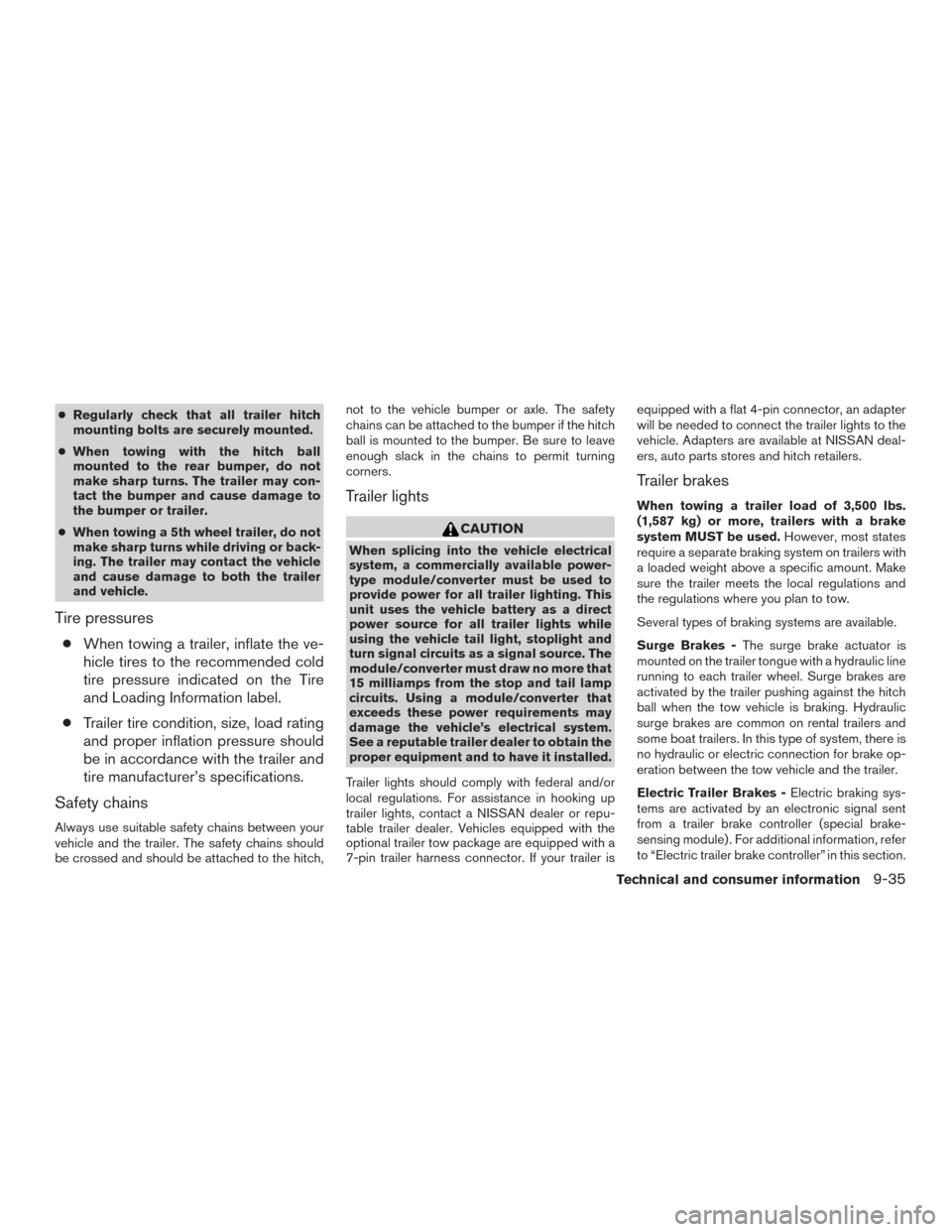
●Regularly check that all trailer hitch
mounting bolts are securely mounted.
● When towing with the hitch ball
mounted to the rear bumper, do not
make sharp turns. The trailer may con-
tact the bumper and cause damage to
the bumper or trailer.
● When towing a 5th wheel trailer, do not
make sharp turns while driving or back-
ing. The trailer may contact the vehicle
and cause damage to both the trailer
and vehicle.
Tire pressures
● When towing a trailer, inflate the ve-
hicle tires to the recommended cold
tire pressure indicated on the Tire
and Loading Information label.
● Trailer tire condition, size, load rating
and proper inflation pressure should
be in accordance with the trailer and
tire manufacturer’s specifications.
Safety chains
Always use suitable safety chains between your
vehicle and the trailer. The safety chains should
be crossed and should be attached to the hitch, not to the vehicle bumper or axle. The safety
chains can be attached to the bumper if the hitch
ball is mounted to the bumper. Be sure to leave
enough slack in the chains to permit turning
corners.
Trailer lights
CAUTION
When splicing into the vehicle electrical
system, a commercially available power-
type module/converter must be used to
provide power for all trailer lighting. This
unit uses the vehicle battery as a direct
power source for all trailer lights while
using the vehicle tail light, stoplight and
turn signal circuits as a signal source. The
module/converter must draw no more that
15 milliamps from the stop and tail lamp
circuits. Using a module/converter that
exceeds these power requirements may
damage the vehicle’s electrical system.
See a reputable trailer dealer to obtain the
proper equipment and to have it installed.
Trailer lights should comply with federal and/or
local regulations. For assistance in hooking up
trailer lights, contact a NISSAN dealer or repu-
table trailer dealer. Vehicles equipped with the
optional trailer tow package are equipped with a
7-pin trailer harness connector. If your trailer is equipped with a flat 4-pin connector, an adapter
will be needed to connect the trailer lights to the
vehicle. Adapters are available at NISSAN deal-
ers, auto parts stores and hitch retailers.
Trailer brakes
When towing a trailer load of 3,500 lbs.
(1,587 kg) or more, trailers with a brake
system MUST be used.
However, most states
require a separate braking system on trailers with
a loaded weight above a specific amount. Make
sure the trailer meets the local regulations and
the regulations where you plan to tow.
Several types of braking systems are available.
Surge Brakes - The surge brake actuator is
mounted on the trailer tongue with a hydraulic line
running to each trailer wheel. Surge brakes are
activated by the trailer pushing against the hitch
ball when the tow vehicle is braking. Hydraulic
surge brakes are common on rental trailers and
some boat trailers. In this type of system, there is
no hydraulic or electric connection for brake op-
eration between the tow vehicle and the trailer.
Electric Trailer Brakes - Electric braking sys-
tems are activated by an electronic signal sent
from a trailer brake controller (special brake-
sensing module) . For additional information, refer
to “Electric trailer brake controller” in this section.
Technical and consumer information9-35
Page 449 of 457
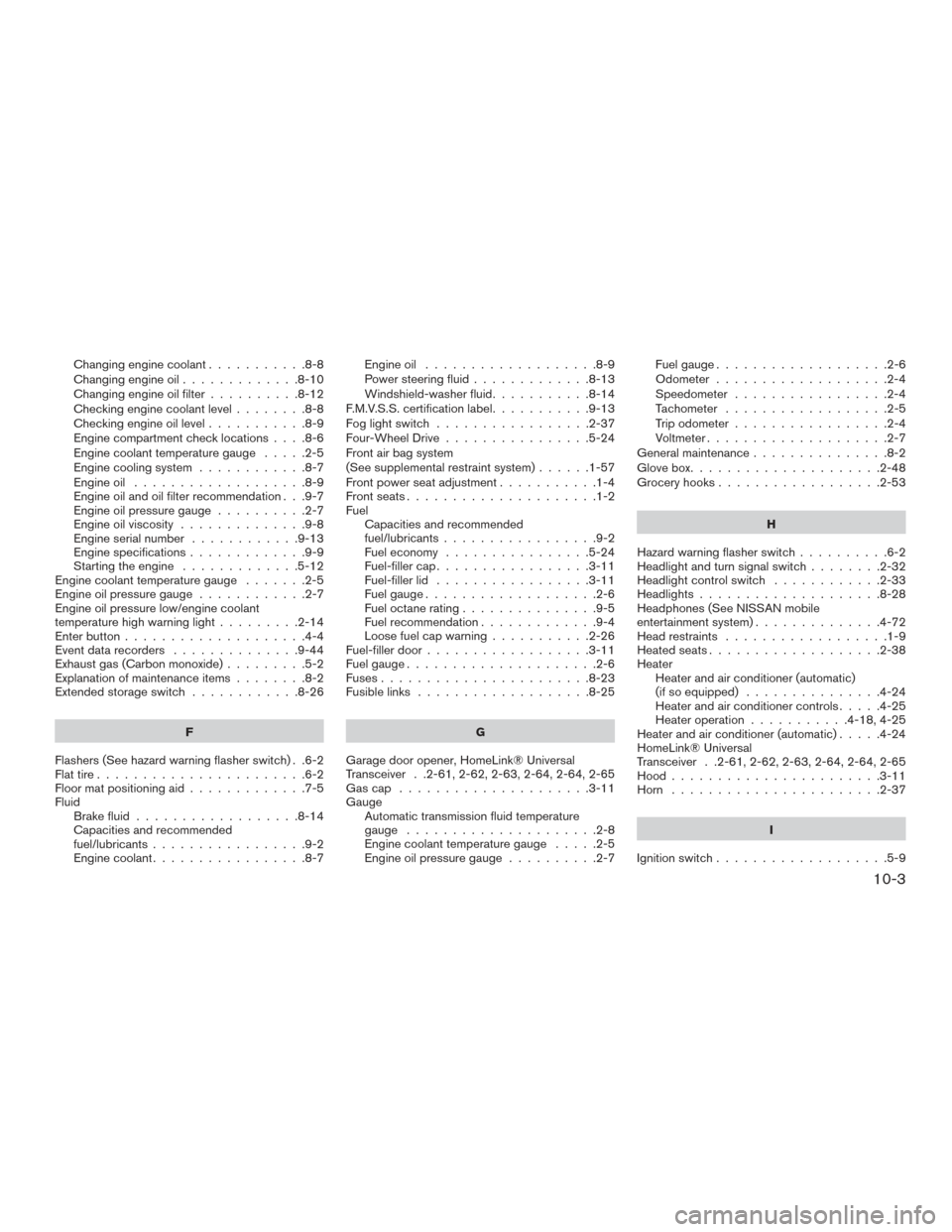
Changing engine coolant...........8-8
Changing engine oil .............8-10
Changing engine oil filter ..........8-12
Checking engine coolant level ........8-8
Checking engine oil level ...........8-9
Engine compartment check locations ....8-6
Engine coolant temperature gauge .....2-5
Engine cooling system ............8-7
Engine oil ...................8-9
Engine oil and oil filter recommendation . . .9-7
Engine oil pressure gauge ..........2-7
Engine oil viscosity ..............9-8
Engine serial number ............9-13
Engine specifications .............9-9
Starting the engine .............5-12
Engine coolant temperature gauge .......2-5
Engineoilpressuregauge............2-7
Engine oil pressure low/engine coolant
temperature high warning light .........2-14
Enterbutton....................4-4
Event data recorders ..............9-44
Exhaust gas (Carbon monoxide) .........5-2
Explanation of maintenance items ........8-2
Extendedstorageswitch ............8-26
F
Flashers (See hazard warning flasher switch) . .6-2
Flat tire .......................6-2
Floor mat positioning aid .............7-5
Fluid Brake fluid ..................8-14
Capacities and recommended
fuel/lubricants .................9-2
Engine coolant .................8-7 Engine oil
...................8-9
Power steering fluid .............8-13
Windshield-washer fluid ...........8-14
F.M.V.S.S. certification label ...........9-13
Foglightswitch .................2-37
Four-Wheel Drive ................5-24
Front air bag system
(See supplemental restraint system) ......1-57
Front power seat adjustment ...........1-4
Frontseats.....................1-2
Fuel Capacities and recommended
fuel/lubricants .................9-2
Fuel economy ................5-24
Fuel-filler cap .................3-11
Fuel-filler lid .................3-11
Fuel gauge ...................2-6
Fuel octane rating ...............9-5
Fuel recommendation .............9-4
Loose fuel cap warning ...........2-26
Fuel-filler door ..................3-11
Fuelgauge.....................2-6
Fuses.......................8-23
Fusiblelinks ...................8-25
G
Garage door opener, HomeLink® Universal
Transceiver . .2-61, 2-62, 2-63, 2-64, 2-64, 2-65
Gascap .....................3-11
Gauge Automatic transmission fluid temperature
gauge .....................2-8
Engine coolant temperature gauge .....2-5
Engine oil pressure gauge ..........2-7 Fuelgauge...................2-6
Odometer
...................2-4
Speedometer .................2-4
Tachometer ..................2-5
Trip odometer .................2-4
Voltmeter ....................2-7
General
maintenance ...............8-2
Glovebox.....................2-48
Groceryhooks..................2-53
H
Hazard warning flasher switch ..........6-2
Headlightandturnsignalswitch........2-32
Headlightcontrolswitch ............2-33
Headlights....................8-28
Headphones (See NISSAN mobile
entertainment system) ..............4-72
Head restraints ..................1-9
Heated seats ...................2-38
Heater Heater and air conditioner (automatic)
(if so equipped) ...............4-24
Heater and air conditioner controls .....4-25
Heater operation ...........4-18,4-25
Heater and air conditioner (automatic) .....4-24
HomeLink® Universal
Transceiver . .2-61, 2-62, 2-63, 2-64, 2-64, 2-65
Hood.......................3-11
Horn .......................2-37
I
Ignition switch ...................5-9
10-3
Page 450 of 457
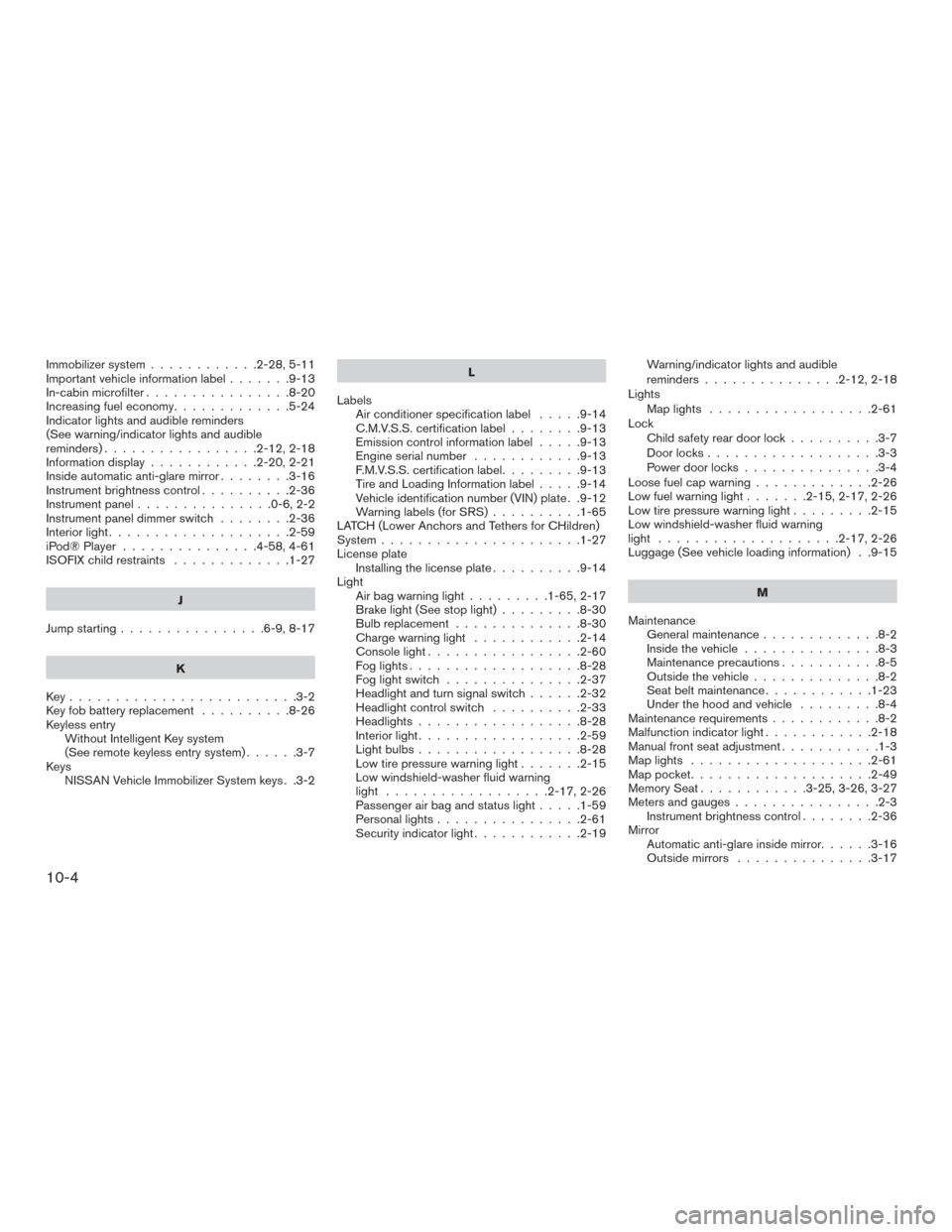
Immobilizer system............2-28,5-11
Important vehicle information label .......9-13
In-cabin microfilter ................8-20
Increasing fuel economy .............5-24
Indicator lights and audible reminders
(See warning/indicator lights and audible
reminders).................2-12,2-18
Informationdisplay............2-20,2-21
Inside automatic anti-glare mirror ........3-16
Instrument brightness control ..........2-36
Instrument panel ...............0-6,2-2
Instrument panel dimmer switch ........2-36
Interiorlight....................2-59
iPod®Player ...............4-58,4-61
ISOFIX child restraints .............1-27
J
Jump starting ................6-9,8-17
K
Key.........................3-2
Key fob battery replacement ..........8-26
Keyless entry Without Intelligent Key system
(See remote keyless entry system) ......3-7
Keys NISSAN Vehicle Immobilizer System keys . .3-2 L
Labels Air conditioner specification label .....9-14
C.M.V.S.S. certification label ........9-13
Emission control information label .....9-13
Engine serial number ............9-13
F.M.V.S.S. certification label .........9-13
Tire and Loading Information label .....9-14
Vehicle identification number (VIN) plate . .9-12
Warning labels (for SRS) ..........1-65
LATCH (Lower Anchors and Tethers for CHildren)
System ......................1-27
License plate Installing the license plate ..........9-14
Light Air bag warning light .........1-65,2-17
Brake light (See stop light) .........8-30
Bulbreplacement..............8-30
Charge warning light ............2-14
Consolelight.................2-60
Foglights...................8-28
Foglightswitch ...............2-37
Headlight and turn signal switch ......2-32
Headlight control switch ..........2-33
Headlights..................8-28
Interiorlight..................2-59
Lightbulbs..................8-28
Low tire pressure warning light .......2-15
Low windshield-washer fluid warning
light ..................2-17,2-26
Passenger air bag and status light .....1-59
Personal lights ................2-61
Security indicator light ............2-19 Warning/indicator lights and audible
reminders
...............2-12,2-18
Lights Maplights ..................2-61
Lock Child safety rear door lock ..........3-7
Door locks ...................3-3
Power door locks ...............3-4
Loose fuel cap warning .............2-26
Low fuel warning light .......2-15,2-17,2-26
Low tire pressure warning light .........2-15
Low windshield-washer fluid warning
light ....................2-17,2-26
Luggage (See vehicle loading information) . .9-15
M
Maintenance General maintenance .............8-2
Insidethevehicle...............8-3
Maintenance precautions ...........8-5
Outside the vehicle ..............8-2
Seat belt maintenance ............1-23
Under the hood and vehicle .........8-4
Maintenance
requirements ............8-2
Malfunction indicator light ............2-18
Manual front seat adjustment ...........1-3
Maplights ....................2-61
Mappocket....................2-49
Memory Seat ............3-25,3-26,3-27
Meters and gauges ................2-3
Instrument brightness control ........2-36
Mirror Automatic anti-glare inside mirror ......3-16
Outside mirrors ...............3-17
10-4
Page 452 of 457
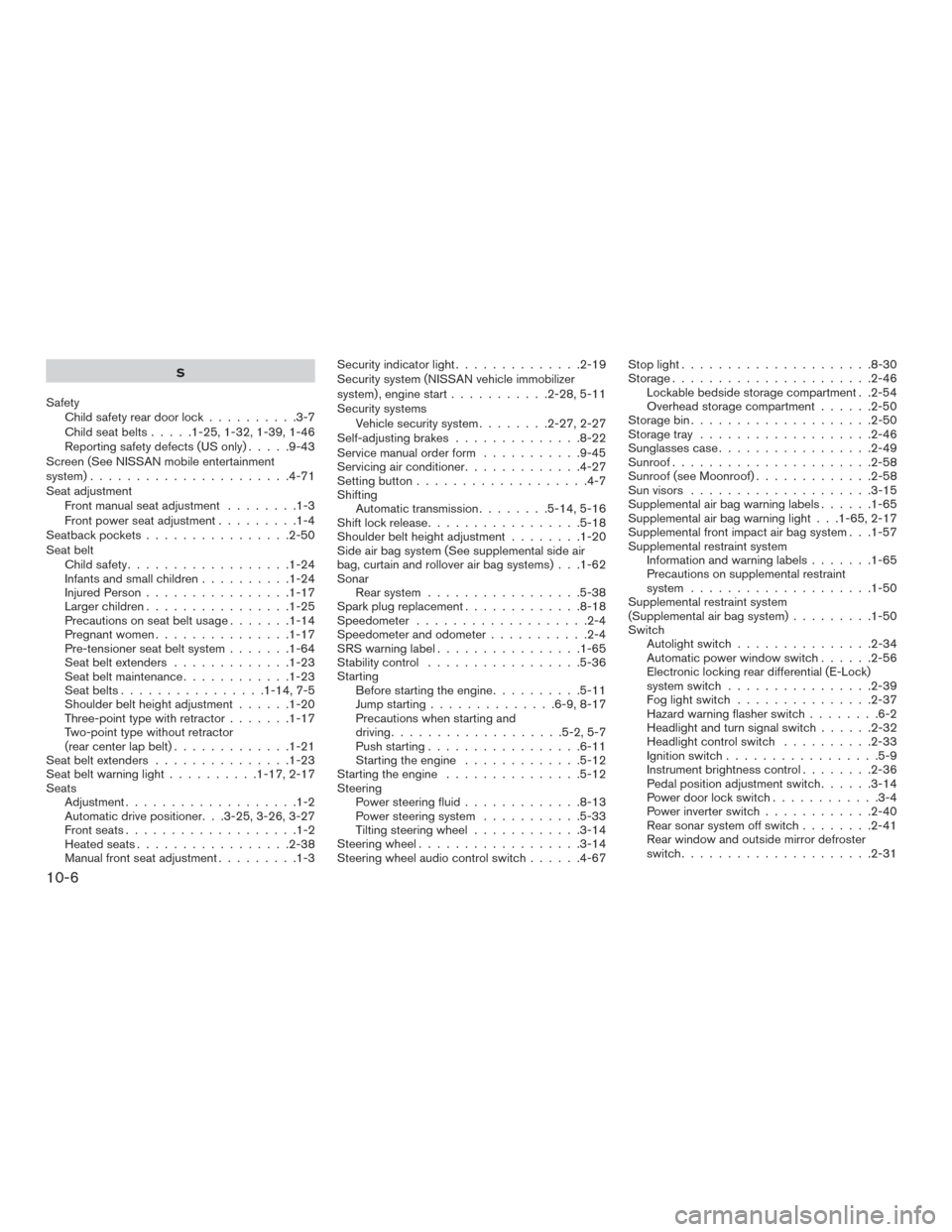
S
Safety Child safety rear door lock ..........3-7
Childseatbelts.....1-25,1-32,1-39,1-46
Reporting safety defects (US only) .....9-43
Screen (See NISSAN mobile entertainment
system)......................4-71
Seat adjustment Front manual seat adjustment ........1-3
Front power seat adjustment .........1-4
Seatback pockets ................2-50
Seat belt Childsafety..................1-24
Infantsandsmallchildren..........1-24
Injured Person ................1-17
Largerchildren................1-25
Precautionsonseatbeltusage.......1-14
Pregnant women ...............1-17
Pre-tensioner seat belt system .......1-64
Seat belt extenders .............1-23
Seat belt maintenance ............1-23
Seat belts ................1-14,7-5
Shoulder belt height adjustment ......1-20
Three-point type with retractor .......1-17
Two-point type without retractor
(rear center lap belt) .............1-21
Seat belt extenders ...............1-23
Seatbeltwarninglight..........1-17,2-17
Seats Adjustment ...................1-2
Automatic drive positioner. . .3-25, 3-26, 3-27
Frontseats...................1-2
Heatedseats.................2-38
Manual front seat adjustment .........1-3Security indicator light
..............2-19
Security system (NISSAN vehicle immobilizer
system) , engine start ...........2-28,5-11
Security systems Vehicle security system ........2-27,2-27
Self-adjusting brakes ..............8-22
Service manual order form ...........9-45
Servicing air conditioner .............4-27
Setting button ...................4-7
Shifting Automatic transmission ........5-14,5-16
Shiftlockrelease.................5-18
Shoulder belt height adjustment ........1-20
Side air bag system (See supplemental side air
bag, curtain and rollover air bag systems) . . .1-62
Sonar Rear system .................5-38
Sparkplugreplacement.............8-18
Speedometer ...................2-4
Speedometer and odometer ...........2-4
SRSwarninglabel................1-65
Stability control .................5-36
Starting Before starting the engine ..........5-11
Jump starting ..............6-9,8-17
Precautions when starting and
driving ...................5-2,5-7
Push starting .................6-11
Starting the engine .............5-12
Starting the engine ...............5-12
Steering Power steering fluid .............8-13
Power steering system ...........5-33
Tilting steering wheel ............3-14
Steeringwheel..................3-14
Steering wheel audio control switch ......4-67Stoplight.....................8-30
Storage......................2-46
Lockable bedside storage compartment . .2-54
Overhead storage compartment ......2-50
Storagebin....................2-50
Storage tray ...................2-46
Sunglasses case .................2-49
Sunroof......................2-58
Sunroof(seeMoonroof).............2-58
Sun visors ....................
3-15
Supplemental air bag warning labels ......1-65
Supplemental air bag warning light . . .1-65, 2-17
Supplemental front impact air bag system . . .1-57
Supplemental restraint system Information and warning labels .......1-65
Precautions on supplemental restraint
system ....................1-50
Supplemental restraint system
(Supplemental air bag system) .........1-50
Switch Autolightswitch...............2-34
Automatic power window switch ......2-56
Electronic locking rear differential (E-Lock)
system switch ................2-39
Fog light switch ...............2-37
Hazard warning flasher switch ........6-2
Headlightandturnsignalswitch......2-32
Headlight control switch ..........2-33
Ignition switch .................5-9
Instrument brightness control ........2-36
Pedal position adjustment switch ......3-14
Power door lock switch ............3-4
Power inverter switch ............2-40
Rear sonar system off switch ........2-41
Rear window and outside mirror defroster
switch .....................2-31
10-6