2015 NISSAN TITAN TPMS
[x] Cancel search: TPMSPage 335 of 457
6 In case of emergency
Hazard warning flasher switch......................6-2
Flat tire ...........................................6-2
Tire Pressure Monitoring System (TPMS) ..........6-2
Changing a flat tire .............................6-3
Jump starting .....................................6-9 Push starting
..................................... 6-11
If your vehicle overheats ........................... 6-11
Towing your vehicle ............................... 6-12
Towing recommended by NISSAN ..............6-12
Vehicle recovery (freeing a stuck vehicle) .........6-14
Page 336 of 457
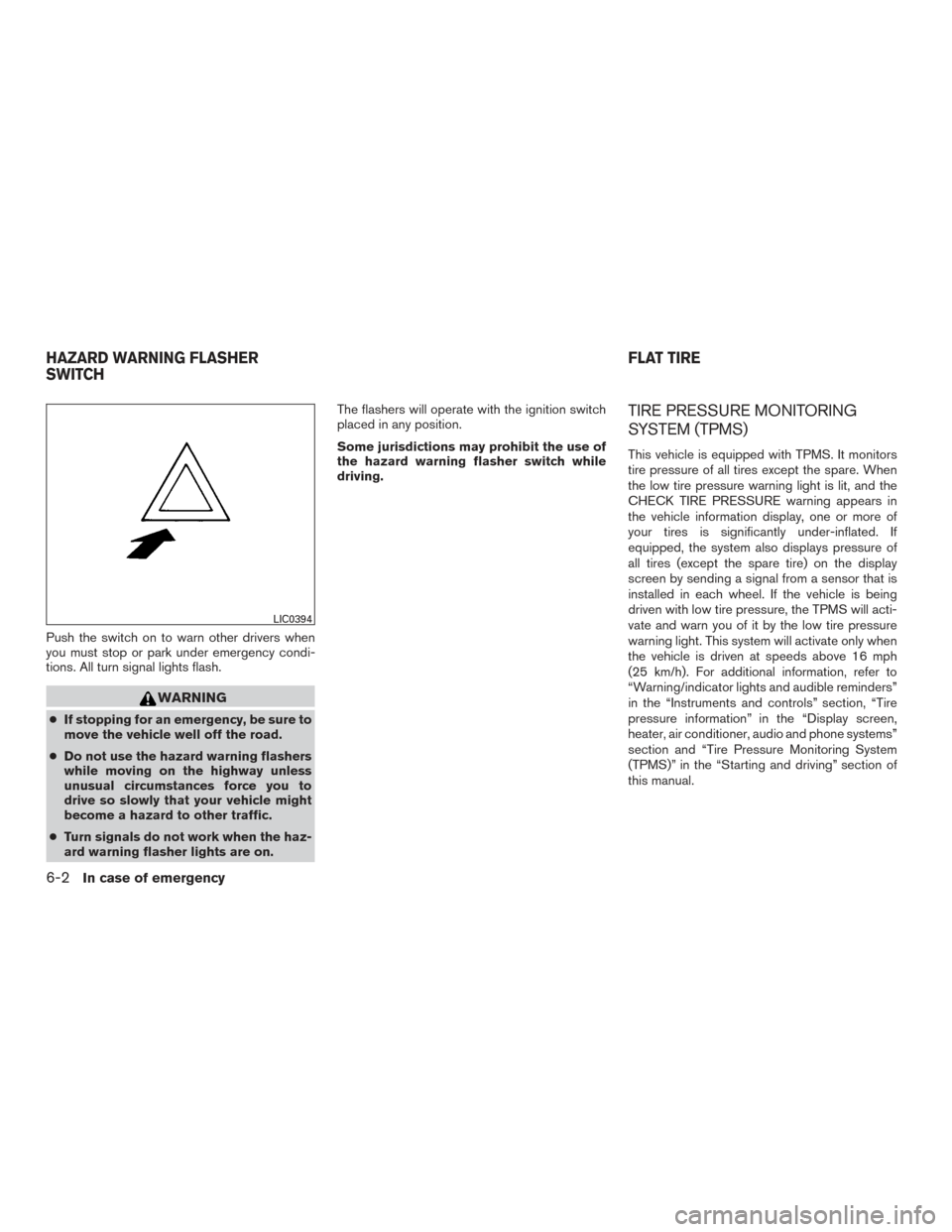
Push the switch on to warn other drivers when
you must stop or park under emergency condi-
tions. All turn signal lights flash.
WARNING
●If stopping for an emergency, be sure to
move the vehicle well off the road.
● Do not use the hazard warning flashers
while moving on the highway unless
unusual circumstances force you to
drive so slowly that your vehicle might
become a hazard to other traffic.
● Turn signals do not work when the haz-
ard warning flasher lights are on. The flashers will operate with the ignition switch
placed in any position.
Some jurisdictions may prohibit the use of
the hazard warning flasher switch while
driving.
TIRE PRESSURE MONITORING
SYSTEM (TPMS)
This vehicle is equipped with TPMS. It monitors
tire pressure of all tires except the spare. When
the low tire pressure warning light is lit, and the
CHECK TIRE PRESSURE warning appears in
the vehicle information display, one or more of
your tires is significantly under-inflated. If
equipped, the system also displays pressure of
all tires (except the spare tire) on the display
screen by sending a signal from a sensor that is
installed in each wheel. If the vehicle is being
driven with low tire pressure, the TPMS will acti-
vate and warn you of it by the low tire pressure
warning light. This system will activate only when
the vehicle is driven at speeds above 16 mph
(25 km/h). For additional information, refer to
“Warning/indicator lights and audible reminders”
in the “Instruments and controls” section, “Tire
pressure information” in the “Display screen,
heater, air conditioner, audio and phone systems”
section and “Tire Pressure Monitoring System
(TPMS)” in the “Starting and driving” section of
this manual.
LIC0394
HAZARD WARNING FLASHER
SWITCH
FLAT TIRE
6-2In case of emergency
Page 337 of 457
WARNING
●Radio waves could adversely affect
electric medical equipment. Those who
use a pacemaker should contact the
electric medical equipment manufac-
turer for the possible influences before
use.
● If the low tire pressure warning light
illuminates while driving, avoid sudden
steering maneuvers or abrupt braking,
reduce vehicle speed, pull off the road
to a safe location and stop the vehicle
as soon as possible. Driving with under-
inflated tires may permanently damage
the tires and increase the likelihood of
tire failure. Serious vehicle damage
could occur and may lead to an accident
and could result in serious personal in-
jury. Check the tire pressure for all four
tires. Adjust the tire pressure to the
recommended COLD tire pressure
shown on the Tire and Loading Informa-
tion label to turn the low tire pressure
warning light OFF. If you have a flat tire,
replace it with a spare tire as soon as
possible. ●
When a spare tire is mounted or a wheel
is replaced, tire pressure will not be
indicated, the TPMS will not function
and the low tire pressure warning light
will flash for approximately 1 minute.
The light will remain on after 1 minute.
Contact your NISSAN dealer as soon as
possible for tire replacement and/or
system resetting.
● Replacing tires with those not originally
specified by NISSAN could affect the
proper operation of the TPMS.
● Do not inject any tire liquid or aerosol
tire sealant into the tires, as this may
cause a malfunction of the tire pressure
sensors.
CHANGING A FLAT TIRE
If you have a flat tire, follow the instructions be-
low:
Stopping the vehicle
1. Safely move the vehicle off the road and
away from traffic.
2. Turn on the hazard warning flashers.
3. Park on a level surface and apply the parking brake. Move the shift lever to P (Park) . 4. Turn off the engine.
5. Raise the hood to warn other traffic and to
signal professional road assistance person-
nel that you need assistance.
6. Have all passengers get out of the vehicle and stand in a safe place, away from traffic
and clear of the vehicle.
WARNING
●Make sure the parking brake is securely
applied and the shift lever is shifted into
P (Park) .
● Never change tires when the vehicle is
on a slope, ice or slippery areas. This is
hazardous.
● Never change tires if oncoming traffic is
close to your vehicle. Wait for profes-
sional road assistance.
In case of emergency6-3
Page 359 of 457
When driving in areas using road salt or other
corrosive materials, check lubrication frequently.
Lights*Clean the headlights on a regular basis.
Make sure that the headlights, stop lights, tail
lights, turn signal lights, and other lights are all
operating properly and installed securely. Also
check headlight aim.
Road wheel nuts (lug nuts)* When checking
the tires, make sure no wheel nuts are missing,
and check for any loose wheel nuts. Tighten if
necessary.
Tire rotation* Tires should be rotated every
5,000 miles (8,000 km).
Tires* Check the pressure with a gauge often
and always prior to long distance trips. If neces-
sary, adjust the pressure in all tires, including the
spare, to the pressure specified. Check carefully
for damage, cuts or excessive wear.
Tire Pressure Monitoring System (TPMS)
transmitter components Replace the TPMS
transmitter grommet seal, valve core and cap
when the tires are replaced due to wear or age.
Wheel alignment and balance If the vehicle
should pull to either side while driving on a
straight and level road, or if you detect uneven or
abnormal tire wear, there may be a need for wheel alignment. If the steering wheel or seat vibrates at
normal highway speeds, wheel balancing may be
needed.
● For additional information regarding tires,
refer to “Important Tire Safety Information”
(US) or “Tire Safety Information” (Canada) in
the Warranty Information Booklet.
Windshield Clean the windshield on a regular
basis. Check the windshield at least every six
months for cracks or other damage. Have a dam-
aged windshield repaired by a qualified repair
facility.
Windshield wiper blades* Check for cracks or
wear if they do not wipe properly.
Inside the vehicle
The maintenance items listed here should be
checked on a regular basis, such as when per-
forming periodic maintenance, cleaning the ve-
hicle, etc.
Additional information on the following
items with an “*” is found in this section.
Accelerator pedal Check the pedal for smooth
operation and make sure the pedal does not bind
or require uneven effort. Keep the floor mat away
from the pedal.
Automatic transmission P (Park) position
mechanism On a fairly steep hill check that your vehicle is held securely with the shift lever in the P
(Park) position without applying any brakes.
Brake pedal
Check the pedal for smooth opera-
tion. If the brake pedal suddenly goes down fur-
ther than normal, the pedal feels spongy or the
vehicle seems to take longer to stop, see a
NISSAN dealer immediately. Keep the floor mat
away from the pedal.
Brakes Check that the brakes do not pull the
vehicle to one side when applied.
Parking brake Check the parking brake opera-
tion regularly. The vehicle should be securely held
on a fairly steep hill with only the parking brake
applied. If the parking brake needs adjustment,
see a NISSAN dealer.
Seats Check seat position controls such as seat
adjusters, seatback recliner, etc. to ensure they
operate smoothly and all latches lock securely in
every position. Check that the head
restraints/headrests move up and down
smoothly and the locks (if so equipped) hold
securely in all latched positions.
Seat belts Check that all parts of the seat belt
system (for example, buckles, anchors, adjusters
and retractors) operate properly and smoothly,
and are installed securely. Check the belt web-
bing for cuts, fraying, wear or damage.
Maintenance and do-it-yourself8-3
Page 390 of 457
If you have a flat tire, refer to “Flat tire” in
the “In case of emergency” section of this
manual for additional information.
TIRE PRESSURE
Tire Pressure Monitoring System
(TPMS)
This vehicle is equipped with the Tire
Pressure Monitoring System (TPMS) . It
monitors tire pressure of all four tires ex-
cept the spare. When the low tire pres-
sure warning light is lit and the CHECK
TIRE PRESSURE warning appears in the
vehicle information display, one or more of
your tires is significantly under-inflated. If
equipped, the system also displays pres-
sure of all tires (except the spare tire) on
the display screen by sending a signal
from a sensor that is installed in each
wheel.
The TPMS will activate only when the
vehicle is driven at speeds above 16 MPH
(25 km/h). Also, this system may not de-
tect a sudden drop in tire pressure (for
example a flat tire while driving) .For additional information, refer to
“Warning/Indicator Lights and Audible
Reminders” in the “Instruments and con-
trols” section, “Tire Pressure Monitoring
System (TPMS)” in the “Starting and driv-
ing” section, and “Flat tire” in the “In case
of emergency” section.Tire inflation pressure
Check the tire pressures (including the
spare) often and always prior to long dis-
tance trips. The recommended tire pres-
sure specifications are shown on the
F.M.V.S.S./C.M.V.S.S. certification label
or the Tire and Loading Information label
under the “Cold Tire Pressure” heading.
The Tire and Loading Information label is
affixed to the driver side center pillar. Tire
pressures should be checked regularly
because:
● Most tires naturally lose air over time.
● Tires can lose air suddenly when
driven over potholes or other objects
or if the vehicle strikes a curb while
parking.
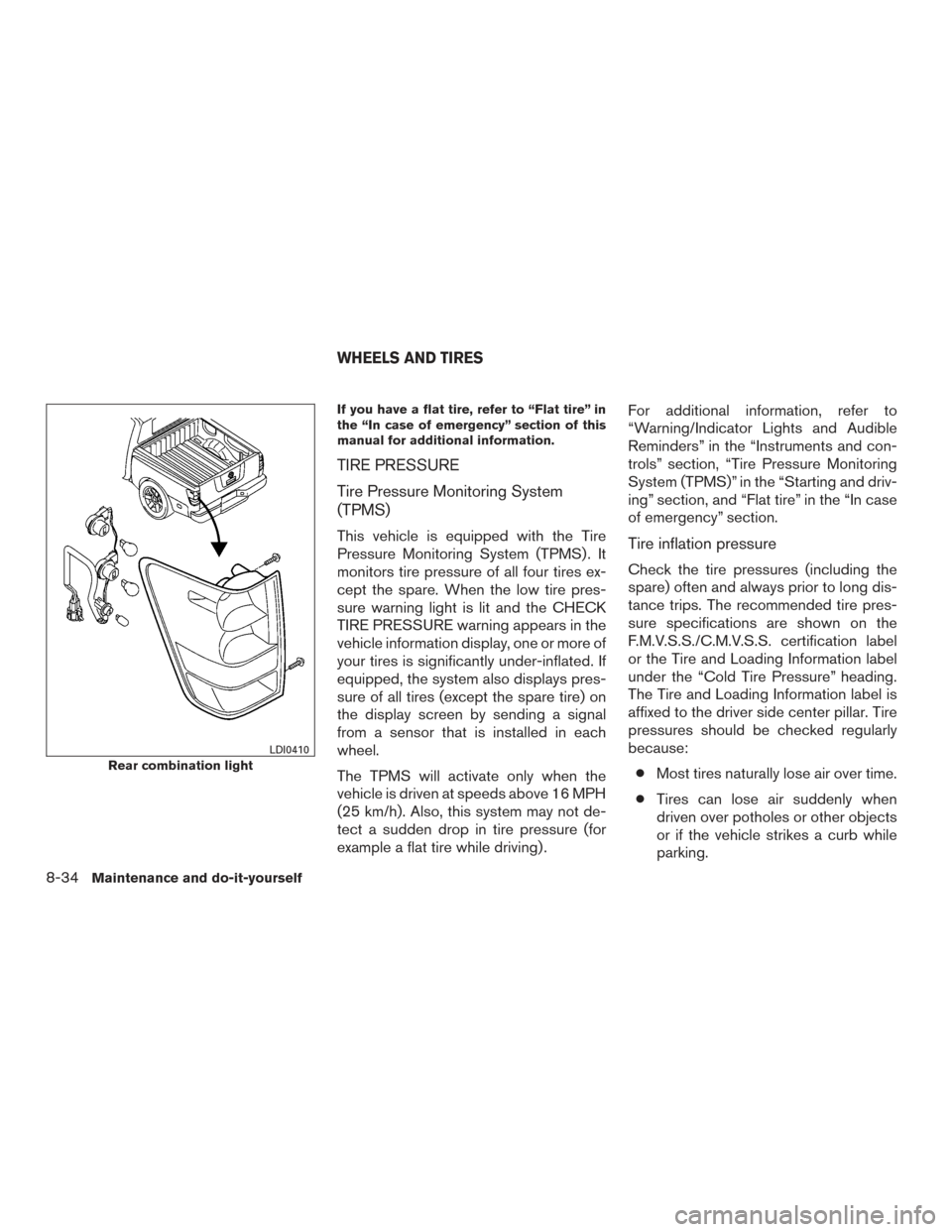
Rear combination light
LDI0410
WHEELS AND TIRES
8-34Maintenance and do-it-yourself
Page 399 of 457
Replacing wheels and tires
When replacing a tire, use the same size, tread
design, speed rating and load carrying capacity
as originally equipped. Recommended types and
sizes are shown in “Wheels and tires” in the
“Technical and consumer information” section of
this manual.
WARNING
●The use of tires other than those recom-
mended or the mixed use of tires of
different brands, construction (bias,
bias-belted or radial) , or tread patterns
can adversely affect the ride, braking,
handling, VDC system, ground clear-
ance, body-to-tire clearance, tire chain
clearance, speedometer calibration,
headlight aim and bumper height.
Some of these effects may lead to acci-
dents and could result in serious per-
sonal injury.
● If your vehicle was originally equipped
with 4 tires that were the same size and
you are only replacing 2 of the 4 tires,
install the new tires on the rear axle.
Placing new tires on the front axle may
cause loss of vehicle control in some
driving conditions and cause an acci-
dent and personal injury. ●
If the wheels are changed for any rea-
son, always replace with wheels which
have the same off-set dimension.
Wheels of a different off-set could
cause premature tire wear, degrade ve-
hicle handling characteristics, affect the
VDC system and/or interference with
the brake discs. Such interference can
lead to decreased braking efficiency
and/or early brake pad wear. Refer to
“Wheels and tires” in the “Technical and
consumer information” section of this
manual for wheel off-set dimensions.
● When a spare tire is mounted or a wheel
is replaced, tire pressure will not be
indicated, the TPMS will not function
and the low tire pressure warning light
will flash for approximately 1 minute.
The light will remain on after 1 minute.
Contact your NISSAN dealer as soon as
possible for tire replacement and/or
system resetting.
● Replacing tires with those not originally
specified by NISSAN could affect the
proper operation of the TPMS. ●
Do not install a damaged or deformed
wheel or tire even if it has been re-
paired. Such wheels or tires could have
structural damage and could fail with-
out warning.
● The use of retread tires is not
recommended.
● For additional information regarding
tires, refer to “Important Tire Safety In-
formation” (US) or “Tire Safety Informa-
tion” (Canada) in the Warranty Informa-
tion Booklet.
Four-wheel drive models
CAUTION
Always use tires of the same type, size,
brand, construction (bias, bias-belted or
radial) , and tread pattern on all four
wheels. Failure to do so may result in a
circumference difference between tires on
the front and rear axles which will cause
excessive tire wear and may damage the
transmission, transfer case and differen-
tial gears.
Maintenance and do-it-yourself8-43
Page 453 of 457
Steering wheel switch for audio
control/Bluetooth® Hands-Free Phone
System....................4-67
Tow mode switch ..............2-42
Turnsignalswitch..............2-36
Vehicle dynamic control (VDC) off
switch.....................2-39
Windshield wiper and washer switch . . .2-30
T
Tachometer ....................2-5
Tailgate latch ...................3-21
Temperature gauge Engine coolant temperature gauge .....2-5
Engine oil pressure low/engine coolant
temperature high warning light .......2-14
Theft (NISSAN vehicle immobilizer system) ,
engine start ................2-28,5-11
Three-way catalyst ................5-2
Tie down hooks .................3-25
Tilting steering wheel ..............3-14
Tire Flat tire .....................6-2
Spare tire ...................6-4
TireandLoadingInformationlabel.....9-14
Tire chains ..................8-41
Tireplacard..................9-14
Tirepressure.................8-34
Tire rotation..................8-41
Tires of 4-wheel drive ............8-43
Types of tires .................8-40
Uniform tire quality grading .........9-41
Wheels and tires ...............8-34
Wheel/tire size ................9-10 Tire pressure
Low tire pressure warning light .......2-15
Tire Pressure Monitoring System (TPMS) ....5-3
Towing 2-wheel drive models ............6-13
4-wheel drive models ............6-13
Flattowing..................9-41
Towing load/specification ..........9-29
Trailer towing .................9-25
Towing a trailer ..................9-25
Towingyourvehicle...............6-12
Tow mode switch ................2-42
Transceiver HomeLink® Universal
Transceiver .......2-61,2-62,2-63,2-64,
2-64, 2-65
Transfer case ...................5-26
Transmission Driving with automatic transmission ....5-14
Shift selector lock release ..........5-18
Travel (See registering your vehicle in another
country) ......................9-12
Trip odometer ...................2-4
Troubleshooting guide (NISSAN voice recognition
system) .....................4-102
Truck - camper loading .............9-23
Turn signal switch ................2-36
U
Uniform tire quality grading ...........9-41
USB interface ...............4-54,4-56
Audio file operation ..........4-55,4-57
Using four wheel drive (4WD) .........5-24 V
Vanity mirror ...................3-15
Variable voltage control system .........8-18
Vehicle dimensions and weights ........9-10
Vehicle dynamic control (VDC) off switch . . .2-39
Vehicle dynamic control (VDC) system .....5-36
Vehicle Dynamic Control (VDC) system .
. . .5-36
Vehicle identification ...............9-12
Vehicle identification number (VIN)
(Chassis number) ................9-12
Vehicle identification number (VIN) plate ....9-12
Vehicle immobilizer system ........2-28,5-11
Vehicle Information Display ........2-20,2-21
Vehicle loading information ...........9-15
Vehicle recovery .................6-14
Vehicle security system ..........2-27,2-27
Vehicle security system (NISSAN vehicle
immobilizer system) , engine start ....2-28,5-11
Vents.......................4-15
Visors.......................3-15
Voice Prompt Interrupt ..........4-82,4-93
Voice recognition system ............4-98
Voltmeter......................2-7
W
Warning 4WD warning light ..............2-15
Airbagwarninglight.........1-65,2-17
Anti-lock brake warning light ........2-13
Battery charge warning light ........2-14
Brake warning light .............2-13
10-7
Page 454 of 457
Engine oil pressure low/engine coolant
temperature high warning light.......2-14
Hazard warning flasher switch ........6-2
Loosefuelcapwarning...........2-26
Lowfuelwarninglight.....2-15,2-17,2-26
Low tire pressure warning light .......2-15
Low windshield-washer fluid warning
light ..................2-17,2-26
Passenger air bag and status light .....1-59
Seat belt warning light ........1-17,2-17
Supplemental air bag warning light .1-65, 2-17
TPMS ......................2-4
Vehicle security system ........2-27,2-27
Warning/indicator lights and audible
reminders ...............2-12,2-18
Warning labels (for SRS) ..........1-65
Warning/indicator lights and audible
reminders .................2-12,2-18
Audible reminders ..........2-12,2-18
Checking bulbs ...............2-12
Indicatorlights ............2-12,2-18
Warninglights.............2-12,2-18
Warninglights...............2-12,2-18
Washer switch Windshield wiper and washer switch . . .2-30
Weights(Seedimensionsandweights)....9-10
Wheels and tires .................8-34
Wheel/tire size ..................9-10
When traveling or registering your vehicle in
another country .................9-12
Windows Locking passengers’ windows .......2-56
Power rear windows .............2-56
Power windows ...............2-54
Rear power windows ............2-56
Rear sliding window .............2-57 Windshield-washerfluid.............8-14
Windshieldwiperandwasherswitch .....2-30
Windshieldwiperblades............8-21
Wiper
Windshield wiper and washer switch . . .2-30
Wiperblades.................8-21
10-8