2015 NISSAN ROGUE SELECT Capacity
[x] Cancel search: CapacityPage 283 of 322
9-2Technical and consumer information
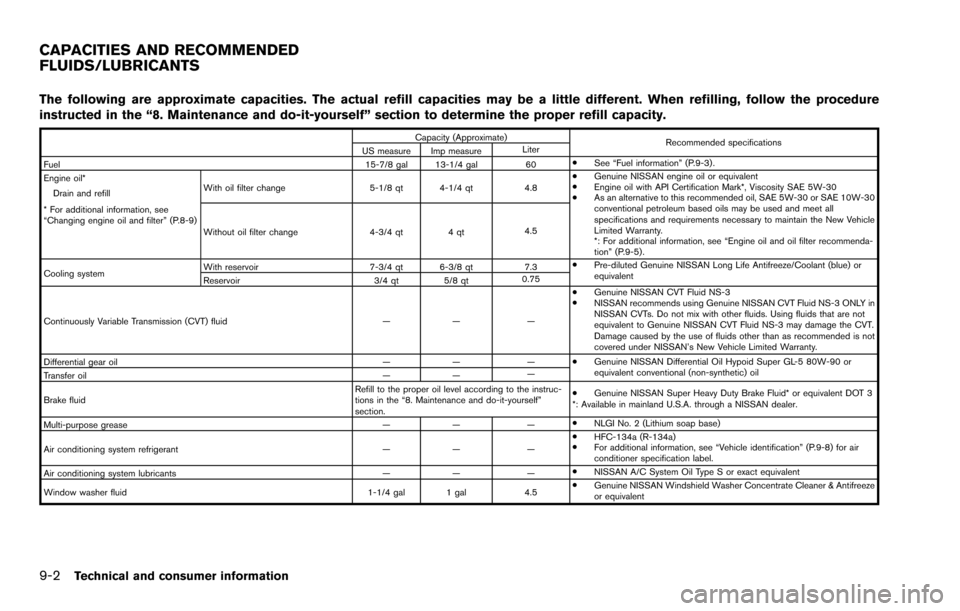
The following are approximate capacities. The actual refill capacities may be a little different. When refilling, follow the procedure
instructed in the “8. Maintenance and do-it-yourself” section to determine the proper refill capacity.
Capacity (Approximate)Recommended specifications
US measure Imp measure Liter
Fuel 15-7/8 gal 13-1/4 gal60.
See “Fuel information” (P.9-3) .
Engine oil* With oil filter change 5-1/8 qt 4-1/4 qt4.8.
Genuine NISSAN engine oil or equivalent
. Engine oil with API Certification Mark*, Viscosity SAE 5W-30
. As an alternative to this recommended oil, SAE 5W-30 or SAE 10W-30
conventional petroleum based oils may be used and meet all
specifications and requirements necessary to maintain the New Vehicle
Limited Warranty.
*: For additional information, see “Engine oil and oil filter recommenda-
tion” (P.9-5) .
Drain and refill
* For additional information, see
“Changing engine oil and filter” (P.8-9) Without oil filter change 4-3/4 qt 4 qt4.5
Cooling system With reservoir
7-3/4 qt 6-3/8 qt7.3.
Pre-diluted Genuine NISSAN Long Life Antifreeze/Coolant (blue) or
equivalent
Reservoir 3/4 qt 5/8 qt0.75
Continuously Variable Transmission (CVT) fluid —— —.
Genuine NISSAN CVT Fluid NS-3
. NISSAN recommends using Genuine NISSAN CVT Fluid NS-3 ONLY in
NISSAN CVTs. Do not mix with other fluids. Using fluids that are not
equivalent to Genuine NISSAN CVT Fluid NS-3 may damage the CVT.
Damage caused by the use of fluids other than as recommended is not
covered under NISSAN’s New Vehicle Limited Warranty.
Differential gear oil —— —.
Genuine NISSAN Differential Oil Hypoid Super GL-5 80W-90 or
equivalent conventional (non-synthetic) oil
Transfer oil ———
Brake fluid Refill to the proper oil level according to the instruc-
tions in the “8. Maintenance and do-it-yourself”
section..
Genuine NISSAN Super Heavy Duty Brake Fluid* or equivalent DOT 3
*: Available in mainland U.S.A. through a NISSAN dealer.
Multi-purpose grease —— —.
NLGI No. 2 (Lithium soap base)
Air conditioning system refrigerant —— —.
HFC-134a (R-134a)
. For additional information, see “Vehicle identification” (P.9-8) for air
conditioner specification label.
Air conditioning system lubricants —— —.
NISSAN A/C System Oil Type S or exact equivalent
Window washer fluid 1-1/4 gal 1 gal4.5.
Genuine NISSAN Windshield Washer Concentrate Cleaner & Antifreeze
or equivalent
CAPACITIES AND RECOMMENDED
FLUIDS/LUBRICANTS
Page 293 of 322
9-12Technical and consumer information
the fascia.
8. Install the license plate bracket with screws.
9. Install the license plate with bolts that are no longer than 0.55 in (14 mm) .
WARNING
.It is extremely dangerous to ride
in a cargo area inside the vehi-
cle. In a collision, people riding
in these areas are more likely to
be seriously injured or killed.
. Do not allow people to ride in
any area of your vehicle that is
not equipped with seats and
seat belts.
. Be sure everyone in your vehicle
is in a seat and using a seat belt
properly.
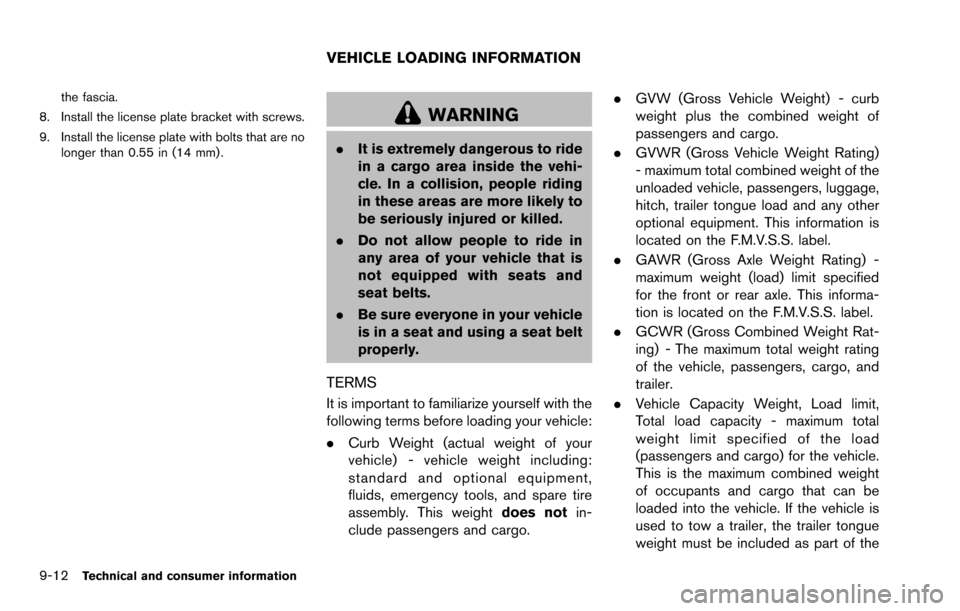
TERMS
It is important to familiarize yourself with the
following terms before loading your vehicle:
.Curb Weight (actual weight of your
vehicle) - vehicle weight including:
standard and optional equipment,
fluids, emergency tools, and spare tire
assembly. This weight does notin-
clude passengers and cargo. .
GVW (Gross Vehicle Weight) - curb
weight plus the combined weight of
passengers and cargo.
. GVWR (Gross Vehicle Weight Rating)
- maximum total combined weight of the
unloaded vehicle, passengers, luggage,
hitch, trailer tongue load and any other
optional equipment. This information is
located on the F.M.V.S.S. label.
. GAWR (Gross Axle Weight Rating) -
maximum weight (load) limit specified
for the front or rear axle. This informa-
tion is located on the F.M.V.S.S. label.
. GCWR (Gross Combined Weight Rat-
ing) - The maximum total weight rating
of the vehicle, passengers, cargo, and
trailer.
. Vehicle Capacity Weight, Load limit,
Total load capacity - maximum total
weight limit specified of the load
(passengers and cargo) for the vehicle.
This is the maximum combined weight
of occupants and cargo that can be
loaded into the vehicle. If the vehicle is
used to tow a trailer, the trailer tongue
weight must be included as part of the
VEHICLE LOADING INFORMATION
Page 294 of 322
cargo load. This information is located
on the Tire and Loading Information
label.
. Cargo capacity - permissible weight of
cargo, the subtracted weight of occu-
pants from the load limit.
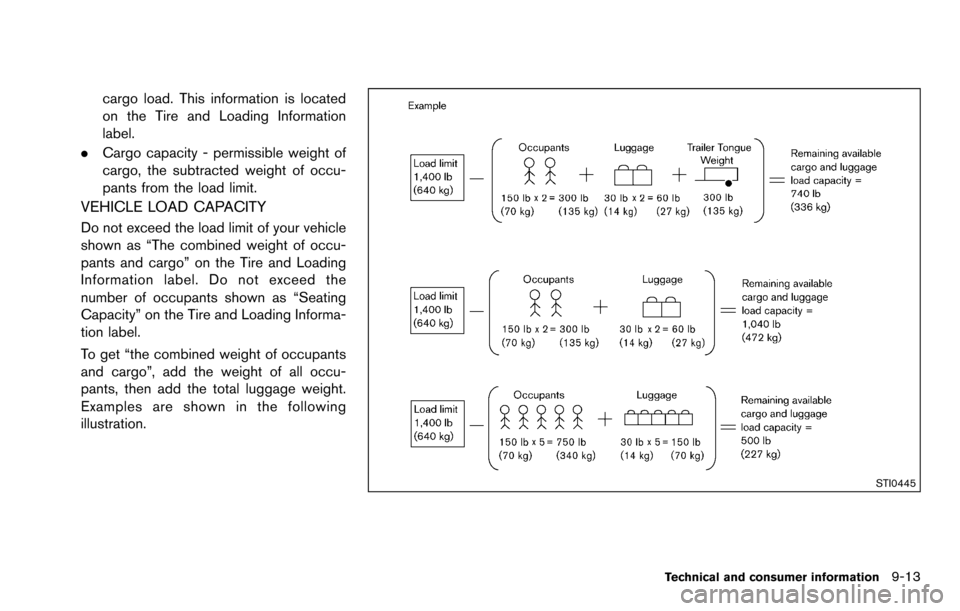
VEHICLE LOAD CAPACITY
Do not exceed the load limit of your vehicle
shown as “The combined weight of occu-
pants and cargo” on the Tire and Loading
Information label. Do not exceed the
number of occupants shown as “Seating
Capacity” on the Tire and Loading Informa-
tion label.
To get “the combined weight of occupants
and cargo”, add the weight of all occu-
pants, then add the total luggage weight.
Examples are shown in the following
illustration.
STI0445
Technical and consumer information9-13
Page 295 of 322
9-14Technical and consumer information
Steps for determining correct load limit
1. Locate the statement “The combinedweight of occupants and cargo should
never exceed XXX kg or XXX lbs” on
your vehicle’s placard.
2. Determine the combined weight of the driver and passengers that will be riding
in your vehicle.
3. Subtract the combined weight of the driver and passengers from XXX kg or
XXX lbs.
4. The resulting figure equals the available amount of cargo and luggage load
capacity. For example, if the XXX
amount equals 1400 lbs. and there will
be five 150 lb. passengers in your
vehicle, the amount of available cargo
and luggage load capacity is 650 lbs.
(1400 í750 (5 x 150) = 650 lbs) or
(640 í340 (5 x 70) = 300 kg.)
5. Determine the combined weight of luggage and cargo being loaded on
the vehicle. That weight may not safely
exceed the available cargo and luggage
load capacity calculated in Step 4. 6. If your vehicle will be towing a trailer,
load from your trailer will be transferred
to your vehicle. Consult this manual to
determine how this reduces the avail-
able cargo and luggage load capacity
of your vehicle.
Before driving a loaded vehicle, confirm
that you do not exceed the Gross Vehicle
Weight Rating (GVWR) or the Gross Axle
Weight Rating (GAWR) for your vehicle.
(See “Measurement of weights” (P.9-15) .)
Also check tires for proper inflation pres-
sures. See the Tire and Loading Information
label.
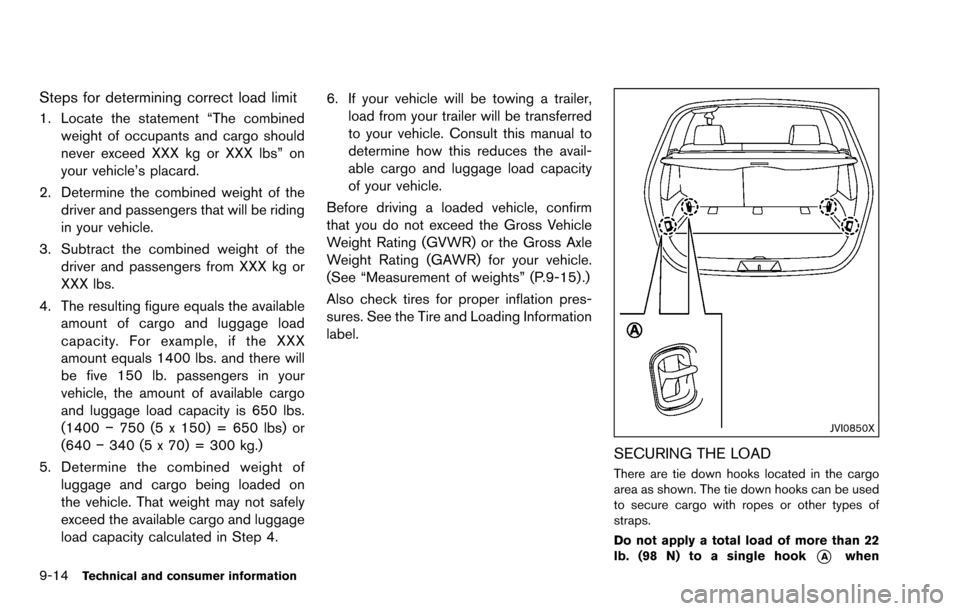
JVI0850X
SECURING THE LOAD
There are tie down hooks located in the cargo
area as shown. The tie down hooks can be used
to secure cargo with ropes or other types of
straps.
Do not apply a total load of more than 22
lb. (98 N) to a single hook
*Awhen
Page 299 of 322
9-18Technical and consumer information
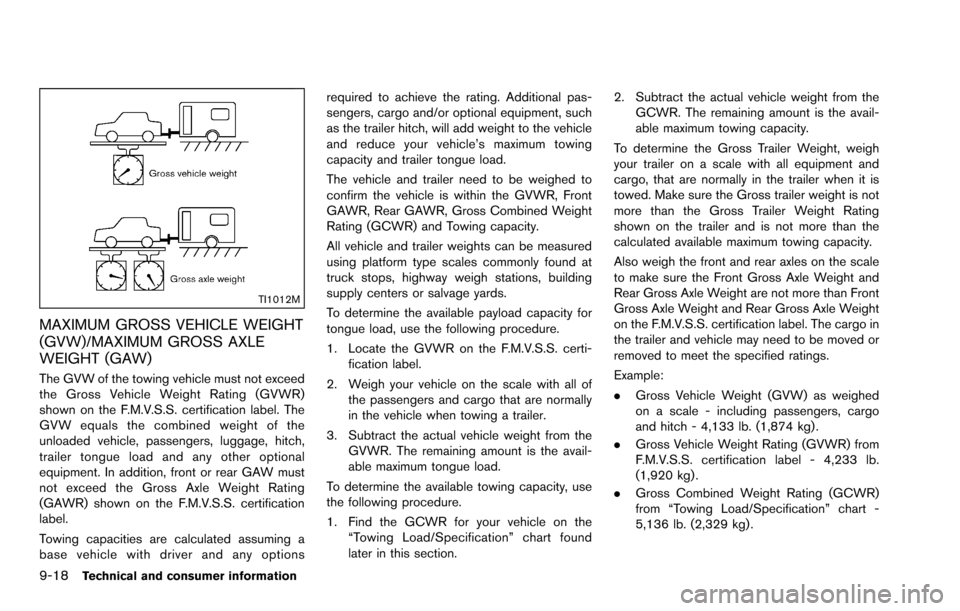
TI1012M
MAXIMUM GROSS VEHICLE WEIGHT
(GVW)/MAXIMUM GROSS AXLE
WEIGHT (GAW)
The GVW of the towing vehicle must not exceed
the Gross Vehicle Weight Rating (GVWR)
shown on the F.M.V.S.S. certification label. The
GVW equals the combined weight of the
unloaded vehicle, passengers, luggage, hitch,
trailer tongue load and any other optional
equipment. In addition, front or rear GAW must
not exceed the Gross Axle Weight Rating
(GAWR) shown on the F.M.V.S.S. certification
label.
Towing capacities are calculated assuming a
base vehicle with driver and any optionsrequired to achieve the rating. Additional pas-
sengers, cargo and/or optional equipment, such
as the trailer hitch, will add weight to the vehicle
and reduce your vehicle’s maximum towing
capacity and trailer tongue load.
The vehicle and trailer need to be weighed to
confirm the vehicle is within the GVWR, Front
GAWR, Rear GAWR, Gross Combined Weight
Rating (GCWR) and Towing capacity.
All vehicle and trailer weights can be measured
using platform type scales commonly found at
truck stops, highway weigh stations, building
supply centers or salvage yards.
To determine the available payload capacity for
tongue load, use the following procedure.
1. Locate the GVWR on the F.M.V.S.S. certi-
fication label.
2. Weigh your vehicle on the scale with all of the passengers and cargo that are normally
in the vehicle when towing a trailer.
3. Subtract the actual vehicle weight from the GVWR. The remaining amount is the avail-
able maximum tongue load.
To determine the available towing capacity, use
the following procedure.
1. Find the GCWR for your vehicle on the “Towing Load/Specification” chart found
later in this section. 2. Subtract the actual vehicle weight from the
GCWR. The remaining amount is the avail-
able maximum towing capacity.
To determine the Gross Trailer Weight, weigh
your trailer on a scale with all equipment and
cargo, that are normally in the trailer when it is
towed. Make sure the Gross trailer weight is not
more than the Gross Trailer Weight Rating
shown on the trailer and is not more than the
calculated available maximum towing capacity.
Also weigh the front and rear axles on the scale
to make sure the Front Gross Axle Weight and
Rear Gross Axle Weight are not more than Front
Gross Axle Weight and Rear Gross Axle Weight
on the F.M.V.S.S. certification label. The cargo in
the trailer and vehicle may need to be moved or
removed to meet the specified ratings.
Example:
. Gross Vehicle Weight (GVW) as weighed
on a scale - including passengers, cargo
and hitch - 4,133 lb. (1,874 kg) .
. Gross Vehicle Weight Rating (GVWR) from
F.M.V.S.S. certification label - 4,233 lb.
(1,920 kg) .
. Gross Combined Weight Rating (GCWR)
from “Towing Load/Specification” chart -
5,136 lb. (2,329 kg) .
Page 300 of 322
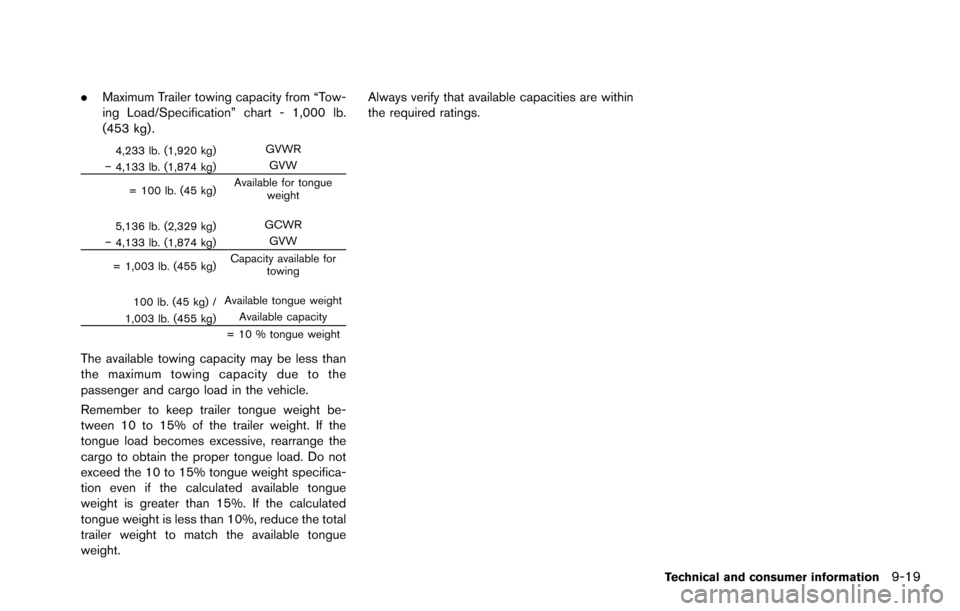
.Maximum Trailer towing capacity from “Tow-
ing Load/Specification” chart - 1,000 lb.
(453 kg).
4,233 lb. (1,920 kg) GVWR
í 4,133 lb. (1,874 kg) GVW
= 100 lb. (45 kg) Available for tongue
weight
5,136 lb. (2,329 kg) GCWR
í 4,133 lb. (1,874 kg) GVW
= 1,003 lb. (455 kg) Capacity available for
towing
100 lb. (45 kg) / Available tongue weight
1,003 lb. (455 kg) Available capacity
= 10 % tongue weight
The available towing capacity may be less than
the maximum towing capacity due to the
passenger and cargo load in the vehicle.
Remember to keep trailer tongue weight be-
tween 10 to 15% of the trailer weight. If the
tongue load becomes excessive, rearrange the
cargo to obtain the proper tongue load. Do not
exceed the 10 to 15% tongue weight specifica-
tion even if the calculated available tongue
weight is greater than 15%. If the calculated
tongue weight is less than 10%, reduce the total
trailer weight to match the available tongue
weight. Always verify that available capacities are within
the required ratings.
Technical and consumer information9-19