Page 268 of 424
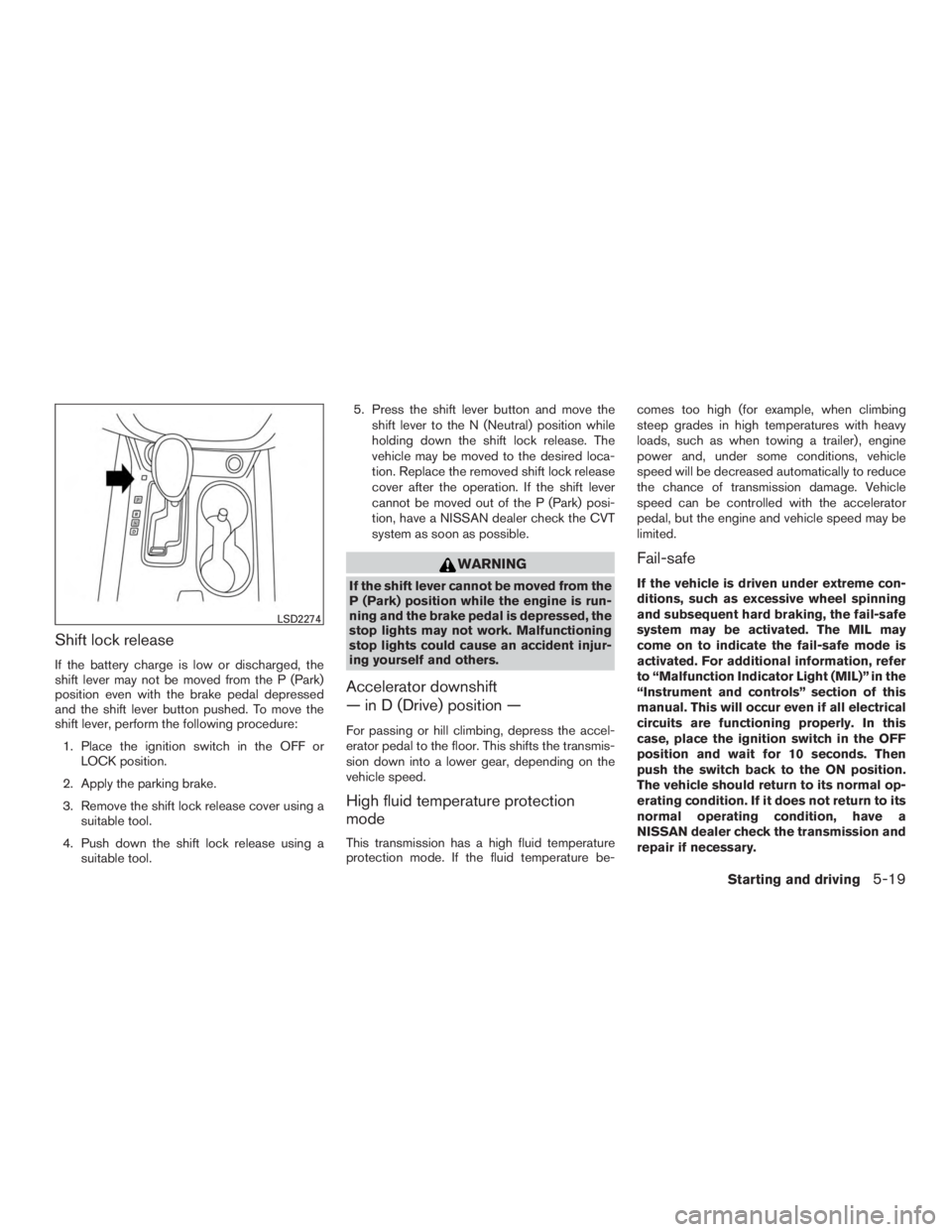
Shift lock release
If the battery charge is low or discharged, the
shift lever may not be moved from the P (Park)
position even with the brake pedal depressed
and the shift lever button pushed. To move the
shift lever, perform the following procedure:1. Place the ignition switch in the OFF or LOCK position.
2. Apply the parking brake.
3. Remove the shift lock release cover using a suitable tool.
4. Push down the shift lock release using a suitable tool. 5. Press the shift lever button and move the
shift lever to the N (Neutral) position while
holding down the shift lock release. The
vehicle may be moved to the desired loca-
tion. Replace the removed shift lock release
cover after the operation. If the shift lever
cannot be moved out of the P (Park) posi-
tion, have a NISSAN dealer check the CVT
system as soon as possible.
Page 322 of 424
FREEING A FROZEN DOOR LOCK
To prevent a door lock from freezing, apply de-
icer through the key hole. If the lock becomes
frozen, heat the key before inserting it into the key
hole, or use the NISSAN Intelligent Key®.
ANTIFREEZE
In the winter when it is anticipated that the tem-
perature will drop below 32°F (0°C) , check the
antifreeze to assure proper winter protection. For
additional information, refer to “Engine cooling
system” in the “Maintenance and do-it-yourself”
section of this manual.
BATTERY
If the battery is not fully charged during extremely
cold weather conditions, the battery fluid may
freeze and damage the battery. To maintain maxi-
mum efficiency, the battery should be checked
regularly. For additional information, refer to “Bat-
tery” in the “Maintenance and do-it-yourself” sec-
tion of this manual.
DRAINING OF COOLANT WATER
If the vehicle is to be left outside without anti-
freeze, drain the cooling system, including the
engine block. Refill before operating the vehicle.
For additional information, refer to “Changingengine coolant” in the “Maintenance and do-it-
yourself” section of this manual.
TIRE EQUIPMENT
1. SUMMER tires have a tread designed to
provide superior performance on dry pave-
ment. However, the performance of these
tires will be substantially reduced in snowy
and icy conditions. If you operate your ve-
hicle on snowy or icy roads, NISSAN recom-
mends the use of MUD & SNOW or ALL
SEASON TIRES on all four wheels. Please
consult a NISSAN dealer for the tire type,
size, speed rating and availability informa-
tion.
2. For additional traction on icy roads, studded tires may be used. However, some U.S.
states and Canadian provinces prohibit their
use. Check local, state and provincial laws
before installing studded tires.
Skid and traction capabilities of studded
snow tires on wet or dry surfaces may be
poorer than that of non-studded snow tires. 3. Tire chains may be used. For additional in- formation, refer to “Tire chains” in the “Main-
tenance and do-it-yourself” section of this
manual.
SPECIAL WINTER EQUIPMENT
It is recommended that the following items be
carried in the vehicle during winter:
● A scraper and stiff-bristled brush to remove
ice and snow from the windows and wiper
blades.
● A sturdy, flat board to be placed under the
jack to give it firm support.
● A shovel to dig the vehicle out of snowdrifts.
● Extra washer fluid to refill the windshield-
washer fluid reservoir.
DRIVING ON SNOW OR ICE
Page 334 of 424
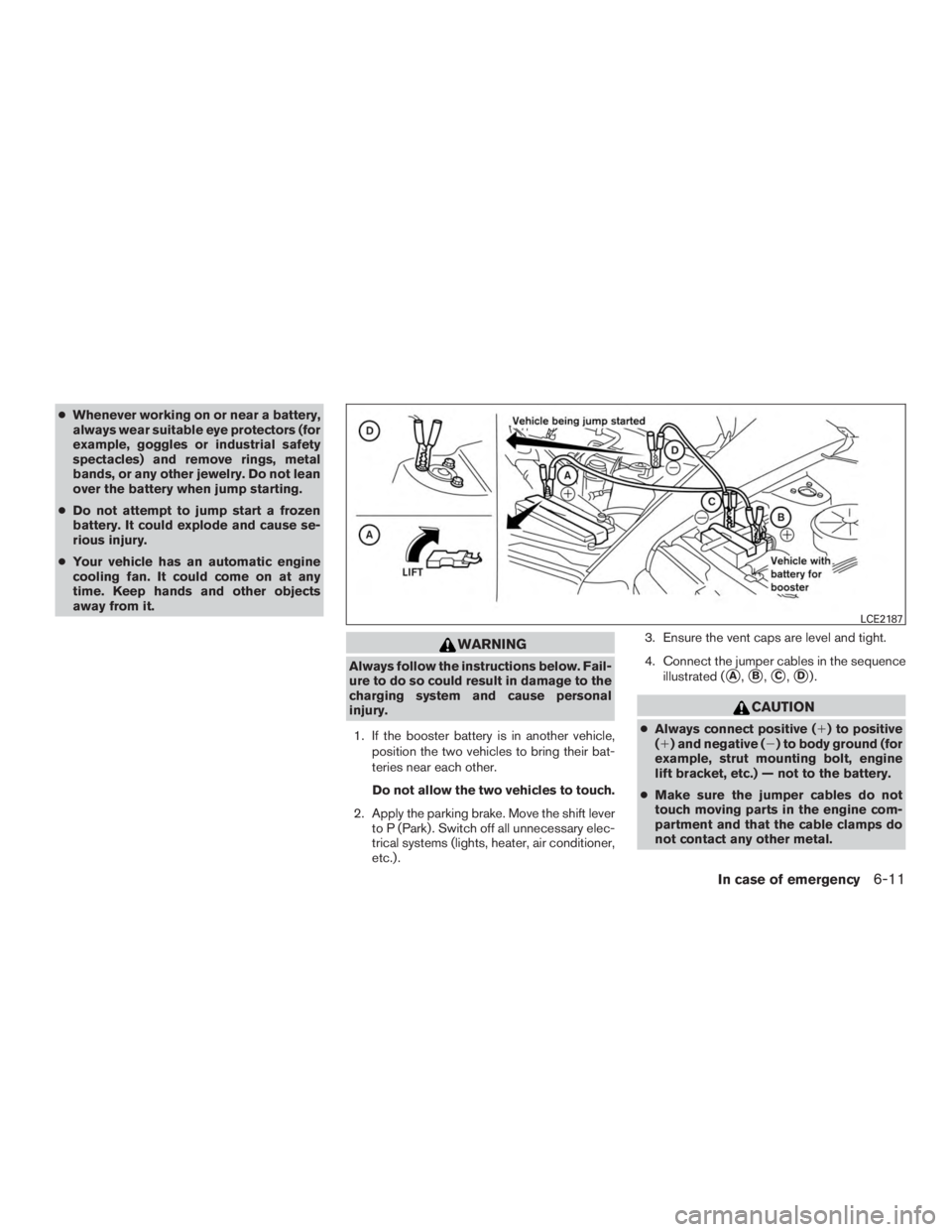
●Whenever working on or near a battery,
always wear suitable eye protectors (for
example, goggles or industrial safety
spectacles) and remove rings, metal
bands, or any other jewelry. Do not lean
over the battery when jump starting.
● Do not attempt to jump start a frozen
battery. It could explode and cause se-
rious injury.
● Your vehicle has an automatic engine
cooling fan. It could come on at any
time. Keep hands and other objects
away from it.
Page 351 of 424
CAUTION
●Do not work under the hood while the
engine is hot. Turn the engine off and
wait until it cools down.
● Avoid contact with used engine oil and
coolant. Improperly disposed engine
oil, engine coolant and/or other vehicle
fluids can damage the environment. Al-
ways conform to local regulations for
disposal of vehicle fluid.
● Never leave the engine or continuously
variable transmission related compo-
nent harnesses disconnected while the
ignition switch is in the ON position.
● Never connect or disconnect the battery
or any transistorized component while
the ignition switch is in the ON position.
This “Maintenance and do-it-yourself” section
gives instructions regarding only those items
which are relatively easy for an owner to perform.
You should be aware that incomplete or improper
servicing may result in operating difficulties or
excessive emissions, and could affect warranty
coverage. If in doubt about any servicing,
have it done by a NISSAN dealer.
Page 352 of 424
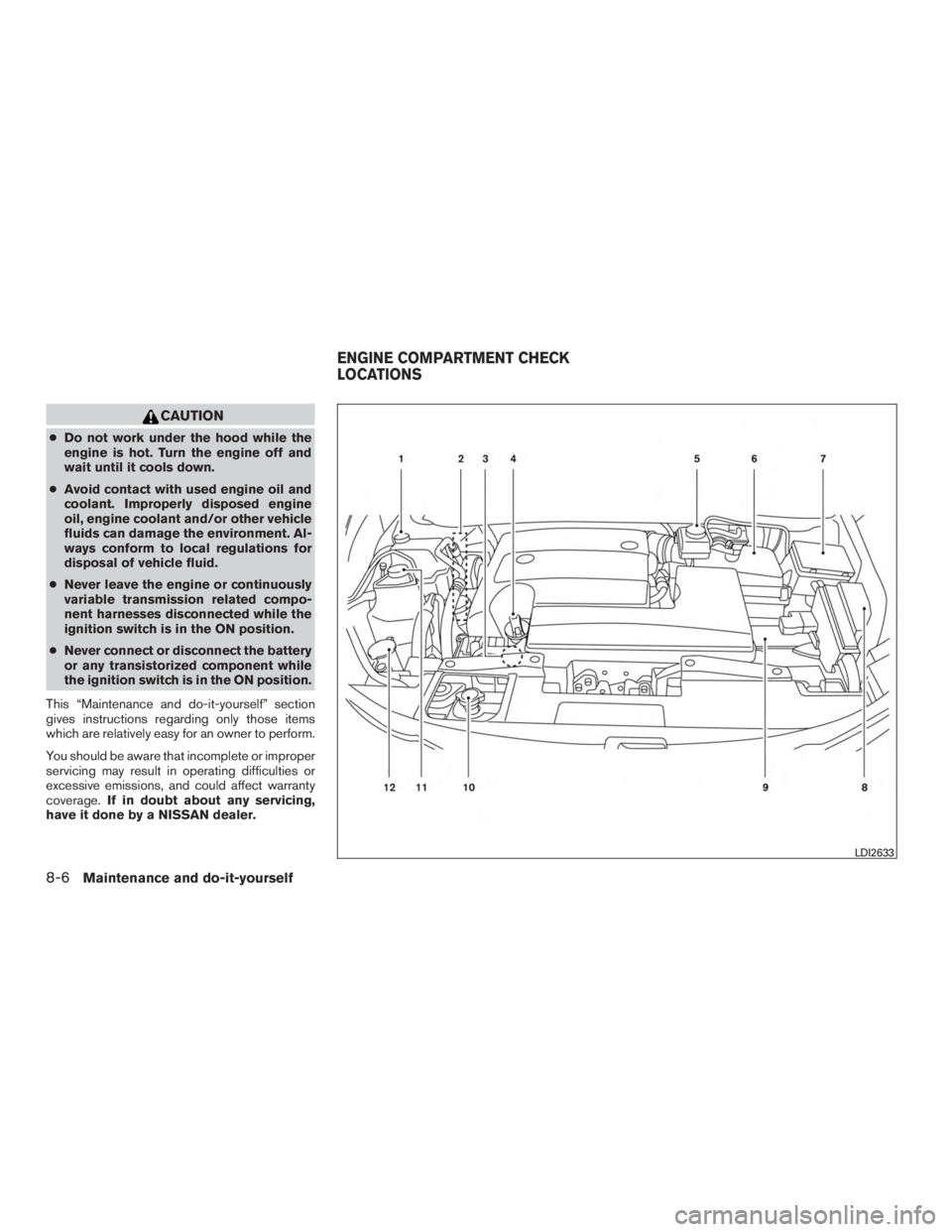
VQ35DE engine
1. Engine coolant reservoir
2. Drive belt location
3. Engine oil dipstick
4. Engine oil filler cap
5. Brake fluid reservoir
6. Air cleaner
7. Fuse box
8. Fuse box/Fusible links
9. Battery
10 Radiator cap
11. Power steering fluid reservoir
12. Windshield-washer fluid reservoirThe engine cooling system is filled at the factory
with a pre-diluted mixture of 50% Genuine
NISSAN Long Life Antifreeze/Coolant (blue) and
50% water to provide year-round antifreeze and
coolant protection. The antifreeze solution con-
tains rust and corrosion inhibitors. Additional en-
gine cooling system additives are not necessary.
Page 361 of 424
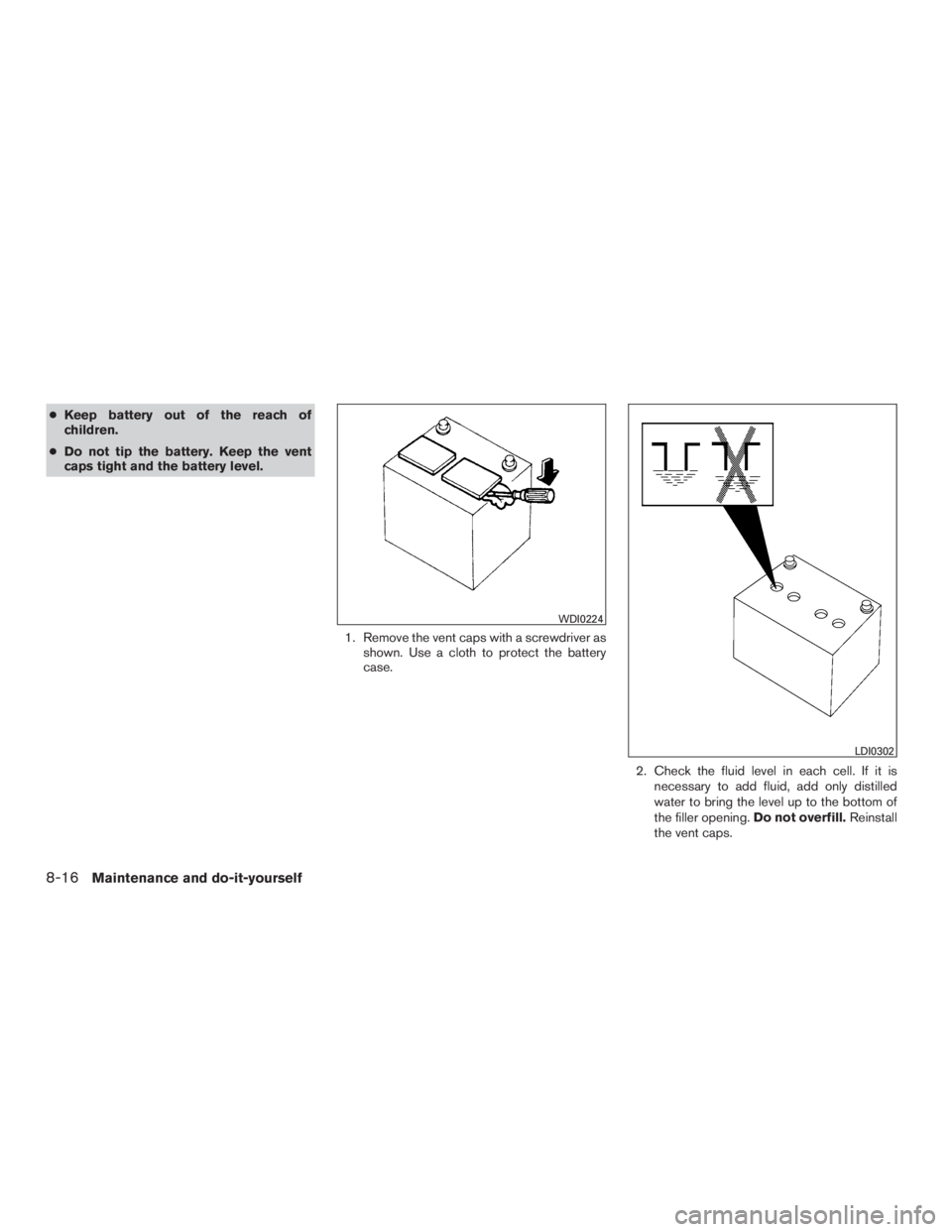
●Keep battery out of the reach of
children.
● Do not tip the battery. Keep the vent
caps tight and the battery level.
1. Remove the vent caps with a screwdriver asshown. Use a cloth to protect the battery
case.
2. Check the fluid level in each cell. If it isnecessary to add fluid, add only distilled
water to bring the level up to the bottom of
the filler opening. Do not overfill.Reinstall
the vent caps.
Page 362 of 424
Vehicles operated in high temperatures or under
severe conditions require frequent checks of the
battery fluid level.
JUMP STARTING
If jump starting is necessary, refer to “Jump start-
ing” in the “In case of emergency” section of this
manual. If the engine does not start by jump
starting, the battery may have to be replaced.
Contact a NISSAN dealer.
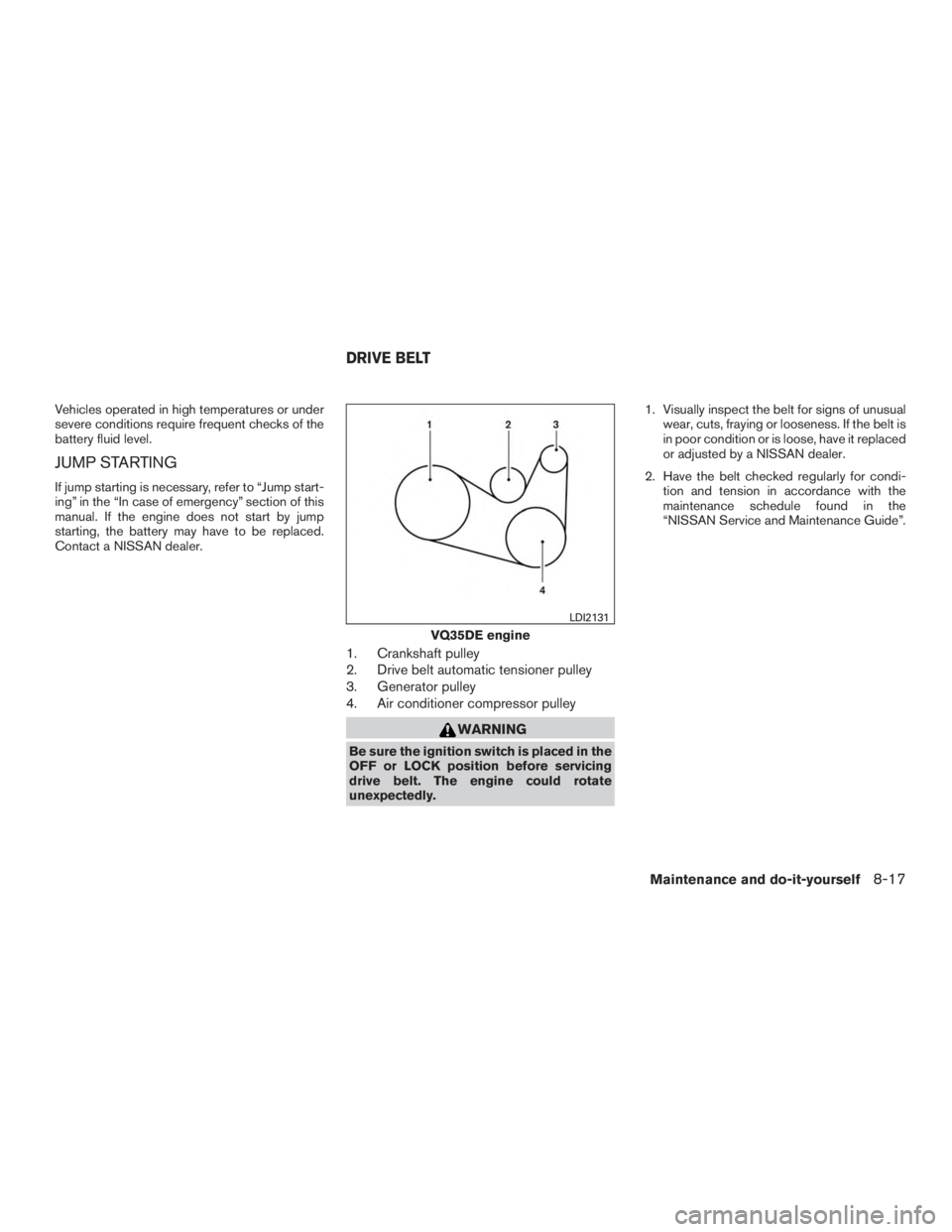
1. Crankshaft pulley
2. Drive belt automatic tensioner pulley
3. Generator pulley
4. Air conditioner compressor pulley
Page 418 of 424
Front air bag system
(See supplemental restraint system)......1-54
Front power seat adjustment ...........1-4
Frontseats.....................1-2
Fuel Capacities and recommended
fuel/lubricants .................9-2
Fuel economy ................5-64
Fuel-filler door and cap ...........3-27
Fuel-filler door lock opener lever ......3-27
Fuel gauge ...................2-6
Fuel octane rating ...............9-5
Fuel recommendation .............9-4
Loose fuel cap warning ........2-23,3-27
Fuel Cell Vehicle (FCV) System Tirepressure.................8-29
Fuel gauge .....................2-6
Fuses.......................8-22
Fusible links ...................8-23
G
Garage door opener, HomeLink® Universal
Transceiver......2-51,2-53,2-54,2-54,2-55
Gascap .....................3-27
Gauge Engine coolant temperature gauge .....2-5
Fuel gauge ...................2-6
Odometer ...................2-4
Speedometer .................2-4
Tachometer ..................2-5
Trip odometer .................2-4
General maintenance ...............8-2
Glovebox.....................2-43 H
Hazard warning flasher switch ..........6-2
Headlight and turn signal switch ........2-30
Headlight control switch ............2-30
Headlights ....................8-27
Head restraints ..................1-10
Heated seats ............2-35,2-36,2-37
Heated steering wheel .............2-34
Heater Heater and air conditioner (automatic)
(if so equipped) ...............4-26
Heater and air conditioner controls .....4-27
Heater operation ...............4-28
Heater and air conditioner (automatic) .....4-26
Hill start assist system ..............5-72
HomeLink® Universal
Transceiver ......2-51,2-53,2-54,2-54,2-55
Hood release ...................3-22
Hook Luggage hook ................2-44
Horn .......................2-34
I
Ignition Switch Push-Button Ignition Switch ........5-10
Immobilizer system ............2-26,5-14
Important vehicle information label .......9-11
In-cabin microfilter ................8-19
Increasing fuel economy .............5-64
Indicator NISSAN Intelligent Key® battery discharge
indicator ...................5-13 Indicator lights and audible reminders
(See warning/indicator lights and audible
reminders)..................2-7,2-12
Inside mirror
...................3-32
Instrument brightness control ..........2-33
Instrumentpanel...............0-6,2-2
Instrument panel dimmer switch ........2-33
Intelligent cruise control (ICC) system Brake
assist.................5-34
Intelligent Key system Key operating range ..............3-8
Key operation .................3-9
Mechanical key ................3-3
Remote keyless entry operation.......3-12
Troubleshooting guide ............3-17
Warning signals ...............3-17
Interior light ....................2-50
iPod®Player...................4-44
ISOFIX child restraints .............1-27
J
Jump starting ...............6-10,8-17
K
Key.........................3-2
Key fob battery replacement ..........8-25
Keyless entry With Intelligent Key system
(See Intelligent Key system) .........3-12
Keys NISSAN Intelligent Key® ........3-2,3-7
10-3