2015 NISSAN MURANO mirror
[x] Cancel search: mirrorPage 276 of 424
Entering from the side
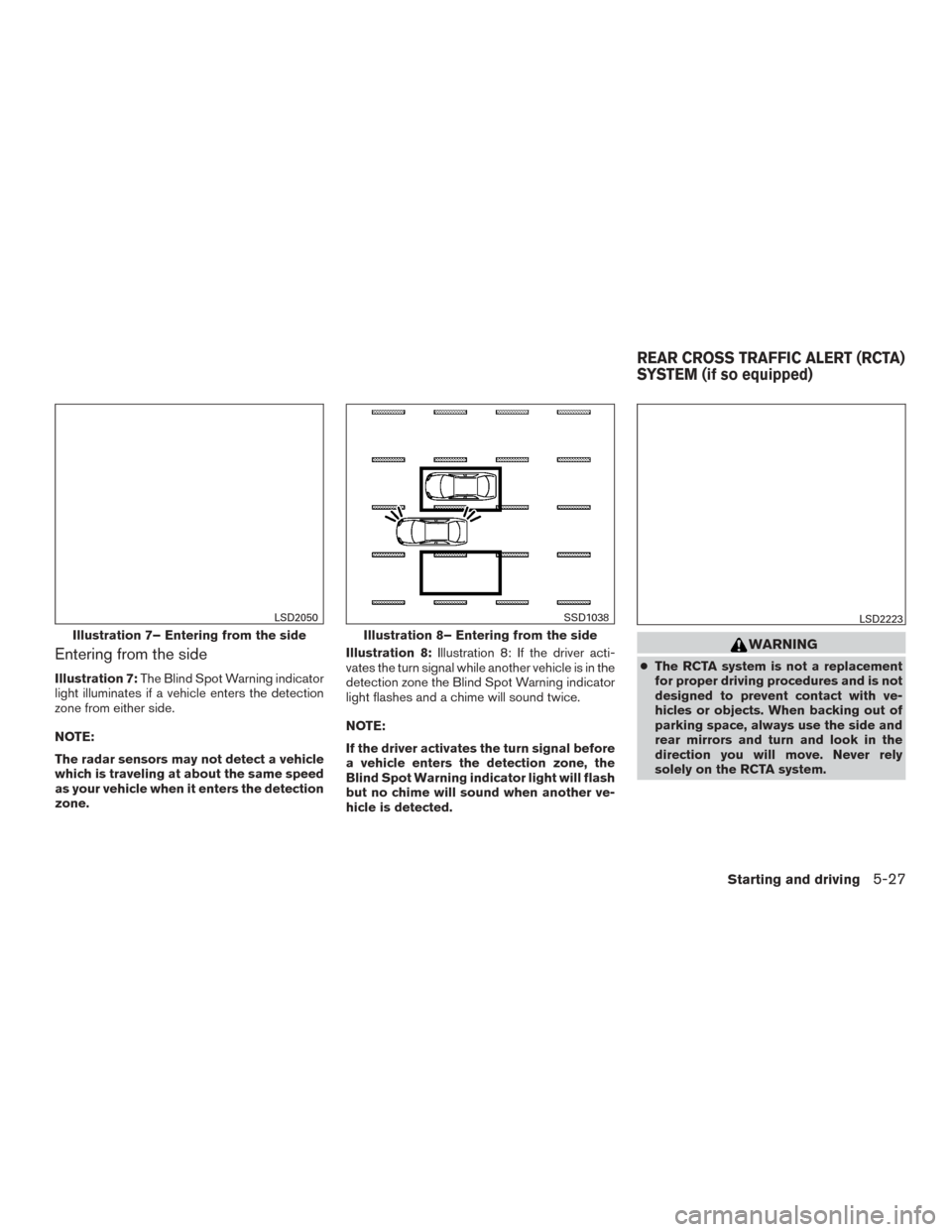
Illustration 7:The Blind Spot Warning indicator
light illuminates if a vehicle enters the detection
zone from either side.
NOTE:
The radar sensors may not detect a vehicle
which is traveling at about the same speed
as your vehicle when it enters the detection
zone. Illustration 8:
Illustration 8: If the driver acti-
vates the turn signal while another vehicle is in the
detection zone the Blind Spot Warning indicator
light flashes and a chime will sound twice.
NOTE:
If the driver activates the turn signal before
a vehicle enters the detection zone, the
Blind Spot Warning indicator light will flash
but no chime will sound when another ve-
hicle is detected.
WARNING
● The RCTA system is not a replacement
for proper driving procedures and is not
designed to prevent contact with ve-
hicles or objects. When backing out of
parking space, always use the side and
rear mirrors and turn and look in the
direction you will move. Never rely
solely on the RCTA system.
Illustration 7– Entering from the side
LSD2050
Illustration 8– Entering from the side
SSD1038LSD2223
REAR CROSS TRAFFIC ALERT (RCTA)
SYSTEM (if so equipped)
Starting and driving5-27
Page 373 of 424
CAUTION
●High pressure halogen gas is sealed
inside the halogen bulb. The bulb may
break if the glass envelope is scratched
or the bulb is dropped.
● When handling the bulb, do not touch
the glass envelope.
● Use the same number and wattage as
originally installed as shown in the
chart.
● Do not leave the bulb out of the fog light
for a long period of time as dust, mois-
ture and smoke may enter the fog light
body and affect the performance of the
fog light.
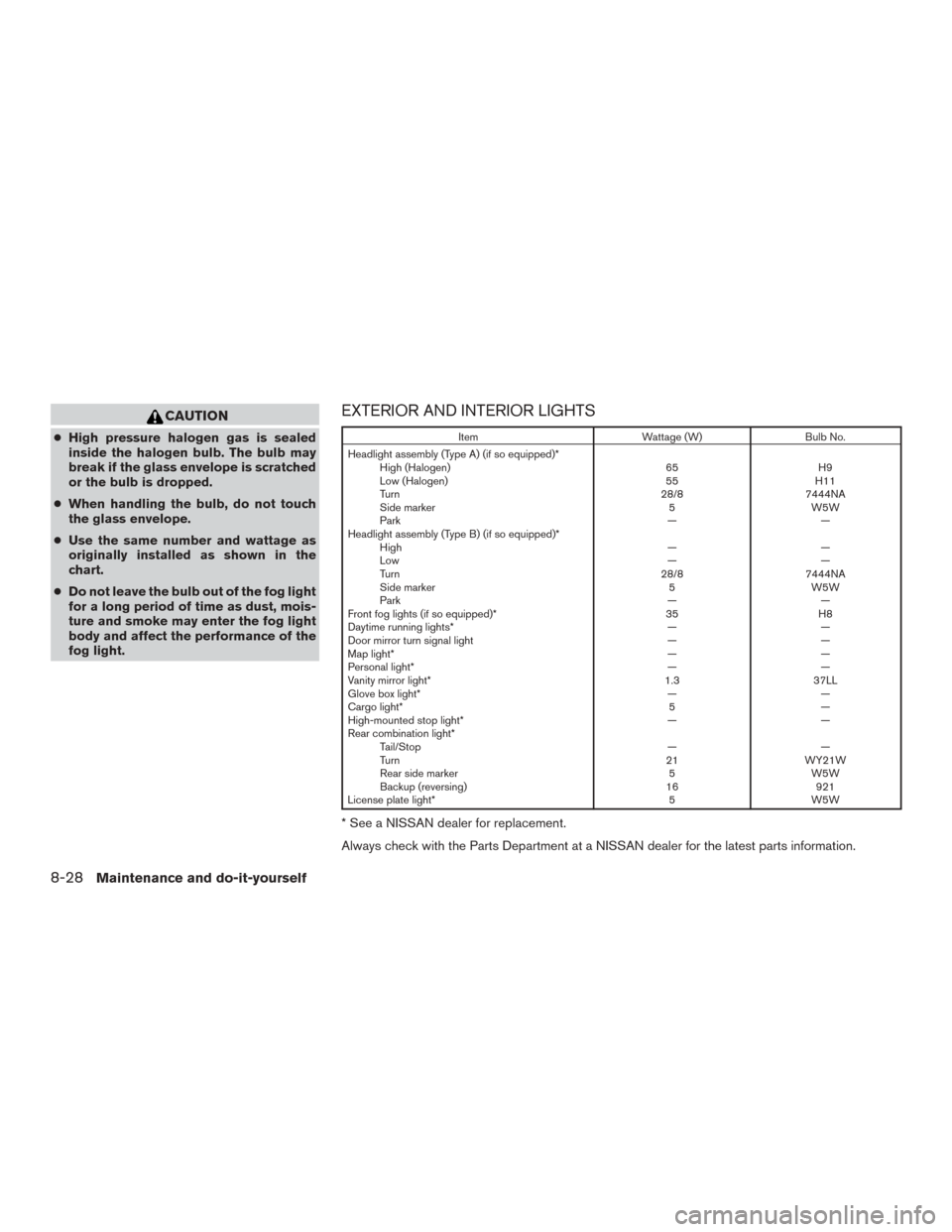
EXTERIOR AND INTERIOR LIGHTS
Item Wattage (W)Bulb No.
Headlight assembly (Type A) (if so equipped)* High (Halogen) 65H9
Low (Halogen) 55H11
Turn 28/87444NA
Side marker 5W5W
Park ——
Headlight assembly (Type B) (if so equipped)* High ——
Low ——
Turn 28/87444NA
Side marker 5W5W
Park ——
Front fog lights (if so equipped)* 35H8
Daytime running lights* ——
Door mirror turn signal light ——
Map light* ——
Personal light* ——
Vanity mirror light* 1.337LL
Glove box light* ——
Cargo light* 5—
High-mounted stop light* ——
Rear combination light* Tail/Stop ——
Turn 21WY21W
Rear side marker 5W5W
Backup (reversing) 16921
License plate light* 5W5W
* See a NISSAN dealer for replacement.
Always check with the Parts Department at a NISSAN dealer for the latest parts information.
8-28Maintenance and do-it-yourself
Page 374 of 424
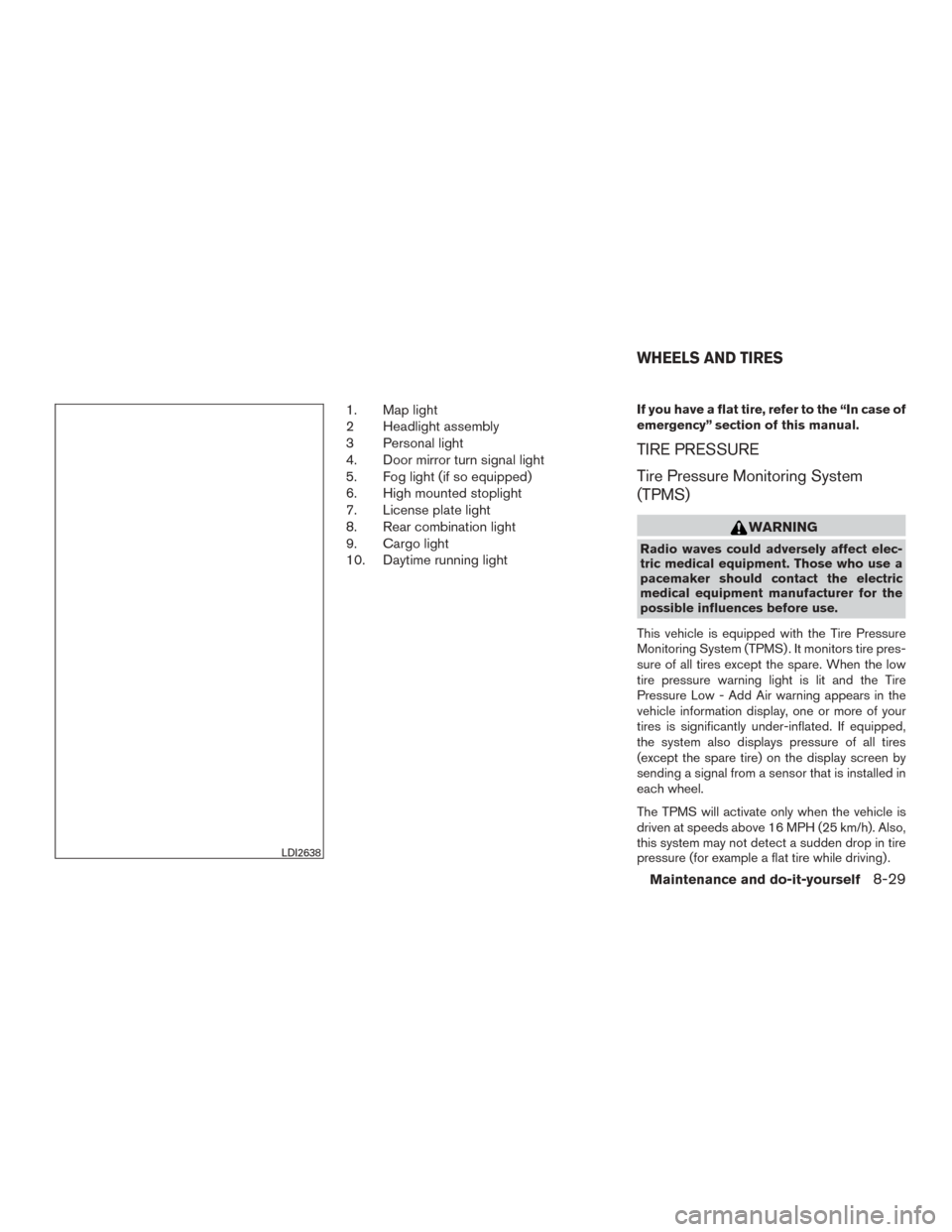
1. Map light
2 Headlight assembly
3 Personal light
4. Door mirror turn signal light
5. Fog light (if so equipped)
6. High mounted stoplight
7. License plate light
8. Rear combination light
9. Cargo light
10. Daytime running lightIf you have a flat tire, refer to the “In case of
emergency” section of this manual.
TIRE PRESSURE
Tire Pressure Monitoring System
(TPMS)
WARNING
Radio waves could adversely affect elec-
tric medical equipment. Those who use a
pacemaker should contact the electric
medical equipment manufacturer for the
possible influences before use.
This vehicle is equipped with the Tire Pressure
Monitoring System (TPMS) . It monitors tire pres-
sure of all tires except the spare. When the low
tire pressure warning light is lit and the Tire
Pressure Low - Add Air warning appears in the
vehicle information display, one or more of your
tires is significantly under-inflated. If equipped,
the system also displays pressure of all tires
(except the spare tire) on the display screen by
sending a signal from a sensor that is installed in
each wheel.
The TPMS will activate only when the vehicle is
driven at speeds above 16 MPH (25 km/h). Also,
this system may not detect a sudden drop in tire
pressure (for example a flat tire while driving) .
LDI2638
WHEELS AND TIRES
Maintenance and do-it-yourself8-29
Page 408 of 424
Pre-towing tips
●Be certain your vehicle maintains a level
position when a loaded and/or unloaded
trailer is hitched. Do not drive the vehicle if it
has an abnormal nose-up or nose-down
condition; check for improper tongue load,
overload, worn suspension or other possible
causes of either condition.
● Always secure items in the trailer to prevent
load shift while driving.
● Keep the cargo load as low as possible in
the trailer to keep the trailer center of gravity
low.
● Load the trailer so approximately 60% of the
trailer load is in the front half and 40% is in
the back half. Also make sure the load is
balanced side to side.
● Check your hitch, trailer tire pressure, ve-
hicle tire pressure, trailer light operation, and
trailer wheel lug nuts every time you attach a
trailer to the vehicle.
● Be certain your rearview mirrors conform to
all federal, state or local regulations. If not,
install any mirrors required for towing before
driving the vehicle. ●
Determine the overall height of the vehicle
and trailer so the required clearance is
known.
Trailer towing tips
In order to gain skill and an understanding of the
vehicle’s behavior, you should practice turning,
stopping and backing up in an area which is free
from traffic. Steering stability and braking perfor-
mance will be somewhat different than under
normal driving conditions.
● Always secure items in the trailer to prevent
load shift while driving.
● Lock the trailer hitch coupler with a pin or
lock to prevent the coupler from inadver-
tently becoming unlatched.
● Avoid abrupt starts, acceleration or stops.
● Avoid sharp turns or lane changes.
● Always drive your vehicle at a moderate
speed.
● When backing up, hold the bottom of the
steering wheel with one hand. Move your
hand in the direction in which you want the
trailer to go. Make small corrections and
back up slowly. If possible, have someone
guide you when you are backing up. Always block the wheels on both vehicle and
trailer when parking. Parking on a slope is not
recommended; however, if you must do so:
CAUTION
If you move the shift lever to the P (Park)
position before blocking the wheels and
applying the parking brake, transmission
damage could occur.
1. Apply and hold the brake pedal.
2. Have someone place blocks on the downhill side of the vehicle and trailer wheels.
3. After the wheel blocks are in place, slowly release the brake pedal until the blocks ab-
sorb the vehicle load.
4. Apply the parking brake.
5. Shift the transmission into P (Park) .
6. Turn off the engine.
To drive away: 1. Start the vehicle.
2. Apply and hold the brake pedal.
3. Shift the transmission into gear.
4. Release the parking brake.
Technical and consumer information9-23
Page 417 of 424
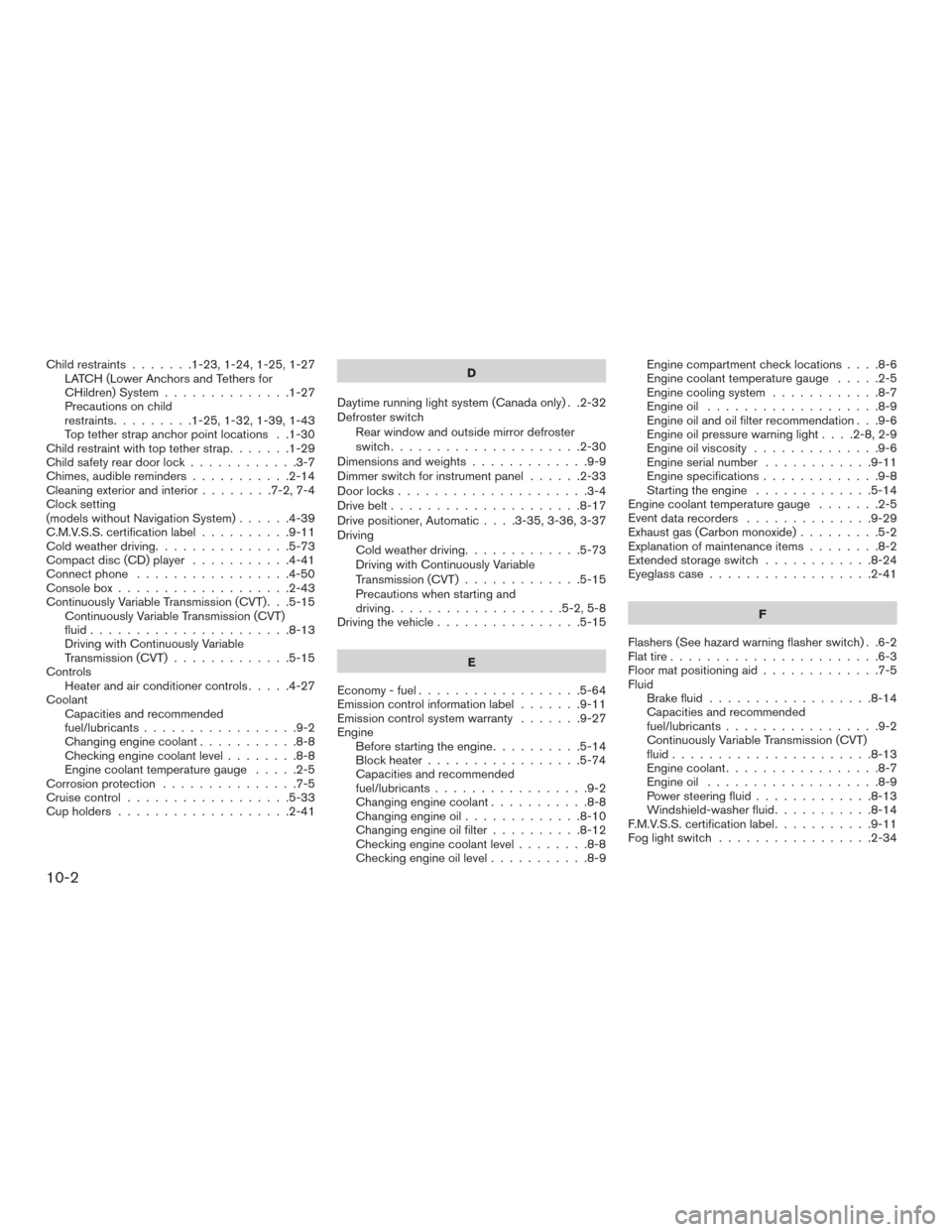
Child restraints.......1-23,1-24,1-25,1-27
LATCH (Lower Anchors and Tethers for
CHildren) System ..............1-27
Precautions on child
restraints.........1-25,1-32,1-39,1-43
Top tether strap anchor point locations . .1-30
Child restraint with top tether strap .......1-29
Child safety rear door lock ............3-7
Chimes, audible reminders ...........2-14
Cleaningexteriorandinterior........7-2,7-4
Clock setting
(models without Navigation System) ......4-39
C.M.V.S.S. certification label ..........9-11
Cold weather driving ...............5-73
Compact disc (CD) player ...........4-41
Connect phone .................4-50
Consolebox...................2-43
Continuously Variable Transmission (CVT) . . .5-15 Continuously Variable Transmission (CVT)
fluid ......................8-13
Driving with Continuously Variable
Transmission (CVT) .............5-15
Controls Heater and air conditioner controls .....4-27
Coolant Capacities and recommended
fuel/lubricants .................9-2
Changing engine coolant ...........8-8
Checking engine coolant level ........8-8
Engine coolant temperature gauge .....2-5
Corrosionprotection ...............7-5
Cruisecontrol..................5-33
Cupholders...................2-41 D
Daytime running light system (Canada only) . .2-32
Defroster switch Rear window and outside mirror defroster
switch.....................2-30
Dimensionsandweights.............9-9
Dimmer switch for instrument panel ......2-33
Door locks .....................3-4
Drive belt .....................8-17
Drive positioner, Automatic ....3-35,3-36,3-37
Driving Cold weather driving .............5-73
Driving with Continuously Variable
Transmission (CVT) .............5-15
Precautions when starting and
driving ...................5-2,5-8
Driving the vehicle ................5-15
E
Economy - fuel ..................5-64
Emission control information label .......9-11
Emission control system warranty .......9-27
Engine Before starting the engine ..........5-14
Block heater .................5-74
Capacities and recommended
fuel/lubricants .................9-2
Changingenginecoolant...........8-8
Changingengineoil.............8-10
Changing engine oil filter ..........8-12
Checking engine coolant level ........8-8
Checking engine oil level ...........8-9 Engine compartment check locations
....8-6
Engine coolant temperature gauge .....2-5
Engine cooling system ............8-7
Engineoil ...................8-9
Engine oil and oil filter recommendation . . .9-6
Engine oil pressure warning light ....2-8,2-9
Engine oil viscosity ..............9-6
Engine serial number ............9-11
Engine specifications .............9-8
Starting the engine .............5-14
Engine coolant temperature gauge .......2-5
Event
data recorders ..............9-29
Exhaust gas (Carbon monoxide) .........5-2
Explanation of maintenance items ........8-2
Extended storage switch ............8-24
Eyeglass case ..................2-41
F
Flashers (See hazard warning flasher switch) . .6-2
Flat tire .......................6-3
Floor mat positioning aid .............7-5
Fluid Brake fluid ..................8-14
Capacities and recommended
fuel/lubricants.................9-2
Continuously Variable Transmission (CVT)
fluid......................8-13
Enginecoolant.................8-7
Engineoil ...................8-9
Power steering fluid .............8-13
Windshield-washer fluid ...........8-14
F.M.V.S.S. certification label ...........9-11
Foglightswitch .................2-34
10-2
Page 418 of 424
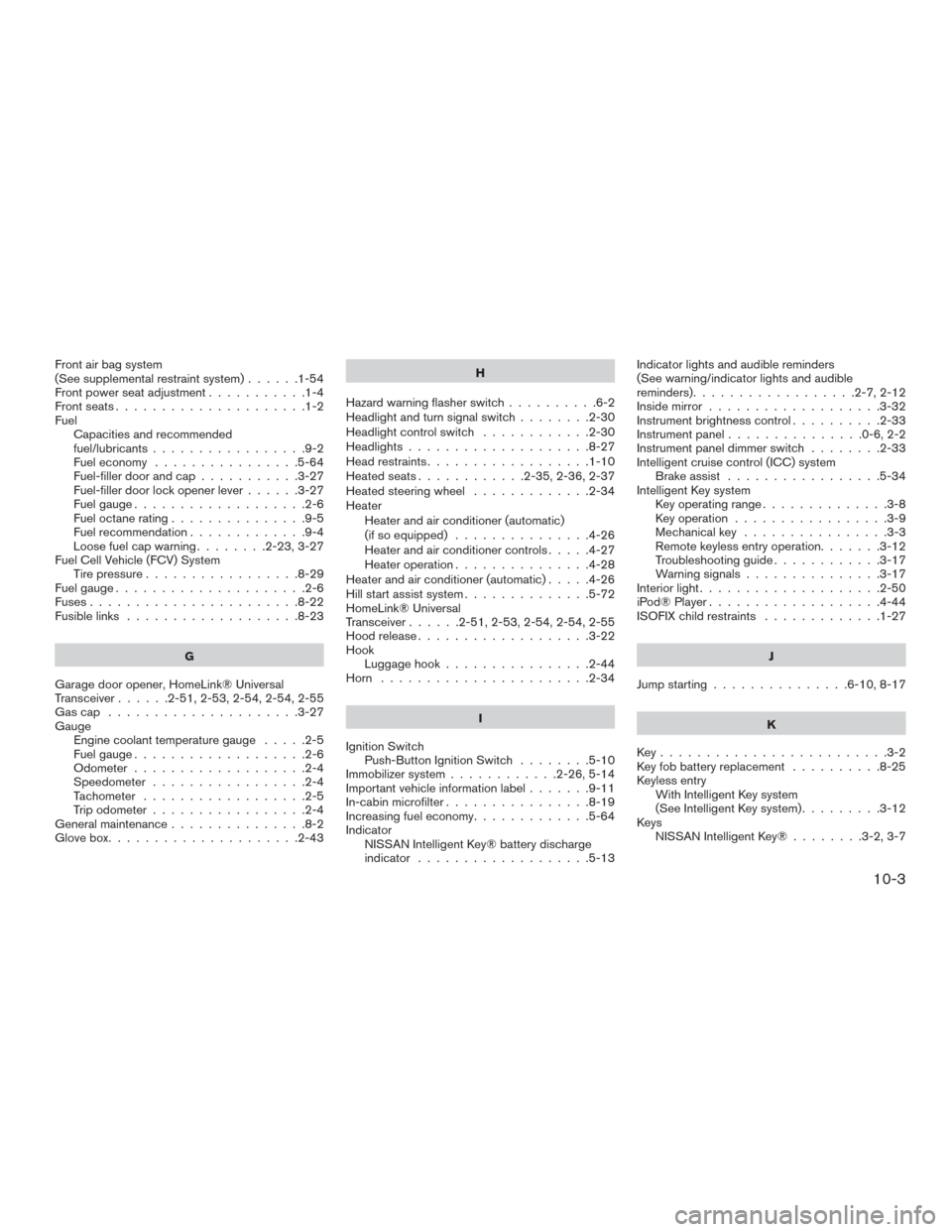
Front air bag system
(See supplemental restraint system)......1-54
Front power seat adjustment ...........1-4
Frontseats.....................1-2
Fuel Capacities and recommended
fuel/lubricants .................9-2
Fuel economy ................5-64
Fuel-filler door and cap ...........3-27
Fuel-filler door lock opener lever ......3-27
Fuel gauge ...................2-6
Fuel octane rating ...............9-5
Fuel recommendation .............9-4
Loose fuel cap warning ........2-23,3-27
Fuel Cell Vehicle (FCV) System Tirepressure.................8-29
Fuel gauge .....................2-6
Fuses.......................8-22
Fusible links ...................8-23
G
Garage door opener, HomeLink® Universal
Transceiver......2-51,2-53,2-54,2-54,2-55
Gascap .....................3-27
Gauge Engine coolant temperature gauge .....2-5
Fuel gauge ...................2-6
Odometer ...................2-4
Speedometer .................2-4
Tachometer ..................2-5
Trip odometer .................2-4
General maintenance ...............8-2
Glovebox.....................2-43 H
Hazard warning flasher switch ..........6-2
Headlight and turn signal switch ........2-30
Headlight control switch ............2-30
Headlights ....................8-27
Head restraints ..................1-10
Heated seats ............2-35,2-36,2-37
Heated steering wheel .............2-34
Heater Heater and air conditioner (automatic)
(if so equipped) ...............4-26
Heater and air conditioner controls .....4-27
Heater operation ...............4-28
Heater and air conditioner (automatic) .....4-26
Hill start assist system ..............5-72
HomeLink® Universal
Transceiver ......2-51,2-53,2-54,2-54,2-55
Hood release ...................3-22
Hook Luggage hook ................2-44
Horn .......................2-34
I
Ignition Switch Push-Button Ignition Switch ........5-10
Immobilizer system ............2-26,5-14
Important vehicle information label .......9-11
In-cabin microfilter ................8-19
Increasing fuel economy .............5-64
Indicator NISSAN Intelligent Key® battery discharge
indicator ...................5-13 Indicator lights and audible reminders
(See warning/indicator lights and audible
reminders)..................2-7,2-12
Inside mirror
...................3-32
Instrument brightness control ..........2-33
Instrumentpanel...............0-6,2-2
Instrument panel dimmer switch ........2-33
Intelligent cruise control (ICC) system Brake
assist.................5-34
Intelligent Key system Key operating range ..............3-8
Key operation .................3-9
Mechanical key ................3-3
Remote keyless entry operation.......3-12
Troubleshooting guide ............3-17
Warning signals ...............3-17
Interior light ....................2-50
iPod®Player...................4-44
ISOFIX child restraints .............1-27
J
Jump starting ...............6-10,8-17
K
Key.........................3-2
Key fob battery replacement ..........8-25
Keyless entry With Intelligent Key system
(See Intelligent Key system) .........3-12
Keys NISSAN Intelligent Key® ........3-2,3-7
10-3
Page 419 of 424
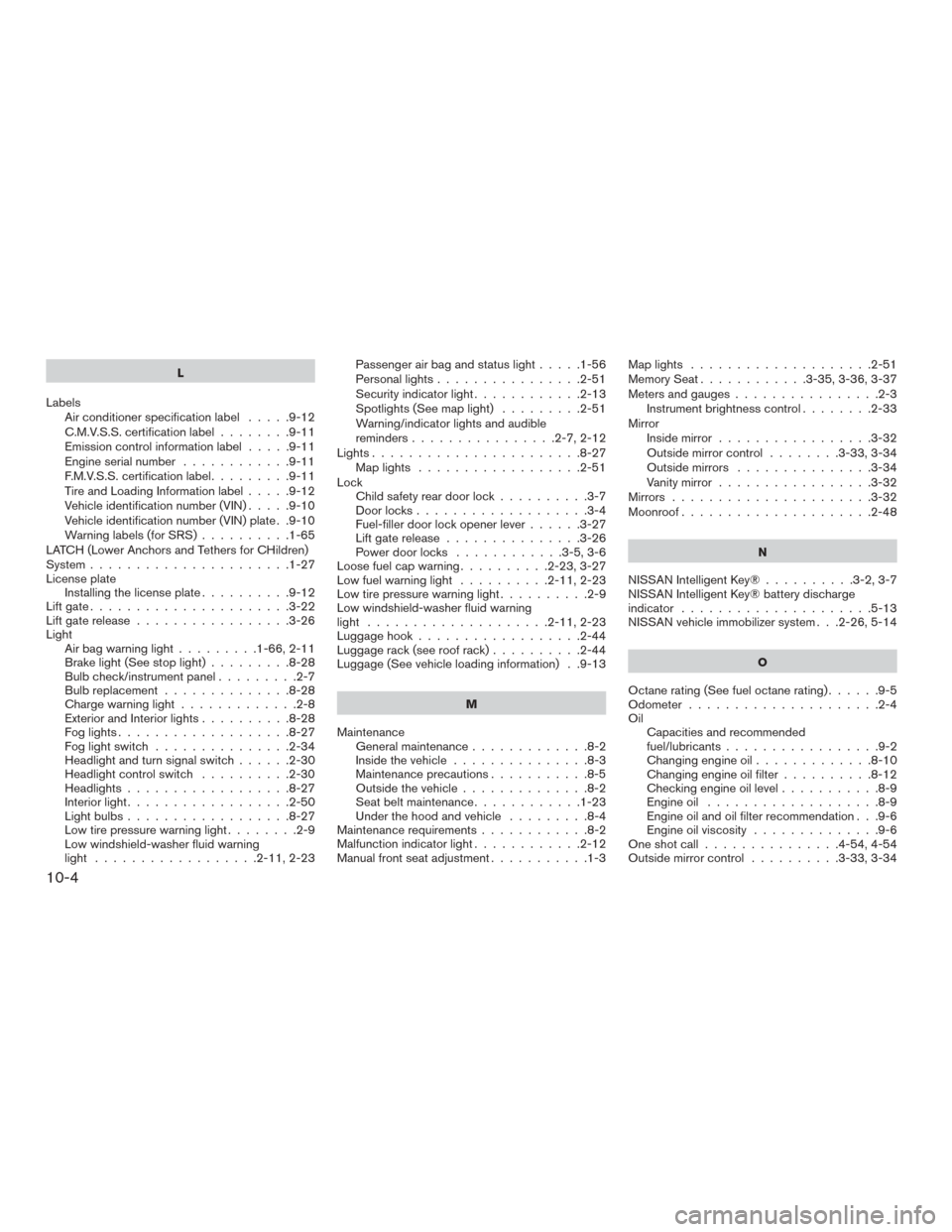
L
Labels Air conditioner specification label .....9-12
C.M.V.S.S. certification label ........9-11
Emissioncontrolinformationlabel.....9-11
Engine serial number ............9-11
F.M.V.S.S. certification label .........9-11
Tire and Loading Information label .....9-12
Vehicle identification number (VIN) .....9-10
Vehicle identification number (VIN) plate . .9-10
Warning labels (for SRS) ..........1-65
LATCH (Lower Anchors and Tethers for CHildren)
System ......................1-27
License plate Installing the license plate ..........9-12
Liftgate......................3-22
Liftgaterelease.................3-26
Light Airbagwarninglight.........1-66,2-11
Brake light (See stop light) .........8-28
Bulb check/instrument panel .........2-7
Bulb replacement ..............8-28
Charge warning light .............2-8
ExteriorandInteriorlights..........8-28
Foglights...................8-27
Foglightswitch ...............2-34
Headlight and turn signal switch ......2-30
Headlight control switch ..........2-30
Headlights ..................8-27
Interiorlight..................2-50
Lightbulbs..................8-27
Low tire pressure warning light ........2-9
Low windshield-washer fluid warning
light ..................2-11,2-23 Passenger air bag and status light
.....1-56
Personal lights ................2-51
Security indicator light ............2-13
Spotlights(Seemaplight) .........2-51
Warning/indicator lights and audible
reminders ................2-7,2-12
Lights.......................8-27 Maplights ..................2-51
Lock Child safety rear door lock ..........3-7
Door locks ...................3-4
Fuel-filler door lock opener lever ......3-27
Liftgaterelease...............3-26
Power door locks ............3-5,3-6
Loose fuel cap warning ..........2-23,3-27
Lowfuelwarninglight ..........2-11,2-23
Low tire pressure warning light ..........2-9
Low windshield-washer fluid warning
light ....................2-11,2-23
Luggage hook ..................2-44
Luggage rack (see roof rack) ..........2-44
Luggage (See vehicle loading information) . .9-13
M
Maintenance Generalmaintenance.............8-2
Insidethevehicle...............8-3
Maintenance precautions ...........8-5
Outside the vehicle ..............8-2
Seatbeltmaintenance............1-23
Underthehoodandvehicle .........8-4
Maintenancerequirements............8-2
Malfunction indicator light ............2-12
Manual front seat adjustment ...........1-3Maplights ....................2-51
Memory Seat
............3-35,3-36,3-37
Meters and gauges ................2-3
Instrument brightness control ........2-33
Mirror Inside mirror .................3-32
Outside mirror control ........3-33,3-34
Outside mirrors ...............3-34
Vanity mirror .................3-32
Mirrors ......................3-32
Moonroof .....................2-48
N
NISSAN Intelligent Key® ..........3-2,3-7
NISSAN Intelligent Key® battery discharge
i
ndicator .....................5-13
NISSAN vehicle immobilizer system . . .2-26, 5-14
O
Octane rating (See fuel octane rating) ......9-5
Odometer .....................2-4
Oil Capacities and recommended
fuel/lubricants.................9-2
Changingengineoil.............8-10
Changing engine oil filter ..........8-12
Checking engine oil level ...........8-9
Engineoil ...................8-9
Engine oil and oil filter recommendation . . .9-6
Engine oil viscosity ..............9-6
Oneshotcall...............4-54,4-54
Outside mirror control ..........3-33,3-34
10-4
Page 420 of 424
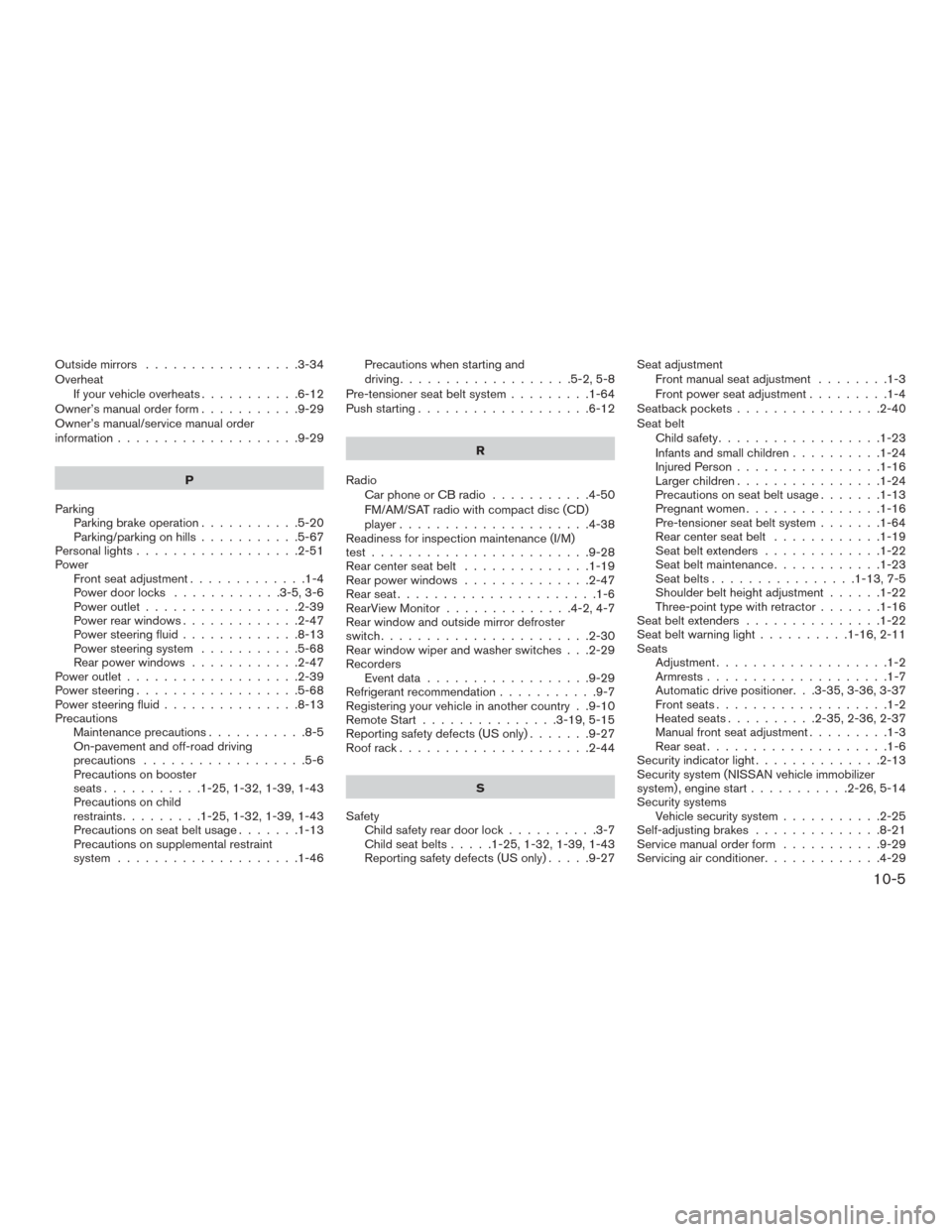
Outside mirrors.................3-34
Overheat Ifyourvehicleoverheats...........6-12
Owner’s manual order form ...........9-29
Owner’s manual/service manual order
information ....................9-29
P
Parking Parking brake operation ...........5-20
Parking/parking on hills ...........5-67
Personallights..................2-51
Power Front seat adjustment .............1-4
Power door locks ............3-5,3-6
Power outlet .................2-39
Power rear windows .............2-47
Power steering fluid .............8-13
Power steering system ...........5-68
Rear power windows ............2-47
Power outlet ...................2-39
Power steering ..................5-68
Power steering fluid ...............8-13
Precautions Maintenance precautions ...........8-5
On-pavement and off-road driving
precautions ..................5-6
Precautions on booster
seats...........1-25,1-32,1-39,1-43
Precautions on child
restraints .........1-25,1-32,1-39,1-43
Precautionsonseatbeltusage.......1-13
Precautions on supplemental restraint
system ....................1-46 Precautions when starting and
driving
...................5-2,5-8
Pre-tensioner seat belt system .........1-64
Push starting ...................6-12
R
Radio Car phone or CB radio ...........4-50
FM/AM/SAT radio with compact disc (CD)
player .....................4-38
Readiness for inspection maintenance (I/M)
test........................9-28
Rear center seat belt ..............1-19
Rear power windows ..............2-47
Rearseat......................1-6
RearView Monitor ..............4-2,4-7
Rear window and outside mirror defroster
switch .......................2-30
Rear window wiper and washer switches . . .2-29
Recorders Eventdata..................9-29
Refrigerant recommendation ...........9-7
Registering your vehicle in another country . .9-10
Remote Start ...............3-19,5-15
Reporting safety defects (US only) .......9-27
Roof rack .....................2-44
S
Safety Child safety rear door lock ..........3-7
Child seat belts .....1-25,1-32,1-39,1-43
Reporting safety defects (US only) .....9-27Seat adjustment
Front manual seat adjustment ........1-3
Front power seat adjustment .........1-4
Seatbackpockets................2-40
Seat belt Child safety ..................1-23
Infants and small children ..........1-24
Injured Person ................1-16
Largerchildren................1-24
Precautions on seat belt usage .......1-13
Pregnant women ...............1-16
Pre-tensioner seat belt system .......1-64
Rear center seat belt ............1-19
Seatbeltextenders .............1-22
Seatbeltmaintenance............1-23
S
eatbelts................1-13,7-5
Shoulder belt height adjustment ......1-22
Three-point type with retractor .......1-16
Seat belt extenders ...............1-22
Seatbeltwarninglight..........1-16,2-11
Seats Adjustment ...................1-2
Armrests....................1-7
Automatic drive positioner. . .3-35, 3-36, 3-37
Frontseats...................1-2
Heatedseats..........2-35, 2-36, 2-37
Manualfrontseatadjustment.........1-3
Rearseat....................1-6
Security indicator light ..............2-13
Security system (NISSAN vehicle immobilizer
system) , engine start ...........2-26,5-14
Security systems Vehicle security system ...........2-25
Self-adjusting brakes ..............8-21
Service manual order form ...........9-29
Servicing air conditioner .............4-29
10-5