2015 NISSAN MURANO engine coolant
[x] Cancel search: engine coolantPage 360 of 424
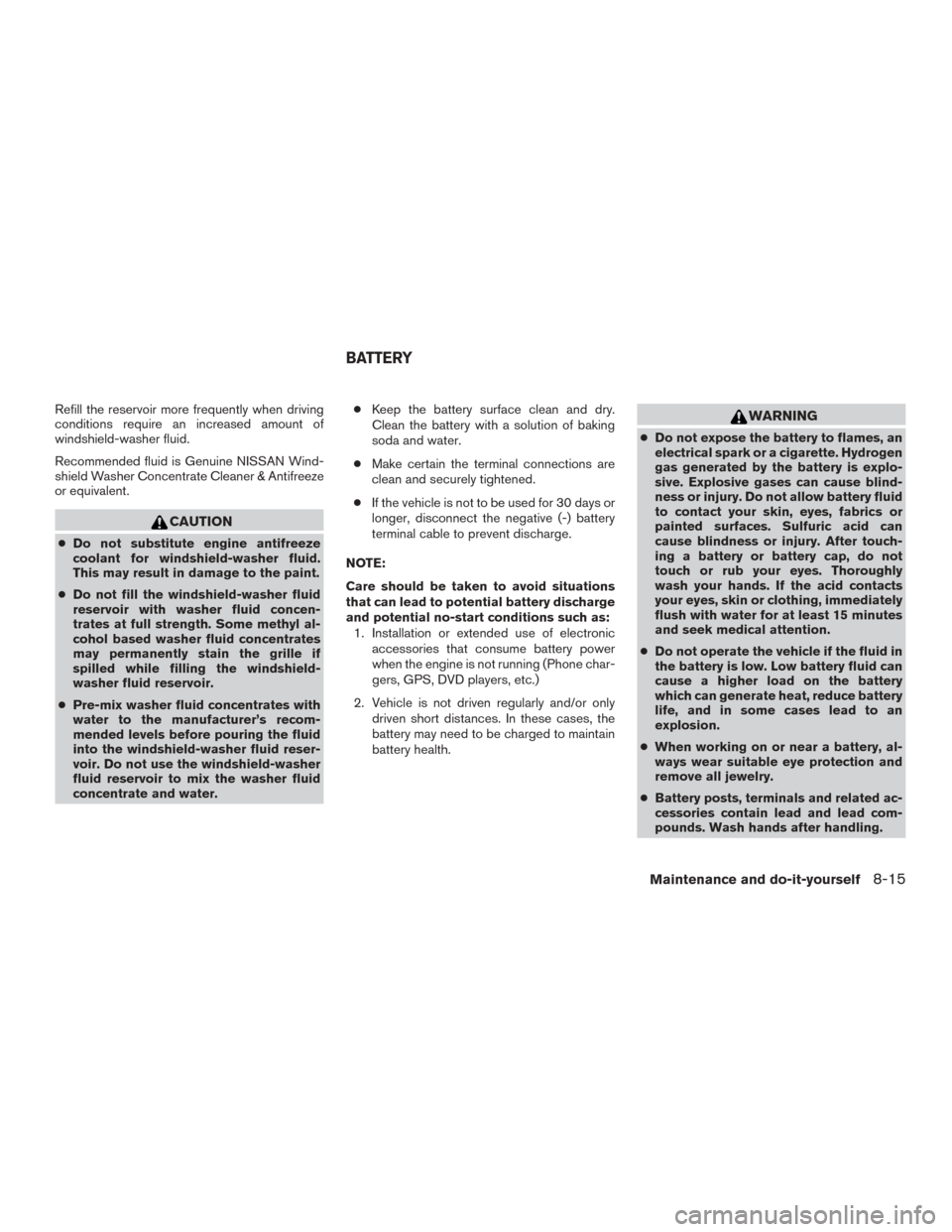
Refill the reservoir more frequently when driving
conditions require an increased amount of
windshield-washer fluid.
Recommended fluid is Genuine NISSAN Wind-
shield Washer Concentrate Cleaner & Antifreeze
or equivalent.
CAUTION
●Do not substitute engine antifreeze
coolant for windshield-washer fluid.
This may result in damage to the paint.
● Do not fill the windshield-washer fluid
reservoir with washer fluid concen-
trates at full strength. Some methyl al-
cohol based washer fluid concentrates
may permanently stain the grille if
spilled while filling the windshield-
washer fluid reservoir.
● Pre-mix washer fluid concentrates with
water to the manufacturer’s recom-
mended levels before pouring the fluid
into the windshield-washer fluid reser-
voir. Do not use the windshield-washer
fluid reservoir to mix the washer fluid
concentrate and water. ●
Keep the battery surface clean and dry.
Clean the battery with a solution of baking
soda and water.
● Make certain the terminal connections are
clean and securely tightened.
● If the vehicle is not to be used for 30 days or
longer, disconnect the negative (-) battery
terminal cable to prevent discharge.
NOTE:
Care should be taken to avoid situations
that can lead to potential battery discharge
and potential no-start conditions such as: 1. Installation or extended use of electronic accessories that consume battery power
when the engine is not running (Phone char-
gers, GPS, DVD players, etc.)
2. Vehicle is not driven regularly and/or only driven short distances. In these cases, the
battery may need to be charged to maintain
battery health.
WARNING
●Do not expose the battery to flames, an
electrical spark or a cigarette. Hydrogen
gas generated by the battery is explo-
sive. Explosive gases can cause blind-
ness or injury. Do not allow battery fluid
to contact your skin, eyes, fabrics or
painted surfaces. Sulfuric acid can
cause blindness or injury. After touch-
ing a battery or battery cap, do not
touch or rub your eyes. Thoroughly
wash your hands. If the acid contacts
your eyes, skin or clothing, immediately
flush with water for at least 15 minutes
and seek medical attention.
● Do not operate the vehicle if the fluid in
the battery is low. Low battery fluid can
cause a higher load on the battery
which can generate heat, reduce battery
life, and in some cases lead to an
explosion.
● When working on or near a battery, al-
ways wear suitable eye protection and
remove all jewelry.
● Battery posts, terminals and related ac-
cessories contain lead and lead com-
pounds. Wash hands after handling.
BATTERY
Maintenance and do-it-yourself8-15
Page 387 of 424
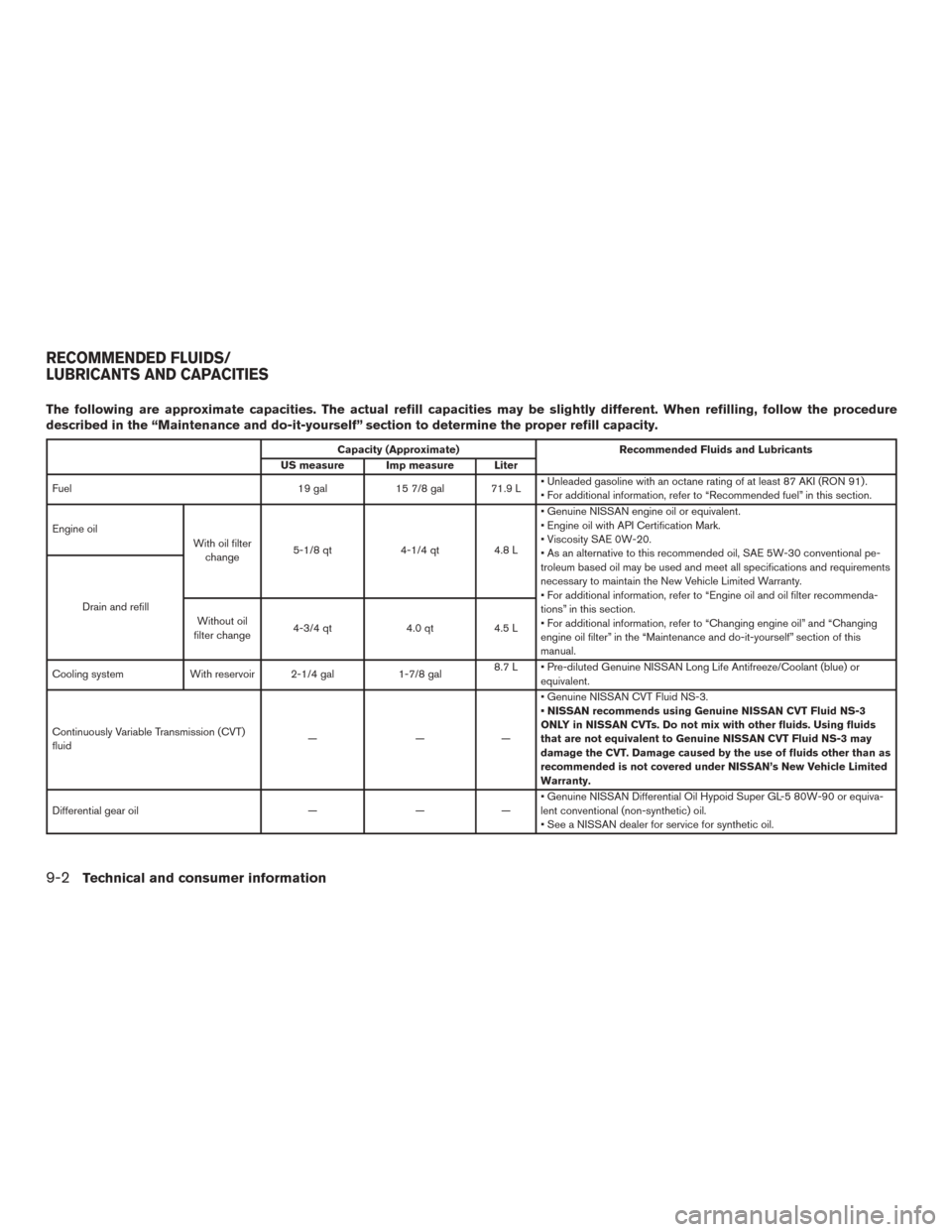
The following are approximate capacities. The actual refill capacities may be slightly different. When refilling, follow the procedure
described in the “Maintenance and do-it-yourself” section to determine the proper refill capacity.
Capacity (Approximate)Recommended Fluids and Lubricants
US measure Imp measure Liter
Fuel 19 gal15 7/8 gal 71.9 L • Unleaded gasoline with an octane rating of at least 87 AKI (RON 91) .
• For additional information, refer to “Recommended fuel” in this section.
Engine oil With oil filterchange 5-1/8 qt
4-1/4 qt4.8 L• Genuine NISSAN engine oil or equivalent.
• Engine oil with API Certification Mark.
• Viscosity SAE 0W-20.
• As an alternative to this recommended oil, SAE 5W-30 conventional pe-
troleum based oil may be used and meet all specifications and requirements
necessary to maintain the New Vehicle Limited Warranty.
• For additional information, refer to “Engine oil and oil filter recommenda-
tions” in this section.
• For additional information, refer to “Changing engine oil” and “Changing
engine oil filter” in the “Maintenance and do-it-yourself” section of this
manual.
Drain and refill
Without oil
filter change 4-3/4 qt
4.0 qt4.5 L
Cooling system With reservoir 2-1/4 gal 1-7/8 gal8.7 L • Pre-diluted Genuine NISSAN Long Life Antifreeze/Coolant (blue) or
equivalent.
Continuously Variable Transmission (CVT)
fluid ———• Genuine NISSAN CVT Fluid NS-3.
• NISSAN recommends using Genuine NISSAN CVT Fluid NS-3
ONLY in NISSAN CVTs. Do not mix with other fluids. Using fluids
that are not equivalent to Genuine NISSAN CVT Fluid NS-3 may
damage the CVT. Damage caused by the use of fluids other than as
recommended is not covered under NISSAN’s New Vehicle Limited
Warranty.
Differential gear oil ———• Genuine NISSAN Differential Oil Hypoid Super GL-5 80W-90 or equiva-
lent conventional (non-synthetic) oil.
• See a NISSAN dealer for service for synthetic oil.
RECOMMENDED FLUIDS/
LUBRICANTS AND CAPACITIES
9-2Technical and consumer information
Page 409 of 424
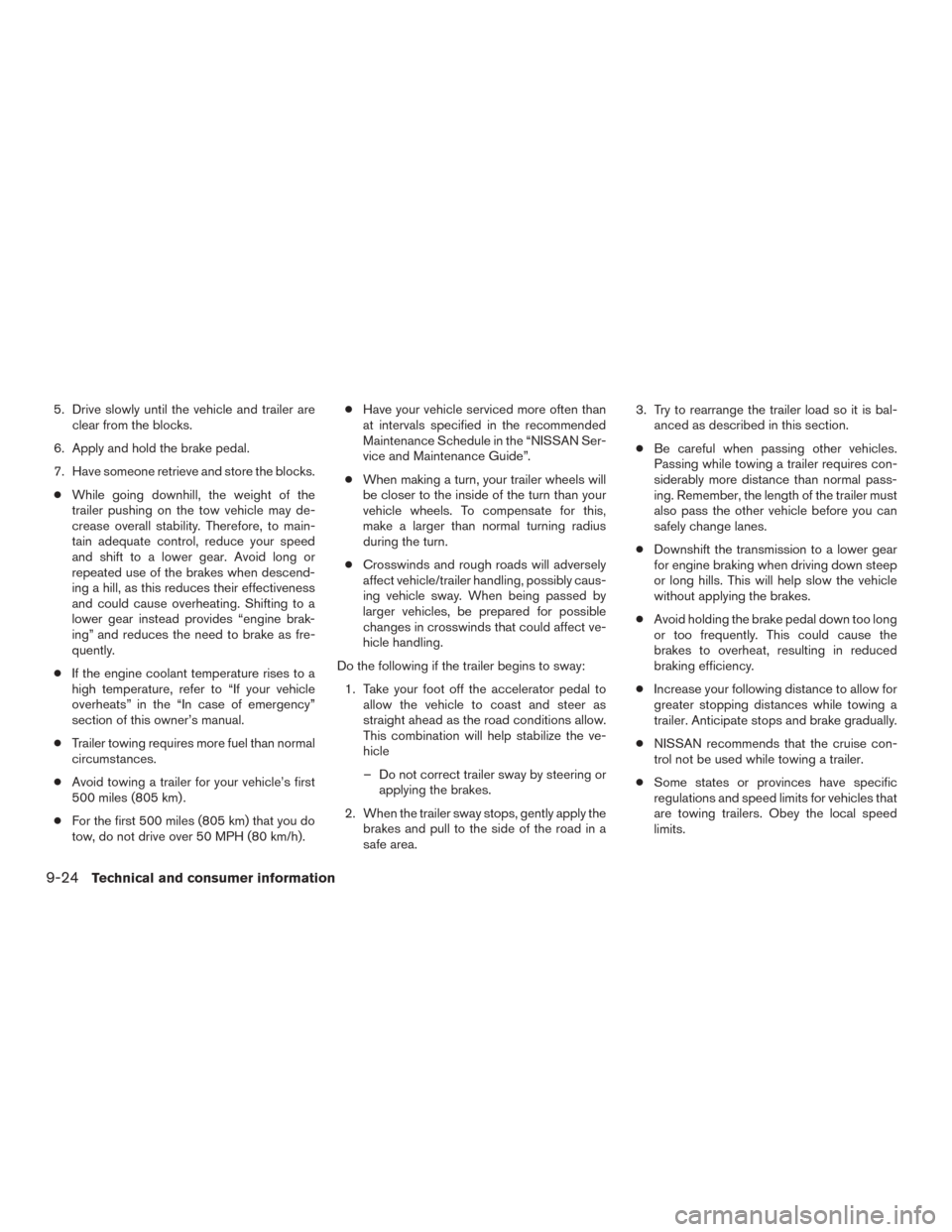
5. Drive slowly until the vehicle and trailer areclear from the blocks.
6. Apply and hold the brake pedal.
7. Have someone retrieve and store the blocks. ● While going downhill, the weight of the
trailer pushing on the tow vehicle may de-
crease overall stability. Therefore, to main-
tain adequate control, reduce your speed
and shift to a lower gear. Avoid long or
repeated use of the brakes when descend-
ing a hill, as this reduces their effectiveness
and could cause overheating. Shifting to a
lower gear instead provides “engine brak-
ing” and reduces the need to brake as fre-
quently.
● If the engine coolant temperature rises to a
high temperature, refer to “If your vehicle
overheats” in the “In case of emergency”
section of this owner’s manual.
● Trailer towing requires more fuel than normal
circumstances.
● Avoid towing a trailer for your vehicle’s first
500 miles (805 km) .
● For the first 500 miles (805 km) that you do
tow, do not drive over 50 MPH (80 km/h). ●
Have your vehicle serviced more often than
at intervals specified in the recommended
Maintenance Schedule in the “NISSAN Ser-
vice and Maintenance Guide”.
● When making a turn, your trailer wheels will
be closer to the inside of the turn than your
vehicle wheels. To compensate for this,
make a larger than normal turning radius
during the turn.
● Crosswinds and rough roads will adversely
affect vehicle/trailer handling, possibly caus-
ing vehicle sway. When being passed by
larger vehicles, be prepared for possible
changes in crosswinds that could affect ve-
hicle handling.
Do the following if the trailer begins to sway: 1. Take your foot off the accelerator pedal to allow the vehicle to coast and steer as
straight ahead as the road conditions allow.
This combination will help stabilize the ve-
hicle
– Do not correct trailer sway by steering or applying the brakes.
2. When the trailer sway stops, gently apply the brakes and pull to the side of the road in a
safe area. 3. Try to rearrange the trailer load so it is bal-
anced as described in this section.
● Be careful when passing other vehicles.
Passing while towing a trailer requires con-
siderably more distance than normal pass-
ing. Remember, the length of the trailer must
also pass the other vehicle before you can
safely change lanes.
● Downshift the transmission to a lower gear
for engine braking when driving down steep
or long hills. This will help slow the vehicle
without applying the brakes.
● Avoid holding the brake pedal down too long
or too frequently. This could cause the
brakes to overheat, resulting in reduced
braking efficiency.
● Increase your following distance to allow for
greater stopping distances while towing a
trailer. Anticipate stops and brake gradually.
● NISSAN recommends that the cruise con-
trol not be used while towing a trailer.
● Some states or provinces have specific
regulations and speed limits for vehicles that
are towing trailers. Obey the local speed
limits.
9-24Technical and consumer information
Page 417 of 424
Child restraints.......1-23,1-24,1-25,1-27
LATCH (Lower Anchors and Tethers for
CHildren) System ..............1-27
Precautions on child
restraints.........1-25,1-32,1-39,1-43
Top tether strap anchor point locations . .1-30
Child restraint with top tether strap .......1-29
Child safety rear door lock ............3-7
Chimes, audible reminders ...........2-14
Cleaningexteriorandinterior........7-2,7-4
Clock setting
(models without Navigation System) ......4-39
C.M.V.S.S. certification label ..........9-11
Cold weather driving ...............5-73
Compact disc (CD) player ...........4-41
Connect phone .................4-50
Consolebox...................2-43
Continuously Variable Transmission (CVT) . . .5-15 Continuously Variable Transmission (CVT)
fluid ......................8-13
Driving with Continuously Variable
Transmission (CVT) .............5-15
Controls Heater and air conditioner controls .....4-27
Coolant Capacities and recommended
fuel/lubricants .................9-2
Changing engine coolant ...........8-8
Checking engine coolant level ........8-8
Engine coolant temperature gauge .....2-5
Corrosionprotection ...............7-5
Cruisecontrol..................5-33
Cupholders...................2-41 D
Daytime running light system (Canada only) . .2-32
Defroster switch Rear window and outside mirror defroster
switch.....................2-30
Dimensionsandweights.............9-9
Dimmer switch for instrument panel ......2-33
Door locks .....................3-4
Drive belt .....................8-17
Drive positioner, Automatic ....3-35,3-36,3-37
Driving Cold weather driving .............5-73
Driving with Continuously Variable
Transmission (CVT) .............5-15
Precautions when starting and
driving ...................5-2,5-8
Driving the vehicle ................5-15
E
Economy - fuel ..................5-64
Emission control information label .......9-11
Emission control system warranty .......9-27
Engine Before starting the engine ..........5-14
Block heater .................5-74
Capacities and recommended
fuel/lubricants .................9-2
Changingenginecoolant...........8-8
Changingengineoil.............8-10
Changing engine oil filter ..........8-12
Checking engine coolant level ........8-8
Checking engine oil level ...........8-9 Engine compartment check locations
....8-6
Engine coolant temperature gauge .....2-5
Engine cooling system ............8-7
Engineoil ...................8-9
Engine oil and oil filter recommendation . . .9-6
Engine oil pressure warning light ....2-8,2-9
Engine oil viscosity ..............9-6
Engine serial number ............9-11
Engine specifications .............9-8
Starting the engine .............5-14
Engine coolant temperature gauge .......2-5
Event
data recorders ..............9-29
Exhaust gas (Carbon monoxide) .........5-2
Explanation of maintenance items ........8-2
Extended storage switch ............8-24
Eyeglass case ..................2-41
F
Flashers (See hazard warning flasher switch) . .6-2
Flat tire .......................6-3
Floor mat positioning aid .............7-5
Fluid Brake fluid ..................8-14
Capacities and recommended
fuel/lubricants.................9-2
Continuously Variable Transmission (CVT)
fluid......................8-13
Enginecoolant.................8-7
Engineoil ...................8-9
Power steering fluid .............8-13
Windshield-washer fluid ...........8-14
F.M.V.S.S. certification label ...........9-11
Foglightswitch .................2-34
10-2
Page 418 of 424
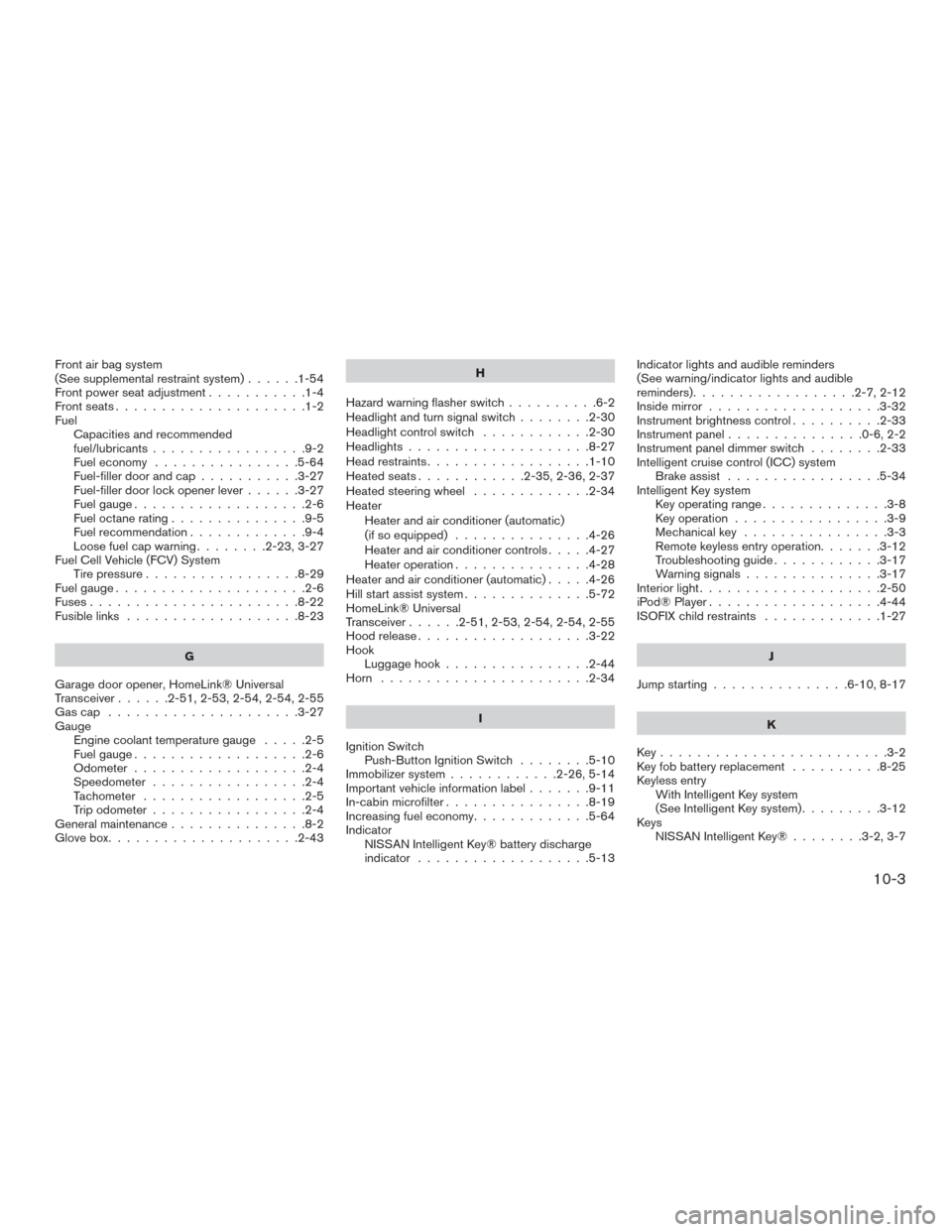
Front air bag system
(See supplemental restraint system)......1-54
Front power seat adjustment ...........1-4
Frontseats.....................1-2
Fuel Capacities and recommended
fuel/lubricants .................9-2
Fuel economy ................5-64
Fuel-filler door and cap ...........3-27
Fuel-filler door lock opener lever ......3-27
Fuel gauge ...................2-6
Fuel octane rating ...............9-5
Fuel recommendation .............9-4
Loose fuel cap warning ........2-23,3-27
Fuel Cell Vehicle (FCV) System Tirepressure.................8-29
Fuel gauge .....................2-6
Fuses.......................8-22
Fusible links ...................8-23
G
Garage door opener, HomeLink® Universal
Transceiver......2-51,2-53,2-54,2-54,2-55
Gascap .....................3-27
Gauge Engine coolant temperature gauge .....2-5
Fuel gauge ...................2-6
Odometer ...................2-4
Speedometer .................2-4
Tachometer ..................2-5
Trip odometer .................2-4
General maintenance ...............8-2
Glovebox.....................2-43 H
Hazard warning flasher switch ..........6-2
Headlight and turn signal switch ........2-30
Headlight control switch ............2-30
Headlights ....................8-27
Head restraints ..................1-10
Heated seats ............2-35,2-36,2-37
Heated steering wheel .............2-34
Heater Heater and air conditioner (automatic)
(if so equipped) ...............4-26
Heater and air conditioner controls .....4-27
Heater operation ...............4-28
Heater and air conditioner (automatic) .....4-26
Hill start assist system ..............5-72
HomeLink® Universal
Transceiver ......2-51,2-53,2-54,2-54,2-55
Hood release ...................3-22
Hook Luggage hook ................2-44
Horn .......................2-34
I
Ignition Switch Push-Button Ignition Switch ........5-10
Immobilizer system ............2-26,5-14
Important vehicle information label .......9-11
In-cabin microfilter ................8-19
Increasing fuel economy .............5-64
Indicator NISSAN Intelligent Key® battery discharge
indicator ...................5-13 Indicator lights and audible reminders
(See warning/indicator lights and audible
reminders)..................2-7,2-12
Inside mirror
...................3-32
Instrument brightness control ..........2-33
Instrumentpanel...............0-6,2-2
Instrument panel dimmer switch ........2-33
Intelligent cruise control (ICC) system Brake
assist.................5-34
Intelligent Key system Key operating range ..............3-8
Key operation .................3-9
Mechanical key ................3-3
Remote keyless entry operation.......3-12
Troubleshooting guide ............3-17
Warning signals ...............3-17
Interior light ....................2-50
iPod®Player...................4-44
ISOFIX child restraints .............1-27
J
Jump starting ...............6-10,8-17
K
Key.........................3-2
Key fob battery replacement ..........8-25
Keyless entry With Intelligent Key system
(See Intelligent Key system) .........3-12
Keys NISSAN Intelligent Key® ........3-2,3-7
10-3
Page 421 of 424
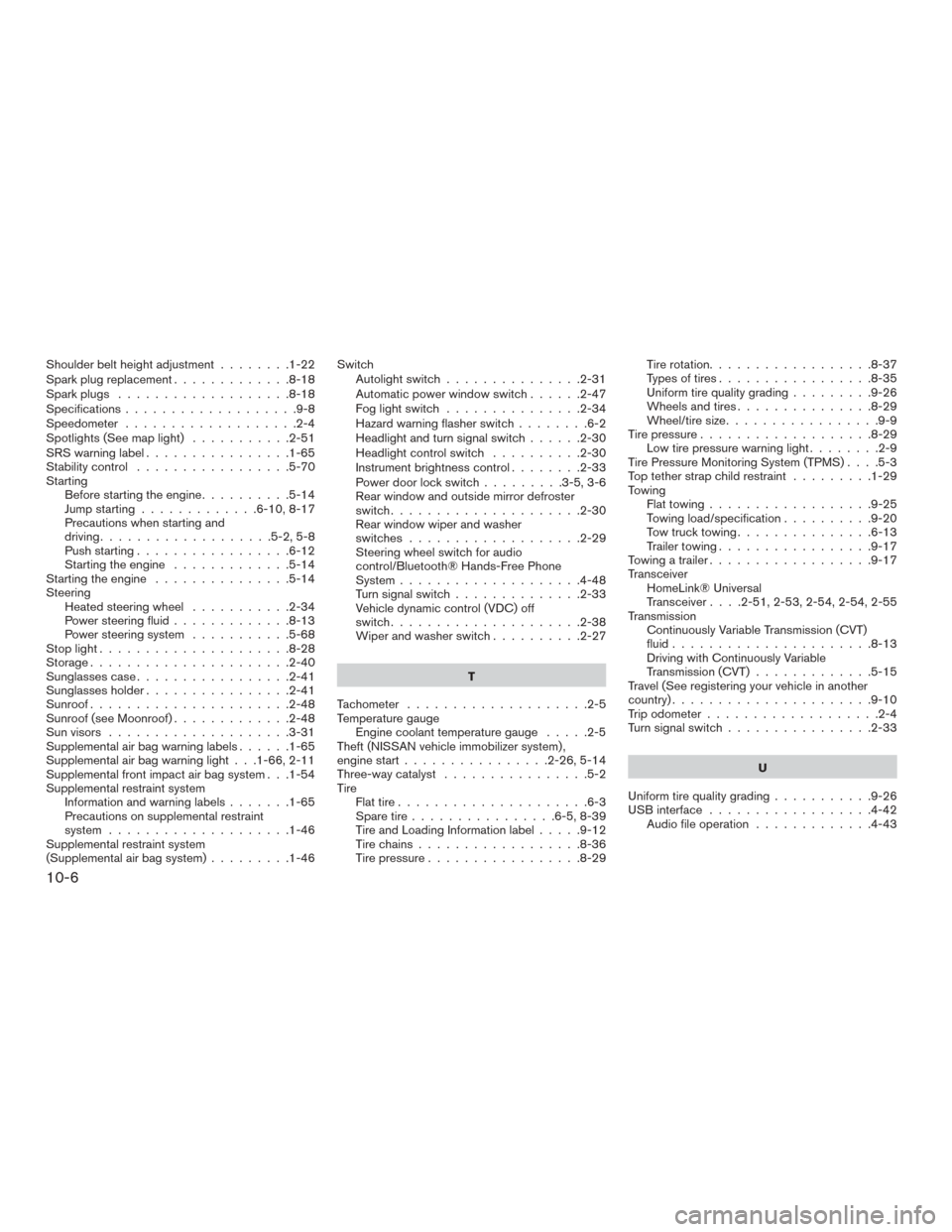
Shoulder belt height adjustment........1-22
Spark plug replacement .............8-18
Spark plugs ...................8-18
Specifications ...................9-8
Speedometer ...................2-4
Spotlights(Seemaplight) ...........2-51
SRS warning label ................1-65
Stability control .................5-70
Starting Before starting the engine ..........5-14
Jump starting .............6-10,8-17
Precautions when starting and
driving ...................5-2,5-8
Push starting .................6-12
Starting the engine .............5-14
Starting the engine ...............5-14
Steering Heated steering wheel ...........2-34
Power steering fluid .............8-13
Power steering system ...........5-68
Stoplight.....................8-28
Storage......................2-40
Sunglassescase.................2-41
Sunglassesholder................2-41
Sunroof......................2-48
Sunroof (see Moonroof) .............2-48
Sun visors ....................3-31
Supplemental air bag warning labels ......1-65
Supplemental air bag warning light . . .1-66, 2-11
Supplemental front impact air bag system . . .1-54
Supplemental restraint system Information and warning labels .......1-65
Precautions on supplemental restraint
system ....................1-46
Supplemental restraint system
(Supplemental air bag system) .........1-46Switch
Autolightswitch...............2-31
Automatic power window switch ......2-47
Foglightswitch ...............2-34
Hazard warning flasher switch ........6-2
Headlight and turn signal switch ......2-30
Headlight control switch ..........2-30
Instrument brightness control ........2-33
Power door lock switch .........3-5,3-6
Rear window and outside mirror defroster
switch.....................2-30
Rear window wiper and washer
switches...................2-29
Steering wheel switch for audio
control/Bluetooth® Hands-Free Phone
System ....................4-48
Turn signal switch ..............2-33
Vehicle dynamic control (VDC) off
switch.....................2-38
Wiperandwasherswitch..........2-27
T
Tachometer ....................2-5
Temperature gauge Engine coolant temperature gauge .....2-5
Theft (NISSAN vehicle immobilizer system) ,
engine start ................2-26,5-14
Three-way catalyst ................5-2
Tire Flat tire .....................6-3
Spare tire ................6-5,8-39
Tire and Loading Information label .....9-12
Tirechains..................8-36
Tire pressure .................8-29 Tire rotation..................8-37
Types of tires
.................8-35
Uniform tire quality grading .........9-26
Wheels and tires ...............8-29
Wheel/tire size .................9-9
Tirepressure...................8-29 Low tire pressure warning light ........2-9
Tire Pressure Monitoring System (TPMS) ....5-3
Top tether strap child restraint .........1-29
Towing Flattowing..................9-25
T
owing load/specification ..........9-20
Towtrucktowing...............6-13
Trailer towing .................9-17
Towing a trailer ..................9-17
Transceiver HomeLink® Universal
Transceiver ....2-51,2-53,2-54,2-54,2-55
Transmission Continuously Variable Transmission (CVT)
fluid......................8-13
Driving with Continuously Variable
Transmission (CVT) .............5-15
Travel (See registering your vehicle in another
country) ......................9-10
Trip odometer ...................2-4
Turn signal switch ................2-33
U
Uniform tire quality grading ...........9-26
USB interface ..................4-42
Audio file operation .............4-43
10-6