2015 NISSAN LEAF belt
[x] Cancel search: beltPage 204 of 412
• Do not place the Intelligent Key nearan electric appliance such as a televi-
sion set, personal computer or cellular
phone.
• Do not allow the Intelligent Key to come into contact with water or salt
water, and do not wash it in a washing
machine. This could affect the system
function.
If an Intelligent Key is lost or stolen,
NISSAN recommends erasing the ID
code of that Intelligent Key. This will pre-
vent the Intelligent Key from unauthor-
ized use to unlock the vehicle. For infor-
mation regarding the erasing procedure,
contact a NISSAN certified LEAF dealer.
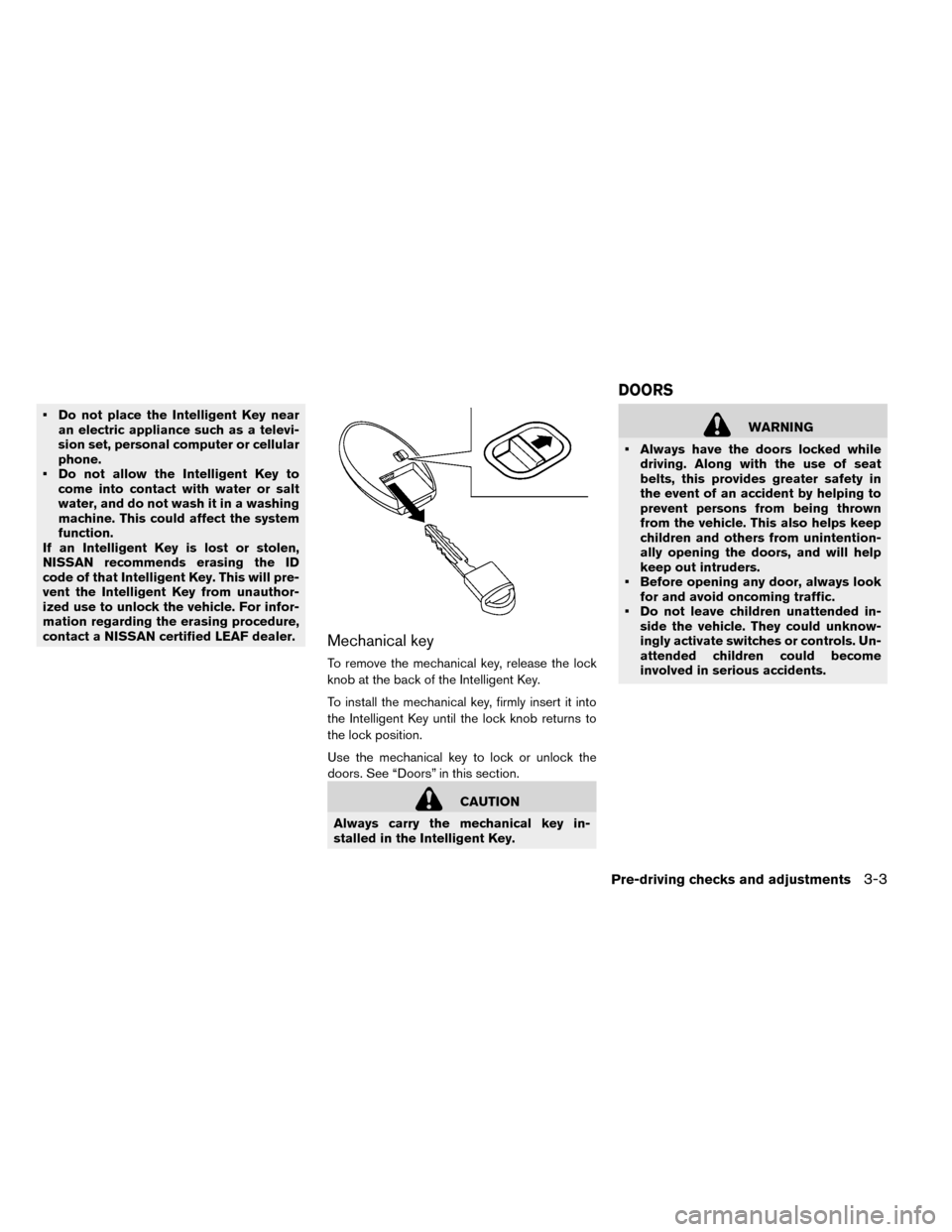
Mechanical key
To remove the mechanical key, release the lock
knob at the back of the Intelligent Key.
To install the mechanical key, firmly insert it into
the Intelligent Key until the lock knob returns to
the lock position.
Use the mechanical key to lock or unlock the
doors. See “Doors” in this section.
CAUTION
Always carry the mechanical key in-
stalled in the Intelligent Key.
WARNING
• Always have the doors locked while driving. Along with the use of seat
belts, this provides greater safety in
the event of an accident by helping to
prevent persons from being thrown
from the vehicle. This also helps keep
children and others from unintention-
ally opening the doors, and will help
keep out intruders.
• Before opening any door, always look for and avoid oncoming traffic.
• Do not leave children unattended in- side the vehicle. They could unknow-
ingly activate switches or controls. Un-
attended children could become
involved in serious accidents.
DOORS
Pre-driving checks and adjustments3-3
Page 292 of 412
– There is a malfunction in the horn or hazardindicators.
– If the Easy Fill Tire Alert does not operate due to TPMS interference, move the vehicle
about 3 ft (1 m) backward or forward and try
again.
If the Easy Fill Tire Alert is not working, use a tire
pressure gauge.
AVOIDING COLLISION AND
ROLLOVER
WARNING
Failure to operate this vehicle in a safe
and prudent manner may result in loss of
control or an accident.
Be alert and drive defensively at all times. Obey
all traffic regulations. Avoid excessive speed,
high speed cornering, or sudden steering ma-
neuvers, because these driving practices could
cause you to lose control of your vehicle. As with
any vehicle, a loss of control could result in
a collision with other vehicles or objects, or
cause the vehicle to rollover, particularly if
the loss of control causes the vehicle to
slide sideways. Be attentive at all times, and avoid driving when tired. Never drive when under
the influence of alcohol or drugs (including pre-
scription or over-the-counter drugs which may
cause drowsiness) . Always wear your seat belt
as outlined in the “Seat belts” in the “Safety —
Seats seat belts and supplemental restraint sys-
tem” section of this manual, and also instruct your
passengers to do so.
Seat belts help reduce the risk of injury in colli-
sions and rollovers.
In a rollover crash, an
unbelted or improperly belted person is
significantly more likely to be injured or
killed than a person properly wearing a
seat belt.
OFF-ROAD RECOVERY
While driving, the right side or left side wheels
may unintentionally leave the road surface. If this
occurs, maintain control of the vehicle by follow-
ing the procedure below. Please note that this
procedure is only a general guide. The vehicle
must be driven as appropriate based on the con-
ditions of the vehicle, road and traffic.
1. Remain calm and do not overreact.
2. Do not apply the brakes.
3. Maintain a firm grip on the steering wheel with both hands and try to hold a straight course. 4. When appropriate, slowly release the accel-
erator pedal to gradually slow the vehicle.
5. If there is nothing in the way, steer the vehicle to follow the road while the vehicle speed is
reduced. Do not attempt to drive the vehicle
back onto the road surface until vehicle speed
is reduced.
6. When it is safe to do so, gradually turn the steering wheel until both tires return to the
road surface. When all tires are on the road
surface, steer the vehicle to stay in the appro-
priate driving lane.
• If you decide that it is not safe to return the vehicle to the road surface based on vehicle,
road or traffic conditions, gradually slow the
vehicle to a stop in a safe place off the road.RAPID AIR PRESSURE LOSS
Rapid air pressure loss or a “blow-out” can occur
if the tire is punctured or is damaged due to
hitting a curb or pothole. Rapid air pressure loss
can also be caused by driving on under-inflated
tires.
Rapid air pressure loss can affect the handling
and stability of the vehicle, especially at highway
speeds.
Starting and driving5-5
Page 297 of 412
4. Push the power switch while depressing thebrake pedal within 10 seconds after the
chime sounds. The power switch position
changes to READY to drive mode.
After step 3 is performed, if the power switch is
pushed without depressing the brake pedal, the
power switch position will change to ACC.
NOTE:
• When the power switch is pushed to the
ACC or ON position or READY to drive
mode by the above procedure, the Intelli-
gent Key battery discharge indicator ap-
pears on the vehicle information display
even if the Intelligent Key is inside the
vehicle. This is not a malfunction. To stop
the warning indicator from blinking, touch
the power switch with the Intelligent Key
again.
• If the Intelligent Key system battery dis-
charge indicator appears on the vehicle
information display, replace the battery as
soon as possible. See “NISSAN Intelligent
Key® battery replacement” in the “Main-
tenance and do-it-yourself” section. • Make sure that the area around the vehicle is
clear.
• Check fluid levels such as coolant, brake fluid, and window washer fluid as frequently as
possible.
• Check that all windows and lights are clean.
• Visually inspect tires for their appearance and condition. Also check tires for proper inflation.
• Check that all doors are closed.
• Adjust the inside and outside mirrors.
• Fasten seat belts and ask all passengers to do likewise.
• Check the operation of the warning lights when the power switch is pushed to the ON position.
(See “Warning/indicator lights and audible re-
minders” in the “Instruments and controls”
section.) 1. Confirm the parking brake is applied.
2. Confirm that the vehicle is in the P (Park)
position.
The EV (Electric Vehicle) is designed not to
operate unless the shift lever is in the P (Park)
or N (Neutral) positions.
The Intelligent Key must be carried with
you when operating the power switch.
3. Depress the brake pedal and push the power switch to place the EV (Electric Vehicle) sys-
tem in the READY to drive position.
To place the vehicle in the READY to drive
position immediately, push and release the
power switch while depressing the brake
pedal with the power switch in any position.
The READY to drive indicator light
in the
meter illuminates.
4. To stop the EV (Electric Vehicle) system, push the P (Park) position switch on the shift lever,
and push the power switch to the OFF
position.
BEFORE STARTING THE EV
(ELECTRIC VEHICLE) SYSTEM STARTING THE EV (ELECTRIC
VEHICLE) SYSTEM
5-10Starting and driving
Page 332 of 412
7 Appearance and care
Cleaning exterior...................... .7-2
Washing ......................... .7-2
Waxing .......................... .7-2
Removing spots ..................... .7-3
Underbody ........................ .7-3
Glass ........................... .7-3
Solar cell module (if so equipped) ...........7-3
Wheels .......................... .7-3
Chrome parts ...................... .7-4
Tire dressing ....................... .7-4
Cleaning interior ....................... .7-4Air fresheners
...................... .7-4
Floor mats ........................ .7-5
Seat belts ........................ .7-5
Electric Vehicle Supply Equipment (EVSE) ......7-6
Corrosion protection .................... .7-6
Most common factors contributing to vehicle
corrosion ......................... .7-6
Environmental factors influence the rate of
corrosion ......................... .7-6
To protect your vehicle from corrosion .........7-6
Page 336 of 412
Carefully read and follow the manufacturer’s in-
structions before using air fresheners.
FLOOR MATS
WARNING
To avoid potential pedal interference that
may result in a collision or injury:
• NEVER place a floor mat on top of another floor mat in the driver front
position.
• Use only genuine NISSAN floor mats specifically designed for use in your
vehicle model. See your NISSAN certi-
fied LEAF dealer for more information.
• Properly position the mats in the floor- well using the floor mat positioning
aid. See “Floor mat positioning aid
(driver’s side only)” in this section.
The use of genuine NISSAN floor mats can ex-
tend the life of your vehicle carpet and make it
easier to clean the interior. Mats should be main-
tained with regular cleaning and replaced if they
become excessively worn.
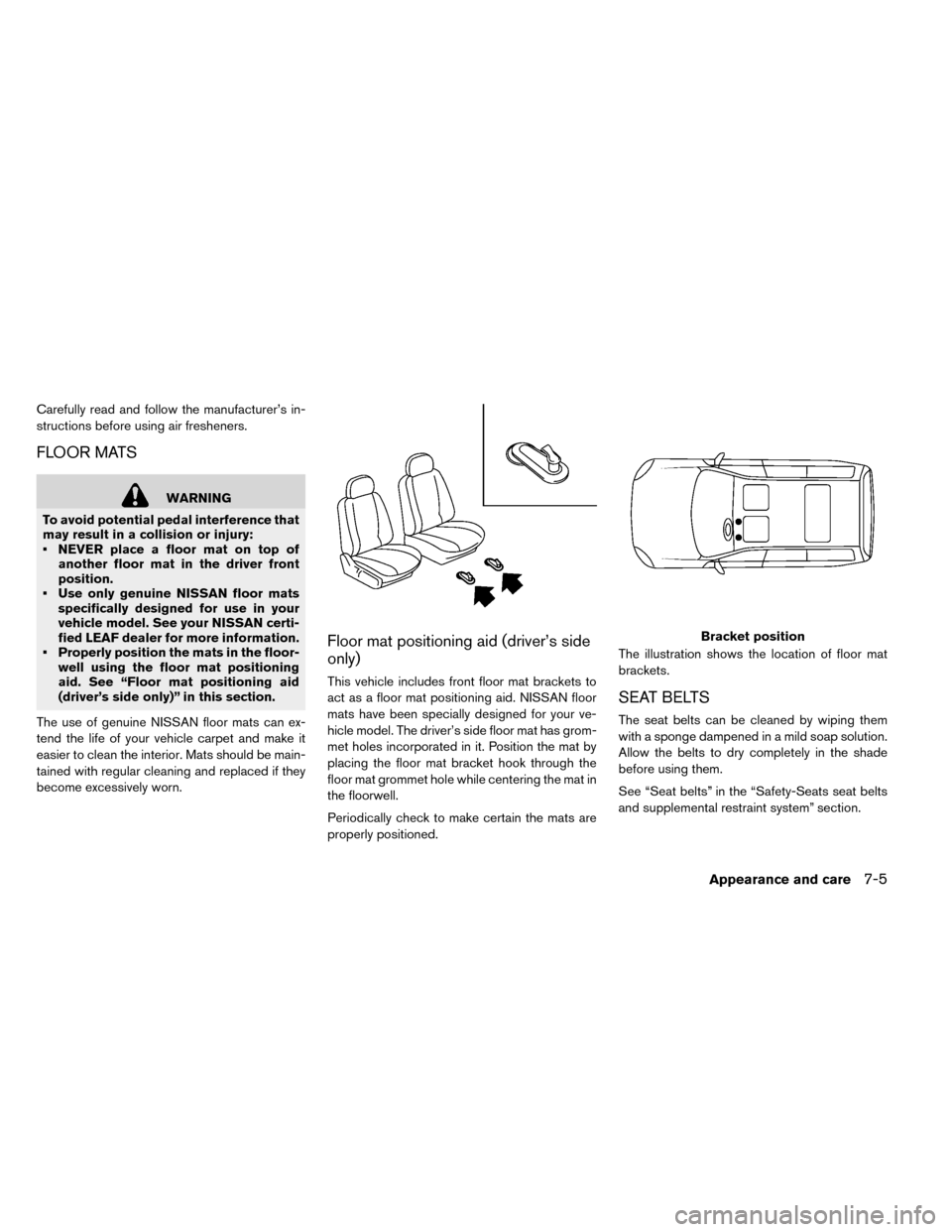
Floor mat positioning aid (driver’s side
only)
This vehicle includes front floor mat brackets to
act as a floor mat positioning aid. NISSAN floor
mats have been specially designed for your ve-
hicle model. The driver’s side floor mat has grom-
met holes incorporated in it. Position the mat by
placing the floor mat bracket hook through the
floor mat grommet hole while centering the mat in
the floorwell.
Periodically check to make certain the mats are
properly positioned. The illustration shows the location of floor mat
brackets.
SEAT BELTS
The seat belts can be cleaned by wiping them
with a sponge dampened in a mild soap solution.
Allow the belts to dry completely in the shade
before using them.
See “Seat belts” in the “Safety-Seats seat belts
and supplemental restraint system” section.
Bracket position
Appearance and care7-5
Page 337 of 412
WARNING
Do not allow wet seat belts to roll up in
the retractor. NEVER use bleach, dye, or
chemical solvents to clean the seat belts,
since these materials may severely
weaken the seat belt webbing.
ELECTRIC VEHICLE SUPPLY
EQUIPMENT (EVSE)
The Electric Vehicle Supply Equipment (EVSE)
can be cleaned by wiping gently with a soft cloth
dampened in a 3% mild soap solution. Wipe and
rinse the soap solution off with a cloth dampened
with water and allow the EVSE to dry in a shady
and well-ventilated place.
MOST COMMON FACTORS
CONTRIBUTING TO VEHICLE
CORROSION
• The accumulation of moisture-retaining dirt and debris in body panel sections, cavities, and
other areas.
• Damage to paint and other protective coatings caused by gravel and stone chips or minor
traffic accidents.
ENVIRONMENTAL FACTORS
INFLUENCE THE RATE OF
CORROSION
Moisture
Accumulation of sand, dirt and water on the ve-
hicle body underside can accelerate corrosion.
Wet floor coverings will not dry completely inside
the vehicle, and should be removed for drying to
avoid floor panel corrosion.
Relative humidity
Corrosion will be accelerated in areas of high
relative humidity, especially those areas where
the temperatures stay above freezing, where at-
mospheric pollution exists, or where road salt is
used.
Temperature
A temperature increase will accelerate the rate of
corrosion to those parts which are not well ven-
tilated.
Air pollution
Industrial pollution, the presence of salt in the air
in coastal areas, or heavy road salt use will accel-
erate the corrosion process. Road salt will also
accelerate the disintegration of paint surfaces.
TO PROTECT YOUR VEHICLE FROM
CORROSION
• Wash and wax your vehicle often to keep thevehicle clean.
• Always check for minor damage to the paint and repair it as soon as possible.
• Keep drain holes at the bottom of the doors open to avoid water accumulation.
• Check the underbody for accumulation of sand, dirt or salt. If present, wash with water as soon
as possible.
CORROSION PROTECTION
7-6Appearance and care
Page 343 of 412
head restraints/headrests move up and down
smoothly and that the locks (if so equipped) hold
securely in all latched positions.
Seat belts:Check that all parts of the seat belt
system (for example, buckles, anchors, adjusters
and retractors) operate properly and smoothly,
and are installed securely. Check the belt web-
bing for cuts, fraying, wear or damage.
Steering wheel: Check for changes in the
steering conditions, such as excessive free play,
hard steering or strange noises.
Warning lights and chimes: Make sure that all
warning lights and chimes are operating properly.
Windshield defroster: Check that the air emits
from the defroster outlets properly and in suffi-
cient quantity when operating the heater or air
conditioner.
Windshield wiper and washer*: Check that
the wipers and washers operate properly and
that the wipers do not streak.
Under hood and vehicle
The maintenance items listed here should be
checked periodically. 12-volt battery (for serviceable battery)*:
Check the fluid level in each cell. It should be
between the MAX and MIN lines. Vehicles oper-
ated in high temperatures or under severe condi-
tions require frequent checks of the 12–volt bat-
tery fluid level.
NOTE:
Care should be taken to avoid situations
that can lead to potential battery discharge
and potential no-start conditions such as:
1. Installation or extended use of electronic ac-
cessories that consume battery power when
the engine is not running (Phone chargers,
GPS, DVD players, etc.)
2. Vehicle is not driven regularly and/or only driven short distances.
In these cases, the battery may need to be
charged to maintain battery health.
Brake fluid level*: Make sure that the brake
fluid level is between the “MAX” and “MIN” lines
on the reservoir.
Coolant level*: Check the coolant level when
the motor compartment is cold. Fluid leaks:
Check under the vehicle for water
or other fluid leaks after the vehicle has been
parked for a while. Water dripping from the air
conditioner after use is normal. If you should
notice any leaks, check for cause and have it
corrected immediately.
Radiator and hoses: Check the front of the
radiator and clean off any dirt, insects, leaves,
etc., that may have accumulated. Make sure that
the hoses have no cracks, deformation, rot or
loose connections.
Underbody: The underbody is frequently ex-
posed to corrosive substances such as those
used on icy roads or to control dust. It is very
important to remove these substances, other-
wise rust will form on the floor pan and frame. At
the end of winter, the underbody should be thor-
oughly flushed with plain water, being careful to
clean those areas where mud and dirt may accu-
mulate. For additional information, see “Cleaning
exterior” in the “Appearance and care” section.
Windshield washer fluid*: Check that there is
an adequate amount of fluid in the reservoir.
8-4Maintenance and do-it yourself
Page 373 of 412
Replacing wheels and tires
When replacing a tire, use the same size, tread
design, speed rating and load carrying capacity
as originally equipped. See “Specifications” in
the “Technical and consumer information” sec-
tion for recommended types and sizes of tires
and wheels.
WARNING
• The use of tires other than those rec- ommended or the mixed use of tires of
different brands, construction (bias,
bias-belted or radial) , or tread patterns
can adversely affect the ride, braking,
handling, ground clearance, body-to-
tire clearance, tire chain clearance,
speedometer calibration, headlight
aim and bumper height. Some of these
effects may lead to accidents and
could result in serious personal injury.
• If your vehicle was originally equipped with 4 tires that were the same size
and you are only replacing 2 of the 4
tires, install the new tires on the rear
axle. Placing new tires on the front
axle may cause loss of vehicle control
in some driving conditions and cause
an accident and personal injury. • If the wheels are changed for any rea-
son, always replace with wheels which
have the same off-set dimension.
Wheels of a different off-set could
cause premature tire wear, degrade
vehicle handling characteristics
and/or interference with the brake
discs. Such interference can lead to
decreased braking efficiency and/or
early brake pad/shoe wear. See
“Wheels and tires” in the “Technical
and consumer information” section of
this manual for wheel off-set dimen-
sions.
• When a wheel is replaced, the TPMS will not function and the low tire pres-
sure warning light will flash for ap-
proximately 1 minute. The light will re-
main on after 1 minute. Contact your
NISSAN certified LEAF dealer as soon
as possible for tire replacement
and/or system resetting.
• Replacing tires with those not origi- nally specified by NISSAN could affect
the proper operation of the TPMS.
• Do not install a damaged or deformed wheel or tire even if it has been re-
paired. Such wheels or tires could have
structural damage and could fail with-
out warning. • The use of retread tire is not recom-
mended.
• For additional information regarding tires, refer to “Important Tire Safety
Information” (US) or “Tire Safety Infor-
mation” (Canada) in the Warranty In-
formation Booklet.Wheel balance
Unbalanced wheels may affect vehicle handling
and tire life. Even with regular use, wheels can get
out of balance. Therefore, they should be bal-
anced as required.
Wheel balance service should be per-
formed with the wheels off the vehicle.
Spin balancing the wheels on the vehicle
could lead to mechanical damage.
For additional information regarding tires, refer to
“Important Tire Safety Information” (US) or “Tire
Safety Information” (Canada) in the Warranty In-
formation Booklet.
Care of wheels
See “Cleaning exterior” in the “Appearance and
care” section for details about care of the wheels.
8-34Maintenance and do-it yourself