Page 29 of 45
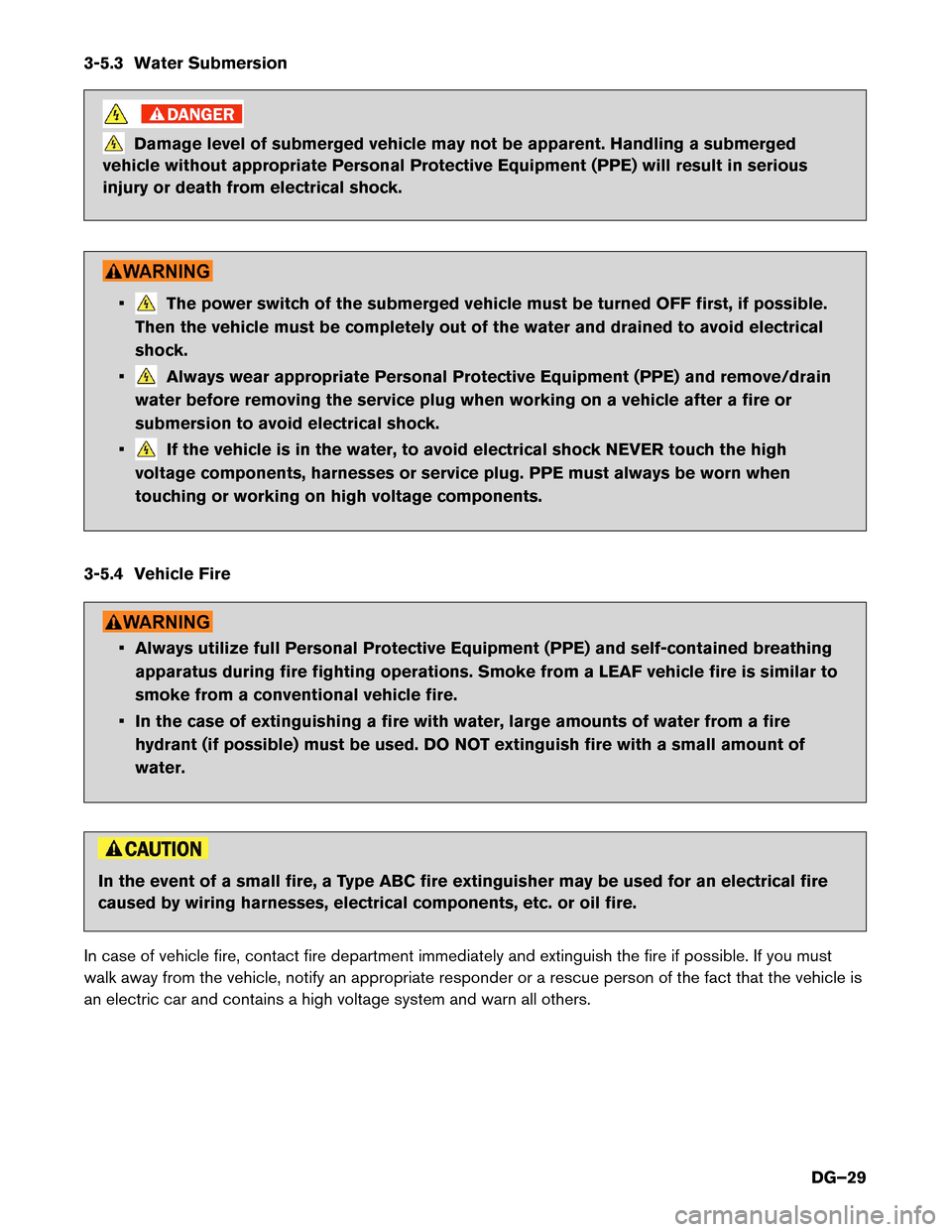
3-5.3 Water Submersion
Damage level of submerged vehicle may not be apparent. Handling a submerged
vehicle without appropriate Personal Protective Equipment (PPE) will result in serious
injury or death from electrical shock. • The power switch of the submerged vehicle must be turned OFF first, if possible.
Then
the vehicle must be completely out of the water and drained to avoid electrical
shock.
• Always wear appropriate Personal Protective Equipment (PPE) and remove/drain
water
before removing the service plug when working on a vehicle after a fire or
submersion to avoid electrical shock.
• If the vehicle is in the water, to avoid electrical shock NEVER touch the high
voltage
components, harnesses or service plug. PPE must always be worn when
touching or working on high voltage components.
3-5.4 Vehicle Fire • Always utilize full Personal Protective Equipment (PPE) and self-contained breathing
apparatus
during fire fighting operations. Smoke from a LEAF vehicle fire is similar to
smoke from a conventional vehicle fire.
• In the case of extinguishing a fire with water, large amounts of water from a fire hydrant (if possible) must be used. DO NOT extinguish fire with a small amount of
water. In the event of a small fire, a Type ABC fire extinguisher may be used for an electrical fire
caused
by wiring harnesses, electrical components, etc. or oil fire.
In case of vehicle fire, contact fire department immediately and extinguish the fire if possible. If you must
walk away from the vehicle, notify an appropriate responder or a rescue person of the fact that the vehicle is
an electric car and contains a high voltage system and warn all others.
DG–29
Page 35 of 45
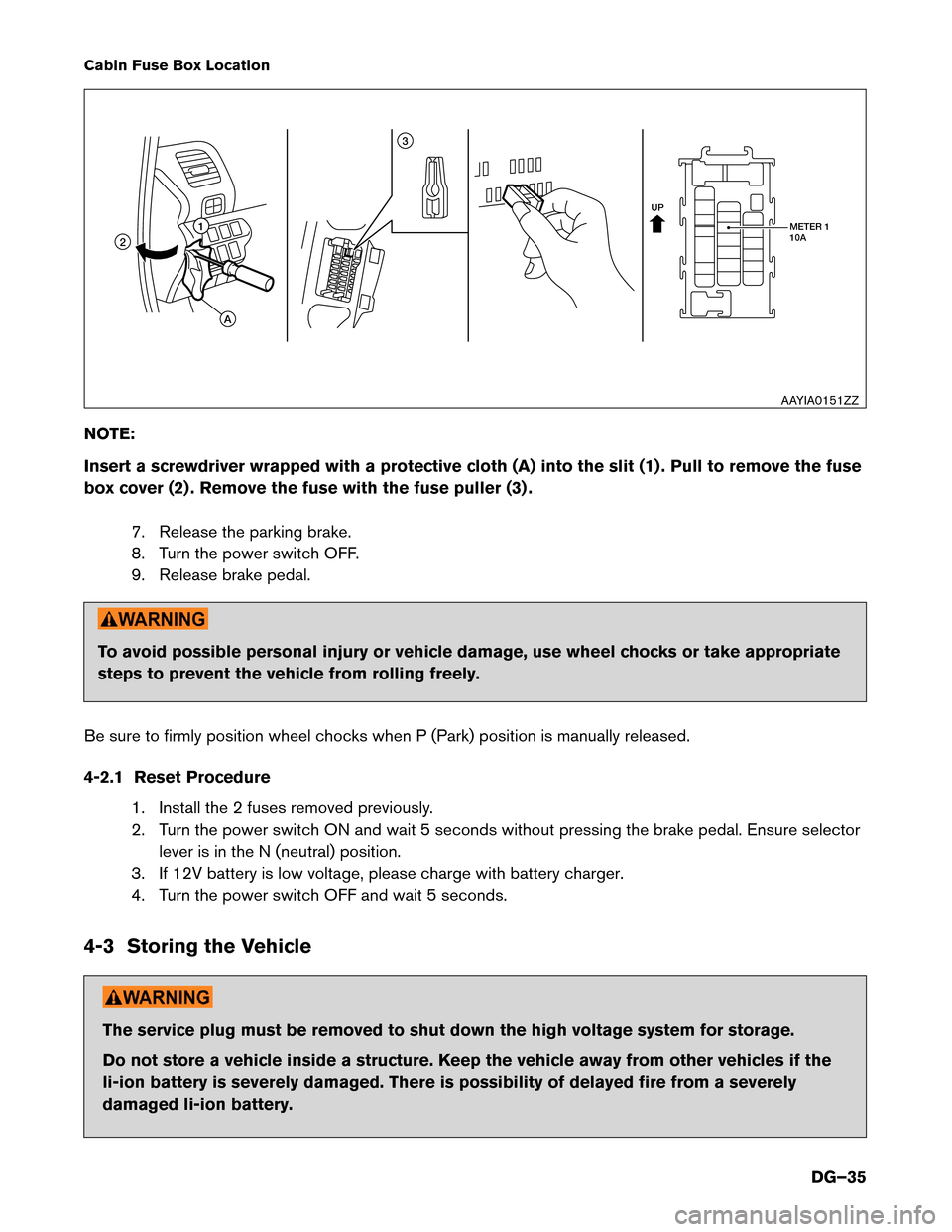
Cabin Fuse Box Location
NO
TE:
Insert a screwdriver wrapped with a protective cloth (A) into the slit (1) . Pull to remove the fuse
box cover (2) . Remove the fuse with the fuse puller (3) .
7. Release the parking brake.
8. Turn the power switch OFF.
9. Release brake pedal. To avoid possible personal injury or vehicle damage, use wheel chocks or take appropriate
steps
to prevent the vehicle from rolling freely.
Be sure to firmly position wheel chocks when P (Park) position is manually released.
4-2.1 Reset Procedure 1. Install the 2 fuses removed previously.
2. Turn the power switch ON and wait 5 seconds without pressing the brake pedal. Ensure selectorlever is in the N (neutral) position.
3. If 12V battery is low voltage, please charge with battery charger.
4. Turn the power switch OFF and wait 5 seconds.
4-3 Storing the Vehicle The service plug must be removed to shut down the high voltage system for storage.
Do
not store a vehicle inside a structure. Keep the vehicle away from other vehicles if the
li-ion battery is severely damaged. There is possibility of delayed fire from a severely
damaged li-ion battery. UP
METER 1
10A
11 3
2
A
AAYIA0151ZZ
DG–35
Page 36 of 45
If LEAF needs to be stored or left unattended, the high voltage system must be shut down by removing the
service
plug [refer to 3-4.6 Alternate Procedure 2 (Remove Service Plug) (DG–24)] and a sign put on the
vehicle
indicating it is an electric vehicle with high voltage dangers. For example: AAYIA0020GB
DG–36
Page 37 of 45
5. Dismantling Information
Removal
or repair of the high voltage battery requires special tools and specific training. Nissan strongly
recommends that only NISSAN certified LEAF dealer technicians perform these operations.
5-1 Precautions for Handling High Voltage Lithium ion (Li-ion) Battery • Because LEAF contains a high voltage (Li-ion) battery, there is the risk of electric
shock,
electric leakage, or similar accidents if the high voltage components or vehicle is
handled incorrectly. Be sure to follow the correct work procedures when performing
inspection and dismantling.
• If it is necessary to touch any of the high voltage harnesses or components you must
always
wear appropriate Personal Protective Equipment (PPE) and properly shut-down
the high voltage system by removing the service plug.
• Be sure to always wear appropriate PPE before beginning work on the high voltage
system.
• Be sure to remove the service plug in order to shut-down the high voltage system
before
performing inspection or dismantling of high voltage system harnesses and parts.
• If the vehicle is heavily damaged, for example the Li-ion battery is deformed,
broken,
or cracked; appropriate PPE must always be used at all times to avoid electrical
shock.
DG–37
Page 38 of 45
• The colors of the high voltage harnesses and connectors are all orange. Orange
High
V
oltage labels are applied to the Li-ion battery and other high voltage devices. Do not
touch the Li-ion battery or other high voltage devices without always wearing appropriate
PPE.
• Clearly identify the persons responsible for high voltage work and ensure that other
persons
do not touch the vehicle. When not working, cover high voltage parts with an
insulating cover sheet and sign or similar item to prevent other persons from contacting
them.
• Be sure to put the removed service plug in your pocket and carry it with you so
another
person does not accidentally reinstall it while work is in progress.
• The high voltage battery retains high voltage at all times. Personal Protective
Equipment
(PPE) must always be worn when touching or working on high voltage
components to avoid risk of electrical shock and severe personal injury or death.
• Immediately insulate disconnected high voltage connectors and terminals with
insulated
tape.
• The vehicle contains parts that contain powerful magnets. If a person who is wearing a
pacemaker
or other medical device is close to these parts, the medical device may be
affected by the magnets. Such persons must not perform work on the vehicle.
• Because this vehicle uses components that contain high voltage and powerful
magnetism,
do not carry any metal products which may cause short circuits, or any
magnetic media (cash cards, credit cards, etc.) which may be damaged when working on
the vehicle.
• Keep removed Li-ion battery packs away from rain to avoid electric shock.
•
Do not heat removed battery packs higher than 158° F (70° C) . There is the possibility of a malfunction occurring if the vehicle is changed to READY
status while the service plug is removed.
DG–38
Page 44 of 45

12. Lower the Li-ion battery from the lift table together with
the pallet.
a. Lift up the Li-ion battery using a stacker.
b. Move the lift table.
c. Lower the Li-ion battery.
d. Operate the stacker and move the Li-ion battery. To avoid serious personal injury, do not move the stacker while the Li-ion battery is lifted
up
because there is danger of tipping over.
13. Be sure service plug socket and high voltage connectors (battery side) are covered with insulated tape.
14. Dismantling the remainder of the LEAF may be performed like conventional Nissan vehicles once the high voltage system is properly shut down and discharged.
5-3 Recovery/Recycling of the Li-ion High Voltage Battery
The Li-ion high voltage battery is fully recyclable. For information regarding safe recovery and recycling of
the high voltage battery, please contact the nearest NISSAN certified LEAF dealer. For assistance in finding
your nearest dealer please call Nissan Customer Assistance at: • Nissan EV Customer Support: 1-877-664-2738 (Hours of operation are Monday-Friday 7am -7pm, Saturday 8am - 4:30pm Central time zone)
• Nissan Consumer Affairs: 1-800-647-7261 (US) or 1-800-387-0122 (Canada) (Hours of operation are 8am - 5pm (Monday-Friday) Eastern, Central and Pacific time zones)
6. a
b c d
AAYIA0174ZZ
DG–44
![NISSAN LEAF 2015 1.G Dismantling Guide If LEAF needs to be stored or left unattended, the high voltage system must be shut down by removing the
service
plug [refer to 3-4.6 Alternate Procedure 2 (Remove Service Plug) (DG–24)] and a sign](/manual-img/5/428/w960_428-35.png "NISSAN LEAF 2015 1.G Dismantling Guide If LEAF needs to be stored or left unattended, the high voltage system must be shut down by removing the
service
plug [refer to 3-4.6 Alternate Procedure 2 (Remove Service Plug) (DG–24)] and a sign")