12. If necessary, connect the vehicle to a charging station or EVSE (Electric Vehicle Supply
Equipment) to charge the Li-ion battery. The vehicle cannot be driven unless the Li-ion battery is
charged.
NOTE:
If it is not possible to turn the LEAF system ON by following this procedure, contact a
NISSAN certified LEAF dealer immediately.
4-2 P (Park) Position Release Procedure
If you need to release the vehicle from the P (Park) position, proceed as follows. When power switch is
turned OFF or 12V battery is low, LEAF automatically shifts to P position.
NOTE: This procedure requires two (2) people.
1. To start the EV system with a booster battery, refer to 4. Jump Starting (DG–31).
2.
Turn power switch ON by pushing the power switch 2 times without pressing brake pedal.
3. Confirm parking brake is applied.
4. Close all doors and press and hold the brake pedal.
5. Place the selector lever in the N (Neutral) position.
6. Remove the following 2 fuses:
• F/L 40A PBW MTR (under hood fuse and relay box)
• METER 1 10A (in the cabin fuse box)
DG–33
5-2.2 Removal Procedure
NEVER disassemble or open the Li-ion battery to avoid severe personal injury or death by
electrical
shock.
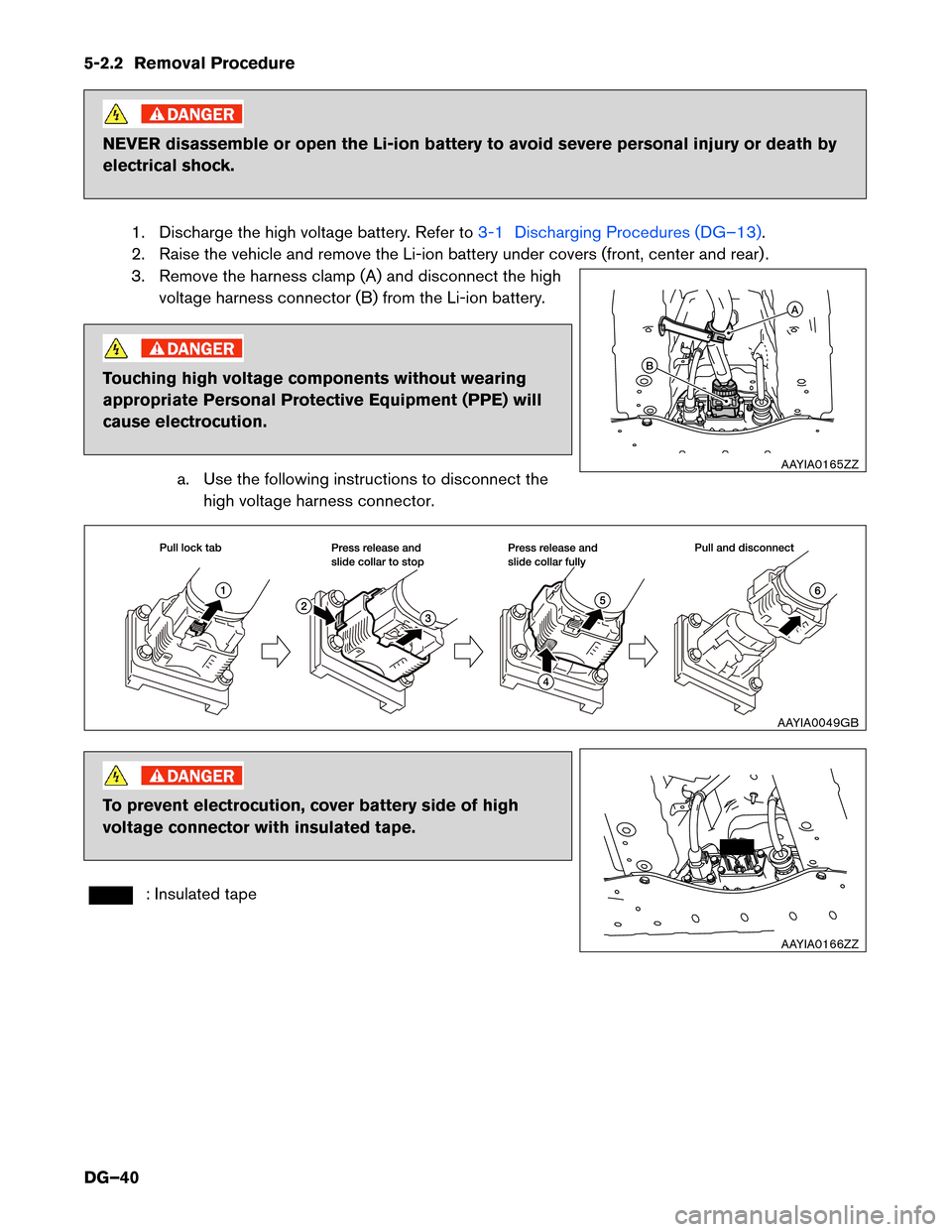
1. Discharge the high voltage battery. Refer to 3-1 Discharging Procedures (DG–13).
2.
Raise the vehicle and remove the Li-ion battery under covers (front, center and rear) .
3. Remove the harness clamp (A) and disconnect the high voltage harness connector (B) from the Li-ion battery. Touching high voltage components without wearing
appropriate
Personal Protective Equipment (PPE) will
cause electrocution.
a. Use the following instructions to disconnect thehigh voltage harness connector. To prevent electrocution, cover battery side of high
voltage
connector with insulated tape. : Insulated tape A
B
AAYIA0165ZZ AAYIA0049GB
AAYIA0166ZZ
DG–40