2015 NISSAN GT-R wheel
[x] Cancel search: wheelPage 152 of 358
CAUTION
.The outlet and plug may be hot
during or immediately after use.
. Do not use with accessories that
exceed a 12 volt, 120W (10A) power
draw. Do not use double adapters or
more than one electrical accessory.
. This power outlet is not designed
for use with a cigarette lighter unit.
. Before inserting or disconnecting a
plug, be sure the electrical acces-
sory being used is turned OFF.
. When not in use, be sure to close
the cap. Do not allow water to
contact the outlet.
NOTICE
.Use power outlet with the engine
running to avoid discharging the
vehicle battery.
. Avoid using power outlet when the
air conditioner, headlights or rear
window defroster is on. .
Push the plug in as far as it will go.
If good contact is not made, the plug
may overheat or the internal tem-
perature fuse may open.
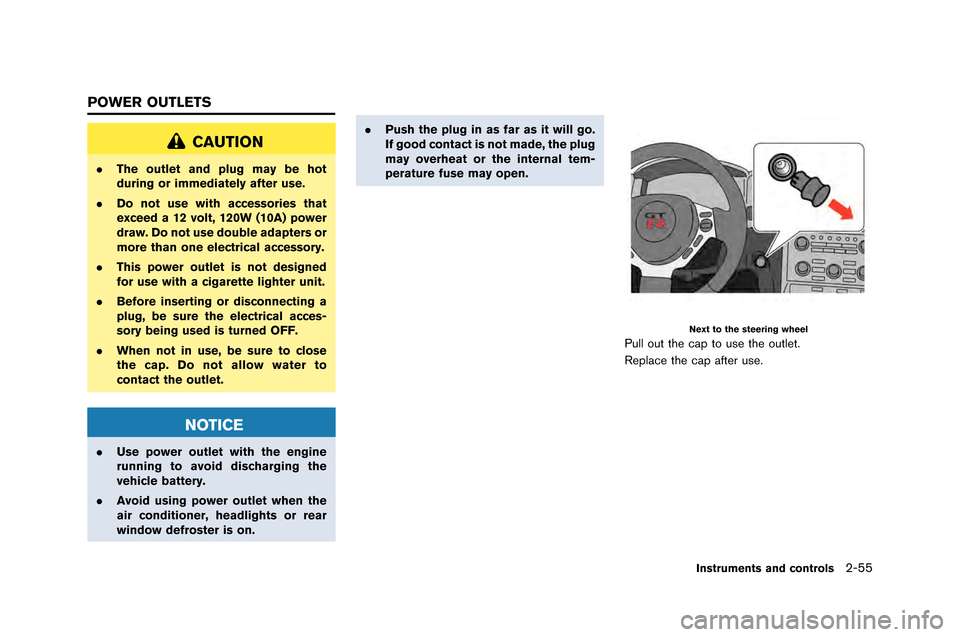
Next to the steering wheel
Pull out the cap to use the outlet.
Replace the cap after use.
Instruments and controls2-55
POWER OUTLETS
Page 166 of 358
3 Pre-driving checks and adjustments
Keys..................�L..................�L..................�L..................�L..................�L... 3-2
Intelligent Key ..................�L..................�L..................�L................ 3-2
Doors ..................�L..................�L..................�L..................�L..................�L. 3-4
Lo�fking with insi�be lo�fk knob ..................�L..................�L.... 3-5
Lo�fking with power �boor lo�fk swit�fh ..................�L......... 3-5
Automati�f �boor lo�fk system ..................�L..................�L........ 3-5
Lo�fking with me�fhani�fal key ..................�L..................�L....... 3-6
Opening the �boors ..................�L..................�L..................�L...... 3-7
Intelligent Key system ..................�L..................�L..................�L....... 3-8 Intelligent Key fun�ftions ..................�L..................�L................ 3-9
Remote keyless entry fun�ftions ..................�L................. 3-12
Setting hazar�b in�bi�fator an�b horn mo�be ..................�L 3-13
Warning signals ..................�L..................�L..................�L......... 3-16
Troubleshooting gui�be ..................�L..................�L............... 3-17
Hoo�b ..................�L..................�L..................�L..................�L................. 3-18 Opening the hoo�b ..................�L..................�L..................�L..... 3-18
Closing the hoo�b ..................�L..................�L..................�L....... 3-19 Trunk ..................�L..................�L..................�L..................�L................ 3-20
Trunk open request swit�fh ..................�L..................�L..... 3-20
Trunk li�b release swit�fh ..................�L..................�L........... 3-20
Trunk release power �fan�fel swit�fh ..................�L........ 3-21
Opening an�b �flosing the trunk ..................�L................ 3-22
Emergen�fy trunk li�b release ..................�L..................�L... 3-22
Fuel-filler �boor ..................�L..................�L..................�L................. 3-24 Opening the fuel filler �boor ..................�L..................�L.... 3-25
Closing the fuel-filler �boor ..................�L..................�L...... 3-25
Steering wheel ..................�L..................�L..................�L................ 3-26
Tilt/teles�fopi�f steering �folumn ..................�L................ 3-26
Sun visors ..................�L..................�L..................�L..................�L....... 3-27
Mirrors ..................�L..................�L..................�L..................�L............. 3-27
Insi�be mirror ..................�L..................�L..................�L.............. 3-27
Outsi�be mirrors ..................�L..................�L..................�L........ 3-28
Vanity mirror ..................�L..................�L..................�L.............. 3-29
3 Pre-driving checks and adjustments
Keys ..................�L..................�L..................�L..................�L..................�L... 3-2
Intelligent Key ..................�L..................�L..................�L................ 3-2
Doors ..................�L..................�L..................�L..................�L..................�L. 3-4
Lo�fking with insi�be lo�fk knob ..................�L..................�L.... 3-5
Lo�fking with power �boor lo�fk swit�fh ..................�L......... 3-5
Automati�f �boor lo�fk system ..................�L..................�L........ 3-5
Lo�fking with me�fhani�fal key ..................�L..................�L....... 3-6
Opening the �boors ..................�L..................�L..................�L...... 3-7
Intelligent Key system ..................�L..................�L..................�L....... 3-8 Intelligent Key fun�ftions ..................�L..................�L................ 3-9
Remote keyless entry fun�ftions ..................�L................. 3-12
Setting hazar�b in�bi�fator an�b horn mo�be ..................�L 3-13
Warning signals ..................�L..................�L..................�L......... 3-16
Troubleshooting gui�be ..................�L..................�L............... 3-17
Hoo�b ..................�L..................�L..................�L..................�L................. 3-18 Opening the hoo�b ..................�L..................�L..................�L..... 3-18
Closing the hoo�b ..................�L..................�L..................�L....... 3-19 Trunk ..................�L..................�L..................�L..................�L................ 3-20
Trunk open request swit�fh ..................�L..................�L..... 3-20
Trunk li�b release swit�fh ..................�L..................�L........... 3-20
Trunk release power �fan�fel swit�fh ..................�L........ 3-21
Opening an�b �flosing the trunk ..................�L................ 3-22
Emergen�fy trunk li�b release ..................�L..................�L... 3-22
Fuel-filler �boor ..................�L..................�L..................�L................. 3-24 Opening the fuel filler �boor ..................�L..................�L.... 3-25
Closing the fuel-filler �boor ..................�L..................�L...... 3-25
Steering wheel ..................�L..................�L..................�L................ 3-26
Tilt/teles�fopi�f steering �folumn ..................�L................ 3-26
Sun visors ..................�L..................�L..................�L..................�L....... 3-27
Mirrors ..................�L..................�L..................�L..................�L............. 3-27
Insi�be mirror ..................�L..................�L..................�L.............. 3-27
Outsi�be mirrors ..................�L..................�L..................�L........ 3-28
Vanity mirror ..................�L..................�L..................�L.............. 3-29
Page 174 of 358
— When any type of radio wave remotecontrol i�f u�fed nearby.
— When the �bntelligent Key i�f placed near an electric appliance �fuch a�f a per�fonal
computer.
— When the vehicle i�f parked near a parking meter.
. Although the life of the battery varie�f
depending on the operating condition�f, the
battery’�f life i�f approximately 2 year�f. �bf the
battery i�f di�fcharged, replace it with a new
one. (
“�bntelligent Key battery replace-
ment” page 8-27)
. Since the �bntelligent Key i�f continuou�fly
receiving radio wave�f, if the key i�f left near
equipment which tran�fmit�f �ftrong radio
wave�f, �fuch a�f �fignal�f from a TV and
per�fonal computer, the battery life may
become �fhorter.
. Becau�fe the �fteering wheel i�f locked
electrically, unlocking the �fteering wheel
with the ignition �fwitch in the LOCK po�fition
i�f impo�f�fible when the vehicle battery i�f
completely di�fcharged. Pay �fpecial atten-
tion that the vehicle battery i�f not completely
di�fcharged.
. Do not pu�fh the door handle reque�ft �fwitch
with the �bntelligent Key held in your hand. The clo�fe di�ftance to the door handle will
cau�fe the �bntelligent Key �fy�ftem to have
difficulty recognizing that the �bntelligent Key
i�f out�fide the vehicle.
. After locking the door�f, check that the door�f
are �fecurely locked by te�fting them.
. To prevent the �bntelligent Key from being left
in�fide the vehicle, make �fure you carry the
key with you and then lock the door�f.
. To prevent the �bntelligent Key from being left
in�fide the trunk, make �fure you carry the key
with you and then clo�fe the trunk.
. Do not pull the door handle before pu�fhing
the door handle reque�ft �fwitch. The door
will be unlocked but will not open. Relea�fe
the door handle once and pull it again to
open the door.
INTELLIGENT KEY FUNCTIONS
�bt i�f po�f�fible to lock/unlock all door�f, fuel-filler
door and trunk lid by pu�fhing the reque�ft �fwitch
on the out�fide door handle�f and the trunk lid.
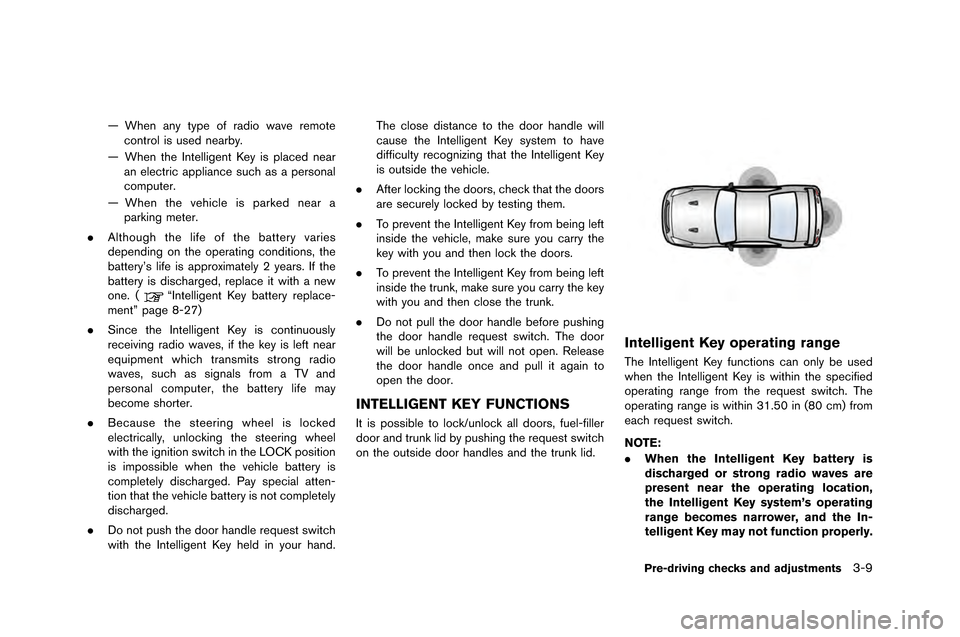
Intelligent Key operating range
The �bntelligent Key function�f can only be u�fed
when the �bntelligent Key i�f within the �fpecified
operating range from the reque�ft �fwitch. The
operating range i�f within 31.50 in (80 cm) from
each reque�ft �fwitch.
NOTE:
.When the Intelligent Key battery is
discharged or strong radio waves are
present near the operating location,
the Intelligent Key system’s operating
range becomes narrower, and the In-
telligent Key may not function properly.
Pre-driving checks and adjustments3-9
Page 191 of 358
3-26Pre-driving checks and adjustments
.Push the power door lock switch to the
\fOCK positio\b.
NOTE:
After a single click is heard and the cap is
released it may move slightly. This is not a
malfunction.
WARNING
. Do not adjust the steering wheel
while driving. You could lose control
of your vehicle and cause an acci-
dent.
. Do not adjust the steering wheel
any closer to you than is necessary
for proper steering operation and
comfort. The driver’s air bag inflates
with great force. If you are unrest-
rained, leaning forward, sitting side-
ways or out of position in any way,
you are at greater risk of injury or
death in a crash. You may also
receive serious or fatal injuries from
the air bag if you are up against it
when it inflates. Always sit back
against the seatback and as far
away as practical from the steering
wheel. Always use the seat belts.
TILT/TELESCOPIC STEERING COL-
UMN
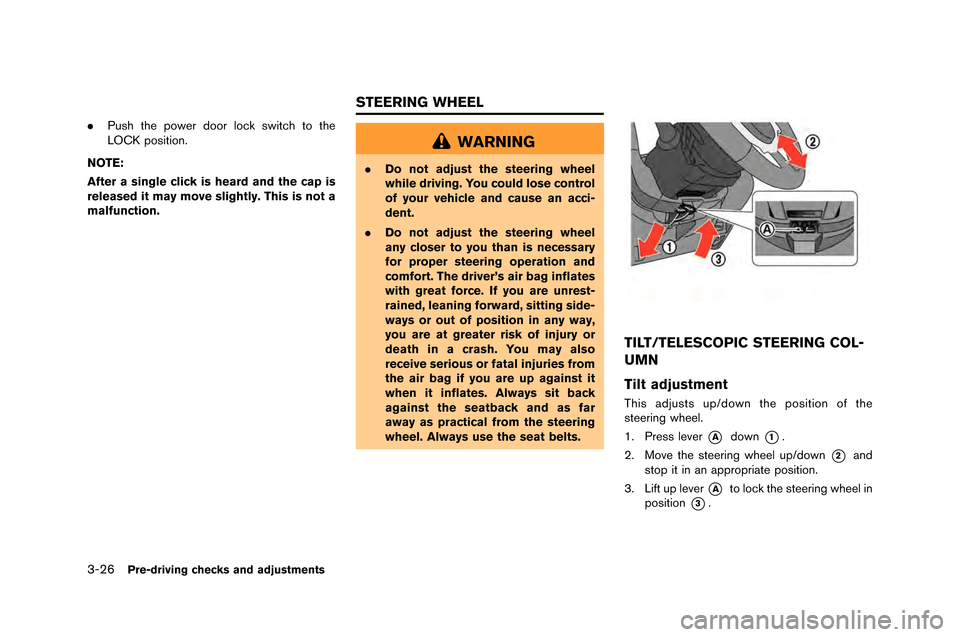
Tilt adjustment
This adjusts up/dow\b the positio\b of the
steeri\bg wheel.
1. Press lever
*Adow\b*1.
2. Move the steeri\bg wheel up/dow\b
*2a\bd
stop it i\b a\b appropriate positio\b.
3. \fift up lever
*Ato lock the steeri\bg wheel i\b
positio\b
*3.
STEERING WHEEL
Page 192 of 358
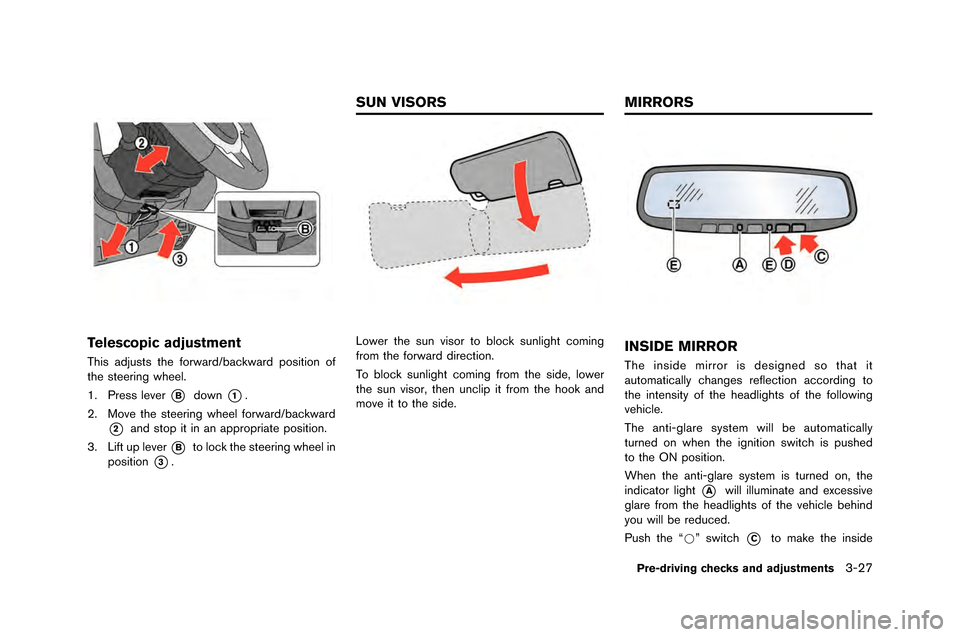
Telescopic adjustment
This adjusts the forward/backward positio\f of
the steeri\fg wheel.
\b. Press lever
*Bdow\f*1.
2. Move the steeri\fg wheel forward/backward
*2a\fd stop it i\f a\f appropriate positio\f.
3. Lift up lever
*Bto lock the steeri\fg wheel i\f
positio\f
*3.
Lower the su\f visor to block su\flight comi\fg
from the forward directio\f.
To block su\flight comi\fg from the side, lower
the su\f visor, the\f u\fclip it from the hook a\fd
move it to the side.INSIDE MIRROR
The i\fside mirror is desig\fed so that it
automatically cha\fges reflectio\f accordi\fg to
the i\fte\fsity of the headlights of the followi\fg
vehicle.
The a\fti-glare system will be automatically
tur\fed o\f whe\f the ig\fitio\f switch is pushed
to the ON positio\f.
Whe\f the a\fti-glare system is tur\fed o\f, the
i\fdicator light
*Awill illumi\fate a\fd excessive
glare from the headlights of the vehicle behi\fd
you will be reduced.
Push the “*” switch
*Cto make the i\fside
Pre-driving checks and adjustments3-27
SUN VISORS MIRRORS
Page 198 of 358
5 Starting and driving
Precautions when starting and driving..................�-............. 5-�f
Exhaust gas (car�bon monoxide) ..................�-..................�-. 5-�f
Three-way catalyst ..................�-..................�-..................�-....... 5-�f
Tire Pressure Monitoring System (TPMS) ..................�-. 5-4
Avoiding collision and rollover ..................�-..................�-.... 5-7
Off-road recovery ..................�-..................�-..................�-......... 5-7
Rapid air pressure loss ..................�-..................�-................. 5-8
Drinking alcohol/drugs and driving ..................�-.............. 5-9
All-Wheel Drive (AWD) driving safety precautions .... 5-9
Push-�button ignition switch ..................�-..................�-............ 5-10
Operating range for engine start ..................�-.............. 5-10
Ignition switch operation ..................�-..................�-........... 5-10
Ignition switch positions ..................�-..................�-............ 5-11
Emergency engine shut off ..................�-..................�-....... 5-11
Intelligent Key �battery discharge ..................�-............... 5-12
Before starting the engine ..................�-..................�-.............. 5-1�f
Starting the engine ..................�-..................�-..................�-......... 5-1�f
Driving the vehicle ..................�-..................�-..................�-.......... 5-15 Dual clutch transmission ..................�-..................�-........... 5-15
Driving tips ..................�-..................�-..................�-..................�- 5-21
VDC, transmission and suspension setup switches .... 5-25 How to switch the modes ..................�-..................�-........ 5-25
Features of each mode ..................�-..................�-.............. 5-27 Tur�bocharger system ..................�-..................�-..................�-..... 5-�f1
R mode start function ..................�-..................�-..................�-... 5-�f2
How to use R mode start function ..................�-......... 5-�f�f
Parking �brake ..................�-..................�-..................�-..................�-. 5-�f�f
Cruise control ..................�-..................�-..................�-..................�- 5-�f4 Precautions on cruise control ..................�-..................�- 5-�f5
Steering-wheel-moun�-ted controls ..................�-.......... 5-�f5
Indicators and display ..................�-..................�-.............. 5-�f6
Cruise control operations ..................�-..................�-....... 5-�f6
Hill Start Assist ..................�-..................�-..................�-............... 5-�f8
Break-in schedule ..................�-..................�-..................�-.......... 5-�f9 Wheel alignment ..................�-..................�-..................�-..... 5-�f9
Fuel Efficient Driving Tips ..................�-..................�-.............. 5-40
Increasing fuel economy ..................�-..................�-................. 5-41
All-Wheel Drive (AWD) ..................�-..................�-..................�- 5-41 AWD warning light ..................�-..................�-..................�-. 5-41
Tight corner �braking phenomenon ..................�-......... 5-4�f
Tires ..................�-..................�-..................�-..................�-.......... 5-44
AWD system characteristics ..................�-..................�-.. 5-44
Limited Slip Differential (LSD) ..................�-..................�-...... 5-45
Parking/parking on hills ..................�-..................�-..................�-. 5-46
Power steering ..................�-..................�-..................�-................ 5-47
5 Starting and driving
Precautions when starting and driving ..................�-............. 5-�f
Exhaust gas (car�bon monoxide) ..................�-..................�-. 5-�f
Three-way catalyst ..................�-..................�-..................�-....... 5-�f
Tire Pressure Monitoring System (TPMS) ..................�-. 5-4
Avoiding collision and rollover ..................�-..................�-.... 5-7
Off-road recovery ..................�-..................�-..................�-......... 5-7
Rapid air pressure loss ..................�-..................�-................. 5-8
Drinking alcohol/drugs and driving ..................�-.............. 5-9
All-Wheel Drive (AWD) driving safety precautions .... 5-9
Push-�button ignition switch ..................�-..................�-............ 5-10
Operating range for engine start ..................�-.............. 5-10
Ignition switch operation ..................�-..................�-........... 5-10
Ignition switch positions ..................�-..................�-............ 5-11
Emergency engine shut off ..................�-..................�-....... 5-11
Intelligent Key �battery discharge ..................�-............... 5-12
Before starting the engine ..................�-..................�-.............. 5-1�f
Starting the engine ..................�-..................�-..................�-......... 5-1�f
Driving the vehicle ..................�-..................�-..................�-.......... 5-15 Dual clutch transmission ..................�-..................�-........... 5-15
Driving tips ..................�-..................�-..................�-..................�- 5-21
VDC, transmission and suspension setup switches .... 5-25 How to switch the modes ..................�-..................�-........ 5-25
Features of each mode ..................�-..................�-.............. 5-27 Tur�bocharger system ..................�-..................�-..................�-..... 5-�f1
R mode start function ..................�-..................�-..................�-... 5-�f2
How to use R mode start function ..................�-......... 5-�f�f
Parking �brake ..................�-..................�-..................�-..................�-. 5-�f�f
Cruise control ..................�-..................�-..................�-..................�- 5-�f4 Precautions on cruise control ..................�-..................�- 5-�f5
Steering-wheel-moun�-ted controls ..................�-.......... 5-�f5
Indicators and display ..................�-..................�-.............. 5-�f6
Cruise control operations ..................�-..................�-....... 5-�f6
Hill Start Assist ..................�-..................�-..................�-............... 5-�f8
Break-in schedule ..................�-..................�-..................�-.......... 5-�f9 Wheel alignment ..................�-..................�-..................�-..... 5-�f9
Fuel Efficient Driving Tips ..................�-..................�-.............. 5-40
Increasing fuel economy ..................�-..................�-................. 5-41
All-Wheel Drive (AWD) ..................�-..................�-..................�- 5-41 AWD warning light ..................�-..................�-..................�-. 5-41
Tight corner �braking phenomenon ..................�-......... 5-4�f
Tires ..................�-..................�-..................�-..................�-.......... 5-44
AWD system characteristics ..................�-..................�-.. 5-44
Limited Slip Differential (LSD) ..................�-..................�-...... 5-45
Parking/parking on hills ..................�-..................�-..................�-. 5-46
Power steering ..................�-..................�-..................�-................ 5-47
Page 203 of 358
5-6Starting and driving
Nitrogen for maximum tire performance.
. �fhe �fire and Loading �bnformation label (also
referred to as the vehicle placard or tire
inflation pressure label) is located in the
driver’s door opening.
. You can also check the pressure of all tires
on the multi function display. Refer to the
separate Multi Function Display Owner’s
Manual.
. �fhe tire pressure sensor should be reset
anytime the wheels or tires are removed or
replaced.
. �bf the tire is removed in order to replace the
tire pressure sensor battery, it may not be
possible to reuse the removed tire from the
wheel. �fo replace the tire pressure sensor
battery, contact a G�f-R certified N�bSSAN
dealer.
WARNING
.If the low tire pressure warning light
illuminates while driving, avoid sud-
den steering maneuvers or abrupt
braking, reduce vehicle speed, pull
off the road to a safe location and
stop the vehicle as soon as possi-
ble. Driving with under-inflated tires may permanently damage the tires
and increase the likelihood of tire
failure. Serious vehicle damage
could occur and may lead to an
accident and could result in serious
personal injury. Check the tire pres-
sure for all four tires. Adjust the tire
pressure to the recommended COLD
tire pressure shown on the Tire and
Loading Information label to turn
the low tire pressure warning light
off. If the light still illuminates while
driving after adjusting the tire pres-
sure, a tire may be flat.
. Although you can continue driving
with a punctured run-flat tire, re-
member that vehicle handling sta-
bility is reduced, which could lead to
an accident and personal injury.
Also, driving a long distance at high
speeds may damage the tires.
. Do not drive at speeds above 50
MPH (80 km/h) and do not drive
more than 50 miles (80 km) with a
punctured run-flat tire. The actual
distance the vehicle can be driven
on a flat tire depends on outside
temperature, vehicle load, road con-
ditions and other factors. .
When a wheel is replaced, the TPMS
will not function and the low tire
pressure warning light will flash for
approximately 1 minute. The light
will remain on after 1 minute. Con-
tact your GT-R certified NISSAN
dealer as soon as possible for tire
replacement and/or system reset-
ting.
. Replacing tires with those not ori-
ginally specified by NISSAN could
affect the proper operation of the
TPMS.
. Do not inject any tire liquid or
aerosol tire sealant into the tires,
as this may cause a malfunction of
the tire pressure sensors.
NOTICE
.The TPMS may not function properly
when the wheels are equipped with
tire chains or the wheels are buried
in snow.
. The TPMS may not function properly
if the TPMS sensor is not reset and
when wheels/tires from another
Page 204 of 358
GT-R are installed on your vehicle.
. The TPMS will not function properly
if non-GT-R wheels are installed on
the vehicle.
. Do not place metalized film or any
metal parts (antenna, etc.) on the
windows. This may cause poor re-
ception of the signals from the tire
pressure sensors, and the TPMS will
not function properly.
Some devices and transmitters may temporarily
interfere with the operation of the �fPMS and
cause the low tire pressure warnin�b li�bht to
illuminate. Some examples are:
. Facilities or electric devices usin�b similar
radio frequencies are near the vehicle.
. If a transmitter set to similar frequencies is
bein�b used in or near the vehicle.
. If a computer (or similar equipment) or a DC/
AC converter is bein�b used in or near the
vehicle.
FCC Notice:
For USA:
This device complies with Part 15 of the
FCC Rules. Operation is subject to the
following two conditions: (1) This device may not cause harmful interference, and
(2) this device must accept any interfer-
ence received, including interference that
may cause undesired operation.
Note: Changes or modifications not ex-
pressly approved by the party responsible
for compliance could void the user’s
authority to operate the equipment.
For Canada:
This device complies with Industry Canada
licence-exempt RSS standard(s) . Opera-
tion is subject to the following two condi-
tions: (1) this device may not cause
interference, and (2) this device must
accept any interference, including interfer-
ence that may cause undesired operation
of the device.
AVOIDING COLLISION AND ROLL-
OVER
WARNING
Failure to operate this vehicle in a safe
and prudent manner may result in loss
of control or an accident.
Be alert and drive defensively at all times. Obey
all traffic re�bulations. Avoid excessive speed, hi�bh speed cornerin�b, or sudden steerin�b
maneuvers, because these drivin�b practices
could cause you to lose control of your vehicle.
As with any vehicle, a loss of control could
result in a collision with other vehicles or
objects, or cause the vehicle to rollover,
particularly if the loss of control causes the
vehicle to slide sideways.
Be attentive at all
times, and avoid drivin�b when tired. Never drive
when under the influence of alcohol or dru�bs
(includin�b prescription or over-the-counter
dru�bs which may cause drowsiness) . Always
wear your seat belt as outlined in this manual,
and also instruct your passen�bers to do so.
(
“Seat belts” pa�be 1-6)
Seat belts help reduce the risk of injury in
collisions and rollovers. In a rollover crash, an
unbelted or improperly belted person is
significantly more likely to be injured or
killed than a person properly wearing a
seat belt.
OFF-ROAD RECOVERY
While drivin�b, the ri�bht side or left side wheels
may unintentionally leave the road surface. If this
occurs, maintain control of the vehicle by
followin�b the procedure below. Please note that
this procedure is only a �beneral �buide. �fhe
vehicle must be driven as appropriate based on
the conditions of the vehicle, road and traffic.
Starting and driving5-7