2015 NISSAN GT-R Break
[x] Cancel search: BreakPage 236 of 358
hill start assist will stop operating completely.
Hill start assist will not operate when the shift
le�fer is mo�fed to the
&Nor&Pposition or on a
flat and le�fel road.
NOTE:
This system does not function when the
Vehicle Dynamic Control VDC) system
warning appears on the vehicle informa-
tion display located in the tachometer.
(
“Vehicle Dynamic Control (VDC) sys-
tem warning” page 2-37)
NOTICE
Follow these recommendations to ob-
tain maximum engine performance and
ensure the future reliability and econo-
my of your new vehicle. Failure to
follow these recommendations may
result in shortened engine life and
reduced vehicle performance.
Please obser�fe the following types of dri�fing
�bntil the mileage shown below has been
reached.
Until 300 miles (500 km):
. Do not depress the accelerator pedal more
than halfway and a�foid rapid acceleration.
. Dri�fe with the engine speed kept at less
than 3,500 RPM.
. A�foid �bnnecessary q�bick steering, abr�bpt
braking and dri�fing on poor roads.
300 to 600 miles (500 to 1,000 km)
. A�foid rapid acceleration in a low gear (1st to
3rd gears) with the accelerator pedal f�blly
depressed. Depress the pedal slowly.
. A�foid �bnnecessary q�bick steering and
abr�bpt braking. .
Dri�fe with the s�bspension set�bp switch in
the COMF mode to allow more s�bspension
stroke.
600 to 1,200 miles (1,000 to 2,000 km)
. Dri�fe with the engine speed kept relati�fely
high with the shift le�fer in the
&Mposition.
Shifting is recommended between 1st and
4th gears.
. A�foid �bnnecessary q�bick steering and
abr�bpt braking.
. Dri�fe with the s�bspension set�bp switch in
the COMF mode to allow more s�bspension
stroke.
E�fen tho�bgh the mileage reaches o�fer 1,200
miles (2,000 km) , the cl�btch may take longer to
properly engage if the �fehicle is mainly dri�fen in
town at a low speed. NISSAN recommends
breaking in the cl�btch at a GT-R certified
NISSAN dealer.
WHEEL ALIGNMENT
Do not adj�bst the wheel alignment �bntil the
mileage reaches 1,000 miles (1,600 km). Until
then, the s�bspension may not engage eno�bgh
and the height may be higher.
Howe�fer, make s�bre to adj�bst the alignment
after 1,000 miles (1,600 km) .
The wheel alignment can be adj�bsted by a GT-R
Starting and driving5-39
BREAK-IN SCHEDULE
Page 245 of 358
5-48Starting and driving
BRAKING PRECAUTIONS
The brake system has two separate hydra�flic
circ�fits�b If one circ�fit malf�fnctions, yo�f will still
have braking at two wheels�b
Yo�f may feel a small click and hear a so�fnd
when the brake pedal is f�flly depressed slowly�b
This is not a malf�fnction and indicates that the
brake assist mechanism is operating properly�b
Vacuum assisted brakes
The brake booster aids braking by �fsing engine
vac�f�fm�b If the engine stops, yo�f can stop the
vehicle by depressing the brake pedal�b However,
greater foot press�fre on the brake pedal will be
req�fired to stop the vehicle and the stopping
distance will be longer�b
Wet brakes
When the vehicle is washed or driven thro�fgh
water, the brakes may get wet�b As a res�flt, yo�fr
braking distance will be longer and the vehicle
may p�fll to one side d�fring braking�b
To dry brakes, drive the vehicle at a safe speed
while lightly tapping the brake pedal to heat-�fp
the brakes�b Do this �fntil the brakes ret�frn to
normal�b Avoid driving the vehicle at high speeds
�fntil the brakes f�fnction correctly�b
Using the brakes
Avoid resting yo�fr foot on the brake pedal while
driving�b This will ca�fse overheating of the
brakes, wearing o�ft the brake and pads faster
and red�fce gas mileage�b
To help red�fce brake wear and to prevent the
brakes from overheating, red�fce speed and
downshift to a lower gear before going down a
slope or long grade�b Overheated brakes may
red�fce braking performance and co�fld res�flt in
loss of vehicle control�b
WARNING
.While driving on a slippery surface,
be careful when braking, accelerat-
ing or downshifting. Abrupt braking
or accelerating could cause the
wheels to skid and result in an
accident.
. If the engine is not running or is
turned off while driving, the power
assist for the brakes will not work.
Braking will be harder.
PARKING BRAKE BREAK-IN
Break in the parking brake shoes whenever the
stopping effect of the parking brake is weakened
or whenever the parking brake shoes and/or
dr�fms/rotors are replaced, in order to ass�fre the
best braking performance�b
This proced�fre is described in the vehicle
service man�fal and can be performed by a
GT-R certified NISSAN dealer�b
BRAKE SYSTEM
Page 288 of 358
CHECKING ENGINE OIL LEVEL
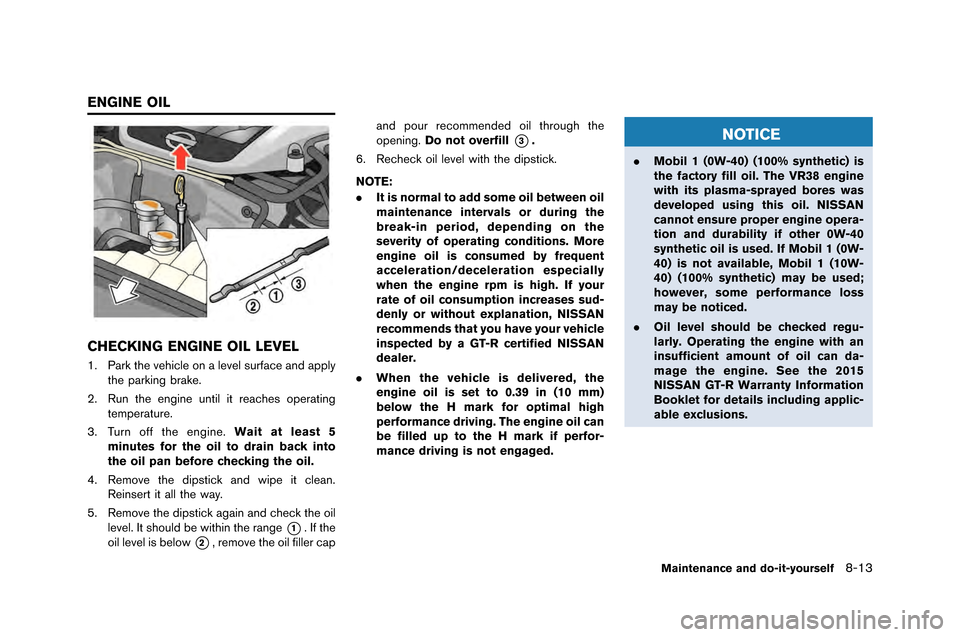
1. Park the vehicle on a level surface and a\f\flythe \farking brake.
\b. Run the engine until it reaches o\ferating tem\ferature.
3. Turn off the engine. Wait at least 5
minutes for the oil to drain back into
the oil pan before checking the oil.
4. Remove the di\fstick and wi\fe it clean. Reinsert it all the way.
5. Remove the di\fstick again and check the oil level. It should be within the range
*1. If the
oil level is below
*2, remove the oil filler ca\f and \four recommended oil through the
o\fening.
Do not overfill
*3.
6. Recheck oil level with the di\fstick.
NOTE:
. It is normal to add some oil between oil
maintenance intervals or during the
break-in period, depending on the
severity of operating conditions. More
engine oil is consumed by frequent
acceleration/deceleration especially
when the engine rpm is high. If your
rate of oil consumption increases sud-
denly or without explanation, NISSAN
recommends that you have your vehicle
inspected by a GT-R certified NISSAN
dealer.
. When the vehicle is delivered, the
engine oil is set to 0.39 in (10 mm)
below the H mark for optimal high
performance driving. The engine oil can
be filled up to the H mark if perfor-
mance driving is not engaged.NOTICE
.Mobil 1 (0W-40) (100% synthetic) is
the factory fill oil. The VR38 engine
with its plasma-sprayed bores was
developed using this oil. NISSAN
cannot ensure proper engine opera-
tion and durability if other 0W-40
synthetic oil is used. If Mobil 1 (0W-
40) is not available, Mobil 1 (10W-
40) (100% synthetic) may be used;
however, some performance loss
may be noticed.
. Oil level should be checked regu-
larly. Operating the engine with an
insufficient amount of oil can da-
mage the engine. See the 2015
NISSAN GT-R Warranty Information
Booklet for details including applic-
able exclusions.
Maintenance and do-it-yourself8-13
ENGINE OIL
Page 341 of 358
9-16Technical and consumer information
Also check tires for proper inflation pres-
s�fres. See the Tire an�b Loa�bing Information
label.
LOADING TIPS
.The GVW m�fst not excee�b GVWR or
GAWR as specifie�b on the F.M.V.S.S./
C.M.V.S.S. certification label.
.Do not loa�b the front an�b rear axle to
the GAWR. Doing so will excee�b the
GVWR.
WARNING
.Properly secure all cargo to help
prevent it from sliding or shift-
ing. Do not place cargo higher
than the seatbacks. In a sudden
stop or collision, unsecured car-
go could cause personal injury.
.Do not load your vehicle any
heavier than the GVWR or the
maximum front and rear
GAWRs. If you do, parts of your
vehicle can break, tire damage
could occur, or it can change the
way your vehicle handles. Thiscould result in loss of control
and cause personal injury.
.Overloading could not only
shorten the life of your vehicle
and the tires, but also could lead
to hazardous vehicle handling
and long braking distance. This
may cause a premature tire
malfunction, which could result
in a serious accident and perso-
nal injury. Repairs due to over-
loading the vehicle are not
covered by the vehicle’s war-
ranty. (See the 2015 NISSAN
GT-R Warranty Information
Booklet.)
MEASUREMENT OF WEIGHTS
Sec�fre loose items to prevent weight shifts
that co�fl�b affect the balance of yo�fr
vehicle. When the vehicle is loa�be�b, �brive
to a scale an�b weigh the front an�b the rear
wheels separately to �betermine axle loa�bs.
In�bivi�b�fal axle loa�bs sho�fl�b not excee�b
either of the gross axle weight ratings
(GAWR) . The total of the axle loa�bs sho�fl�b
not excee�b the gross vehicle weight rating
(GVWR) . These ratings are given on the
vehicle certification label. If weight ratings
are excee�be�b, move or remove items to
bring all weights below the ratings.
Page 348 of 358
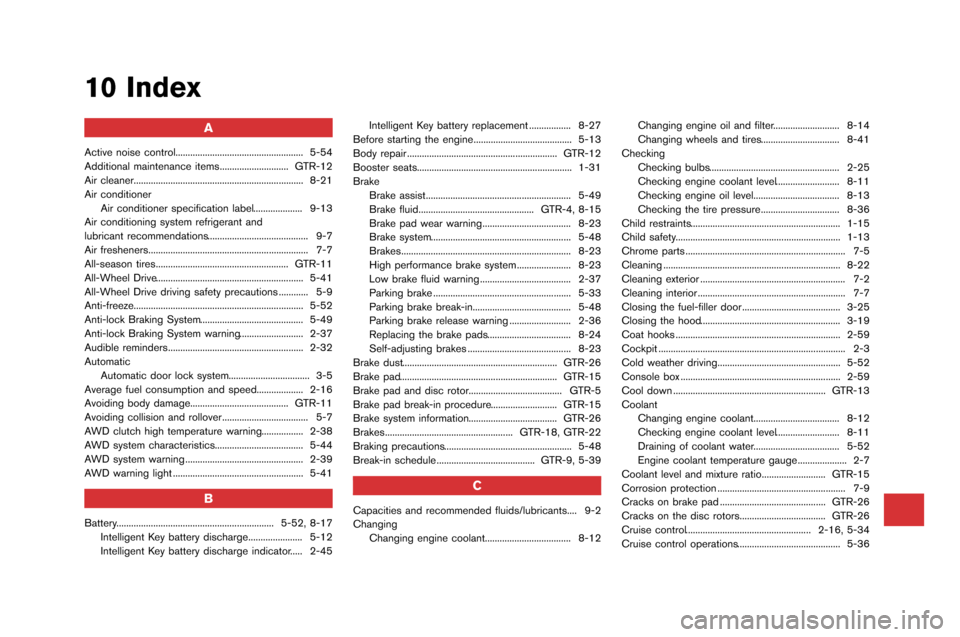
10 Index
A
Active noise control..................�G..................�G................ 5-54
Additional maintenance items..................�G.......... G�fR-12
Air cleaner..................�G..................�G..................�G............... �b-21
Air conditioner Air conditioner specification label..................�G.. 9-13
Air conditioning system refrigerant and
lubricant recommendations..................�G..................�G..... 9-7
Air fresheners..................�G..................�G............................. 7-7
All-season tires..................�G..................�G..................�G G�fR-11
All-Wheel Drive..................�G..................�G..................�G...... 5-41
All-Wheel Drive driving safety precautions ............ 5-9
Anti-freeze..................�G..................�G..................�G............... 5-52
Anti-lock Braking System..................�G..................�G...... 5-49
Anti-lock Braking System warning..................�G........ 2-37
Audible reminders..................�G..................�G................... 2-32
Automatic
Automatic door lock system..................�G............... 3-5
Average fuel consumption and speed..................�G. 2-16
Avoiding body damage..................�G..................�G.... G�fR-11
Avoiding collision and rollover..................�G................. 5-7
AWD clutch high temperature warning................. 2-3�b
AWD system characteristics..................�G..................�G 5-44
AWD system warning ..................�G..................�G............ 2-39
AWD warning light ..................�G..................�G................. 5-41
B
Battery ..................�G..................�G............................ 5-52, �b-17
Intelligent Key battery discharge..................�G.... 5-12
Intelligent Key battery discharge indicator..... 2-45 Intelligent Key battery replacement ................. �b-27
Before starting the engine..................�G..................�G.... 5-13
Body repair ..................�G..................�G......................... G�fR-12
Booster seats..................�G..................�G........................... 1-31
Brake Brake assist..................�G..................�G.....................�G.. 5-49
Brake fluid..................�G..................�G........... G�fR-4, �b-15
Brake pad wear warning..................�G..................�G �b-23
Brake system..................�G..................�G..................�G... 5-4�b
Brakes..................�G..................�G...............................�G.. �b-23
High performance brake system ..................�G.... �b-23
Low brake fluid warning ..................�G..................�G. 2-37
Parking brake ..................�G..................�G.................... 5-33
Parking brake break-in...............�G..................�G....... 5-4�b
Parking brake release warning ..................�G....... 2-36
Replacing the brake pads..................�G................ �b-24
Self-adjusting brakes ..................�G..................�G...... �b-23
Brake dust..................�G..................�G..................�G......... G�fR-26
Brake pad..................�G..................�G.....................�G....... G�fR-15
Brake pad and disc rotor..................�G..................�G.. G�fR-5
Brake pad break-in procedure..................�G......... G�fR-15
Brake system information..................�G..................�G G�fR-26
Brakes..................�G..................�G................ G�fR-1�b, G�fR-22
Braking precautions..................�G..................�G................ 5-4�b
Break-in schedule ..................�G..................�G.... G�fR-9, 5-39
C
Capacities and recommended fluids/lubricants .... 9-2
Changing
Changing engine coolant..................�G................. �b-12 Changing engine oil and filter..................�G......... �b-14
Changing wheels and tires..................�G.............. �b-41
Checking Checking bulbs..................�G..................�G................. 2-25
Checking engine coolant level..................�G........ �b-11
Checking engine oil level.............�G..................�G.... �b-13
Checking the tire pressure..................�G.............. �b-36
Child restraints..................�G..................�G..................�G....... 1-15
Child safety..................�G..................�G..........................�G..... 1-13
Chrome parts ..................�G..................�G............................. 7-5
Cleaning ..................�G..................�G...............................�G..... �b-22
Cleaning exterior ..................�G..................�G..................�G..... 7-2
Cleaning interior ..................�G..................�G........................ 7-7
Closing the fuel-filler door ..................�G..................�G.... 3-25
Closing the hood..................�G..................�G..................�G... 3-19
Coat hooks ..................�G..................�G..........................�G..... 2-59
Cockpit ..................�G..................�G..................�G...................... 2-3
Cold weather driving..................�G..................�G.............. 5-52
Console box ..................�G..................�G..................�G........... 2-59
Cool down ..................�G..................�G..................�G........ G�fR-13
Coolant Changing engine coolant..................�G................. �b-12
Checking engine coolant level..................�G........ �b-11
Draining of coolant water..................�G................. 5-52
Engine coolant temperature gauge..................�G.. 2-7
Coolant level and mixture ratio..................�G........ G�fR-15
Corrosion protection ..................�G..................�G................ 7-9
Cracks on brake pad ..................�G..................�G....... G�fR-26
Cracks on the disc rotors..................�G................. G�fR-26
Cruise control..................�G..................�G............... 2-16, 5-34
Cruise control operations..................�G..................�G...... 5-36
Page 352 of 358
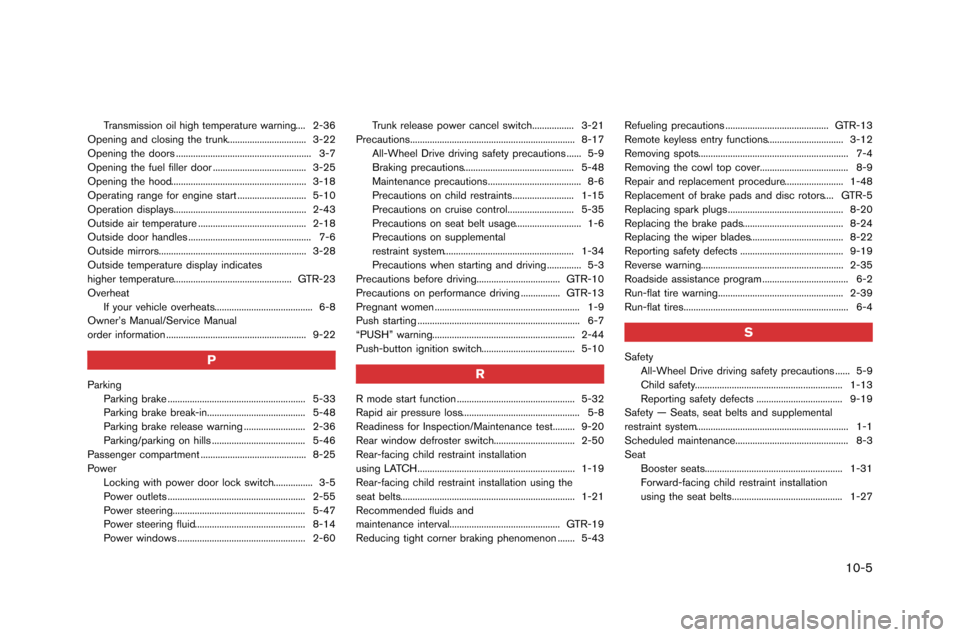
Transmission oil high temperature warning.... 2-�f6
Opening and �blosing the trunk..................�-.............. �f-22
Opening the doors ..................�-..................�-................... �f-7
Opening the fuel filler door ..................�-..................�-.. �f-25
Opening the hood..................�-..................�-................... �f-18
Operating range for engine start ..................�-.......... 5-10
Operation displays..................�-..................�-.................. 2-4�f
Outside air temperature ..................�-..................�-........ 2-18
Outside door handles ..................�-..................�-.............. 7-6
Outside mirrors..................�-..................�-..................�-...... �f-28
Outside temperature display indi�bates
higher temperature..................�-..................�-............ GTR-2�f
Overheat If your vehi�ble overheats..................�-..................�-.... 6-8
Owner’s Manual/Servi�be Manual
order information ..................�-..................�-..................�-... 9-22
P
Parking Parking brake ..................�-..................�-.................... 5-�f�f
Parking brake break-in................�-..................�-...... 5-48
Parking brake release warning ..................�-....... 2-�f6
Parking/parking on hills ..................�-..................�-.. 5-46
Passenger �bompartment ..................�-..................�-....... 8-25
Power Lo�bking with power door lo�bk swit�bh................ �f-5
Power outlets ..................�-..................�-.................... 2-55
Power steering..................�-..................�-..................�- 5-47
Power steering fluid..................�-..................�-......... 8-14
Power windows ..................�-..................�-................ 2-60 Trunk release power �ban�bel swit�bh................. �f-21
Pre�bautions..................�-..................�-..........................�-..... 8-17 All-Wheel Drive driving safety pre�bautions ...... 5-9
Braking pre�bautions..................�-..................�-......... 5-48
Maintenan�be pre�bautions..................�-..................�-.. 8-6
Pre�bautions on �bhild restraints..................�-....... 1-15
Pre�bautions on �bruise �bontrol..................�-......... 5-�f5
Pre�bautions on seat belt usage..................�-......... 1-6
Pre�bautions on supplemental
restraint system..................�-..................�-................. 1-�f4
Pre�bautions when starting and driving .............. 5-�f
Pre�bautions before driving..................�-................ GTR-10
Pre�bautions on performan�be driving ................ GTR-1�f
Pregnant women ..................�-..................�-..................�-..... 1-9
Push starting ..................�-..................�-..................�-............ 6-7
“PUSH” warning..................�-..................�-...................... 2-44
Push-button ignition swit�bh..................�-..................�-.. 5-10R
R mode start fun�btion ..................�-..................�-............ 5-�f2
Rapid air pressure loss..................�-..................�-............ 5-8
Readiness for Inspe�btion/Maintena�-n�be test......... 9-20
Rear window defroster swit�bh..................�-............... 2-50
Rear-fa�bing �bhild restraint installation
using LATCH..................�-..................�-..................�-.......... 1-19
Rear-fa�bing �bhild restraint installation using the
seat belts..................�-..................�-..........................�-......... 1-21
Re�bommended fluids and
maintenan�be interval..................�-..................�-......... GTR-19
Redu�bing tight �borner braking phenomenon ....... 5-4�f Refueling pre�bautions ..................�-..................�-...... GTR-1�f
Remote keyless entry fun�btions..................�-............. �f-12
Removing spots..................�-..................�-......................... 7-4
Removing the �bowl top �bover..................�-..................�- 8-9
Repair and repla�bement pro�bedure..................�-...... 1-48
Repla�bement of brake pads and dis�b rotors.... GTR-5
Repla�bing spark plugs ..................�-..................�-........... 8-20
Repla�bing the brake pads..................�-..................�-..... 8-24
Repla�bing the wiper blades..................�-..................�-.. 8-22
Reporting safety defe�bts ..................�-..................�-...... 9-19
Reverse warning..................�-..................�-...................... 2-�f5
Roadside assistan�be program ..................�-................. 6-2
Run-flat tire warning..................�-..................�-............... 2-�f9
Run-flat tires..................�-..................�-..................�-............. 6-4
S
Safety
All-Wheel Drive driving safety pre�bautions ...... 5-9
Child safety..................�-..................�-........................ 1-1�f
Reporting safety defe�bts ..................�-................. 9-19
Safety — Seats, seat belts and supplemental
restraint system..................�-..................�-..................�-........ 1-1
S�bheduled maintenan�be........�-..................�-..................�-.. 8-�f
Seat
Booster seats..................�-..................�-.................... 1-�f1
Forward-fa�bing �bhild restraint installation
using the seat belts..................�-..................�-......... 1-27
10-5
Page 357 of 358
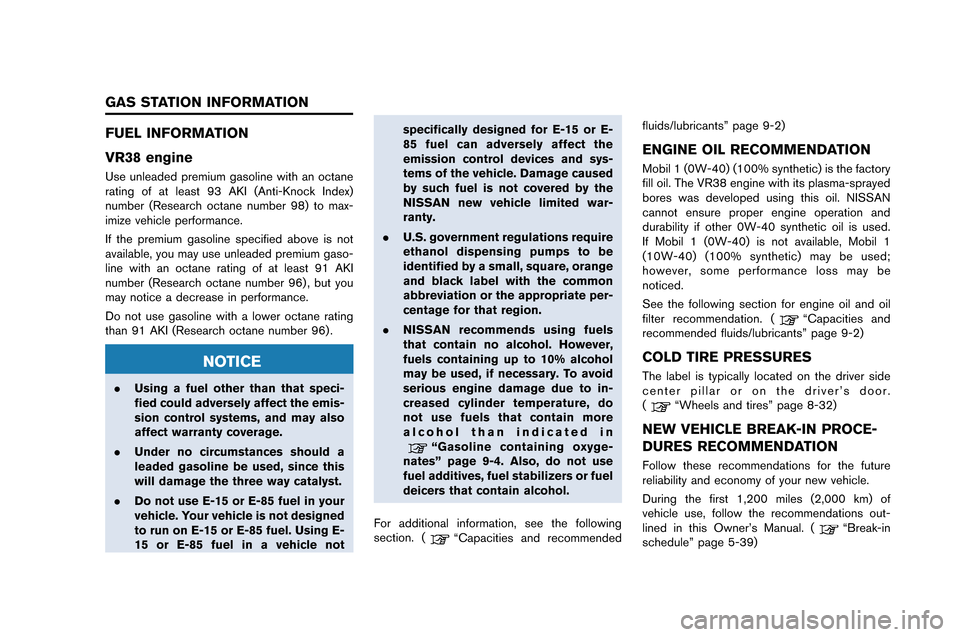
FUEL INFORMATION
VR38 engine
Use unleaded premium gasoline with an octane
rating of at least �f3 AK�b (Anti-Knock �bndex)
number (Research octane number �f8) to max-
imize vehicle performance.
�bf the premium gasoline specified above is not
available, you may use unleaded premium gaso-
line with an octane rating of at least �f1 AK�b
number (Research octane number �f6) , but you
may notice a decrease in performance.
Do not use gasoline with a lower octane rating
than �f1 AK�b (Research octane number �f6) .
NOTICE
.Using a fuel other than that speci-
fied could adversely affect the emis-
sion control systems, and may also
affect warranty coverage.
. Under no circumstances should a
leaded gasoline be used, since this
will damage the three way catalyst.
. Do not use E-15 or E-85 fuel in your
vehicle. Your vehicle is not designed
to run on E-15 or E-85 fuel. Using E-
15 or E-85 fuel in a vehicle not specifically designed for E-15 or E-
85 fuel can adversely affect the
emission control devices and sys-
tems of the vehicle. Damage caused
by such fuel is not covered by the
NISSAN new vehicle limited war-
ranty.
. U.S. government regulations require
ethanol dispensing pumps to be
identified by a small, square, orange
and black label with the common
abbreviation or the appropriate per-
centage for that region.
. NISSAN recommends using fuels
that contain no alcohol. However,
fuels containing up to 10% alcohol
may be used, if necessary. To avoid
serious engine damage due to in-
creased cylinder temperature, do
not use fuels that contain more
alcohol than indicated in
“Gasoline containing oxyge-
nates” page 9-4. Also, do not use
fuel additives, fuel stabilizers or fuel
deicers that contain alcohol.
For additional information, see the following
section. (
“Capacities and recommended fluids/lubricants” page �f-2)
ENGINE OIL RECOMMENDATION
Mobil 1 (0W-40) (100% synthetic) is the factory
fill oil. The VR38 engine with its plasma-sprayed
bores was developed using this oil. N�bSSAN
cannot ensure proper engine operation and
durability if other 0W-40 synthetic oil is used.
�bf Mobil 1 (0W-40) is not available, Mobil 1
(10W-40) (100% synthetic) may be used;
however, some performance loss may be
noticed.
See the following section for engine oil and oil
filter recommendation. (
“Capacities and
recommended fluids/lubricants” page �f-2)
COLD TIRE PRESSURES
The label is typically located on the driver side
center pillar or on the driver’s door.
(
“Wheels and tires” page 8-32)
NEW VEHICLE BREAK-IN PROCE-
DURES RECOMMENDATION
Follow these recommendations for the future
reliability and economy of your new vehicle.
During the first 1,200 miles (2,000 km) of
vehicle use, follow the recommendations out-
lined in this Owner’s Manual. (
“Break-in
schedule” page 5-3�f)
GAS STATION INFORMATION