2015 NISSAN FRONTIER automatic transmission
[x] Cancel search: automatic transmissionPage 370 of 466
8 Maintenance and do-it-yourself
Maintenance requirements..........................8-2
General maintenance ..............................8-2
Explanation of general maintenance items .........8-2
Maintenance precautions ...........................8-5
Engine compartment check locations ................8-7
Engine cooling system .............................8-9
Checking engine coolant level ..................8-10
Changing engine coolant .......................8-10
Engine oil ........................................ 8-11
Checking engine oil level .......................8-11
Changing engine oil ........................... 8-12
Changing engine oil filter .......................8-13
5-speed automatic transmission fluid
(if so equipped) .................................. 8-15
Power steering fluid ............................... 8-15
Brake and clutch (if so equipped) fluid ..............8-15
Brake fluid .................................... 8-16
Clutch fluid (if so equipped) ....................8-16
Windshield-washer fluid ........................... 8-16
Windshield-washer fluid reservoir ...............8-16
Battery .......................................... 8-17
Jump starting ................................. 8-19
Variable voltage control system .....................8-19Drive belt
........................................ 8-20
Spark plugs ...................................... 8-21
Replacing spark plugs ......................... 8-21
Air cleaner ....................................... 8-21
In-cabin microfilter (if so equipped) ..............8-22
Windshield wiper blades .......................... 8-23
Cleaning ..................................... 8-23
Replacing .................................... 8-24
Brakes .......................................... 8-25
Fuses ........................................... 8-25
Engine compartment ........................... 8-26
Passenger compartment .......................8-27
Battery replacement .............................. 8-29
Key fob (if so equipped) ........................ 8-30
Lights ........................................... 8-31
Headlights .................................... 8-31
Fog
lights (if so equipped) ...................... 8-32
Exterior and interior lights .......................8-33
Wheels and tires ................................. 8-35
Tire pressure .................................. 8-35
Tire labeling ................................... 8-39
Types of tires .................................. 8-41
Tire chains .................................... 8-42
Changing wheels and tires .....................8-42
Page 372 of 466
When driving in areas using road salt or other
corrosive materials, check lubrication frequently.
Lights*Clean the headlights on a regular basis.
Make sure that the headlights, stop lights, tail
lights, turn signal lights, and other lights are all
operating properly and installed securely. Also
check headlight aim.
Road wheel nuts (lug nuts)* When checking
the tires, make sure no wheel nuts are missing,
and check for any loose wheel nuts. Tighten if
necessary.
Tire rotation* Tires should be rotated every
5,000 miles (8,000 km).
Tires* Check the pressure with a gauge often
and always prior to long distance trips. If neces-
sary, adjust the pressure in all tires, including the
spare, to the pressure specified. Check carefully
for damage, cuts or excessive wear.
Tire Pressure Monitoring System (TPMS)
transmitter components Replace the TPMS
transmitter grommet seal, valve core and cap
when the tires are replaced due to wear or age.
Wheel alignment and balance If the vehicle
should pull to either side while driving on a
straight and level road, or if you detect uneven or
abnormal tire wear, there may be a need for wheel alignment. If the steering wheel or seat vibrates at
normal highway speeds, wheel balancing may be
needed.
● For additional information regarding tires,
refer to “Important Tire Safety Information”
(US) or “Tire Safety Information” (Canada) in
the Warranty Information Booklet.
Windshield Clean the windshield on a regular
basis. Check the windshield at least every six
months for cracks or other damage. Have a dam-
aged windshield repaired by a qualified repair
facility.
Windshield wiper blades* Check for cracks or
wear if they do not wipe properly.
Inside the vehicle
The maintenance items listed here should be
checked on a regular basis, such as when per-
forming periodic maintenance, cleaning the ve-
hicle, etc.
Additional information on the following
items with an “*” is found in this section.
Accelerator pedal Check the pedal for smooth
operation and make sure the pedal does not bind
or require uneven effort. Keep the floor mat away
from the pedal.
Automatic transmission P (Park) position
mechanism On a fairly steep hill check that your vehicle is held securely with the shift lever in the P
(Park) position without applying any brakes.
Brake pedal
Check the pedal for smooth opera-
tion. If the brake pedal suddenly goes down fur-
ther than normal, the pedal feels spongy or the
vehicle seems to take longer to stop, see a
NISSAN dealer immediately. Keep the floor mat
away from the pedal.
Brakes Check that the brakes do not pull the
vehicle to one side when applied.
Parking brake Check the parking brake opera-
tion regularly. The vehicle should be securely held
on a fairly steep hill with only the parking brake
applied. If the parking brake needs adjustment,
see a NISSAN dealer.
Seats Check seat position controls such as seat
adjusters, seatback recliner, etc. to ensure they
operate smoothly and all latches lock securely in
every position. Check that the head
restraints/headrests move up and down
smoothly and the locks (if so equipped) hold
securely in all latched positions.
Seat belts Check that all parts of the seat belt
system (for example, buckles, anchors, adjusters
and retractors) operate properly and smoothly,
and are installed securely. Check the belt web-
bing for cuts, fraying, wear or damage.
Maintenance and do-it-yourself8-3
Page 384 of 466
When checking or replacement is required, we
recommend your NISSAN dealer for servicing.
CAUTION
●Use Genuine NISSAN Matic S ATF. If
Genuine NISSAN Matic S ATF is not
available, Genuine NISSAN Matic J ATF
may also be used.
● Using automatic transmission fluid
other than Genuine NISSAN Matic S
ATF or Matic J ATF will cause deteriora-
tion in driveability and automatic trans-
mission durability, and may damage the
automatic transmission, which is not
covered by the NISSAN new vehicle lim-
ited warranty.
The specified automatic transmission fluid is also
described on caution labels located in the engine
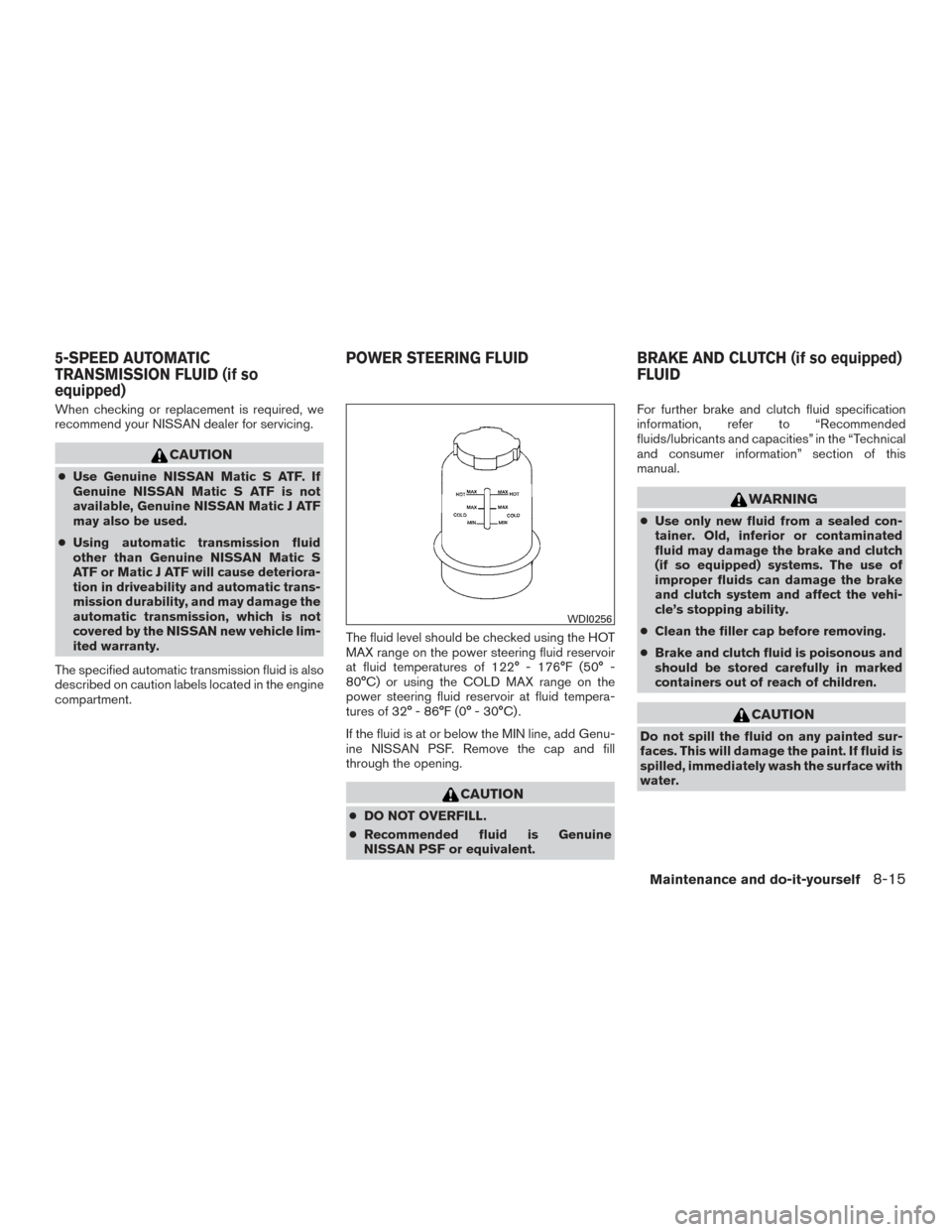
compartment. The fluid level should be checked using the HOT
MAX range on the power steering fluid reservoir
at fluid temperatures of 122° - 176°F (50° -
80°C) or using the COLD MAX range on the
power steering fluid reservoir at fluid tempera-
tures of 32° - 86°F (0° - 30°C) .
If the fluid is at or below the MIN line, add Genu-
ine NISSAN PSF. Remove the cap and fill
through the opening.
CAUTION
●
DO NOT OVERFILL.
● Recommended fluid is Genuine
NISSAN PSF or equivalent. For further brake and clutch fluid specification
information, refer to “Recommended
fluids/lubricants and capacities” in the “Technical
and consumer information” section of this
manual.
WARNING
●
Use only new fluid from a sealed con-
tainer. Old, inferior or contaminated
fluid may damage the brake and clutch
(if so equipped) systems. The use of
improper fluids can damage the brake
and clutch system and affect the vehi-
cle’s stopping ability.
● Clean the filler cap before removing.
● Brake and clutch fluid is poisonous and
should be stored carefully in marked
containers out of reach of children.
CAUTION
Do not spill the fluid on any painted sur-
faces. This will damage the paint. If fluid is
spilled, immediately wash the surface with
water.
WDI0256
5-SPEED AUTOMATIC
TRANSMISSION FLUID (if so
equipped) POWER STEERING FLUID
BRAKE AND CLUTCH (if so equipped)
FLUID
Maintenance and do-it-yourself8-15
Page 418 of 466
Capacity (Approximate)Recommended Fluids and Lubricants
US measure Imp measure Liter
Automatic transmission fluid Refill to the proper level according to the instructions inthe “Maintenance and do-it-yourself” section. • Genuine NISSAN Matic S ATF
• If Genuine NISSAN Matic S ATF is not available, Genuine NISSAN Matic
J ATF may also be used. Using automatic transmission fluid other than
Genuine NISSAN Matic S ATF or Genuine NISSAN Matic J ATF will cause
deterioration in driveability and automatic transmission durability, and may
damage the automatic transmission, which is not covered by the NISSAN
new vehicle limited warranty.
Power steering fluid (PSF) • Genuine NISSAN PSF or equivalent.
• DEXRON™ VI type ATF may also be used.
Brake and clutch (if so equipped) fluid • Genuine NISSAN Super Heavy Duty Brake Fluid or equivalent DOT 3
• Available in mainland USA through a NISSAN dealer.
Multi-purpose grease ——— • NLGI No. 2 (Lithium Soap base)
Air conditioning system refrigerant ———• HFC-134a (R-134a)
• For additional information, refer to “Air conditioner specification label” in
this section.
Air conditioning system oil ———• Genuine NISSAN A/C System Oil Type R or equivalent
• For additional information, refer to “Air conditioner specification label” in
this section.
Transfer fluid 2-1/8 qt1-3/4 qt 2.0 L • Genuine NISSAN Matic D ATF recommended
• Using fluid other than Genuine NISSAN Matic D ATF will cause deteriora-
tion in driveability and transfer durability, and may damage the transfer,
which is not covered by the NISSAN new vehicle limited warranty.
Front final drive oil 1-3/4 pt1-1/2 pt 0.85 L • Genuine NISSAN Differential Oil Hypoid Super GL-5 80W-90 or API
GL-5
• Viscosity SAE 80W-90
• For hot climates, Viscosity SAE 90 is suitable for ambient temperatures
above 0° (32°F)
Technical and consumer information9-3
Page 450 of 466
Pre-towing tips
●Be certain your vehicle maintains a level
position when a loaded and/or unloaded
trailer is hitched. Do not drive the vehicle if it
has an abnormal nose-up or nose-down
condition; check for improper tongue load,
overload, worn suspension or other possible
causes of either condition.
● Always secure items in the trailer to prevent
load shift while driving.
●
Keep the cargo load as low as possible in the
trailer to keep the trailer center of gravity low.
● Load the trailer so approximately 60% of the
trailer load is in the front half and 40% is in
the back half. Also make sure the load is
balanced side to side.
● Check your hitch, trailer tire pressure, ve-
hicle tire pressure, trailer light operation, and
trailer wheel lug nuts every time you attach a
trailer to the vehicle.
● Be certain your rearview mirrors conform to
all federal, state or local regulations. If not,
install any mirrors required for towing before
driving the vehicle.
●
Determine the overall height of the vehicle and
trailer so the required clearance is known.
Trailer towing tips
In order to gain skill and an understanding of the
vehicle’s behavior, you should practice turning,
stopping and backing up in an area which is free
from traffic. Steering stability and braking perfor-
mance will be somewhat different than under
normal driving conditions.
● Always secure items in the trailer to prevent
load shift while driving.
● Lock the trailer hitch coupler with a pin or
lock to prevent the coupler from inadver-
tently becoming unlatched.
● Avoid abrupt starts, acceleration or stops.
● Avoid sharp turns or lane changes.
● Always drive your vehicle at a moderate
speed.
● When backing up, hold the bottom of the
steering wheel with one hand. Move your
hand in the direction in which you want the
trailer to go. Make small corrections and
back up slowly. If possible, have someone
guide you when you are backing up.
Always block the wheels on both vehicle and
trailer when parking. Parking on a slope is not
recommended; however, if you must do so:
CAUTION
If you move the shift lever to the P (Park)
position before blocking the wheels and
applying the parking brake, transmission
damage could occur.
1. Apply and hold the brake pedal.
2. Have someone place blocks on the downhill side of the vehicle and trailer wheels.
3. After the wheel blocks are in place, slowly release the brake pedal until the blocks ab-
sorb the vehicle load.
4. Apply the parking brake.
5. Shift the transmission into P (Park) .
6. Make sure the
indicator light (if so
equipped) indicates the transfer case is in
4H, 4L, or 2H and that the ATP light is off. If
the
indicator light is flashing, or the
ATP light is ON, make sure the transmission
is in P (Park) (A/T) and turn the 4WD switch
to 2WD or 4H. Refer to “Automatic trans-
mission park warning light” in the “Instru-
ments and controls” section and “Using four
wheel drive (4WD)” in the “Starting and
driving” section.
7. Turn off the engine.
Technical and consumer information9-35
Page 453 of 466
Automatic Transmission (if so
equipped)
To tow a vehicle equipped with an automatic
transmission, an appropriate vehicle dollyMUST
be placed under the towed vehicle’s drive
wheels. Always follow the dolly manufacturer’s
recommendations when using their product. DOT (Department of Transportation) Quality
Grades: All passenger car tires must conform to
federal safety requirements in addition to these
grades.
Quality grades can be found where applicable on
the tire sidewall between tread shoulder and
maximum section width. For example:
Treadwear 200 Traction AA Temperature A
Treadwear
The treadwear grade is a comparative rating
based on the wear rate of the tire when tested
under controlled conditions on a specified gov-
ernment test course. For example, a tire graded
150 would wear one and one-half (1 1/2) times
as well on the government course as a tire graded
100. The relative performance of tires depends
upon the actual conditions of their use, however,
and may depart significantly from the norm due to
variations in driving habits, service practices and
differences in road characteristics and climate.
Traction AA, A, B and C
The traction grades, from highest to lowest, are
AA, A, B, and C. Those grades represent the
tire’s ability to stop on wet pavement as mea-
sured under controlled conditions on specified
government test surfaces of asphalt and con-
crete. A tire marked C may have poor traction
performance.
WARNING
The traction grade assigned to this tire is
based on straight-ahead braking traction
tests, and does not include acceleration,
cornering, hydroplaning, or peak traction
characteristics.
Temperature A, B and C
The temperature grades are A (the highest) , B,
and C, representing the tire’s resistance to the
generation of heat, and its ability to dissipate heat
when tested under controlled conditions on a
specified indoor laboratory test wheel. Sustained
high temperature can cause the material of the
tire to degenerate and reduce tire life, and exces-
sive temperature can lead to sudden tire failure.
The grade C corresponds to a level of perfor-
mance which all passenger car tires must meet
under the Federal Motor Safety Standard No.
109. Grades B and A represent higher levels of
performance on the laboratory test wheel than
the minimum required by law.
UNIFORM TIRE QUALITY GRADING
9-38Technical and consumer information
Page 458 of 466
10 Index
4WDwarninglight...............2-17A
Active brake limited slip (ABLS) system . . .5-36
Air bag (See supplemental restraint
system) .....................1-70
Air bag system Front (See supplemental front impact air bag
system) ...................1-77
Airbagwarninglabels.............1-84
Airbagwarninglight...........1-85,2-20
Air bag warning light, supplemental . .1-85, 2-20
Air cleaner housing filter ............8-21
Air conditioner Air conditioner operation ..........4-24
Air conditioner service ...........4-34
Air conditioner specification label .....9-14
Air conditioner system refrigerant and
oil recommendations .............9-8
Heater and air conditioner
controls............4-15,4-21,4-32
Servicing air conditioner ..........4-34
Airflowcharts..............4-18,4-25
Alarm system (See vehicle security system). .2-24
Anchor point locations .............1-31
Antenna .....................4-71
Anti-lock brake warning light ..........2-15
Anti-lock Braking System (ABS) ........5-35
Apps .......................4-71
Audible reminders ...............2-24
Audio system ..................4-34 AMradioreception.............4-35
Bluetooth®audio..............4-67
Compact disc (CD) player . .4-44, 4-49, 4-56
FM-AM radio with compact disc (CD)
player ....................4-42
FM/AM/SAT radio with compact disc (CD)
player.................4-46,4-51
FMradioreception.............4-34
iPod® Player
.............4-61,4-63
iPod® player operation .......4-61,4-63
Radio ....................4-34
Steering wheel audio control switch . . .4-69
USB interface ............4-57,4-59
USB (Universal Serial Bus) Connection
Port..................4-57,4-59
Autolight switch .................2-29
Automatic Automatic power window switch .....2-50
Automatic transmission position indicator
light .....................2-20
Driving with automatic transmission ....5-13
Automatic anti-glare inside mirror .......3-15
Automatic door locks ..............3-5
AUXjack.................4-45,4-57
B
Backbutton....................4-7
Battery ..................5-41,8-17
Chargewarninglight............2-16
Battery replacement Keyfob ...................8-30 Before starting the engine
...........5-12
Belt (See drive belt) ..............8-20
Block heater Engine ....................5-42
Bluetooth® audio ................4-67
Bluetooth® hands-free phone
system...............4-73,4-87,4-97
Boosterseats..................1-65
Brake Anti-lock Braking System (ABS) ......5-35
Brake fluid ..................8-15
Brakelight(Seestoplight).........8-33
Brake system ................5-34
Brakewarninglight.............2-16
Brakewearindicators........2-24,8-25
Parking brake operation ..........5-20
Self-adjusting brakes ............8-25
Brake fluid ....................8-15
Brakes ......................8-25
Brake system ..................5-34
Break-inschedule ...............5-22
Brightness/contrast button ...........4-9
Brightness control Instrument panel ..............2-31
Bulb check/instrument panel ..........2-15
Bulbreplacement................8-33
C
Capacities and recommended fuel/lubricants..9-2
Cargolightswitch ...............2-33
Cargo (See vehicle loading information) . . .9-15
Page 459 of 466
Car phone or CB radio.............4-72
CD care and cleaning ..............4-69
CD player (See audio system) . .4-44, 4-49, 4-56
Check tire press ..................2-5
Child restraints .......1-24,1-24,1-25,1-28
LATCH (Lower Anchors and Tethers for
CHildren) System ..............1-28
Precautions on child
restraints.........1-25,1-38,1-54,1-65
Top tether strap anchor point locations . .1-31
Child restraint with top tether strap .......1-30
Child safety rear door lock ............3-6
Chimes, audible reminders ...........2-24
Cleaningexteriorandinterior...........7-2
Clock.......................4-43 (models without navigation system) ....4-43
Clockset.....................4-43
Clock set/adjustment ........4-7,4-43,4-47
Clutch Clutch fluid ..................8-16
Clutch interlock (clutch start) switch ......2-37
C.M.V.S.S. certification label ..........9-13
Cold weather driving ...............5-41
Compact disc (CD) player ....4-44,4-49,4-56
Compass display .................2-10
Consolebox...................2-40
Control panel buttons ...............4-4
Backbutton..................4-7
Brightness/contrast button ..........4-9
Enterbutton..................4-4
Setting button .................4-7
With navigation system .........4-4,4-5
Controls Audiocontrols(steeringwheel).......4-69
Heater and air conditioner
controls.............4-15,4-21,4-32 Coolant
Capacities and recommended
fuel/lubricants .................9-2
Changingenginecoolant..........8-10
Checking engine coolant level .......8-10
Engine coolant temperature gauge .....2-6
Corrosion protection ...............7-5
Cruisecontrol..................5-21
Cupholders...................2-45
Curtainside-impactandrolloverairbag....1-82
D
Daytime running light system (Canada only) . .2-31
Defroster switch Rear window defroster switch .......2-28
Dimensionsandweights ............9-11
Dimmer switch for instrument panel ......2-31
Display controls (see control panel buttons) . .4-4
Door locks .....................3-3
Door open warning light .............2-17
Drive belt .....................8-20
Driving Cold weather driving .............5-41
Driving with automatic transmission ....5-13
Driving with manual transmission ......5-18
Precautions when starting and driving ....5-2
Driving the vehicle ................5-13
E
Economy - fuel ..................5-24
Electronic locking rear differential (E-Lock)
system ......................5-31 Electronic locking rear differential (E-Lock)
system switch
..................2-36
Emission control information label .......9-13
Emission control system warranty .......9-39
Engine Before starting the engine ..........5-12
Blockheater.................5-42
Capacities and recommended
fuel/lubricants.................9-2
Changing engine coolant ..........8-10
Changingengineoil.............8-12
Changing engine oil filter ..........8-13
Checking engine coolant level .......8-10
Checking
engine oil level ..........8-11
Engine compartment check locations ....8-7
Engine coolant temperature gauge .....2-6
Engine cooling system ............8-9
Engineoil...................8-11
Engine oil and oil filter recommendation . . .9-7
Engineoilpressuregauge..........2-8
Engine oil pressure warning light ......2-17
Engine oil viscosity ..............9-7
Engine serial number ............9-13
Engine specifications .............9-9
Starting the engine .............5-12
Engine coolant temperature gauge .......2-6
Engine oil pressure gauge ............2-8
Enter button ....................4-4
Event data recorders ..............9-41
Exhaust gas (Carbon monoxide) .........5-2
Explanation of maintenance items ........8-2
Extended storage switch ............8-28
10-2