2015 NISSAN FRONTIER flat tire
[x] Cancel search: flat tirePage 433 of 466
5. Determine the combined weight ofluggage and cargo being loaded on
the vehicle. That weight may not
safely exceed the available cargo and
luggage load capacity calculated in
Step 4.
6. If your vehicle will be towing a trailer, load from your trailer will be trans-
ferred to your vehicle. Consult this
manual to determine how this re-
duces the available cargo and lug-
gage load capacity of your vehicle.
Before driving a loaded vehicle, confirm
that you do not exceed the GVWR or the
GAWR for your vehicle. For additional
information, refer to “Measurement of
weights” in this section.
Also check tires for proper inflation pres-
sures. For additional information, refer to
the “Tire and Loading Information label” in
the Maintenance and do-it-yourself” sec-
tion of this manual.
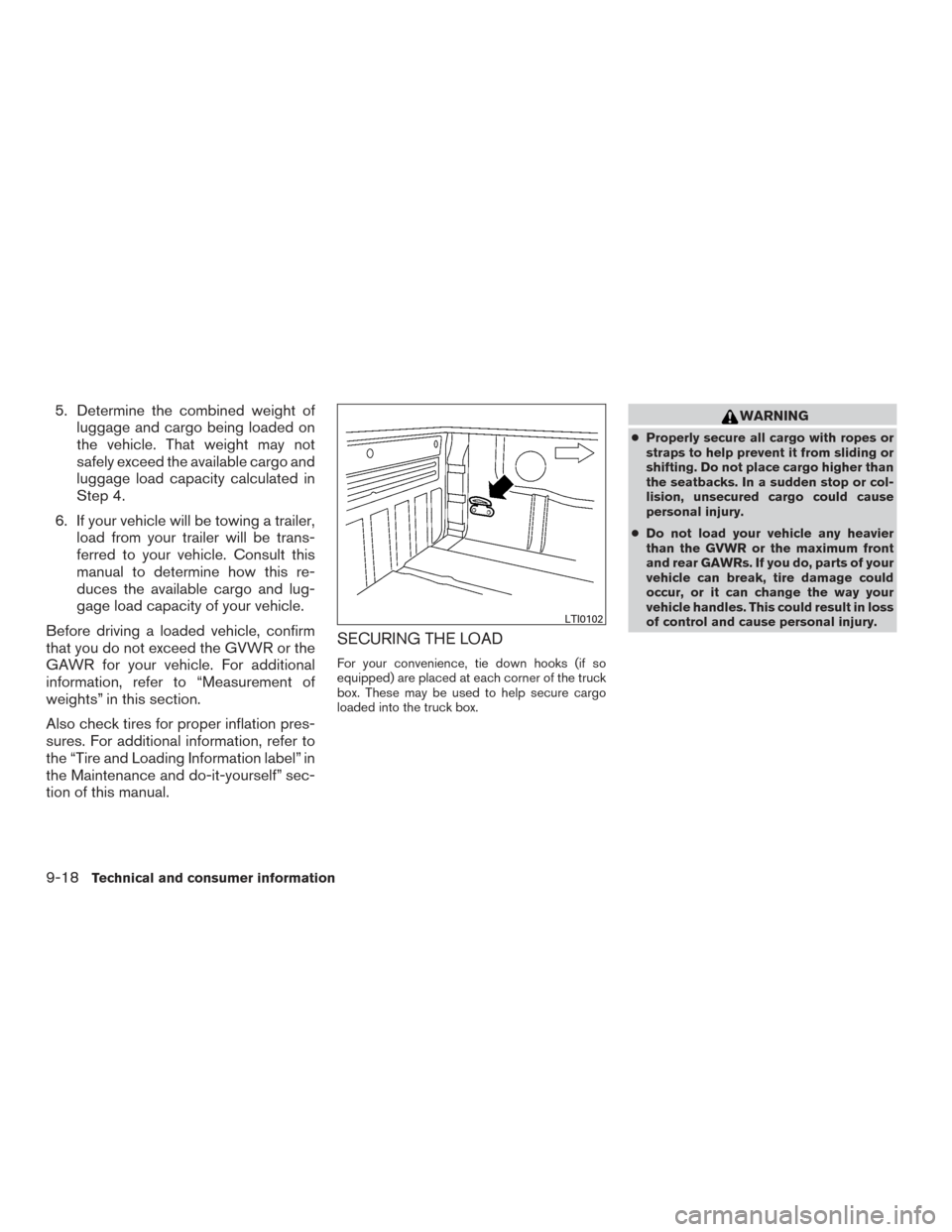
SECURING THE LOAD
For your convenience, tie down hooks (if so
equipped) are placed at each corner of the truck
box. These may be used to help secure cargo
loaded into the truck box.
WARNING
● Properly secure all cargo with ropes or
straps to help prevent it from sliding or
shifting. Do not place cargo higher than
the seatbacks. In a sudden stop or col-
lision, unsecured cargo could cause
personal injury.
● Do not load your vehicle any heavier
than the GVWR or the maximum front
and rear GAWRs. If you do, parts of your
vehicle can break, tire damage could
occur, or it can change the way your
vehicle handles. This could result in loss
of control and cause personal injury.
LTI0102
9-18Technical and consumer information
Page 440 of 466
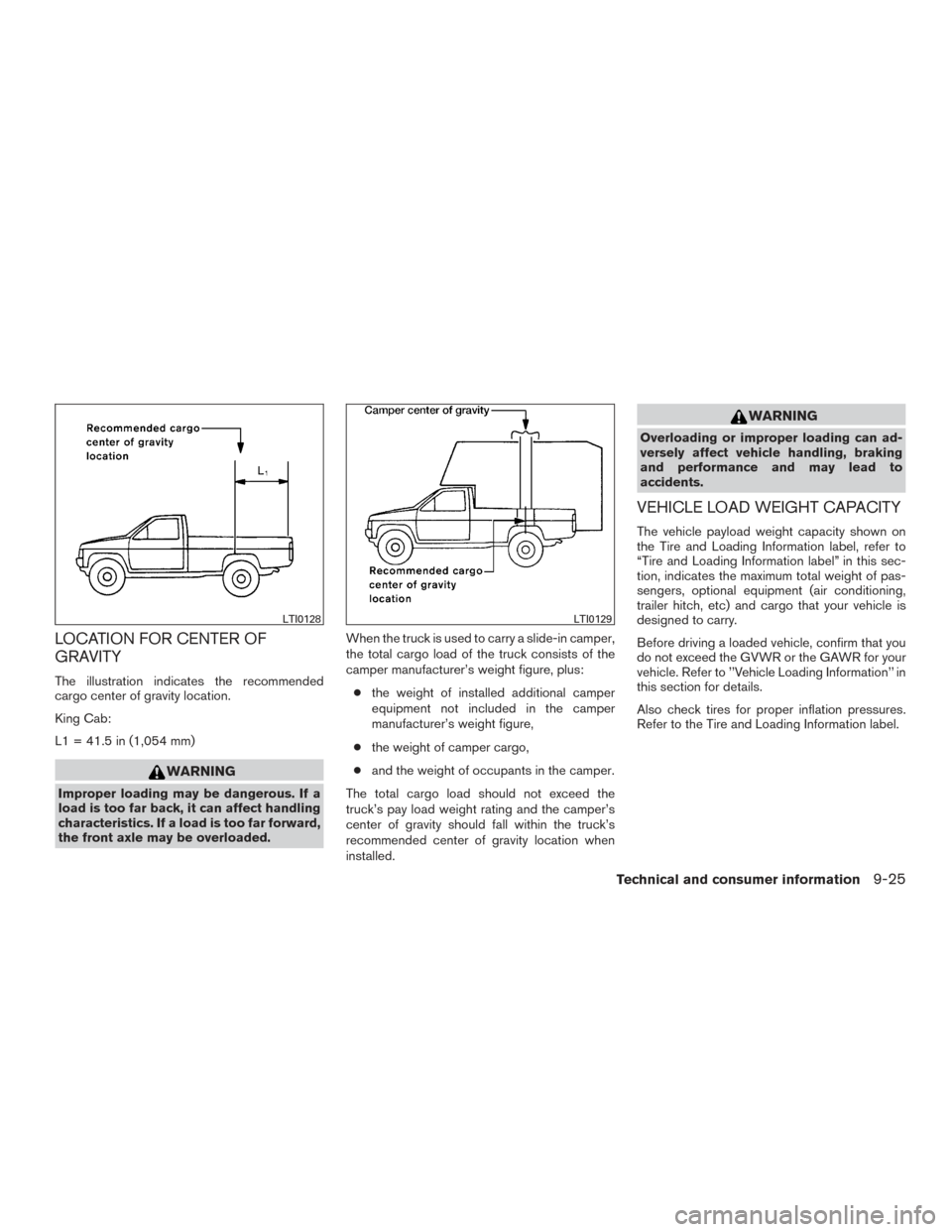
LOCATION FOR CENTER OF
GRAVITY
The illustration indicates the recommended
cargo center of gravity location.
King Cab:
L1 = 41.5 in (1,054 mm)
WARNING
Improper loading may be dangerous. If a
load is too far back, it can affect handling
characteristics. If a load is too far forward,
the front axle may be overloaded.When the truck is used to carry a slide-in camper,
the total cargo load of the truck consists of the
camper manufacturer’s weight figure, plus:
● the weight of installed additional camper
equipment not included in the camper
manufacturer’s weight figure,
● the weight of camper cargo,
● and the weight of occupants in the camper.
The total cargo load should not exceed the
truck’s pay load weight rating and the camper’s
center of gravity should fall within the truck’s
recommended center of gravity location when
installed.
WARNING
Overloading or improper loading can ad-
versely affect vehicle handling, braking
and performance and may lead to
accidents.
VEHICLE LOAD WEIGHT CAPACITY
The vehicle payload weight capacity shown on
the Tire and Loading Information label, refer to
“Tire and Loading Information label” in this sec-
tion, indicates the maximum total weight of pas-
sengers, optional equipment (air conditioning,
trailer hitch, etc) and cargo that your vehicle is
designed to carry.
Before driving a loaded vehicle, confirm that you
do not exceed the GVWR or the GAWR for your
vehicle. Refer to ’’Vehicle Loading Information’’ in
this section for details.
Also check tires for proper inflation pressures.
Refer to the Tire and Loading Information label.
LTI0128LTI0129
Technical and consumer information9-25
Page 448 of 466
Sway control device
Sudden maneuvers, wind gusts, and buffeting
caused by other vehicles can affect trailer han-
dling. Sway control devices may be used to help
control these affects. If you choose to use one,
contact a reputable trailer hitch supplier to make
sure the sway control device will work with the
vehicle, hitch, trailer and the trailer’s brake sys-
tem. Follow the instructions provided by the
manufacturer for installing and using the sway
control device.
Class I hitch
Class I trailer hitch equipment (receiver, ball
mount and hitch ball) can be used to tow trailers
of a maximum weight of 2,000 lb (907 kg) .
Class II hitch
Class II trailer hitch equipment (receiver, ball
mount and hitch ball) can be used to tow trailers
of a maximum weight of 3,500 lb (1,587 kg).
The Genuine NISSAN step bumper is consid-
ered a Class II ball mount.
Class III hitch
Class III trailer hitch equipment (receiver, ball
mount and hitch ball) can be used to tow trailers
of a maximum weight of 5,000 lb (2,268 kg).
Class IV hitch
Class IV trailer hitch equipment (receiver, ball
mount and hitch ball) can be used to tow trailers
of a maximum weight of 10,000 lb (4,535 kg). A
weight distributing hitch should be used to tow
trailers that weigh over 5,000 lb (2,268 kg).
Your vehicle may be equipped with Class IV
trailer hitch equipment that has a 10,000 lb
(4,535 kg) maximum weight rating, but your ve-
hicle is only capable of towing the maximum
trailer weights shown in the “Towing
Load/Specification” chart earlier in this section.
CAUTION
●Special hitches which include frame re-
inforcements are required for towing
above 2,000 lb (907 kg) . Suitable Genu-
ine NISSAN hitches, ball mounts and
hitch balls for pickup trucks and sport
utility vehicles are available at a
NISSAN dealer.
● The hitch should not be attached to or
affect the operation of the impact-
absorbing bumper.
● Do not use axle-mounted hitches.
● Do not modify the vehicle exhaust sys-
tem, brake system, etc. to install a
trailer hitch. ●
To reduce the possibility of additional
damage if your vehicle is struck from
the rear, where practical, remove the
receiver when not in use.
● Regularly check that all trailer hitch
mounting bolts are securely mounted.
Tire pressures
● When towing a trailer, inflate the ve-
hicle tires to the recommended cold
tire pressure indicated on the Tire
and Loading Information label.
● Trailer tire condition, size, load rating
and proper inflation pressure should
be in accordance with the trailer and
tire manufacturer’s specifications.
Safety chains
Always use suitable safety chains between your
vehicle and the trailer. The safety chains should
be crossed and should be attached to the hitch,
not to the vehicle bumper or axle. The safety
chains can be attached to the bumper if the hitch
ball is mounted to the bumper. Be sure to leave
enough slack in the chains to permit turning
corners.
Technical and consumer information9-33
Page 452 of 466
●Some states or provinces have specific
regulations and speed limits for vehicles that
are towing trailers. Obey the local speed
limits.
● Check your hitch, trailer wiring harness con-
nections, and trailer wheel lug nuts after
50 miles (80 km) of travel and at every break.
● When launching a boat, don’t allow the wa-
ter level to go over the exhaust tail pipe or
rear bumper.
● Make sure you disconnect the trailer lights
before backing the trailer into the water or
the trailer lights may burn out.
When towing a trailer, final drive gear oil
should be replaced and transmission
oil/fluid should be changed more fre-
quently. For additional information, refer to
“Maintenance and do-it-yourself” section
in this manual.
FLAT TOWING FOR ALL–WHEEL
DRIVE VEHICLE (if so equipped)
Towing your vehicle with all four wheels on the
ground is sometimes called flat towing. This
method is sometimes used when towing a vehicle
behind a recreational vehicle, such as a motor
home.
CAUTION
● Failure to follow these guidelines can
result in severe transmission damage.
● Never flat tow your All-wheel drive
(AWD) vehicle.
● DO NOT tow your All-wheel drive (AWD)
vehicle with any wheels on the ground.
Doing so may cause serious and expen-
sive damage to the powertrain.
● For emergency towing procedures refer
to “Towing recommended by NISSAN”
in the “In case of emergency” section of
this manual.
FLAT TOWING FOR FRONT WHEEL
DRIVE VEHICLE (if so equipped)
Towing your vehicle with all four wheels on the
ground is sometimes called flat towing. This
method is sometimes used when towing a vehicle
behind a recreational vehicle, such as a motor
home.
CAUTION
● Failure to follow these guidelines can
result in severe transmission damage.
● Whenever flat towing your vehicle, al-
ways tow forward, never backward. ●
Never tow your front wheel drive vehicle
with the front tires on the ground. Doing
so may cause serious and expensive
damage to the powertrain.
● DO NOT tow your front wheel drive au-
tomatic transmission vehicle with all
four wheels on the ground (flat towing) .
Doing so WILL DAMAGE internal trans-
mission parts due to lack of transmis-
sion lubrication.
● For emergency towing procedures refer
to “Towing recommended by NISSAN”
in the “In case of emergency” section of
this manual.
Manual Transmission (if so equipped)
● Always tow with the manual transmission in
Neutral.
● On 4-wheel drive vehicles, place the transfer
case in the 2H range. Failure to do so will
cause the powertrain to bind up.
● After towing 500 miles (805 km) , start and
idle the engine with the transmission in Neu-
tral for two minutes. Failure to idle the engine
after every 500 miles (805 km) of towing
may cause damage to internal transmission
parts.
Technical and consumer information9-37
Page 454 of 466
WARNING
The temperature grade for this tire is es-
tablished for a tire that is properly inflated
and not overloaded. Excessive speed,
under-inflation, or excessive loading, ei-
ther separately or in combination, can
cause heat build-up and possible tire
failure.Your NISSAN vehicle is covered by the following
emission warranties:
For USA
1. Emission Defects Warranty
2. Emissions Performance Warranty
Details of this warranty may be found with other
vehicle warranties in your Warranty Information
Booklet which comes with your NISSAN vehicle.
If you did not receive a Warranty Information
Booklet, or it is lost, you may obtain a replace-
ment by writing to: ● Nissan North America, Inc.
Consumer Affairs Department
P.O. Box 685003
Franklin, TN 37068-5003
For Canada
Emission Control System Warranty
Details of this warranty may be found with other
vehicle warranties in your Warranty Information
Booklet which comes with your NISSAN vehicle.
If you did not receive a Warranty Information
Booklet, or it is lost, you may obtain a replace-
ment by writing to: ● Nissan Canada Inc.
5290 Orbitor Drive
Mississauga, Ontario, L4W 4Z5
For USA
If you believe that your vehicle has a de-
fect which could cause a crash or could
cause injury or death, you should immedi-
ately inform the National Highway Traffic
Safety Administration (NHTSA) in addi-
tion to notifying NISSAN.
If NHTSA receives similar complaints, it
may open an investigation, and if it finds
that a safety defect exists in a group of
vehicles, it may order a recall and remedy
campaign. However, NHTSA cannot be-
come involved in individual problems be-
tween you, your dealer, or NISSAN.
To contact NHTSA, you may call the Ve-
hicle Safety Hotline toll-free at 1-888-
327-4236 (TTY: 1-800-424-9153); go
to http://www.safercar.gov; or write to:
Administrator, NHTSA, 400 Seventh
Street, SW., Washington, D.C. 20590.
You can also obtain other information
about motor vehicle safety from
http://www.safercar.gov.
EMISSION CONTROL SYSTEM
WARRANTY REPORTING SAFETY DEFECTS
Technical and consumer information9-39
Page 460 of 466
F
First aid kit .....................6-2
Flashers (See hazard warning flasher switch) . .6-2
Flat tire .......................6-3
Floor mat positioning aid .............7-5
Fluid Brake fluid ..................8-15
Capacities and recommended
fuel/lubricants .................9-2
Clutchfluid..................8-16
Engine coolant .................8-9
Engine oil ...................8-11
Power steering fluid .............8-15
Windshield-washerfluid...........8-16
F.M.V.S.S. certification label ...........9-13
Foglightswitch .................2-32
Front air bag system
(See supplemental restraint system) ......1-77
Front power seat adjustment ...........1-4
Frontseats.....................1-2
Fuel Capacities and recommended
fuel/lubricants .................9-2
Fuel economy ................5-24
Fuel-filler door and cap ...........3-11
Fuel gauge ...................2-7
Fuel octane rating ...............9-6
Fuel recommendation .............9-5
Loose fuel cap warning ........2-5,3-11
Fuel gauge .....................2-7
Fuses.......................8-25
Fusible links ...................8-27 G
Garage door opener, HomeLink® Universal
Transceiver ......2-54,2-55,2-56,2-57,2-58
Gascap .....................3-11
Gauge Engine coolant temperature gauge .....2-6
Engine oil pressure gauge ..........2-8
Fuel gauge ...................2-7
Odometer ...................2-4
Speedometer .................2-4
Tachometer ..................2-6
Trip computer .................2-9
Trip odometer .................2-4
Voltmeter....................2-8
General maintenance ...............8-2
Glovebox.....................2-42
H
Hands-free phone system,
Bluetooth®.............4-73,4-87,4-97
Hazard warning flasher switch ..........6-2
Headlight and turn signal switch ........2-28
Headlight control switch ............2-28
Headlights ....................8-31
Head restraints ..................1-9
Heated seats ...................2-33
Heater Heater and air conditioner
controls.............4-15,4-21,4-32
Heater operation ........4-17,4-23,4-33
Hill descent control switch ...........2-35
Hill descent control system ...........5-39Hill start assist system
..............5-39
HomeLink® Universal
Transceiver......2-54,2-55,2-56,2-57,2-58
Hoodrelease...................3-10
Horn .......................2-33
I
Ignition switch ..................5-10
Immobilizer system .........2-25,3-2,5-12
Important vehicle information label .......9-13
In-cabin microfilter ................8-22
Increasing
fuel economy .............5-24
Indicator lights and audible reminders
(See warning/indicator lights and audible
reminders)....................2-14
Inside automatic anti-glare mirror ........3-15
Inside mirror ...................3-15
Instrument brightness control ..........2-31
Instrumentpanel...............0-6,2-2
Instrument panel dimmer switch ........2-31
Interior light ....................2-52
iPod®Player ............... 4-61, 4-63
ISOFIX child restraints .............1-28
J
Jumpseat .....................1-6
Jump starting ...............6-11,8-19
K
Key.........................3-2
10-3
Page 463 of 466
Security system (NISSAN vehicle immobilizer
system) , engine start........2-25,3-2,5-12
Security systems Vehicle security system ...........2-24
Self-adjusting brakes ..............8-25
Service manual order form ...........9-42
Servicing air conditioner .............4-34
Setting button ...................4-7
Shifting Automatic transmission ...........5-14
Manual transmission .............5-18
Shift lock release .................5-16
Shoulder belt height adjustment ........1-22
Side air bag system (See supplemental side air
bag, curtain and rollover air bag systems) . . .1-82
Smartphone connectivity ............4-71
Sonar Rear system .................5-40
Spark plug replacement .............8-21
Spark plugs ...................8-21
Specifications ...................9-9
Speedometer ...................2-4
SRS warning label ................1-84
Stability control .................5-37
Starting Before starting the engine ..........5-12
Jump starting .............6-11,8-19
Precautions when starting and driving ....5-2
Push starting .................6-13
Starting the engine .............5-12
Starting the engine ...............5-12
Steering Power steering fluid .............8-15
Power steering system ...........5-34
Tilting steering wheel ............3-13
Steering wheel ..................3-13 Steering wheel audio control switch
......4-69
Stoplight.....................8-33
Storage......................2-39
Storage tray ................2-39,2-41
Sunglassescase.................2-43
Sunroof(seeMoonroof).............2-51
Sun visors ....................3-14
Supplemental air bag warning labels ......1-84
Supplemental air bag warning light . . .1-85, 2-20
Supplemental front impact air bag system . . .1-77
Supplemental restraint system Information and warning labels .......1-84
Precautions on supplemental restraint
system ....................1-70
Supplemental restraint system
(Supplemental air bag system) .........1-70
Switch Autolightswitch...............2-29
Automatic power window switch ......2-50
Clutch interlock (clutch start) switch ....2-37
Electronic locking rear differential (E-Lock)
system switch ................2-36
Foglightswitch ...............2-32
Hazard warning flasher switch ........6-2
Headlight and turn signal switch ......2-28
Headlight control switch ..........2-28
Hill descent control switch .........2-35
Ignition switch ................5-10
Instrument brightness control ........2-31
Overdrive switch ...............5-17
Power door lock switch ............3-4
Rear sonar system off switch ........2-37
Rear
window defroster switch .......2-28
Turn signal switch ..............2-32
Vehicle dynamic control (VDC) off switch. .2-34
Windshield wiper and washer switch . . .2-27 T
Tachometer ....................2-6
Tailgate ......................3-18
Tailgate latch ............3-18,3-22,3-23
Temperature gauge Engine coolant temperature gauge .....2-6
Theft (NISSAN vehicle immobilizer system) ,
engine start .............2-25,3-2,5-12
Three-way catalyst ................5-3
Tie down hooks .................3-23
Tilting steering wheel ..............3-13
Tire Flat tire .....................6-3
Spare tire ...................6-5
Tire and Loading Information label .....9-14
Tire chains ..................8-42
Tire pressure .................8-35
Tire rotation..................8-42
Tires of 4-wheel drive ............8-44
Types of tires .................8-41
Uniform tire quality grading .........9-38
Wheels and tires ...............8-35
Wheel/tire size ................9-10
Tire pressure Low tire pressure warning light .......2-18
Tire Pressure Monitoring System (TPMS) ....5-3
Top tether strap child restraint .........1-30
Towing 2-wheel drive models ............6-15
4-wheel drive models ............6-16
Flattowing..................9-37
Towing load/specification ..........9-30
Towtrucktowing...............6-14
Trailer towing .................9-26
10-6