Page 150 of 466
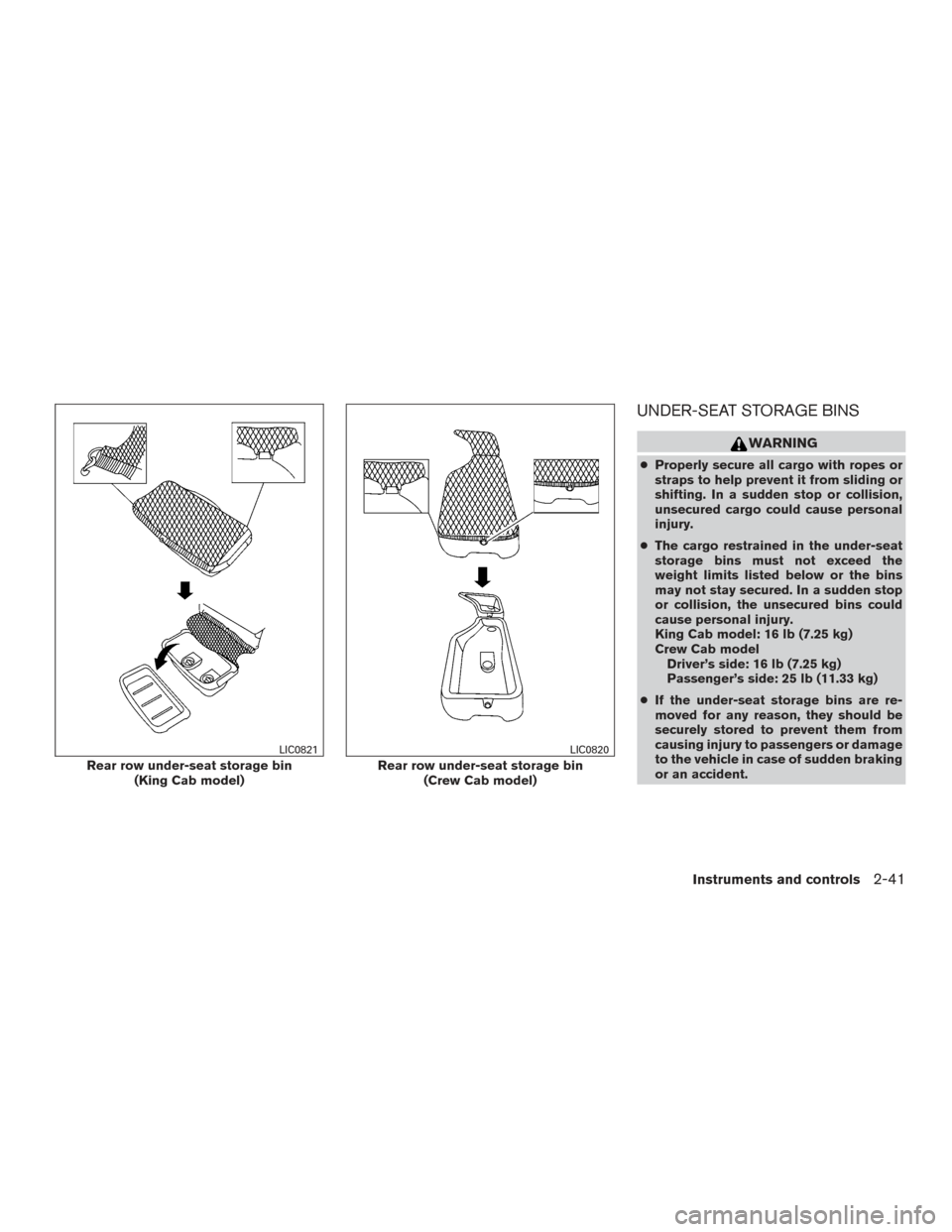
UNDER-SEAT STORAGE BINS
WARNING
●Properly secure all cargo with ropes or
straps to help prevent it from sliding or
shifting. In a sudden stop or collision,
unsecured cargo could cause personal
injury.
● The cargo restrained in the under-seat
storage bins must not exceed the
weight limits listed below or the bins
may not stay secured. In a sudden stop
or collision, the unsecured bins could
cause personal injury.
King Cab model: 16 lb (7.25 kg)
Crew Cab model Driver’s side: 16 lb (7.25 kg)
Passenger’s side: 25 lb (11.33 kg)
● If the under-seat storage bins are re-
moved for any reason, they should be
securely stored to prevent them from
causing injury to passengers or damage
to the vehicle in case of sudden braking
or an accident.
Rear row under-seat storage bin (King Cab model)
LIC0821
Rear row under-seat storage bin(Crew Cab model)
LIC0820
Instruments and controls2-41
Page 156 of 466
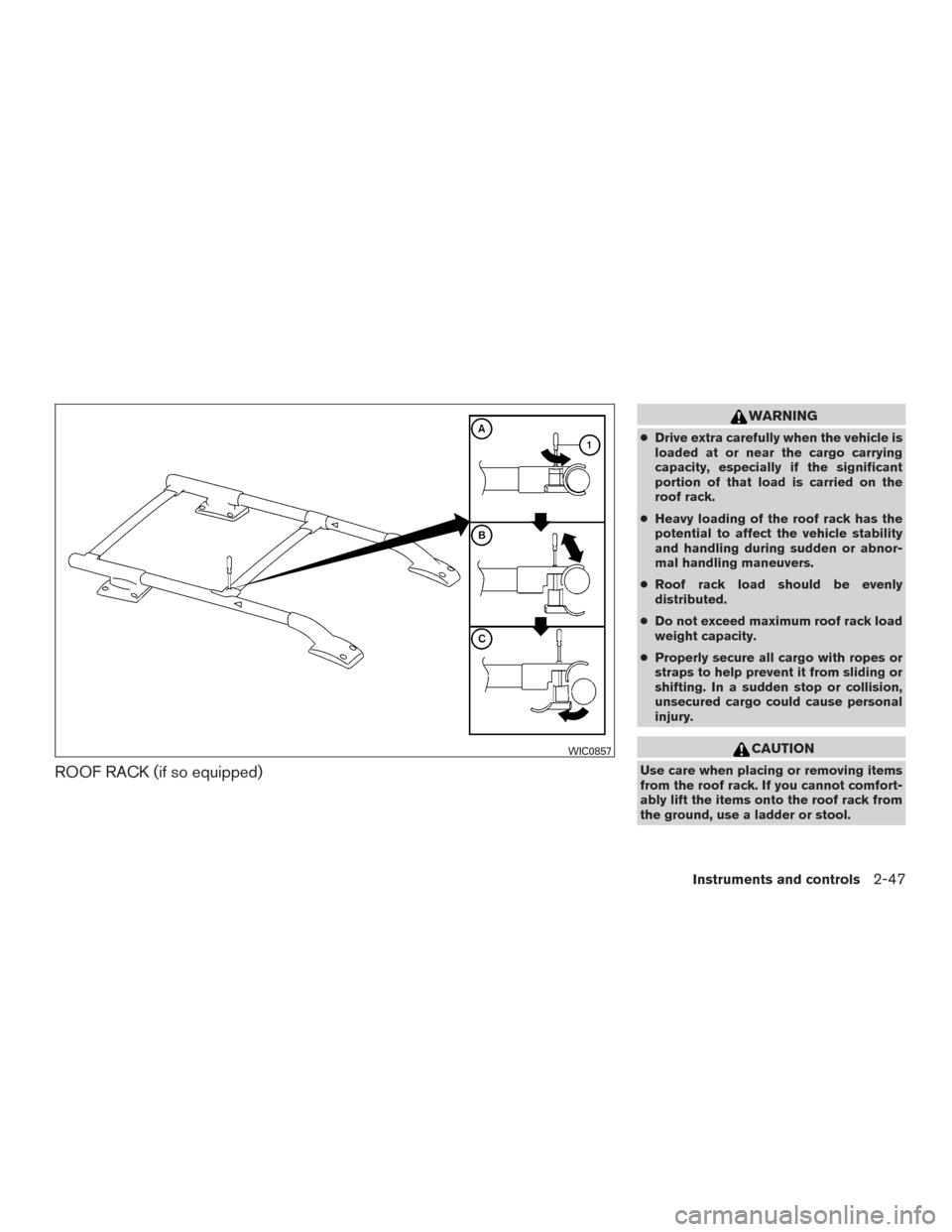
ROOF RACK (if so equipped)
WARNING
●Drive extra carefully when the vehicle is
loaded at or near the cargo carrying
capacity, especially if the significant
portion of that load is carried on the
roof rack.
● Heavy loading of the roof rack has the
potential to affect the vehicle stability
and handling during sudden or abnor-
mal handling maneuvers.
● Roof rack load should be evenly
distributed.
● Do not exceed maximum roof rack load
weight capacity.
● Properly secure all cargo with ropes or
straps to help prevent it from sliding or
shifting. In a sudden stop or collision,
unsecured cargo could cause personal
injury.
CAUTION
Use care when placing or removing items
from the roof rack. If you cannot comfort-
ably lift the items onto the roof rack from
the ground, use a ladder or stool.
WIC0857
Instruments and controls2-47
Page 157 of 466
Always evenly distribute the cargo on the tubular
roof rack.The maximum total load is 125 lb
(56 kg) evenly distributed. Be careful that your
vehicle does not exceed the Gross Vehicle
Weight Rating (GVWR) or the Gross Axle
Weight Ratings (GAWR front and rear) . The
GVWR and GAWR are located on the F.M.V.S.S.
label (located on the driver’s side door jamb
pillar) . For additional information regarding
GVWR and GAWR, refer to “Vehicle loading
information” in the “Technical and consumer in-
formation” section of this manual.
The front crossbar can be adjusted or removed.
Use the TORX® driver provided in the tool kit to
loosen both crossbar adjusting screws.
To adjust:
1. Loosen the adjusting screws with the TORX® driver
�1by turning counterclock-
wise
�A.
2. When the clamp is loosened, move the crossbar so the cargo can be positioned on
the crossbar
�B.
3. Tighten the crossbar adjusting screws with the TORX® driver by turning clockwise.
4. Secure the cargo with rope.
5. Always check the tightness of the crossbar adjusting screws. To remove:
1. Loosen the adjusting screws with the TORX® driver
�1by turning counterclock-
wise
�A.
2. Rotate the clamps
�C.
3. Remove the crossbar.
4. Reverse to install.
5. Always check the tightness of the crossbar adjusting screws.
If you hear wind noise coming from the roof rack
while driving, adjust the roof rack crossbar to the
neutral position.
MANUAL WINDOWS (if so equipped)
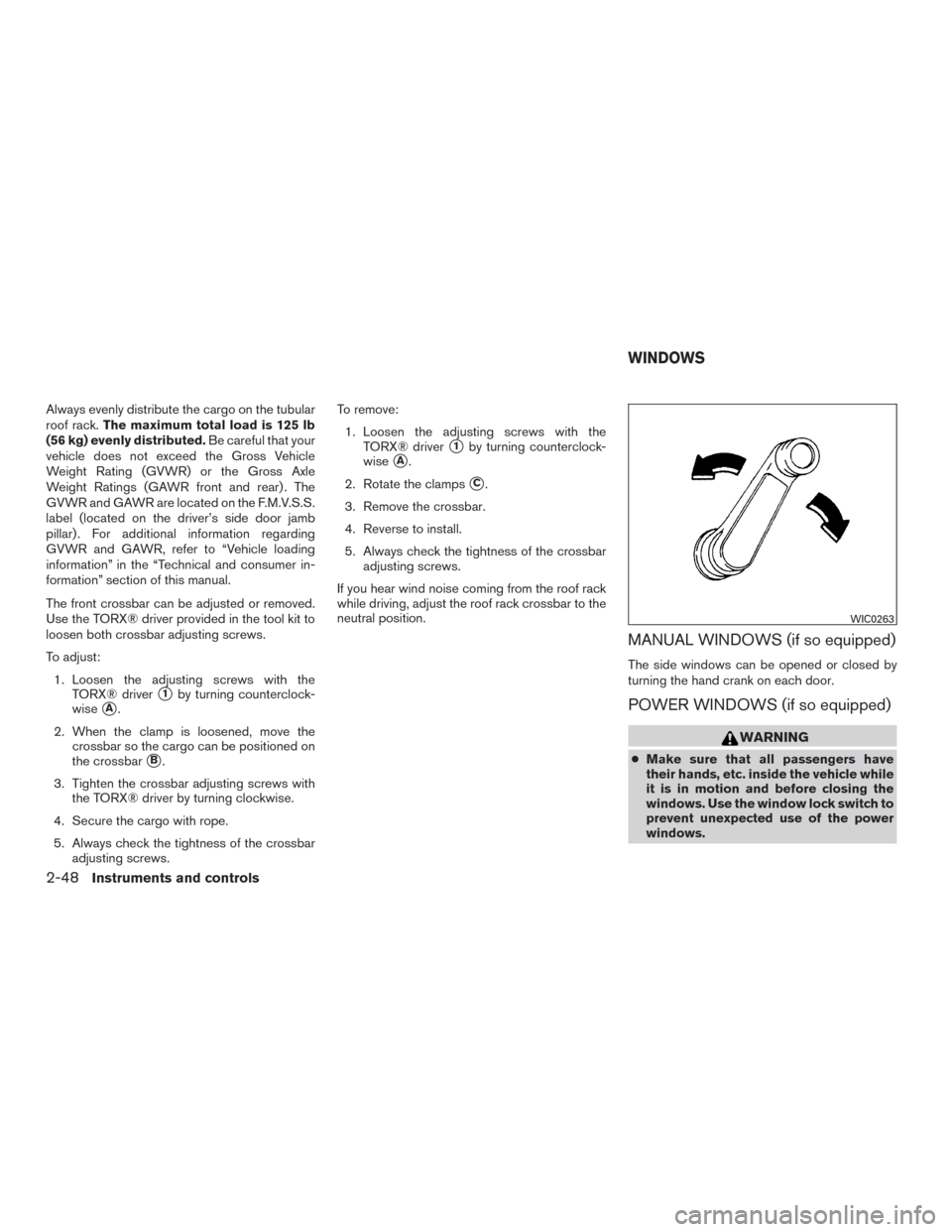
The side windows can be opened or closed by
turning the hand crank on each door.
POWER WINDOWS (if so equipped)
WARNING
● Make sure that all passengers have
their hands, etc. inside the vehicle while
it is in motion and before closing the
windows. Use the window lock switch to
prevent unexpected use of the power
windows.
WIC0263
WINDOWS
2-48Instruments and controls
Page 190 of 466
NOTE:
Use care when rotating extender, buckles
may come in contact with the truck bed
railing.
Removing and installing the bed
extender
To remove or install the bed extender perform the
following:1. Open the tailgate.
2. Rotate the bed extender into a vertical posi- tion and lift straight up (to remove) or lower
straight down (to install) .
To store the bed extender in the front of the truck
when not in use perform the following: 1. Position the sliding brackets past the center of the wheel well.
2. Re-install the extender into the brackets (see above) .
3. Rotate the extender to the inward position.
4. Push the brackets forward until the extender comes in contact with the front wall of the
truck box.
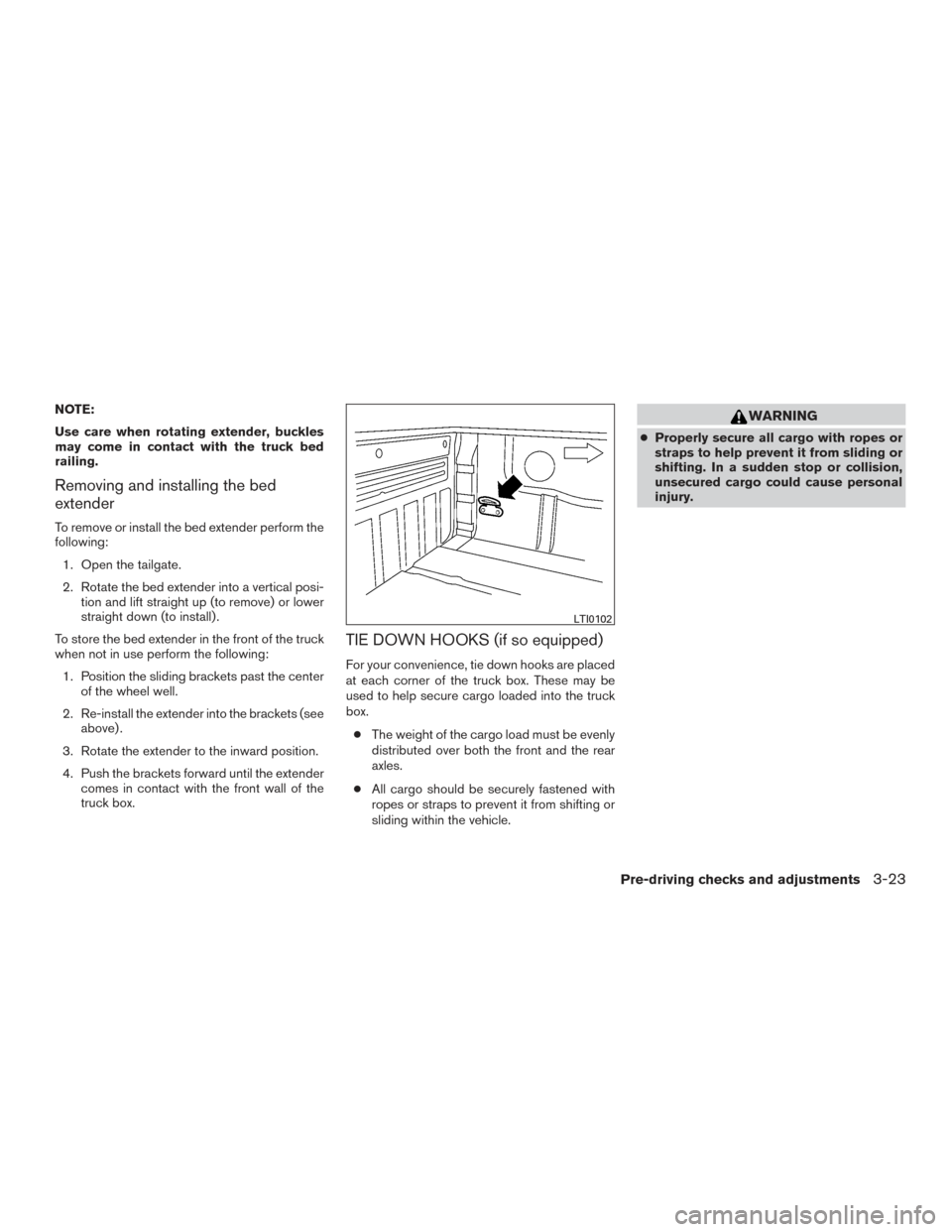
TIE DOWN HOOKS (if so equipped)
For your convenience, tie down hooks are placed
at each corner of the truck box. These may be
used to help secure cargo loaded into the truck
box.
● The weight of the cargo load must be evenly
distributed over both the front and the rear
axles.
● All cargo should be securely fastened with
ropes or straps to prevent it from shifting or
sliding within the vehicle.
WARNING
● Properly secure all cargo with ropes or
straps to help prevent it from sliding or
shifting. In a sudden stop or collision,
unsecured cargo could cause personal
injury.
LTI0102
Pre-driving checks and adjustments3-23
Page 405 of 466
Tire inflation pressure
Check the tire pressures (including the
spare) often and always prior to long dis-
tance trips. The recommended tire pres-
sure specifications are shown on the
F.M.V.S.S./C.M.V.S.S. certification label
or the Tire and Loading Information label
under the “Cold Tire Pressure” heading.
The Tire and Loading Information label is
affixed to the driver side center pillar. Tire
pressures should be checked regularly
because:● Most tires naturally lose air over time.
● Tires can lose air suddenly when
driven over potholes or other objects
or if the vehicle strikes a curb while
parking.
The tire pressures should be checked
when the tires are cold. The tires are
considered COLD after the vehicle has
been parked for 3 or more hours, or driven
less than 1 mile (1.6 km) at moderate
speeds. Incorrect tire pressure, including un-
der inflation, may adversely affect
tire life and vehicle handling.
WARNING
● Improperly inflated tires can fail
suddenly and cause an accident.
● The Gross Vehicle Weight Rating
(GVWR) is located on the
F.M.V.S.S./C.M.V.S.S. certifica-
tion label. The vehicle weight ca-
pacity is indicated on the Tire and
Loading Information label. Do
not load your vehicle beyond this
capacity. Overloading your ve-
hicle may result in reduced tire
life, unsafe operating conditions
due to premature tire failure, or
unfavorable handling character-
istics and could also lead to a
serious accident. Loading beyond
the specified capacity may also
result in failure of other vehicle
components. ●
Before taking a long trip, or
whenever you heavily load your
vehicle, use a tire pressure gauge
to ensure that the tire pressures
are at the specified level.
● For additional information re-
garding tires, refer to “Important
Tire Safety Information” (US) or
“Tire Safety Information”
(Canada) in the Warranty Infor-
mation Booklet.
8-36
Maintenance and do-it-yourself
Page 408 of 466
TIRE LABELING
Federal law requires tire manufacturers to
place standardized information on the
sidewall of all tires. This information iden-
tifies and describes the fundamental
characteristics of the tire and also pro-
vides the tire identification number (TIN)
for safety standard certification. The TIN
can be used to identify the tire in case of a
recall.
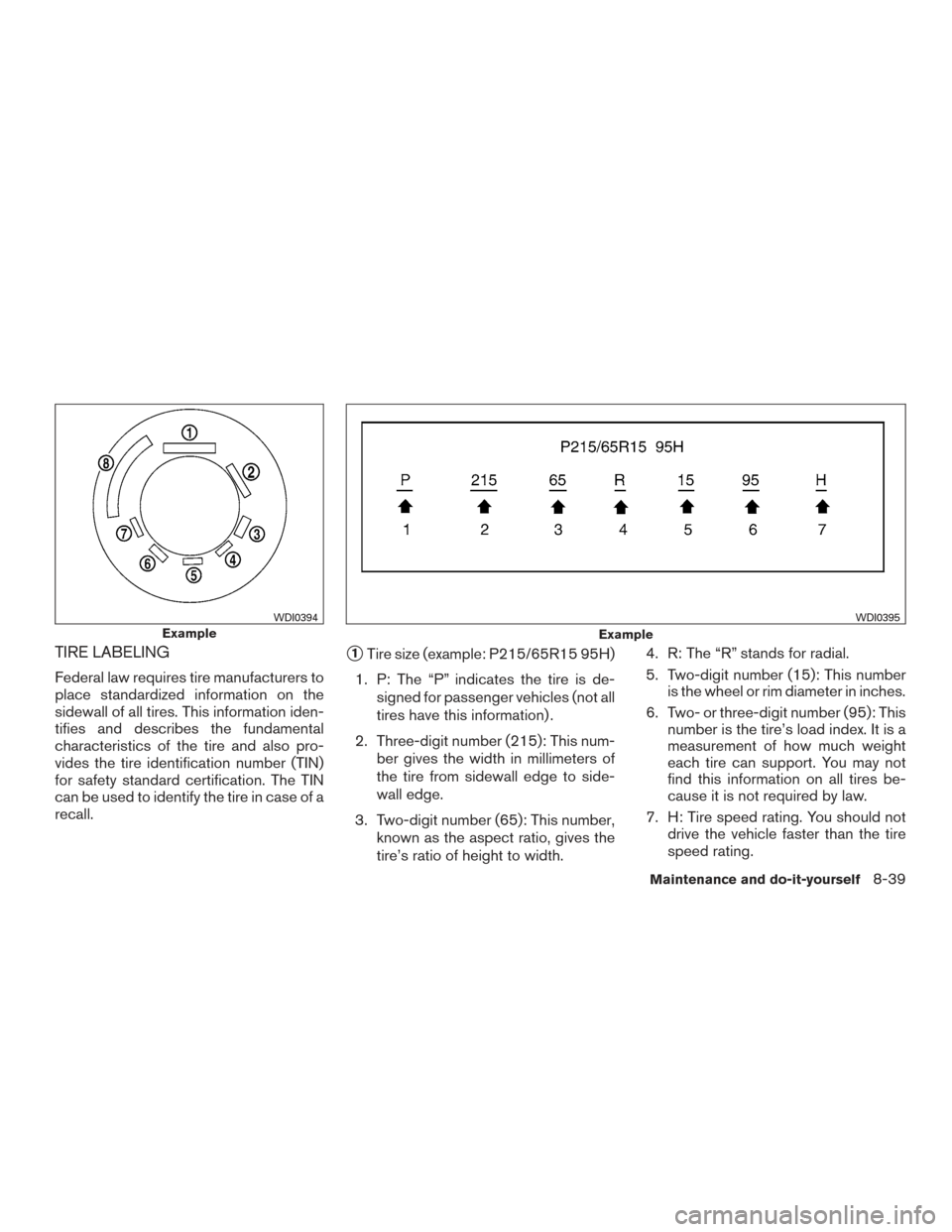
�1Tire size (example: P215/65R15 95H)
1. P: The “P” indicates the tire is de- signed for passenger vehicles (not all
tires have this information) .
2. Three-digit number (215): This num- ber gives the width in millimeters of
the tire from sidewall edge to side-
wall edge.
3. Two-digit number (65): This number, known as the aspect ratio, gives the
tire’s ratio of height to width. 4. R: The “R” stands for radial.
5. Two-digit number (15): This number
is the wheel or rim diameter in inches.
6. Two- or three-digit number (95): This number is the tire’s load index. It is a
measurement of how much weight
each tire can support. You may not
find this information on all tires be-
cause it is not required by law.
7. H: Tire speed rating. You should not drive the vehicle faster than the tire
speed rating.
Example
WDI0394
Example
WDI0395
Maintenance and do-it-yourself8-39
Page 415 of 466
9 Technical and consumer information
Recommended fluids/lubricants and capacities.......9-2
Recommended fuel .............................9-5
Engine oil and oil filter recommendations ..........9-7
Air conditioner system (if so equipped)
refrigerant and oil recommendations ..............9-8
Specifications .....................................9-9
Engine ........................................9-9
Wheels and tires .............................. 9-10
Dimensions and weights .......................9-11
When traveling or registering your vehicle in
another country .................................. 9-12
Vehicle identification .............................. 9-12
Vehicle identification number (VIN) plate .........9-12
Engine serial number ........................... 9-13
F.M.V.S.S./C.M.V.S.S. certification label ..........9-13
Emission control information label ...............9-13
Tire and loading information label ................9-14
Air conditioner specification label
(if so equipped) ............................... 9-14
Installing front license plate ........................9-14
Installing front license plate with grommets .......9-14
Installing front license plate without
grommets .................................... 9-15
Vehicle loading information ........................9-15Terms
........................................ 9-15
Vehicle load capacity .......................... 9-16
Securing the load .............................. 9-18
Utili-track™ channel system (if so equipped) ......9-19
Loading tips .................................. 9-24
Truck-camper loading information ..................9-24
Crew Cab Models ............................. 9-24
King Cab models .............................. 9-24
Special Body vehicles .......................... 9-24
Location for center of gravity ....................9-25
Vehicle load weight capacity ....................9-25
Measurement of weights .......................9-26
Towing a trailer ................................... 9-26
Maximum load limits ........................... 9-26
Towing load/specification .......................9-30
T
owing safety ................................. 9-31
Flat towing for All–Wheel drive vehicle
(if so equipped) ............................... 9-37
Flat towing for front wheel drive vehicle
(if so equipped) ............................... 9-37
Uniform tire quality grading ........................9-38
Emission control system warranty ..................9-39
Reporting safety defects .......................... 9-39
Page 426 of 466
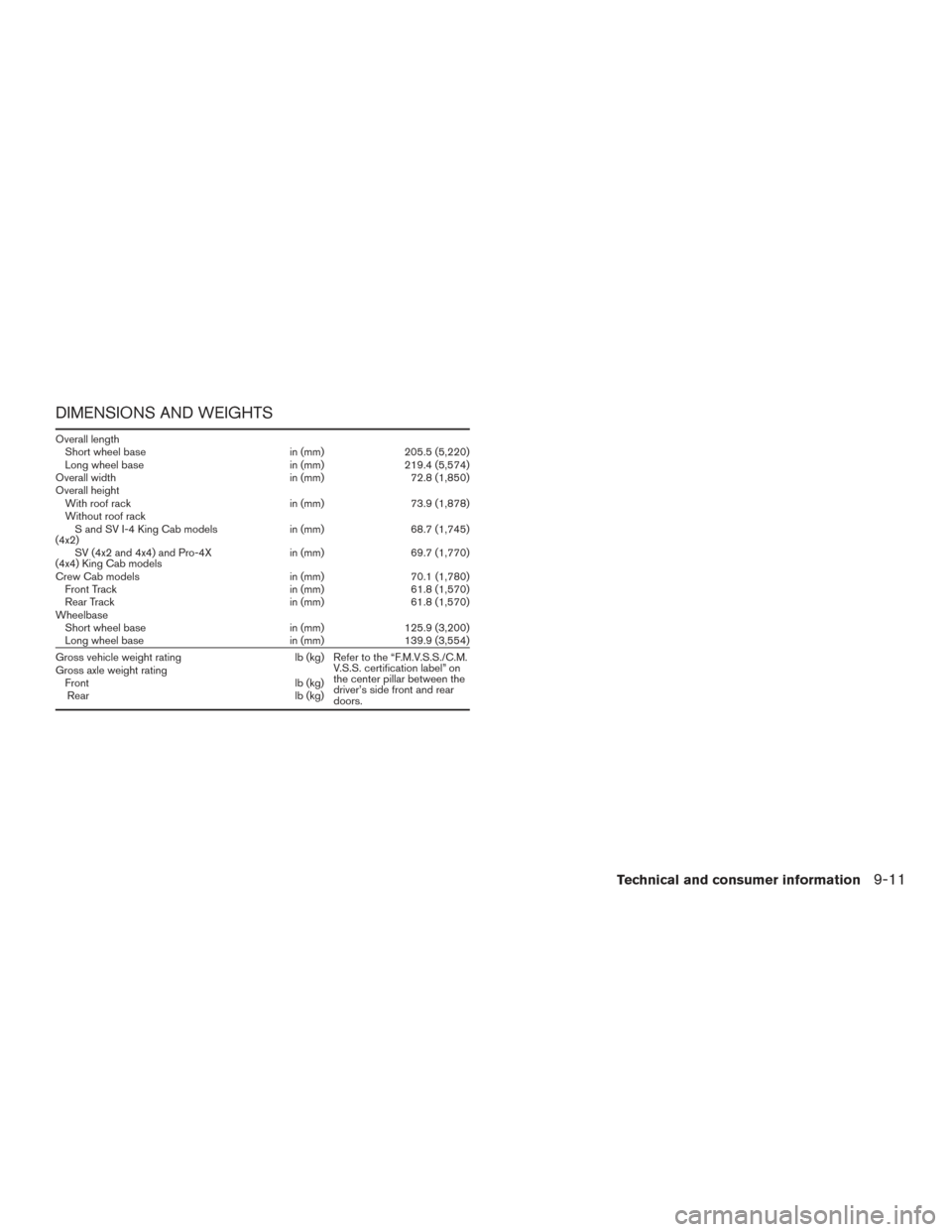
DIMENSIONS AND WEIGHTS
Overall lengthShort wheel base in (mm) 205.5 (5,220)
Long wheel base in (mm) 219.4 (5,574)
Overall width in (mm) 72.8 (1,850)
Overall height With roof rack in (mm) 73.9 (1,878)
Without roof rackS and SV I-4 King Cab models
(4x2) in (mm) 68.7 (1,745)
SV (4x2 and 4x4) and Pro-4X
(4x4) King Cab models in (mm)
69.7 (1,770)
Crew Cab models in (mm)70.1 (1,780)
Front Track in (mm)61.8 (1,570)
Rear Track in (mm)61.8 (1,570)
Wheelbase Short wheel base in (mm)125.9 (3,200)
Long wheel base in (mm)139.9 (3,554)
Gross vehicle weight rating lb (kg) Refer to the “F.M.V.S.S./C.M.
V.S.S. certification label” on
the center pillar between the
driver’s side front and rear
doors.
Gross axle weight rating
Front lb (kg)
Rear lb (kg)
Technical and consumer information9-11