2015 NISSAN FRONTIER coolant
[x] Cancel search: coolantPage 377 of 466
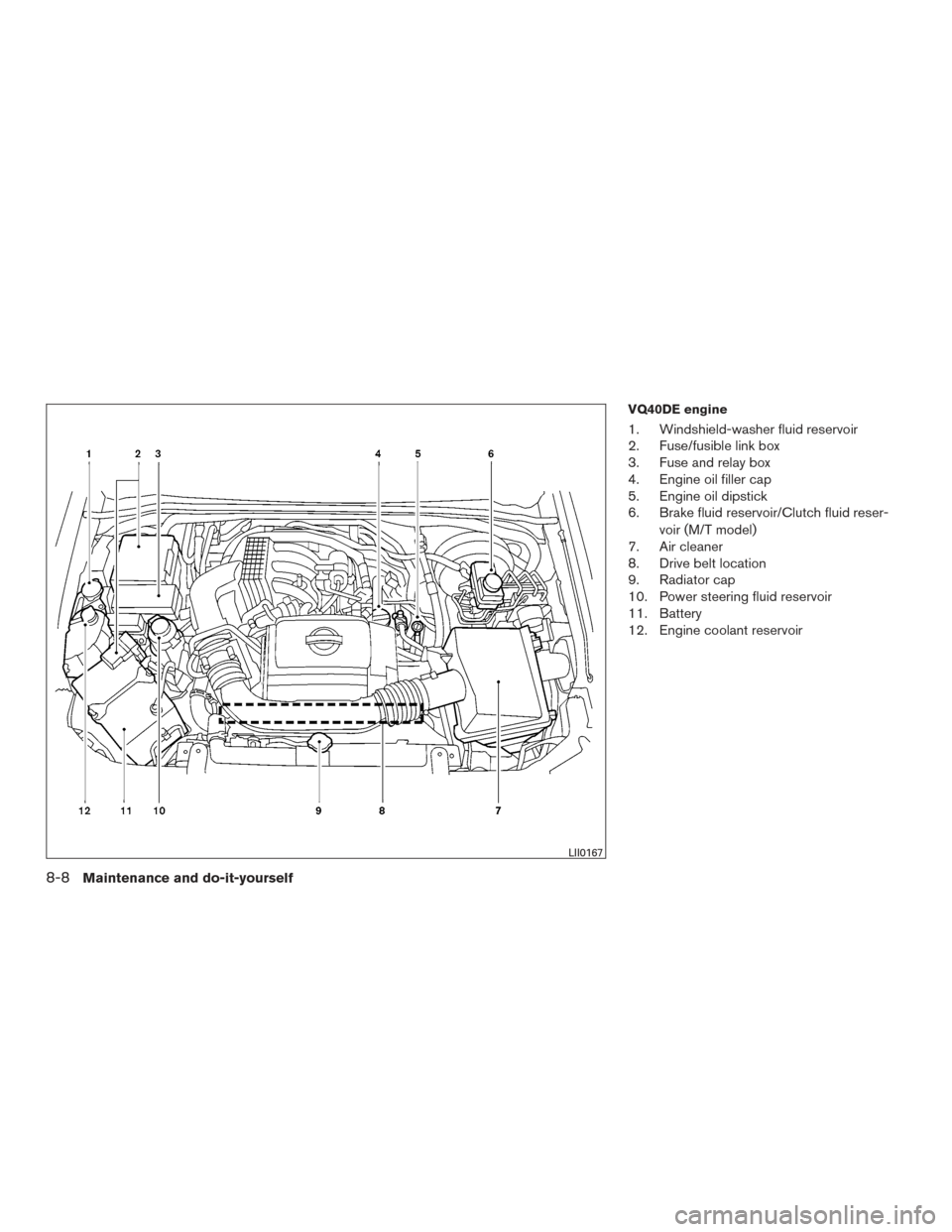
VQ40DE engine
1. Windshield-washer fluid reservoir
2. Fuse/fusible link box
3. Fuse and relay box
4. Engine oil filler cap
5. Engine oil dipstick
6. Brake fluid reservoir/Clutch fluid reser-voir (M/T model)
7. Air cleaner
8. Drive belt location
9. Radiator cap
10. Power steering fluid reservoir
11. Battery
12. Engine coolant reservoir
LII0167
8-8Maintenance and do-it-yourself
Page 378 of 466
The engine cooling system is filled at the factory
with a pre-diluted mixture of 50% Genuine
NISSAN Long Life Antifreeze/Coolant (blue) and
50% water to provide year-round antifreeze and
coolant protection. The antifreeze solution con-
tains rust and corrosion inhibitors. Additional en-
gine cooling system additives are not necessary.
WARNING
●Never remove the radiator or coolant
reservoir cap when the engine is hot.
Wait until the engine and radiator cool
down. Serious burns could be caused
by high pressure fluid escaping from
the radiator. For additional information,
refer to precautions in “If your vehicle
overheats” found in the “In case of
emergency” section of this manual.
● The radiator is equipped with a pres-
sure type radiator cap. To prevent en-
gine damage, use only a Genuine
NISSAN radiator cap.
CAUTION
● Never use any cooling system additives
such as radiator sealer. Additives may
clog the cooling system and cause dam-
age to the engine, transmission and/or
cooling system.
● When adding or replacing coolant, be
sure to use only Genuine NISSAN Long
Life Antifreeze/Coolant (blue) or
equivalent. Genuine NISSAN Long Life
Antifreeze/Coolant (blue) is pre-diluted
to provide antifreeze protection to -34°
F (-37° C) . If additional freeze protection
is needed due to weather where you
operate your vehicle, add Genuine
NISSAN Long Life Antifreeze/Coolant
(blue) concentrate following the direc-
tions on the container. If an equivalent
coolant other than Genuine NISSAN
Long Life Antifreeze/Coolant (blue) is
used, follow the coolant manufacturer’s
instructions to maintain minimum anti-
freeze protection to -34° F (-37° C) . The
use of other types of coolant solutions
other than Genuine NISSAN Long Life
Antifreeze/Coolant (blue) or equivalent
may damage the engine cooling
system. ●
The life expectancy of the factory-fill
coolant is 105,000 miles (168,000 km) or
7 years. Mixing any other type of cool-
ant other than Genuine NISSAN Long
Life Antifreeze/Coolant (blue) , includ-
ing Genuine NISSAN Long Life
Antifreeze/Coolant (green) , or the use
of non-distilled water will reduce the
life expectancy of the factory-fill cool-
ant. For additional information, refer to
the NISSAN Service and Maintenance
Guide.
ENGINE COOLING SYSTEM
Maintenance and do-it-yourself8-9
Page 379 of 466
CHECKING ENGINE COOLANT
LEVEL
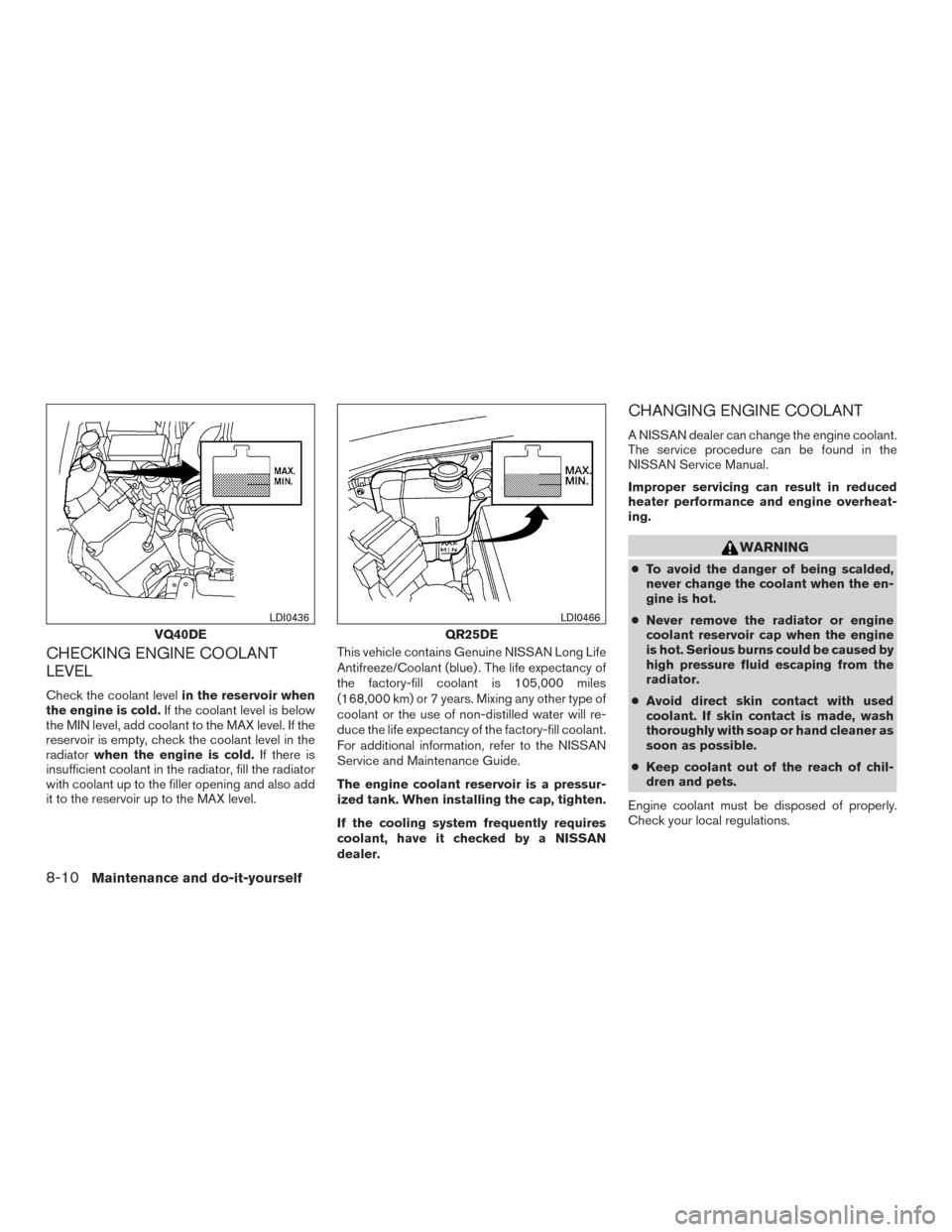
Check the coolant levelin the reservoir when
the engine is cold. If the coolant level is below
the MIN level, add coolant to the MAX level. If the
reservoir is empty, check the coolant level in the
radiator when the engine is cold. If there is
insufficient coolant in the radiator, fill the radiator
with coolant up to the filler opening and also add
it to the reservoir up to the MAX level. This vehicle contains Genuine NISSAN Long Life
Antifreeze/Coolant (blue) . The life expectancy of
the factory-fill coolant is 105,000 miles
(168,000 km) or 7 years. Mixing any other type of
coolant or the use of non-distilled water will re-
duce the life expectancy of the factory-fill coolant.
For additional information, refer to the NISSAN
Service and Maintenance Guide.
The engine coolant reservoir is a pressur-
ized tank. When installing the cap, tighten.
If the cooling system frequently requires
coolant, have it checked by a NISSAN
dealer.
CHANGING ENGINE COOLANT
A NISSAN dealer can change the engine coolant.
The service procedure can be found in the
NISSAN Service Manual.
Improper servicing can result in reduced
heater performance and engine overheat-
ing.
WARNING
●
To avoid the danger of being scalded,
never change the coolant when the en-
gine is hot.
● Never remove the radiator or engine
coolant reservoir cap when the engine
is hot. Serious burns could be caused by
high pressure fluid escaping from the
radiator.
● Avoid direct skin contact with used
coolant. If skin contact is made, wash
thoroughly with soap or hand cleaner as
soon as possible.
● Keep coolant out of the reach of chil-
dren and pets.
Engine coolant must be disposed of properly.
Check your local regulations.
VQ40DE
LDI0436
QR25DE
LDI0466
8-10Maintenance and do-it-yourself
Page 386 of 466
Refill the reservoir more frequently when driving
conditions require an increased amount of
windshield-washer fluid.
Recommended fluid is Genuine NISSAN
Windshield-Washer Concentrate Cleaner & An-
tifreeze or equivalent.
CAUTION
●Do not substitute engine antifreeze
coolant for windshield-washer solution.
This may result in damage to the paint.
● Do not fill the windshield-washer reser-
voir with washer fluid concentrates at
full strength. Some methyl alcohol
based washer fluid concentrates may
permanently stain the grille if spilled
while filling the windshield-washer
reservoir.
● Pre-mix washer fluid concentrates with
water to the manufacturer’s recom-
mended levels before pouring the fluid
into the windshield-washer reservoir.
Do not use the windshield-washer res-
ervoir to mix the washer fluid concen-
trate and water. ●
Keep the battery surface clean and dry.
Clean the battery with a solution of baking
soda and water.
● Make certain the terminal connections are
clean and securely tightened.
● If the vehicle is not to be used for 30 days or
longer, disconnect the negative (-) battery
terminal cable to prevent discharge.
NOTE:
Care should be taken to avoid situations
that can lead to potential battery discharge
and potential no-start conditions such as: 1. Installation or extended use of electronic accessories that consume battery power
when the engine is not running (Phone char-
gers, GPS, DVD players, etc.)
2. Vehicle is not driven regularly and/or only driven short distances. In these cases, the
battery may need to be charged to maintain
battery health.
WARNING
●Do not expose the battery to flames, an
electrical spark or a cigarette. Hydrogen
gas generated by the battery is explo-
sive. Explosive gases can cause blind-
ness or injury. Do not allow battery fluid
to contact your skin, eyes, fabrics or
painted surfaces. Sulfuric acid can
cause blindness or injury. After touch-
ing a battery or battery cap, do not
touch or rub your eyes. Thoroughly
wash your hands. If the acid contacts
your eyes, skin or clothing, immediately
flush with water for at least 15 minutes
and seek medical attention.
● Do not operate the vehicle if the fluid in
the battery is low. Low battery fluid can
cause a higher load on the battery
which can generate heat, reduce battery
life, and in some cases lead to an
explosion.
● When working on or near a battery, al-
ways wear suitable eye protection and
remove all jewelry.
● Battery posts, terminals and related ac-
cessories contain lead and lead com-
pounds. Wash hands after handling.
BATTERY
Maintenance and do-it-yourself8-17
Page 417 of 466
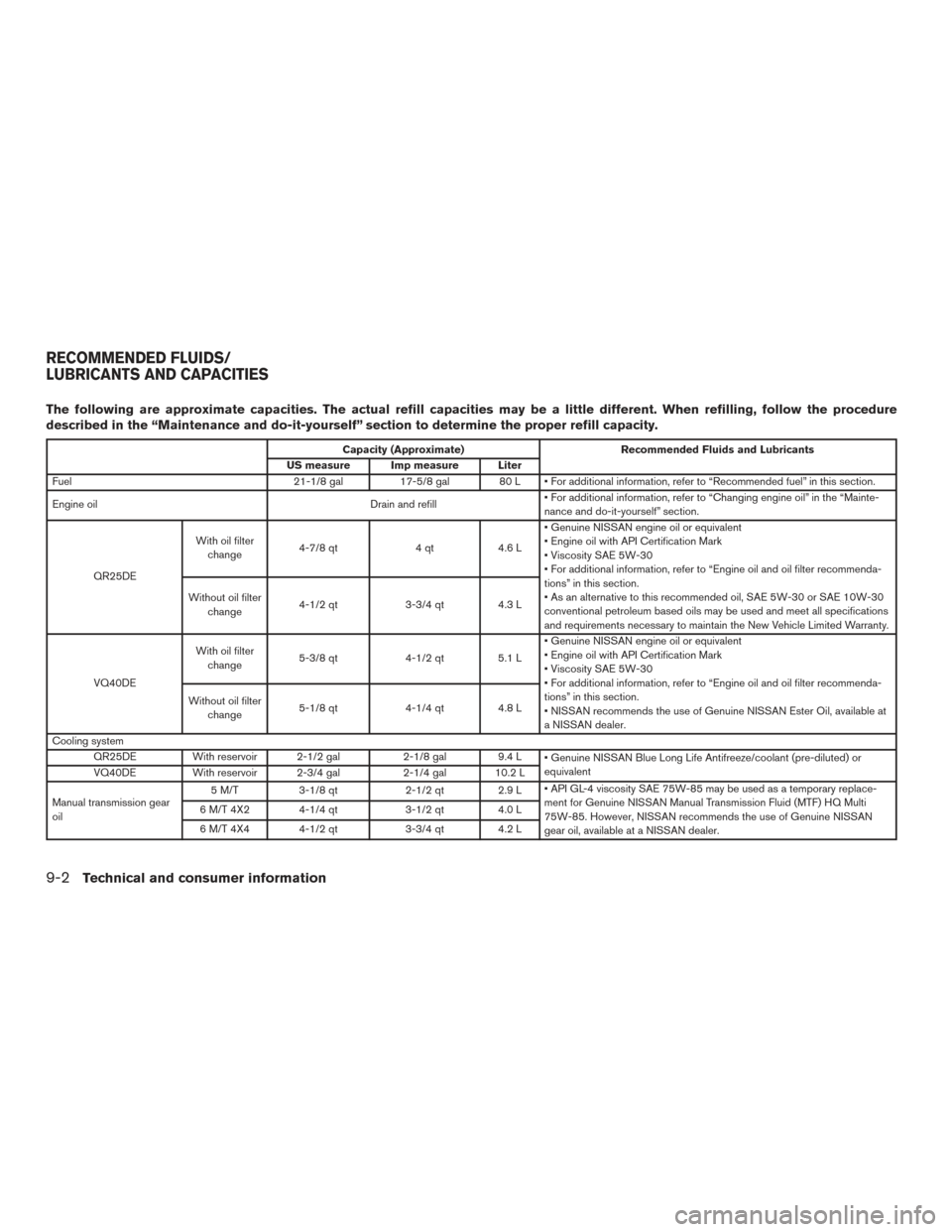
The following are approximate capacities. The actual refill capacities may be a little different. When refilling, follow the procedure
described in the “Maintenance and do-it-yourself” section to determine the proper refill capacity.
Capacity (Approximate)Recommended Fluids and Lubricants
US measure Imp measure Liter
Fuel 21-1/8 gal17-5/8 gal 80 L • For additional information, refer to “Recommended fuel” in this section.
Engine oil Drain and refill• For additional information, refer to “Changing engine oil” in the “Mainte-
nance and do-it-yourself” section.
QR25DE With oil filter
change 4-7/8 qt
4 qt4.6 L• Genuine NISSAN engine oil or equivalent
• Engine oil with API Certification Mark
• Viscosity SAE 5W-30
• For additional information, refer to “Engine oil and oil filter recommenda-
tions” in this section.
• As an alternative to this recommended oil, SAE 5W-30 or SAE 10W-30
conventional petroleum based oils may be used and meet all specifications
and requirements necessary to maintain the New Vehicle Limited Warranty.
Without oil filter
change 4-1/2 qt
3-3/4 qt 4.3 L
VQ40DE With oil filter
change 5-3/8 qt
4-1/2 qt 5.1 L • Genuine NISSAN engine oil or equivalent
• Engine oil with API Certification Mark
• Viscosity SAE 5W-30
• For additional information, refer to “Engine oil and oil filter recommenda-
tions” in this section.
• NISSAN recommends the use of Genuine NISSAN Ester Oil, available at
a NISSAN dealer.
Without oil filter
change 5-1/8 qt
4-1/4 qt 4.8 L
Cooling system QR25DE With reservoir 2-1/2 gal 2-1/8 gal 9.4 L
• Genuine NISSAN Blue Long Life Antifreeze/coolant (pre-diluted) or
equivalent
VQ40DE With reservoir 2-3/4 gal 2-1/4 gal 10.2 L
Manual transmission gear
oil 5 M/T
3-1/8 qt 2-1/2 qt 2.9 L • API GL-4 viscosity SAE 75W-85 may be used as a temporary replace-
ment for Genuine NISSAN Manual Transmission Fluid (MTF) HQ Multi
75W-85. However, NISSAN recommends the use of Genuine NISSAN
gear oil, available at a NISSAN dealer.
6 M/T 4X2 4-1/4 qt
3-1/2 qt 4.0 L
6 M/T 4X4 4-1/2 qt 3-3/4 qt 4.2 L
RECOMMENDED FLUIDS/
LUBRICANTS AND CAPACITIES
9-2Technical and consumer information
Page 451 of 466
To drive away:1. Start the vehicle.
2. Apply and hold the brake pedal.
3. Shift the transmission into gear.
4. Release the parking brake.
5. Drive slowly until the vehicle and trailer are clear from the blocks.
6. Apply and hold the brake pedal.
7. Have someone retrieve and store the blocks. ● While going downhill, the weight of the
trailer pushing on the tow vehicle may de-
crease overall stability. Therefore, to main-
tain adequate control, reduce your speed
and shift to a lower gear. Avoid long or
repeated use of the brakes when descend-
ing a hill, as this reduces their effectiveness
and could cause overheating. Shifting to a
lower gear instead provides “engine brak-
ing” and reduces the need to brake as fre-
quently.
● If the engine coolant temperature rises to a
high temperature, refer to “If your vehicle
overheats” in the “In case of emergency”
section of this owner’s manual.
● Trailer towing requires more fuel than normal
circumstances. ●
Avoid towing a trailer for your vehicle’s first
500 miles (805 km) .
● For the first 500 miles (805 km) that you do
tow, do not drive over 50 MPH (80 km/h).
● Have your vehicle serviced more often than
at intervals specified in the recommended
Maintenance Schedule in the “NISSAN Ser-
vice and Maintenance Guide”.
● When making a turn, your trailer wheels will
be closer to the inside of the turn than your
vehicle wheels. To compensate for this,
make a larger than normal turning radius
during the turn.
● Crosswinds and rough roads will adversely
affect vehicle/trailer handling, possibly caus-
ing vehicle sway. When being passed by
larger vehicles, be prepared for possible
changes in crosswinds that could affect ve-
hicle handling.
Do the following if the trailer begins to sway: 1. Take your foot off the accelerator pedal to allow the vehicle to coast and steer as
straight ahead as the road conditions allow.
This combination will help stabilize the ve-
hicle
– Do not correct trailer sway by steering or applying the brakes. 2. When the trailer sway stops, gently apply the
brakes and pull to the side of the road in a
safe area.
3. Try to rearrange the trailer load so it is bal- anced as described in this section.
● Be careful when passing other vehicles.
Passing while towing a trailer requires con-
siderably more distance than normal pass-
ing. Remember, the length of the trailer must
also pass the other vehicle before you can
safely change lanes.
● Downshift the transmission to a lower gear
for engine braking when driving down steep
or long hills. This will help slow the vehicle
without applying the brakes.
● Avoid holding the brake pedal down too long
or too frequently. This could cause the
brakes to overheat, resulting in reduced
braking efficiency.
● Increase your following distance to allow for
greater stopping distances while towing a
trailer. Anticipate stops and brake gradually.
● NISSAN recommends that the cruise con-
trol not be used while towing a trailer.
9-36Technical and consumer information
Page 459 of 466
Car phone or CB radio.............4-72
CD care and cleaning ..............4-69
CD player (See audio system) . .4-44, 4-49, 4-56
Check tire press ..................2-5
Child restraints .......1-24,1-24,1-25,1-28
LATCH (Lower Anchors and Tethers for
CHildren) System ..............1-28
Precautions on child
restraints.........1-25,1-38,1-54,1-65
Top tether strap anchor point locations . .1-31
Child restraint with top tether strap .......1-30
Child safety rear door lock ............3-6
Chimes, audible reminders ...........2-24
Cleaningexteriorandinterior...........7-2
Clock.......................4-43 (models without navigation system) ....4-43
Clockset.....................4-43
Clock set/adjustment ........4-7,4-43,4-47
Clutch Clutch fluid ..................8-16
Clutch interlock (clutch start) switch ......2-37
C.M.V.S.S. certification label ..........9-13
Cold weather driving ...............5-41
Compact disc (CD) player ....4-44,4-49,4-56
Compass display .................2-10
Consolebox...................2-40
Control panel buttons ...............4-4
Backbutton..................4-7
Brightness/contrast button ..........4-9
Enterbutton..................4-4
Setting button .................4-7
With navigation system .........4-4,4-5
Controls Audiocontrols(steeringwheel).......4-69
Heater and air conditioner
controls.............4-15,4-21,4-32 Coolant
Capacities and recommended
fuel/lubricants .................9-2
Changingenginecoolant..........8-10
Checking engine coolant level .......8-10
Engine coolant temperature gauge .....2-6
Corrosion protection ...............7-5
Cruisecontrol..................5-21
Cupholders...................2-45
Curtainside-impactandrolloverairbag....1-82
D
Daytime running light system (Canada only) . .2-31
Defroster switch Rear window defroster switch .......2-28
Dimensionsandweights ............9-11
Dimmer switch for instrument panel ......2-31
Display controls (see control panel buttons) . .4-4
Door locks .....................3-3
Door open warning light .............2-17
Drive belt .....................8-20
Driving Cold weather driving .............5-41
Driving with automatic transmission ....5-13
Driving with manual transmission ......5-18
Precautions when starting and driving ....5-2
Driving the vehicle ................5-13
E
Economy - fuel ..................5-24
Electronic locking rear differential (E-Lock)
system ......................5-31 Electronic locking rear differential (E-Lock)
system switch
..................2-36
Emission control information label .......9-13
Emission control system warranty .......9-39
Engine Before starting the engine ..........5-12
Blockheater.................5-42
Capacities and recommended
fuel/lubricants.................9-2
Changing engine coolant ..........8-10
Changingengineoil.............8-12
Changing engine oil filter ..........8-13
Checking engine coolant level .......8-10
Checking
engine oil level ..........8-11
Engine compartment check locations ....8-7
Engine coolant temperature gauge .....2-6
Engine cooling system ............8-9
Engineoil...................8-11
Engine oil and oil filter recommendation . . .9-7
Engineoilpressuregauge..........2-8
Engine oil pressure warning light ......2-17
Engine oil viscosity ..............9-7
Engine serial number ............9-13
Engine specifications .............9-9
Starting the engine .............5-12
Engine coolant temperature gauge .......2-6
Engine oil pressure gauge ............2-8
Enter button ....................4-4
Event data recorders ..............9-41
Exhaust gas (Carbon monoxide) .........5-2
Explanation of maintenance items ........8-2
Extended storage switch ............8-28
10-2
Page 460 of 466
F
First aid kit .....................6-2
Flashers (See hazard warning flasher switch) . .6-2
Flat tire .......................6-3
Floor mat positioning aid .............7-5
Fluid Brake fluid ..................8-15
Capacities and recommended
fuel/lubricants .................9-2
Clutchfluid..................8-16
Engine coolant .................8-9
Engine oil ...................8-11
Power steering fluid .............8-15
Windshield-washerfluid...........8-16
F.M.V.S.S. certification label ...........9-13
Foglightswitch .................2-32
Front air bag system
(See supplemental restraint system) ......1-77
Front power seat adjustment ...........1-4
Frontseats.....................1-2
Fuel Capacities and recommended
fuel/lubricants .................9-2
Fuel economy ................5-24
Fuel-filler door and cap ...........3-11
Fuel gauge ...................2-7
Fuel octane rating ...............9-6
Fuel recommendation .............9-5
Loose fuel cap warning ........2-5,3-11
Fuel gauge .....................2-7
Fuses.......................8-25
Fusible links ...................8-27 G
Garage door opener, HomeLink® Universal
Transceiver ......2-54,2-55,2-56,2-57,2-58
Gascap .....................3-11
Gauge Engine coolant temperature gauge .....2-6
Engine oil pressure gauge ..........2-8
Fuel gauge ...................2-7
Odometer ...................2-4
Speedometer .................2-4
Tachometer ..................2-6
Trip computer .................2-9
Trip odometer .................2-4
Voltmeter....................2-8
General maintenance ...............8-2
Glovebox.....................2-42
H
Hands-free phone system,
Bluetooth®.............4-73,4-87,4-97
Hazard warning flasher switch ..........6-2
Headlight and turn signal switch ........2-28
Headlight control switch ............2-28
Headlights ....................8-31
Head restraints ..................1-9
Heated seats ...................2-33
Heater Heater and air conditioner
controls.............4-15,4-21,4-32
Heater operation ........4-17,4-23,4-33
Hill descent control switch ...........2-35
Hill descent control system ...........5-39Hill start assist system
..............5-39
HomeLink® Universal
Transceiver......2-54,2-55,2-56,2-57,2-58
Hoodrelease...................3-10
Horn .......................2-33
I
Ignition switch ..................5-10
Immobilizer system .........2-25,3-2,5-12
Important vehicle information label .......9-13
In-cabin microfilter ................8-22
Increasing
fuel economy .............5-24
Indicator lights and audible reminders
(See warning/indicator lights and audible
reminders)....................2-14
Inside automatic anti-glare mirror ........3-15
Inside mirror ...................3-15
Instrument brightness control ..........2-31
Instrumentpanel...............0-6,2-2
Instrument panel dimmer switch ........2-31
Interior light ....................2-52
iPod®Player ............... 4-61, 4-63
ISOFIX child restraints .............1-28
J
Jumpseat .....................1-6
Jump starting ...............6-11,8-19
K
Key.........................3-2
10-3