2015 NISSAN ARMADA warning
[x] Cancel search: warningPage 486 of 510
TOWING SAFETY
Trailer hitch
Your vehicle may be equipped with an optional
trailer tow package. The trailer tow package in-
cludes a receiver-type frame mounted hitch. This
hitch is rated for the maximum towing capacity of
this vehicle when the proper towing equipment is
used. Choose a proper ball mount and hitch ball
that is rated for the trailer to be towed. Genuine
NISSAN ball mounts and hitch balls are available
from a NISSAN dealer.
If your vehicle is not equipped with the optional
trailer tow package, check the towing capacity of
your bumper hitch or receiver-type frame
mounted hitch. Choose a proper hitch for your
vehicle and trailer. A Genuine NISSAN trailer
hitch is available from a NISSAN dealer. Make
sure the trailer hitch is securely attached to the
vehicle to help avoid personal injury or property
damage due to sway caused by crosswinds,
rough road surfaces or passing trucks.
WARNING
Trailer hitch components have specific
weight ratings. Your vehicle may be capable
of towing a trailer heavier than the weight
rating of the hitch components. Never ex-
ceed the weight rating of the hitch compo-
nents. Doing so can cause serious personal
injury or property damage.
Hitch ball
Choose a hitch ball of the proper size and weight
rating for your trailer:● The required hitch ball size is stamped on
most trailer couplers. Most hitch balls also
have the size printed on the top of the ball.
● Choose the proper class hitch ball based on
the trailer weight.
● The diameter of the threaded shank of the
hitch ball must be matched to the ball mount
hole diameter. The hitch ball shank should
be no more than 1/16” smaller than the hole
in the ball mount.
●
The threaded shank of the hitch ball must be
long enough to be properly secured to the ball
mount. There should be at least 2 threads
showing beyond the lock washer and nut.
Ball mount
The hitch ball is attached to the ball mount and
the ball mount is inserted into the hitch receiver.
Choose a proper class ball mount based on the
trailer weight. Additionally, the ball mount should
be chosen to keep the trailer tongue level with the
ground.
Weight carrying hitches
A weight carrying or “dead weight” ball mount is
one that is designed to carry the whole amount of
tongue weight and gross weight directly on the
ball mount and on the receiver.
Weight distribution hitch
This type of hitch is also called a “load-leveling” or
“equalizing” hitch. A set of bars attach to the ball
mount and to the trailer to distribute the tongue
weight (hitch weight) of your trailer. Many ve-
hicles can’t carry the full tongue weight of a given
trailer, and need some of the tongue weight
transferred through the frame and pushing down
on the front wheels. This gives stability to the tow
vehicle.
Technical and consumer information9-23
Page 487 of 510
A weight-distributing hitch system (Class IV) is
recommended if you plan to tow trailers with a
maximum weight over 5,000 lbs (2,268 kg).
Check with the trailer and towing equipment
manufacturers to determine if they recommend
the use of a weight-distributing hitch system.
NOTE:
A weight-distributing hitch system may af-
fect the operation of trailer surge brakes. If
you are considering use of a weight-
distributing hitch system with a surge
brake-equipped trailer, check with the
surge brake, hitch or trailer manufacturer
to determine if and how this can be done.
Follow the instructions provided by the manufac-
turer for installing and using the weight-
distributing hitch system.
General set-up instructions are as follows:1. Park unloaded vehicle on a level surface. With the ignition on and the doors closed,
allow the vehicle to stand for several minutes
so that it can level.
2. Measure the height of a reference point on the front and rear bumpers at the center of
the vehicle. 3. Attach the trailer to the vehicle and adjust
the hitch equalizers so that the front bumper
height is within0-.5inches (0 – 13 mm) of
the reference height measured in step 2. The
rear bumper should be no higher than the
reference height measured in step 2.
WARNING
Properly adjust the weight distributing
hitch so the rear of the bumper is no
higher than the measured reference
height when the trailer is attached. If the
rear bumper is higher than the measured
reference height when loaded, the vehicle
may handle unpredictably which could
cause a loss of vehicle control and cause
serious personal injury or property
damage.
Sway control device
Sudden maneuvers, wind gusts, and buffeting
caused by other vehicles can affect trailer han-
dling. Sway control devices may be used to help
control these affects. If you choose to use one,
contact a reputable trailer hitch supplier to make
sure the sway control device will work with the
vehicle, hitch, trailer and the trailer’s brake sys-
tem. Follow the instructions provided by the
manufacturer for installing and using the sway
control device.
Class I hitch
Class I trailer hitch equipment (receiver, ball
mount and hitch ball) can be used to tow trailers
of a maximum weight of 2,000 lb (907 kg) .
Class II hitch
Class II trailer hitch equipment (receiver, ball
mount and hitch ball) can be used to tow trailers
of a maximum weight of 3,500 lb (1,587 kg).
Class III hitch
Class III trailer hitch equipment (receiver, ball
mount and hitch ball) can be used to tow trailers
of a maximum weight of 5,000 lb (2,268 kg).
Class IV hitch
Class IV trailer hitch equipment (receiver, ball
mount and hitch ball) can be used to tow trailers
of a maximum weight of 10,000 lb (4,535 kg). A
weight distributing hitch should be used to tow
trailers that weigh over 5,000 lb (2,268 kg).
Your vehicle may be equipped with Class IV
trailer hitch equipment that has a 10,000 lb
(4,535 kg) maximum weight rating, but your ve-
hicle is only capable of towing the maximum
trailer weights shown in the “Towing
Load/Specification” chart in this section.
9-24Technical and consumer information
Page 489 of 510
Trailer brakes
When towing a trailer load of 3,500 lbs.
(1,587 kg) or more, trailers with a brake
system MUST be used.However, most states
require a separate braking system on trailers with
a loaded weight above a specific amount. Make
sure the trailer meets the local regulations and
the regulations where you plan to tow.
Several types of braking systems are available.
Surge Brakes - The surge brake actuator is
mounted on the trailer tongue with a hydraulic line
running to each trailer wheel. Surge brakes are
activated by the trailer pushing against the hitch
ball when the tow vehicle is braking. Hydraulic
surge brakes are common on rental trailers and
some boat trailers. In this type of system, there is
no hydraulic or electric connection for brake op-
eration between the tow vehicle and the trailer.
Electric Trailer Brakes - Electric braking sys-
tems are activated by an electronic signal sent
from a trailer brake controller (special brake-
sensing module) . For additional information, refer
to “Electric trailer brake controller” in this section.
Have a professional supplier of towing equip-
ment make sure the trailer brakes are properly
installed and demonstrate proper brake function
testing.
WARNING
Never connect a trailer brake system di-
rectly to the vehicle brake system.
Electric trailer brake controller
Trailers equipped with electric brakes may re-
quire the installation of an aftermarket trailer
brake controller.
Your vehicle is equipped with a connector and
jumper harness that is specifically designed to be
used when installing an aftermarket brake con-
troller.
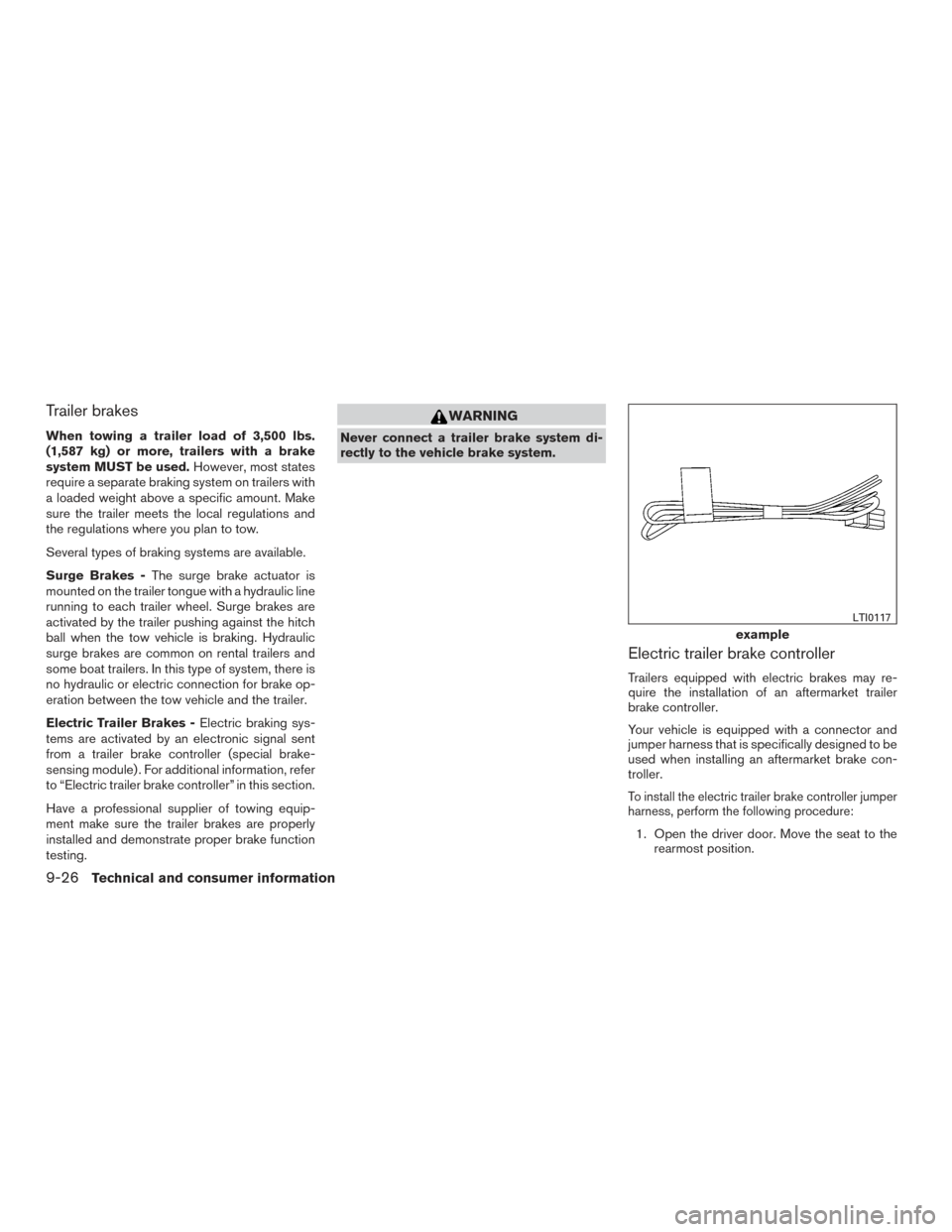
To install the electric trailer brake controller jumper
harness, perform the following procedure:
1. Open the driver door. Move the seat to the rearmost position.
example
LTI0117
9-26Technical and consumer information
Page 494 of 510
FLAT TOWING
Towing your vehicle with all four wheels on the
ground is sometimes called flat towing. This
method is sometimes used when towing a vehicle
behind a recreational vehicle, such as a motor
home.
CAUTION
●Failure to follow these guidelines can
result in severe transmission damage.
● Whenever flat towing your vehicle, al-
ways tow forward, never backward.
● DO NOT tow any automatic transmis-
sion vehicle with all four wheels on the
ground (flat towing) . Doing so WILL
DAMAGE internal transmission parts
due to lack of transmission lubrication.
● For additional information, refer to
“Towing recommended by NISSAN” in
the “In case of emergency” section of
this manual.
Automatic Transmission
To tow a vehicle equipped with an automatic
transmission, an appropriate vehicle dolly MUST
be placed under the towed vehicle’s drive
wheels. Always follow the dolly manufacturer’s
recommendations when using their product.
WARNING
Do not use this vehicle for snowplowing.
Installing a snowplow may affect vehicle
handling. This may cause the driver to lose
control of the vehicle and could result in
serious vehicle damage or personal injury. DOT (Department of Transportation) Quality
Grades: All passenger car tires must conform to
federal safety requirements in addition to these
grades.
Quality grades can be found where applicable on
the tire sidewall between tread shoulder and
maximum section width. For example:
Treadwear 200 Traction AA Temperature A
Treadwear
The treadwear grade is a comparative rating
based on the wear rate of the tire when tested
under controlled conditions on a specified gov-
ernment test course. For example, a tire graded
150 would wear one and one-half (1 1/2) times
as well on the government course as a tire graded
100. The relative performance of tires depends
upon the actual conditions of their use, however,
and may depart significantly from the norm due to
variations in driving habits, service practices and
differences in road characteristics and climate.
Traction AA, A, B and C
The traction grades, from highest to lowest, are
AA, A, B, and C. Those grades represent the
tire’s ability to stop on wet pavement as mea-
sured under controlled conditions on specified
government test surfaces of asphalt and con-
crete. A tire marked C may have poor traction
performance.
SNOW PLOW
UNIFORM TIRE QUALITY GRADING
Technical and consumer information9-31
Page 495 of 510
WARNING
The traction grade assigned to this tire is
based on straight-ahead braking traction
tests, and does not include acceleration,
cornering, hydroplaning, or peak traction
characteristics.
Temperature A, B and C
The temperature grades are A (the highest) , B,
and C, representing the tire’s resistance to the
generation of heat, and its ability to dissipate heat
when tested under controlled conditions on a
specified indoor laboratory test wheel. Sustained
high temperature can cause the material of the
tire to degenerate and reduce tire life, and exces-
sive temperature can lead to sudden tire failure.
The grade C corresponds to a level of perfor-
mance which all passenger car tires must meet
under the Federal Motor Safety Standard No.
109. Grades B and A represent higher levels of
performance on the laboratory test wheel than
the minimum required by law.
WARNING
The temperature grade for this tire is es-
tablished for a tire that is properly inflated
and not overloaded. Excessive speed,
under-inflation, or excessive loading, ei-
ther separately or in combination, can
cause heat build-up and possible tire
failure. Your NISSAN vehicle is covered by the following
emission warranties:
For USA
1. Emission Defects Warranty
2. Emissions Performance Warranty
Details of this warranty may be found with other
vehicle warranties in your Warranty Information
Booklet which comes with your NISSAN vehicle.
If you did not receive a Warranty Information
Booklet, or it is lost, you may obtain a replace-
ment by writing to: ● Nissan North America, Inc.
Consumer Affairs Department
P.O. Box 685003
Franklin, TN 37068-5003
For Canada
Emission Control System Warranty
Details of this warranty may be found with other
vehicle warranties in your Warranty Information
Booklet which comes with your NISSAN vehicle.
If you did not receive a Warranty Information
Booklet, or it is lost, you may obtain a replace-
ment by writing to: ● Nissan Canada Inc.
5290 Orbitor Drive
Mississauga, Ontario, L4W 4Z5
EMISSION CONTROL SYSTEM
WARRANTY
9-32Technical and consumer information
Page 500 of 510
10 Index
2nd row bench seat adjustment.........1-4
4WDwarninglight...............2-15
A
Adjusting pedal position ............3-31
Air bag (See supplemental restraint
system) .....................1-55
Air bag system Front (See supplemental front impact
air bag system) ...............1-62
Airbagwarninglabels.............1-72
Airbagwarninglight...........1-72,2-18
Air bag warning light, supplemental . .1-72, 2-18
AirCleaner ...................8-19
Air cleaner housing filter ............8-19
Air conditioner Air conditioner service ...........4-33
Air conditioner specification label .....9-13
Air conditioner system refrigerant and oil
recommendations ..............9-8
Air conditioner system refrigerant
recommendations ..............9-8
Heater and air conditioner controls ....4-29
Rear seat air conditioner ..........4-31
Servicing air conditioner ..........4-33
Anchor point locations .............1-38
Antenna .....................4-82
Antifreeze ....................5-37
Anti-lock brake warning light ..........2-13
Anti-lock Braking System (ABS) ........5-32
Audible reminders ...............2-20 Audio system
..................4-33
AMradioreception.............4-34
Bluetooth®audio..............4-77
Bluetooth® streaming audio ........4-77
Compact disc (CD) player .....4-53,4-59
Digital Versatile Disc (DVD) Player
Operation ..................4-63
FM/AM/SAT radio with compact disc (CD)
player.................4-49,4-55
FMradioreception.............4-33
iPod® Player .............4-71,4-74
iPod® player operation .......4-71,4-74
Radio ....................4-33
Settings ...............4-50,4-56
Steering wheel audio control switch . . .4-81
USB interface ............4-66,4-67
USB (Universal Serial Bus)
Connection Port ...........4-66,4-67
Autolight switch .................2-35
Automatic Automatic drive positioner .....3-36,3-36
Automatic power window switch .....2-58
Automatic transmission position indicator
light .....................2-28
Driving with automatic transmission ....5-15
Automatic anti-glare inside mirror .......3-33
Automatic door locks ..............3-6
Automatic drive positioner .......3-36,3-36
Automatic transmission fluid temperature
gauge.......................2-8 B
Battery ..................5-37, 8-15
Charge warning light ............2-15
Battery replacement Keyfob................8-28,8-29
NISSAN Intelligent Key® ..........8-30
Before starting the engine ...........5-13
Belt (See drive belt) ..............8-17
Block heater Engine ....................5-39
Bluetooth® audio ................4-77
Bluetooth® hands-free
phone system .............4- 108, 4-122
Boosterseats..................1-52
Brake Anti-lock Braking System (ABS) ......5-32
Brake fluid ..................8-13
Brakelight(Seestoplight).........8-33
Brake system ................5-31
Brakewarninglight.............2-14
Brakewearindicators........2-20,8-24
Parking brake operation ..........5-19
Self-adjusting brakes ............8-24
Brake
fluid ....................8-13
Brakes ......................8-24
Brake system ..................5-31
Break-inschedule ...............5-21
Brightness/contrast button .......4-10,4-19
Brightness control Instrument panel ..............2-37
Bulb check/instrument panel ..........2-13
Page 501 of 510
Bulb replacement................8-33
C
Capacities and recommended fuel/lubricants . .9-2
Captain’s chair adjustment (2nd row) . . .1-6, 1-7
Cargolight....................2-64
Cargo(Seevehicleloadinginformation)....9-14
Car phone or CB radio .............4-108
CD care and cleaning ..............4-80
CD player (See audio system) ......4-53,4-59
Check tire pressure ...............2-28
Child restraints .......1-30,1-31,1-32,1-34
LATCH (Lower Anchors and Tethers for
CHildren) System ..............1-34
Precautions on child
restraints.........1-32,1-40,1-46,1-52
Top tether strap anchor point locations . .1-38
Child restraint with top tether strap .......1-37
Child safety rear door lock ............3-7
Chimes, audible reminders ...........2-20
Cleaningexteriorandinterior........7-2,7-4
Clock.......................4-50
Clock setting
(models with Navigation System) ........4-16
Clock setting
(models without Navigation System) .......4-8
C.M.V.S.S. certification label ..........9-12
Cold weather driving ...............5-37
Compact disc (CD) player ........4-53,4-59
Consolebox................2-46,2-51
Control panel buttons ..............4-10
Brightness/contrast button ......4-10,4-19
Enterbutton...............4-4,4-10
Without navigation system ..........4-4Controls
Audio controls (steering wheel) .......4-81
Heater and air conditioner controls .....4-29
Rear seat air conditioner ..........4-31
Coolant Capacities and recommended
fuel/lubricants .................9-2
Changingenginecoolant...........8-8
Checking engine coolant level ........8-8
Engine coolant temperature gauge .....2-5
Corrosion protection ...............7-5
Cruisecontrol ...........5-20,5-20,5-20
Cupholders...................2-49
Curtainside-impactandrolloverairbag....1-69
D
Daytime running light system (Canada only) . .2-36
Defroster switch Rear window and outside mirror defroster
switch.....................2-34
Digital Versatile Disc (DVD) player .......4-63
Digital video disc DVD ..............4-83
Dimensionsandweights ............9-10
Dimmer switch for instrument panel ......2-37
Display......................2-21
Display controls
(seecontrolpanelbuttons) ........4-4,4-10
Door locks .....................3-5
Drive belt .....................8-17
Drive positioner, Automatic ........3-36,3-36
Driving Cold weather driving .............5-37
Driving with automatic transmission ....5-15
Precautions when starting and driving ....5-2Driving the vehicle
................5-14
E
Economy-fuel..................5-23
Emission control information label .......9-12
Emission control system warranty .......9-32
Engine Before starting the engine ..........5-13
Blockheater.................5-39
Capacities and recommended
fuel/lubricants.................9-2
Changing engine coolant ...........8-8
Changingengineoil.............8-10
Changing engine oil filter ..........8-11
Checking engine coolant level ........8-8
Checking engine oil level ...........8-9
Engine compartment check locations ....
8-6
Engine coolant temperature gauge .....2-5
Engine cooling system ............8-7
Engineoil ...................8-9
Engine oil and oil filter recommendation . . .9-7
Engineoilpressuregauge..........2-7
Engine oil viscosity ..............9-8
Engine serial number ............9-12
Engine specifications .............9-9
Starting the engine .............5-13
Engine coolant temperature gauge .......2-5
Engine oil pressure gauge ............2-7
Engine oil pressure low/engine coolant
temperature high warning light .........2-15
Enter button .................4-4,4-10
Event Data recorders ..............9-34
Exhaust gas (Carbon monoxide) .........5-2
Explanation of maintenance items ........8-2
10-2
Page 502 of 510
Extendedstorageswitch ............8-28
Eyeglass case..................2-47
F
Flashers (See hazard warning flasher switch) . .6-2
Flat tire ....................6-2,6-3
Floor mat positioning aid .............7-5
Fluid Brake fluid ..................8-13
Capacities and recommended
fuel/lubricants .................9-2
Engine coolant .................8-7
Engine oil ...................8-9
Power steering fluid .............8-13
Windshield-washerfluid...........8-14
F.M.V.S.S. certification label ...........9-12
Foglightswitch .................2-38
Front air bag system
(See supplemental restraint system) ......1-62
Front and rear sonar system ..........5-36
Front power seat adjustment ...........1-3
Frontseats.....................1-2
Fuel Capacities and recommended
fuel/lubricants .................9-2
Fuel economy ................5-23
Fuel gauge ...................2-6
Fuel octane rating ...............9-5
Fuel recommendation .............9-4
Loose fuel cap warning ........2-28,3-28
Fuel Cell Vehicle (FCV) System Tirepressure.................8-37
Fuel-filler door ..................3-28
Fuel gauge .....................2-6 Fuses.......................8-24
Fusiblelinks ...................8-26
G
Garage door opener, HomeLink® Universal
Transceiver .........2-64,2-65,2-66,2-67
Gauge Automatic transmission fluid temperature
gauge .....................2-8
Engine coolant temperature gauge .....2-5
Engine oil pressure gauge ..........2-7
Fuel gauge ...................2-6
Odometer ...................2-4
Speedometer .................2-4
Tachometer ..................2-5
Trip odometer .................2-4
Voltmeter....................2-7
General maintenance ...............8-2
Glass hatch ...................3-28
Glovebox.....................2-47
Gloveboxlock..................2-47
H
Hands-free phone system,
Bluetooth®...............4- 108, 4-122
Hazard warning flasher switch ..........6-2
Headlight and turn signal switch ........2-34
Headlight control switch ............2-35
Headlights ....................8-31
Head restraints ..................1-14
Heated seats ...............2-39,2-40
Heated steering wheel .............2-41 Heater
Heater and air conditioner controls .....4-29
Heater operation ...............4-30
Rear seat air conditioner ..........4-31
HomeLink® Universal
Transceiver .........2-64,2-65,2-66,2-67
H
ood.......................3-23
Hook Luggage hook ................2-53
Horn .......................2-38
I
Ignition switch ...................5-9
Imageviewer...................4-19
Immobilizer system .........2-30,3-4,5-12
Important vehicle information label .......9-12
In-cabin microfilter ................8-19
Increasing fuel economy .............5-23
Indicator lights and audible reminders
(See warning/indicator lights and
audible reminders) .........2-12,2-13,2-18
Information display ................2-21
Inside automatic anti-glare mirror ........3-33
Instrument brightness control ..........2-37
Instrumentpanel...............0-6,2-2
Instrument panel dimmer switch ........2-37
Intelligent Key system Key operating range .............3-14
Key operation ................3-15
Mechanical key ................3-3
Remote keyless entry operation.......3-17
Troubleshooting guide ............3-22
Warning signals ...............3-22
Interior light ....................2-62
10-3