Page 26 of 510
back can be reclined to allow occupants to rest
when the vehicle is stopped and the shift lever is
in P (Park) .
WARNING
●After adjustment, gently rock in the seat
to make sure it is securely locked.
● Do not ride in a moving vehicle when
the seatback is reclined. This can be
dangerous. The shoulder belt will not
be against your body. In an accident,
you could be thrown into it and receive
neck or other serious injuries. You
could also slide under the lap belt and
receive serious internal injuries.
● For the most effective protection when
the vehicle is in motion, the seat should
be upright. Always sit well back and
upright in the seat and adjust the seat
belt properly. For additional informa-
tion, refer to “Precautions on seat belt
usage” in this section.
Tip up for easy entry/exit of the 3rd
row
The outboard seating positions on the 2nd row
bench seat can be tipped forward for easy entry
or exit from the 3rd row bench seat. To enter the
3rd row
�1, lift up on the seatback latch located
on the upper corner of the seatback on the 2nd
row bench seat and fold the seatback forward at
an angle over the seat base. This will release the
back of the seat so it may be tipped forward. Then
�2lift up on the lower corner of the seat
base and tip the outboard seating position of the
2nd row bench seat forward. To exit the 3rd row
bench seat, lift up on the same seatback latch
and fold the seatback forward onto the seat base.
Then lift up on the seat base and tip it forward.
WARNING
When returning the seatbacks to the up-
right position, be certain they are com-
pletely secured in the latched position. If
they are not completely secured, passen-
gers may be injured in an accident or sud-
den stop.
WRS0414LRS0331
Safety—Seats, seat belts and supplemental restraint system1-5
Page 28 of 510
3RD ROW BENCH SEAT
ADJUSTMENT
The 3rd row bench seat is non-adjustable. How-
ever, the seats can be folded to lay flat for maxi-
mum cargo capacity. For additional information,
refer to “Flexible seating” in this section.
ARMRESTS (captain’s chairs)
�AStowed position
�BResting position
To use the armrests, pull them down to the rest-
ing position.
FLEXIBLE SEATING
WARNING
● Never allow anyone to ride in the cargo
area or on the rear seats when they are
in the fold-down position. In a collision,
people riding in these areas without
proper restraints are more likely to be
seriously injured or killed.
● Do not allow people to ride in any area
of your vehicle that is not equipped with
seats and seat belts. Be sure everyone
in your vehicle is in a seat and using a
seat belt properly.
● Do not allow more than one person to
use the same seat belt.
● Do not fold down the rear seats when
occupants are in the rear seat area or
any luggage is on the rear seats.
– Make sure that the seat path is clear before moving the seat.
– Be careful not to allow hands or feet to get caught or pinched in the seat.
LRS2471WRS0368
Safety—Seats, seat belts and supplemental restraint system1-7
Page 31 of 510
8. Rotate the head restraint/headrest forwardto return it to the normal seating position.
WARNING
When the seat is returned to the normal
seating position, the head
restraint/headrest must be returned to the
upright position to properly protect ve-
hicle occupants.
Folding the 2nd row captain’s chairs (if
so equipped)
To fold the 2nd row captain’s chairs flat for maxi-
mum cargo hauling:
�1Raise the armrest to the stowed position.
Remove the 2nd row center console, refer to
“2nd row center console” in the “Instruments
and controls” section of this Owner’s
Manual.
�2Pull the strap forward, located in the center
of the seat cushion, and fold the seat cush-
ion toward the front of the vehicle. 3. Pull the strap to release the head
restraint/headrest rearward.
LRS0332LRS2063
1-10Safety—Seats, seat belts and supplemental restraint system
Page 32 of 510
�4Then lift up on the recline lever to fold the
seatback flat forward.
5. There is a carpet panel flap that can be folded toward the back of the vehicle. 6. The carpet panel flaps provide a level cargo
floor when the 3rd row seats are also folded
flat. Reverse this process to return the 2nd
row captain’s chairs to a seating position.
Make sure to properly raise the seat-
back to an upright position and push
the seat cushion down into place.
7. Rotate the head restraint/headrest forward to return it to the normal seating position.
WARNING
When the seat is returned to the normal
seating position, the head
restraints/headrests must be returned to
the upright position to properly protect
vehicle occupants.
LRS2096LRS2078
Safety—Seats, seat belts and supplemental restraint system1-11
Page 33 of 510
3rd row manual folding seats (if so
equipped)
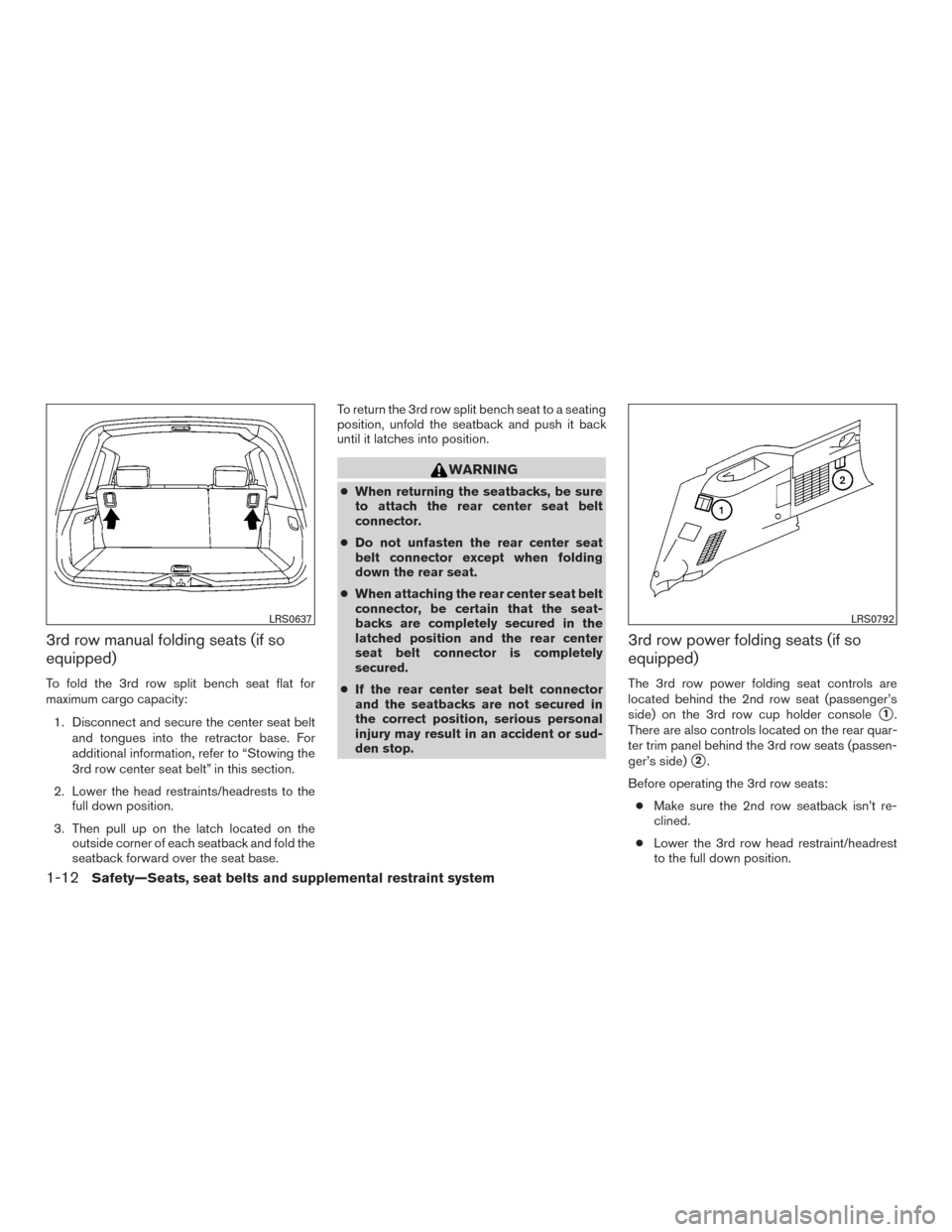
To fold the 3rd row split bench seat flat for
maximum cargo capacity:1. Disconnect and secure the center seat belt and tongues into the retractor base. For
additional information, refer to “Stowing the
3rd row center seat belt” in this section.
2. Lower the head restraints/headrests to the full down position.
3. Then pull up on the latch located on the outside corner of each seatback and fold the
seatback forward over the seat base. To return the 3rd row split bench seat to a seating
position, unfold the seatback and push it back
until it latches into position.
WARNING
●
When returning the seatbacks, be sure
to attach the rear center seat belt
connector.
● Do not unfasten the rear center seat
belt connector except when folding
down the rear seat.
● When attaching the rear center seat belt
connector, be certain that the seat-
backs are completely secured in the
latched position and the rear center
seat belt connector is completely
secured.
● If the rear center seat belt connector
and the seatbacks are not secured in
the correct position, serious personal
injury may result in an accident or sud-
den stop.
3rd row power folding seats (if so
equipped)
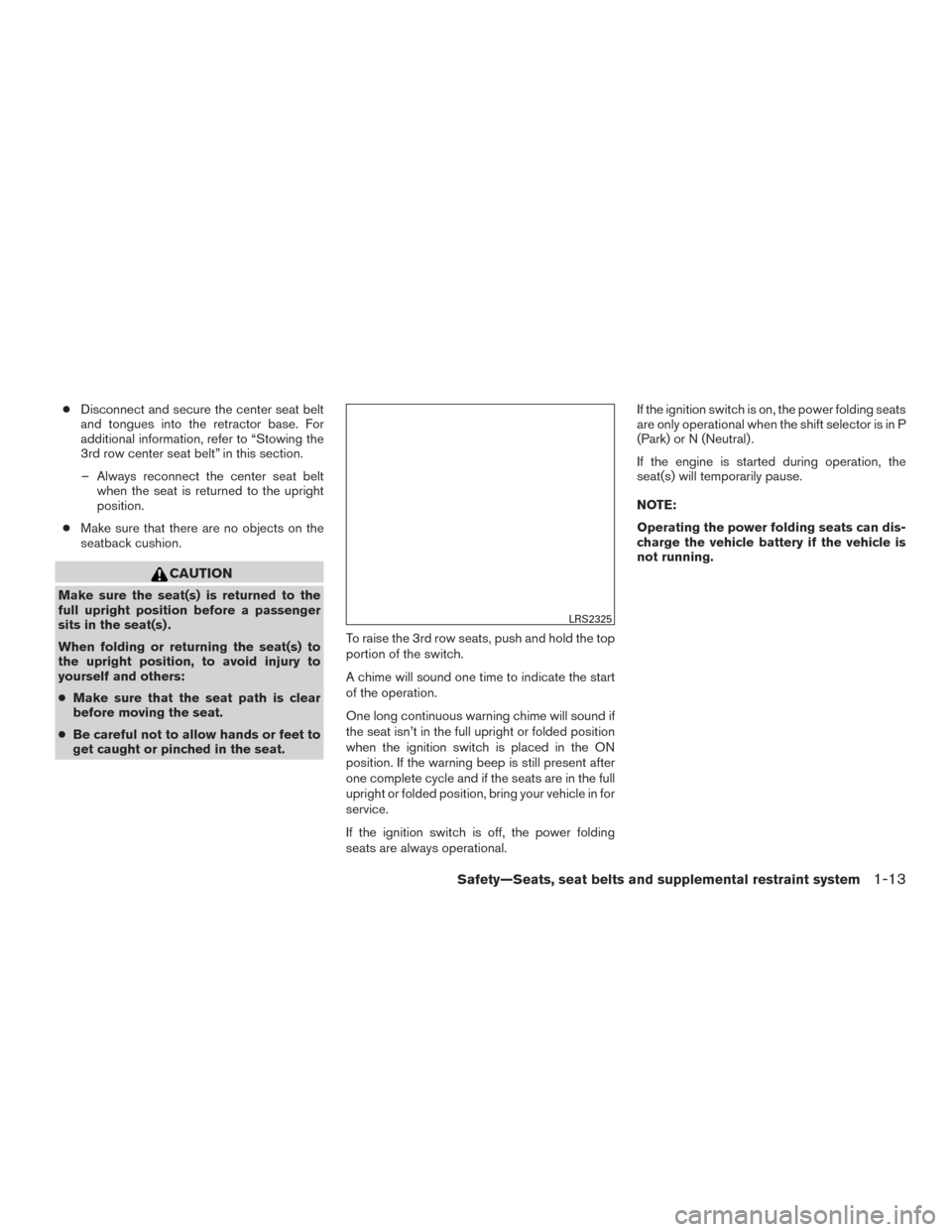
The 3rd row power folding seat controls are
located behind the 2nd row seat (passenger’s
side) on the 3rd row cup holder console
�1.
There are also controls located on the rear quar-
ter trim panel behind the 3rd row seats (passen-
ger’s side)
�2.
Before operating the 3rd row seats: ● Make sure the 2nd row seatback isn’t re-
clined.
● Lower the 3rd row head restraint/headrest
to the full down position.
LRS0637LRS0792
1-12Safety—Seats, seat belts and supplemental restraint system
Page 34 of 510
●Disconnect and secure the center seat belt
and tongues into the retractor base. For
additional information, refer to “Stowing the
3rd row center seat belt” in this section.
– Always reconnect the center seat belt when the seat is returned to the upright
position.
● Make sure that there are no objects on the
seatback cushion.
CAUTION
Make sure the seat(s) is returned to the
full upright position before a passenger
sits in the seat(s) .
When folding or returning the seat(s) to
the upright position, to avoid injury to
yourself and others:
● Make sure that the seat path is clear
before moving the seat.
● Be careful not to allow hands or feet to
get caught or pinched in the seat. To raise the 3rd row seats, push and hold the top
portion of the switch.
A chime will sound one time to indicate the start
of the operation.
One long continuous warning chime will sound if
the seat isn’t in the full upright or folded position
when the ignition switch is placed in the ON
position. If the warning beep is still present after
one complete cycle and if the seats are in the full
upright or folded position, bring your vehicle in for
service.
If the ignition switch is off, the power folding
seats are always operational. If the ignition switch is on, the power folding seats
are only operational when the shift selector is in P
(Park) or N (Neutral) .
If the engine is started during operation, the
seat(s) will temporarily pause.
NOTE:
Operating the power folding seats can dis-
charge the vehicle battery if the vehicle is
not running.
LRS2325
Safety—Seats, seat belts and supplemental restraint system1-13
Page 35 of 510
WARNING
Head restraints/headrests supplement
the other vehicle safety systems. They may
provide additional protection against in-
jury in certain rear end collisions. Adjust-
able head restraints/headrests must be
adjusted properly, as specified in this sec-
tion. Check the adjustment after someone
else uses the seat. Do not attach anything
to the head restraint/headrest stalks or
remove the head restraint/headrest. Do
not use the seat if the head
restraint/headrest has been removed. If
the head restraint/headrest was removed,
reinstall and properly adjust the head
restraint/headrest before an occupant
uses the seating position. Failure to fol-
low these instructions can reduce the ef-
fectiveness of the head
restraints/headrests. This may increase
the risk of serious injury or death in a
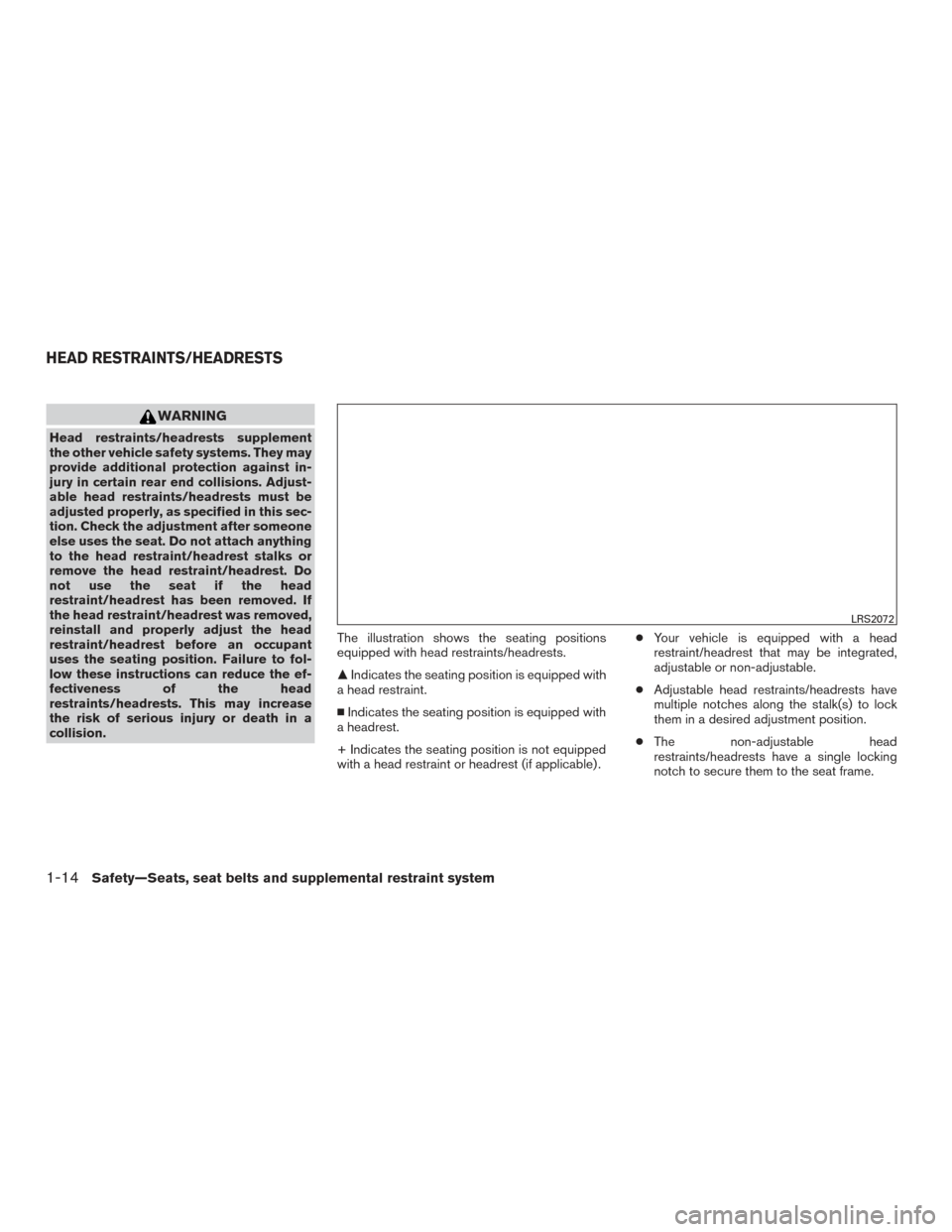
collision.The illustration shows the seating positions
equipped with head restraints/headrests.
�
Indicates the seating position is equipped with
a head restraint.
� Indicates the seating position is equipped with
a headrest.
+ Indicates the seating position is not equipped
with a head restraint or headrest (if applicable) . ●
Your vehicle is equipped with a head
restraint/headrest that may be integrated,
adjustable or non-adjustable.
● Adjustable head restraints/headrests have
multiple notches along the stalk(s) to lock
them in a desired adjustment position.
● The non-adjustable head
restraints/headrests have a single locking
notch to secure them to the seat frame.
LRS2072
HEAD RESTRAINTS/HEADRESTS
1-14Safety—Seats, seat belts and supplemental restraint system
Page 40 of 510
WARNING
When the seat is returned to the normal
seating position, the head
restraint/headrest must be returned to the
upright position to properly protect ve-
hicle occupants.
FRONT-SEAT ACTIVE HEAD
RESTRAINTS
WARNING
●Always adjust the head restraints prop-
erly as specified in this section. Failure
to do so can reduce the effectiveness of
the active head restraint.
● Active head restraints are designed to
supplement other safety systems. Al-
ways wear seat belts. No system can
prevent all injuries in any accident. ●
Do not attach anything to the head re-
straint stalks. Doing so could impair
active head restraint function.
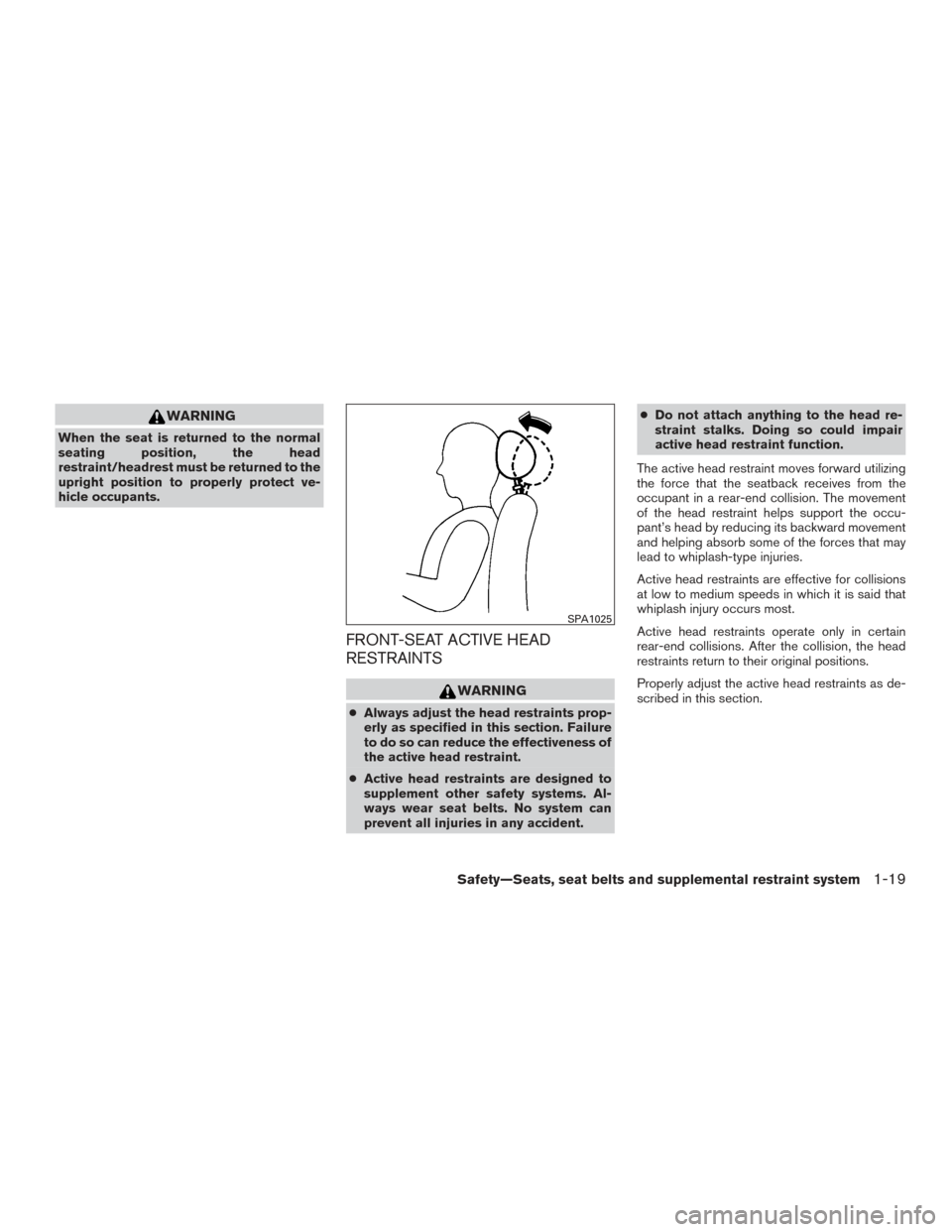
The active head restraint moves forward utilizing
the force that the seatback receives from the
occupant in a rear-end collision. The movement
of the head restraint helps support the occu-
pant’s head by reducing its backward movement
and helping absorb some of the forces that may
lead to whiplash-type injuries.
Active head restraints are effective for collisions
at low to medium speeds in which it is said that
whiplash injury occurs most.
Active head restraints operate only in certain
rear-end collisions. After the collision, the head
restraints return to their original positions.
Properly adjust the active head restraints as de-
scribed in this section.
SPA1025
Safety—Seats, seat belts and supplemental restraint system1-19