2015 NISSAN ARMADA ignition
[x] Cancel search: ignitionPage 487 of 510
A weight-distributing hitch system (Class IV) is
recommended if you plan to tow trailers with a
maximum weight over 5,000 lbs (2,268 kg).
Check with the trailer and towing equipment
manufacturers to determine if they recommend
the use of a weight-distributing hitch system.
NOTE:
A weight-distributing hitch system may af-
fect the operation of trailer surge brakes. If
you are considering use of a weight-
distributing hitch system with a surge
brake-equipped trailer, check with the
surge brake, hitch or trailer manufacturer
to determine if and how this can be done.
Follow the instructions provided by the manufac-
turer for installing and using the weight-
distributing hitch system.
General set-up instructions are as follows:1. Park unloaded vehicle on a level surface. With the ignition on and the doors closed,
allow the vehicle to stand for several minutes
so that it can level.
2. Measure the height of a reference point on the front and rear bumpers at the center of
the vehicle. 3. Attach the trailer to the vehicle and adjust
the hitch equalizers so that the front bumper
height is within0-.5inches (0 – 13 mm) of
the reference height measured in step 2. The
rear bumper should be no higher than the
reference height measured in step 2.
WARNING
Properly adjust the weight distributing
hitch so the rear of the bumper is no
higher than the measured reference
height when the trailer is attached. If the
rear bumper is higher than the measured
reference height when loaded, the vehicle
may handle unpredictably which could
cause a loss of vehicle control and cause
serious personal injury or property
damage.
Sway control device
Sudden maneuvers, wind gusts, and buffeting
caused by other vehicles can affect trailer han-
dling. Sway control devices may be used to help
control these affects. If you choose to use one,
contact a reputable trailer hitch supplier to make
sure the sway control device will work with the
vehicle, hitch, trailer and the trailer’s brake sys-
tem. Follow the instructions provided by the
manufacturer for installing and using the sway
control device.
Class I hitch
Class I trailer hitch equipment (receiver, ball
mount and hitch ball) can be used to tow trailers
of a maximum weight of 2,000 lb (907 kg) .
Class II hitch
Class II trailer hitch equipment (receiver, ball
mount and hitch ball) can be used to tow trailers
of a maximum weight of 3,500 lb (1,587 kg).
Class III hitch
Class III trailer hitch equipment (receiver, ball
mount and hitch ball) can be used to tow trailers
of a maximum weight of 5,000 lb (2,268 kg).
Class IV hitch
Class IV trailer hitch equipment (receiver, ball
mount and hitch ball) can be used to tow trailers
of a maximum weight of 10,000 lb (4,535 kg). A
weight distributing hitch should be used to tow
trailers that weigh over 5,000 lb (2,268 kg).
Your vehicle may be equipped with Class IV
trailer hitch equipment that has a 10,000 lb
(4,535 kg) maximum weight rating, but your ve-
hicle is only capable of towing the maximum
trailer weights shown in the “Towing
Load/Specification” chart in this section.
9-24Technical and consumer information
Page 493 of 510
Do the following if the trailer begins to sway:1. Take your foot off the accelerator pedal to allow the vehicle to coast and steer as
straight ahead as the road conditions allow.
This combination will help stabilize the ve-
hicle
– Do not correct trailer sway by steering or applying the brakes.
2. When the trailer sway stops, gently apply the brakes and pull to the side of the road in a
safe area.
3. Try to rearrange the trailer load so it is bal- anced as described in this section.
● Be careful when passing other vehicles.
Passing while towing a trailer requires con-
siderably more distance than normal pass-
ing. Remember, the length of the trailer must
also pass the other vehicle before you can
safely change lanes.
● Downshift the transmission to a lower gear
for engine braking when driving down steep
or long hills. This will help slow the vehicle
without applying the brakes.
● Avoid holding the brake pedal down too long
or too frequently. This could cause the
brakes to overheat, resulting in reduced
braking efficiency. ●
Increase your following distance to allow for
greater stopping distances while towing a
trailer. Anticipate stops and brake gradually.
● NISSAN recommends that the cruise con-
trol not be used while towing a trailer.
● Some states or provinces have specific
regulations and speed limits for vehicles that
are towing trailers. Obey the local speed
limits.
● Check your hitch, trailer wiring harness con-
nections, and trailer wheel lug nuts after
50 miles (80 km) of travel and at every break.
● When launching a boat, don’t allow the wa-
ter level to go over the exhaust tail pipe or
rear bumper.
● Make sure you disconnect the trailer lights
before backing the trailer into the water or
the trailer lights may burn out.
When towing a trailer, final drive gear oil
should be replaced and transmission
oil/fluid should be changed more fre-
quently. For additional information, refer to
“Maintenance and do-it-yourself” section
in this manual.Tow mode (if so equipped)
Using tow mode is recommended when pulling a
heavy trailer or hauling a heavy load. Press the
TOW MODE switch to activate tow mode. The
indicator light on the TOW MODE switch illumi-
nates when tow mode is selected. Press the
TOW MODE switch again to turn tow mode off.
Tow mode is automatically cancelled when the
ignition switch is turned OFF.
Tow mode includes the following features: ● Grade logic — Adjusts transmission shifts
when pulling a trailer or hauling a load up a
grade.
● Downhill Speed Control (DSC) — automati-
cally downshifts when driving down a grade
with a trailer or heavy load to help control
vehicle speed.
Driving the vehicle in the tow mode with no
trailer/load or light trailer/light load will not cause
any damage. However, fuel economy may be
reduced and the transmission/engine driving
characteristics may feel unusual.
When towing a trailer, final drive gear oil
should be replaced and transmission
oil/fluid should be changed more fre-
quently. For additional information, refer to
“Maintenance and do-it-yourself” section
in this manual.
9-30Technical and consumer information
Page 497 of 510
Due to legal requirements in some states and
Canadian Provinces, your vehicle may be re-
quired to be in what is called the “ready condi-
tion” for an Inspection/Maintenance (I/M) test of
the emission control system.
The vehicle is set to the “ready condition” when it
is driven through certain driving patterns. Usually,
the ready condition can be obtained by ordinary
usage of the vehicle.
If a powertrain system component is repaired or
the battery is disconnected, the vehicle may be
reset to a “not ready” condition. Before taking the
I/M test, check the vehicle’s
inspection/maintenance test readiness condi-
tion. Place the ignition switch in the ON position
without starting the engine. If the Malfunction
Indicator Light (MIL) comes on steady for 20 sec-
onds and then blinks for 10 seconds , the I/M test
condition is “not ready”. If the MIL does not blink
after 20 seconds, the I/M test condition is
“ready”. Contact a NISSAN dealer to set the
“ready condition” or to prepare the vehicle for
testing.This vehicle is equipped with an Event Data Re-
corder (EDR) . The main purpose of an EDR is to
record, in certain crash or near crash-like situa-
tions, such as an air bag deployment or hitting a
road obstacle, data that will assist in understand-
ing how a vehicle’s systems performed. The EDR
is designed to record data related to vehicle
dynamics and safety systems for a short period of
time, typically 30 seconds or less. The EDR in this
vehicle is designed to record such data as:
● How various systems in your vehicle were
operating;
● Whether or not the driver and passenger
safety belts were buckled/fastened;
● How far (if at all) the driver was depressing
the accelerator and/or brake pedal; and,
● How fast the vehicle was traveling.
● Sounds are not recorded. These data can help provide a better understand-
ing of the circumstances in which crashes and
injuries occur. NOTE: EDR data are recorded by
your vehicle only if a nontrivial crash situation
occurs; no data are recorded by the EDR under
normal driving conditions and no personal data
(e.g. name, gender, age and crash location) are
recorded. However, other parties, such as law
enforcement, could combine the EDR data with
the type of personally identifying data routinely
acquired during a crash investigation.
To read data recorded by an EDR, special equip-
ment is required and access to the vehicle or the
EDR is needed. In addition to the vehicle manu-
facturer and NISSAN dealer, other parties, such
as law enforcement, that have the special equip-
ment, can read the information if they have ac-
cess to the vehicle or the EDR. EDR data will only
be accessed with the consent of the vehicle
owner or lessee or as otherwise required or per-
mitted by law.
READINESS FOR INSPECTION/
MAINTENANCE (I/M) TEST
EVENT DATA RECORDERS (EDR)
9-34Technical and consumer information
Page 502 of 510
Extendedstorageswitch ............8-28
Eyeglass case..................2-47
F
Flashers (See hazard warning flasher switch) . .6-2
Flat tire ....................6-2,6-3
Floor mat positioning aid .............7-5
Fluid Brake fluid ..................8-13
Capacities and recommended
fuel/lubricants .................9-2
Engine coolant .................8-7
Engine oil ...................8-9
Power steering fluid .............8-13
Windshield-washerfluid...........8-14
F.M.V.S.S. certification label ...........9-12
Foglightswitch .................2-38
Front air bag system
(See supplemental restraint system) ......1-62
Front and rear sonar system ..........5-36
Front power seat adjustment ...........1-3
Frontseats.....................1-2
Fuel Capacities and recommended
fuel/lubricants .................9-2
Fuel economy ................5-23
Fuel gauge ...................2-6
Fuel octane rating ...............9-5
Fuel recommendation .............9-4
Loose fuel cap warning ........2-28,3-28
Fuel Cell Vehicle (FCV) System Tirepressure.................8-37
Fuel-filler door ..................3-28
Fuel gauge .....................2-6 Fuses.......................8-24
Fusiblelinks ...................8-26
G
Garage door opener, HomeLink® Universal
Transceiver .........2-64,2-65,2-66,2-67
Gauge Automatic transmission fluid temperature
gauge .....................2-8
Engine coolant temperature gauge .....2-5
Engine oil pressure gauge ..........2-7
Fuel gauge ...................2-6
Odometer ...................2-4
Speedometer .................2-4
Tachometer ..................2-5
Trip odometer .................2-4
Voltmeter....................2-7
General maintenance ...............8-2
Glass hatch ...................3-28
Glovebox.....................2-47
Gloveboxlock..................2-47
H
Hands-free phone system,
Bluetooth®...............4- 108, 4-122
Hazard warning flasher switch ..........6-2
Headlight and turn signal switch ........2-34
Headlight control switch ............2-35
Headlights ....................8-31
Head restraints ..................1-14
Heated seats ...............2-39,2-40
Heated steering wheel .............2-41 Heater
Heater and air conditioner controls .....4-29
Heater operation ...............4-30
Rear seat air conditioner ..........4-31
HomeLink® Universal
Transceiver .........2-64,2-65,2-66,2-67
H
ood.......................3-23
Hook Luggage hook ................2-53
Horn .......................2-38
I
Ignition switch ...................5-9
Imageviewer...................4-19
Immobilizer system .........2-30,3-4,5-12
Important vehicle information label .......9-12
In-cabin microfilter ................8-19
Increasing fuel economy .............5-23
Indicator lights and audible reminders
(See warning/indicator lights and
audible reminders) .........2-12,2-13,2-18
Information display ................2-21
Inside automatic anti-glare mirror ........3-33
Instrument brightness control ..........2-37
Instrumentpanel...............0-6,2-2
Instrument panel dimmer switch ........2-37
Intelligent Key system Key operating range .............3-14
Key operation ................3-15
Mechanical key ................3-3
Remote keyless entry operation.......3-17
Troubleshooting guide ............3-22
Warning signals ...............3-22
Interior light ....................2-62
10-3
Page 505 of 510
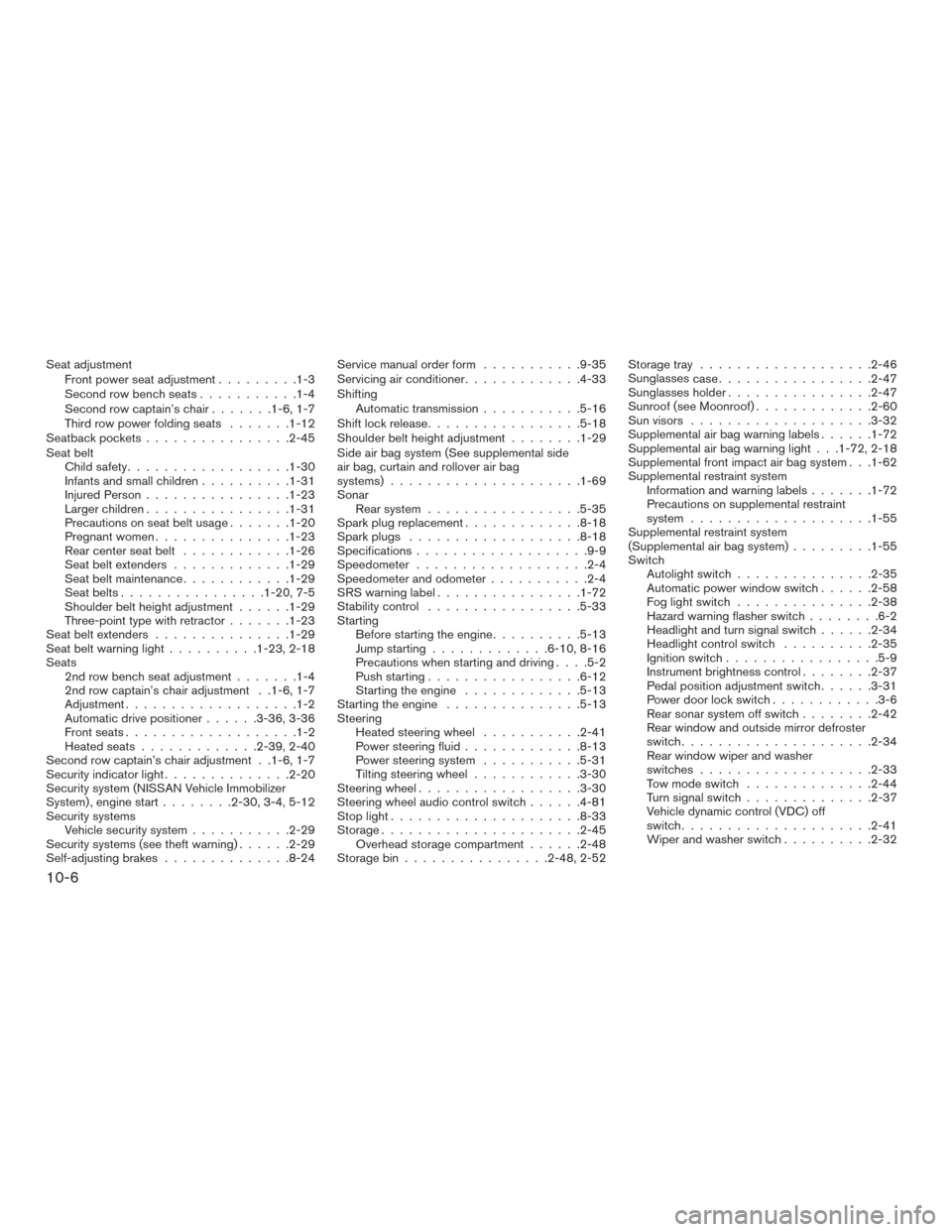
Seat adjustmentFront power seat adjustment .........1-3
Second row bench seats ...........1-4
Second row captain’s chair .......1-6,1-7
Third row power folding seats .......1-12
Seatback pockets ................2-45
Seat belt Childsafety..................1-30
Infantsandsmallchildren..........1-31
Injured Person ................1-23
Largerchildren................1-31
Precautionsonseatbeltusage.......1-20
Pregnant women ...............1-23
Rear center seat belt ............1-26
Seat belt extenders .............1-29
Seat belt maintenance ............1-29
Seat belts ................1-20,7-5
Shoulder belt height adjustment ......1-29
Three-point type with retractor .......1-23
Seat belt extenders ...............1-29
Seatbeltwarninglight..........1-23,2-18
Seats 2nd row bench seat adjustment .......1-4
2nd row captain’s chair adjustment . .1-6, 1-7
Adjustment ...................1-2
Automatic drive positioner ......3-36,3-36
Frontseats...................1-2
Heatedseats.............2-39,2-40
Second row captain’s chair adjustment . .1-6, 1-7
Security indicator light ..............2-20
Security system (NISSAN Vehicle Immobilizer
System) , engine start ........2-30,3-4,5-12
Security systems Vehicle security system ...........2-29
Security systems (see theft warning) ......2-29
Self-adjusting brakes ..............8-24 Service manual order form
...........9-35
Servicing air conditioner .............4-33
Shifting Automatic transmission ...........5-16
Shiftlockrelease.................5-18
Shoulder belt height adjustment ........1-29
Side air bag system (See supplemental side
air bag, curtain and rollover air bag
systems) .....................1-69
Sonar Rear system .................5-35
Sparkplugreplacement.............8-18
Sparkplugs ...................8-18
Specifications ...................9-9
Speedometer ...................2-4
Speedometer and odometer ...........2-4
SRSwarninglabel................1-72
Stability control .................5-33
Starting Before starting the engine ..........5-13
Jump starting .............6-10,8-16
Precautions when starting and driving ....5-2
Push starting .................6-12
Starting the engine .............5-13
Starting the engine ...............5-13
Steering Heated steering wheel ...........2-41
Power steering fluid .............8-13
Power steering system ...........5-31
Tilting steering wheel ............3-30
Steeringwheel..................3-30
Steering wheel audio control switch ......4-81
Stoplight.....................8-33
Storage......................2-45 Overhead storage compartment ......2-48
Storagebin................2-48,2-52 Storage tray
...................2-46
Sunglasses
case .................2-47
Sunglasses holder ................2-47
Sunroof(seeMoonroof).............2-60
Sun visors ....................3-32
Supplemental air bag warning labels ......1-72
Supplemental air bag warning light . . .1-72, 2-18
Supplemental front impact air bag system . . .1-62
Supplemental restraint system Information and warning labels .......1-72
Precautions on supplemental restraint
system ....................1-55
Supplemental restraint system
(Supplemental air bag system) .........1-55
Switch Autolightswitch...............2-35
Automatic power window switch ......2-58
Fog light switch ...............2-38
Hazard warning flasher switch ........6-2
Headlightandturnsignalswitch......2-34
Headlight control switch ..........2-35
Ignition switch .................5-9
Instrument brightness control ........2-37
Pedal position adjustment switch ......3-31
Power door lock switch ............3-6
Rear sonar system off switch ........2-42
Rear window and outside mirror defroster
switch .....................2-34
Rear window wiper and washer
switches ...................2-33
Tow mode switch ..............2-44
Turnsignalswitch..............2-37
Vehicle dynamic control (VDC) off
switch .....................2-41
Wiper and washer switch ..........2-32
10-6